Resources
Google Ads for Therapists | Setup and Measurement
Running successful google ads for therapists requires high-intent keyword targeting, strict compliance with healthcare privacy rules, and measurement grounded in completed clinical appointments. Because Google prohibits retargeting for mental health services, campaigns must convert prospects on their first journey. Clinical ad efficiency is defined by cost per qualified intake assessment rather than cost per click.
By Mike Hulick, Founder, Marketing Powered

Advertising Sensitive Health Conditions on Google
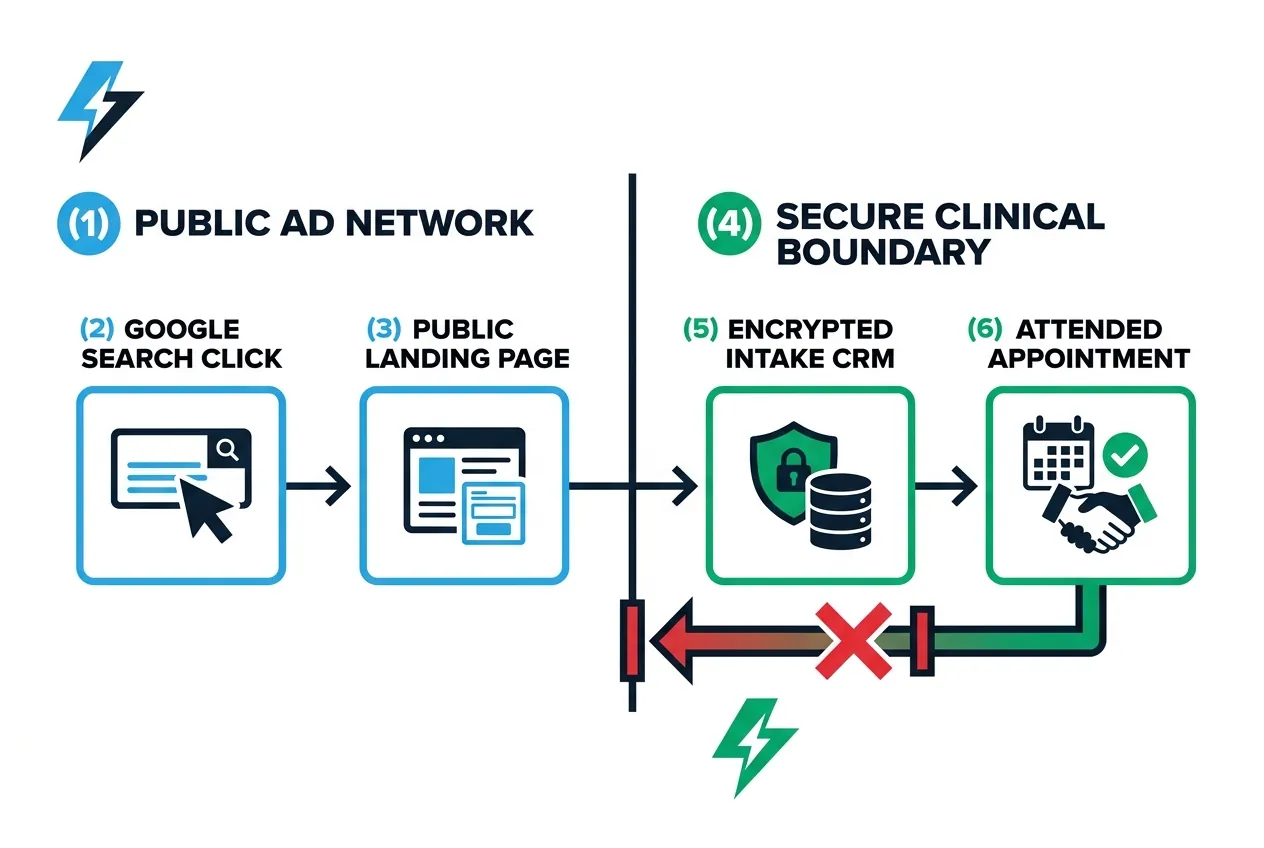
Treating mental health marketing like standard commercial lead generation produces compliance failures and account suspensions. Google classifies mental health conditions under its sensitive personal categories. The platform strictly prohibits the use of personalized advertising based on sensitive health conditions, preventing advertisers from using remarketing, customer match lists, and demographic micro-targeting Google Ads Policies on Personalized Advertising. Standard client-side tracking tags must not send identifiable clinical inquiries to third-party ad networks. State and federal data privacy guardrails enforce limits on tracking technologies on healthcare web pages that collect individually identifiable health information without patient authorization or a Business Associate Agreement HHS OCR Guidance on Online Tracking Technologies. When addiction or specialized co-occurring treatment is present, advertising requirements escalate to LegitScript certification standards, differentiating substance use disorder advertising from general outpatient psychotherapy. Marketing Powered operates as LegitScript-aware and HIPAA-aware; built for Google's sensitive healthcare vertical, where retargeting is not permitted. The compliance boundary for these campaigns must separate the public ad network tracking environment from the secure clinical intake environment, ensuring no protected health information leaks back to the advertising platform through unsecured pixels.
Campaign Architecture for Specialty and Intent
Blended campaigns that group anxiety, couples counseling, and child therapy into one ad group waste budget on low-relevance clicks. Structuring campaigns requires separating ad groups by distinct service categories. This logical division allows group practices to allocate budget based on clinical availability and margin. Break down geographic ring-fencing based on clinician licensure boundaries, drive times, and telehealth coverage zones. The approach draws on insights from a former healthcare CMO who ran marketing for a treatment network that grew from 3 to 24 locations, where geographic precision dictated viable patient volume. Broad match keywords often trigger ads for non-clinical searches. Instead, use modified phrase and exact match targeting for high-cost terms. Industry data reveals the search query "google ads for therapists" carries an average CPC of $16.78 at 480 searches per month with a keyword difficulty of 10. Related terms such as "therapist google ads" generate 90 monthly searches with a keyword difficulty of 8. The query "mental health google ads" sees 70 monthly searches with a keyword difficulty of 5. Match type selection protects practice margins by preventing budget erosion on generic educational searches.
Building a Defensible Negative Keyword Foundation
The most expensive clicks in mental health pay-per-click advertising come from people you cannot legally treat or clinically support. Building a defensible negative keyword foundation prevents ads from showing for out-of-network insurance providers. It also filters out Medicaid or Medicare searches if your clinic only accepts commercial payers. Furthermore, negative keywords block crisis terms requiring emergency intervention outside an outpatient scope of care. Establish a routine workflow that reviews search term reports weekly. This process involves adding irrelevant queries to campaign-level negative keyword lists. Group practice leaders must ensure ad assets and landing page qualification filters clearly state accepted insurance networks and clinical specialties to deter unqualified clicks before they cost the practice money.
Free Audit
Want a straight read on where your budget is leaking?
Eliminating the Cheap Lead Fallacy
Mental health practices waste paid search capital when they optimize for cheap clicks or unvalidated web forms. Group practices and outpatient clinics often enter Google Ads without structured intake attribution, burning marketing budgets on non-qualified traffic. A high volume of raw calls does not equal high clinical yield. We managed $1.5 to $2M per month in Google Ads across 11+ behavioral and mental health accounts. That volume clearly demonstrates that paying for cheap top-of-funnel clicks results in voicemails, spam, or inquiries for unoffered services. Cost per click is a front-end metric. Cost per qualified clinical intake is the bottom-line clinical metric that matters. Accountable marketing requires a structural shift. As a court-certified expert witness in advertising strategy, the founder emphasizes that raw traffic volume is irrelevant if it fails to convert into attended initial evaluations. Visualizing this workflow requires an operational dashboard that separates search terms by intent, clinical relevance, and geographic origin.

First-Party Data and Offline Conversion Tracking
In behavioral healthcare paid search, the conversion event must never be the landing page click, the page view, or the raw phone inquiry. Because Google restricts second-chance audience marketing for mental health conditions, initial search intent must bear the full weight of conversion. Clinics must feed validated intake outcomes back into Google Ads as offline conversions to train smart bidding on viable insured patients. This requires a robust first-party data strategy and offline conversion tracking pipeline. Marketing Powered leverages owned, local AI infrastructure for HIPAA-aware inference to handle data categorizations securely. The technical setup involves linking your Customer Relationship Management system to Google Ads via secure API or manual offline uploads, sending a conversion signal only when an intake appointment is attended.

Measuring Success with Admissions-Based Campaigns
Group practices must shift their reporting from marketing vanity metrics to operational metrics. Define success by the number of qualified inquiries matched to clinicians with open availability. Operating as an AI-native since 2022, the firm focuses on conversion systems that align paid media spend with actual revenue generation. Connecting your healthcare PPC services to clinical intake systems ensures you stop paying for traffic that never materializes into patient care. Whether expanding therapy groups or scaling multi-location clinical networks, measuring admitted patients provides the only accurate calculation of return on ad spend. Tracking this progression requires an attribution pipeline that follows the user from the initial Google Ads click directly to a verified intake assessment within the Electronic Health Record, utilizing attribution tracked to admission, not just lead.
Ready to see where your marketing can improve?
Request a free audit of your paid media, landing pages, attribution, and measurement setup. You'll get a straight assessment of where the opportunities are.
or email us at info@marketingpowered.ai