Resources
How to Choose a Healthcare PPC Agency
Finding the best ppc agency for healthcare requires evaluating a vendor on operational fluency, privacy-safe offline conversion tracking, and verified clinical admissions rather than generic top-of-funnel lead counts. Because regulated advertising demands navigating strict platform policies and privacy mandates, healthcare organizations need an accountable partner who builds acquisition engines mapped directly to business outcomes.
By Mike Hulick, Founder, Marketing Powered

Navigating Platform Restrictions and Compliance

What Defines Effective Healthcare Paid Search?
Traditional digital marketing metrics routinely mislead healthcare executives. Generalist agencies optimize for impressions, clicks, and generic lead form submissions. However, raw search volume and cheap cost-per-click metrics do not pay operational salaries or keep clinical facilities open. Verified patient intakes and successful appointments do.
The distinction between consumer e-commerce campaigns and regulated healthcare customer journeys is severe. In a multi-location medical practice or a behavioral health facility, a high volume of unqualified calls actively damages operations. Intake coordinators waste hours filtering non-viable insurance inquiries, misrouted Medicaid traffic, or immediate disconnections. The right marketing partner measures success exactly how the facility does: cost per qualified assessment, in-network verification rate, and cost per acquired patient.
Evaluating this capability requires looking closely at the admissions desk. An effective paid search strategy connects the marketer's dashboard directly to the electronic medical record system and the call center software. When marketing strategy aligns with clinical operations, the focus shifts from generating traffic to generating qualified commercial demand.
An agency lacking deep vertical specialization risks immediate ad account suspension or severe legal non-compliance within weeks of launch. The major advertising platforms heavily restrict how healthcare organizations can acquire patients.
For example, Google Ads requires advertisers targeting addiction treatment services in the United States to obtain and maintain active certification through LegitScript before any advertisements can run Google Ads Healthcare and Medicines Policy. Vendors unfamiliar with this verification process will stall campaign launches for months.
Furthermore, Google prohibits personalized retargeting and audience remarketing based on sensitive healthcare conditions, which includes mental health, addiction, and personal clinical status Google Ads Policy on Personalized Advertising. A generalist agency will often propose a standard remarketing strategy, attempting to follow users around the web after they visit a treatment center website. This practice is entirely prohibited in sensitive healthcare categories. Compliant agencies build intent-based search funnels and capture demand on the first interaction without relying on non-compliant remarketing pixels.
Attribution Beyond the Click to Admission
The true value of a healthcare advertising partner lies in the tracking infrastructure built beyond the initial ad click. Proper attribution requires securely mapping a search keyword to a clinical outcome without compromising patient data.
Many digital marketing firms install unvetted third-party tracking pixels on patient-facing healthcare portals to measure conversions. This creates massive operational and legal risk. The use of third-party tracking pixels on patient portals or web pages addressing specific health conditions can trigger regulatory scrutiny under federal privacy rules governing protected health information HHS Office for Civil Rights Guidance on Online Tracking Technologies.
Instead of relying on front-end browser pixels, advanced healthcare advertisers use offline conversion imports. When a searcher clicks an advertisement and calls the intake line, the CRM logs the specific click ID. If that caller eventually admits to the facility, the CRM securely formats that disposition data and pushes it server-side back to the Google Ads API. This allows Google Smart Bidding algorithms to optimize specifically for users likely to admit, rather than users who just click. Setting up this data pipeline requires specialized technical architecture. Utilizing owned, local AI infrastructure for HIPAA-aware inference provides exact control over data sovereignty, ensuring sensitive information never leaks to unauthorized third-party platforms.
Free Audit
Want a straight read on where your budget is leaking?
The Healthcare Paid Search Evaluation Scorecard
Healthcare executives need an objective vetting system to evaluate competing proposals. This due diligence framework cuts through sales presentations to expose actual technical competence.
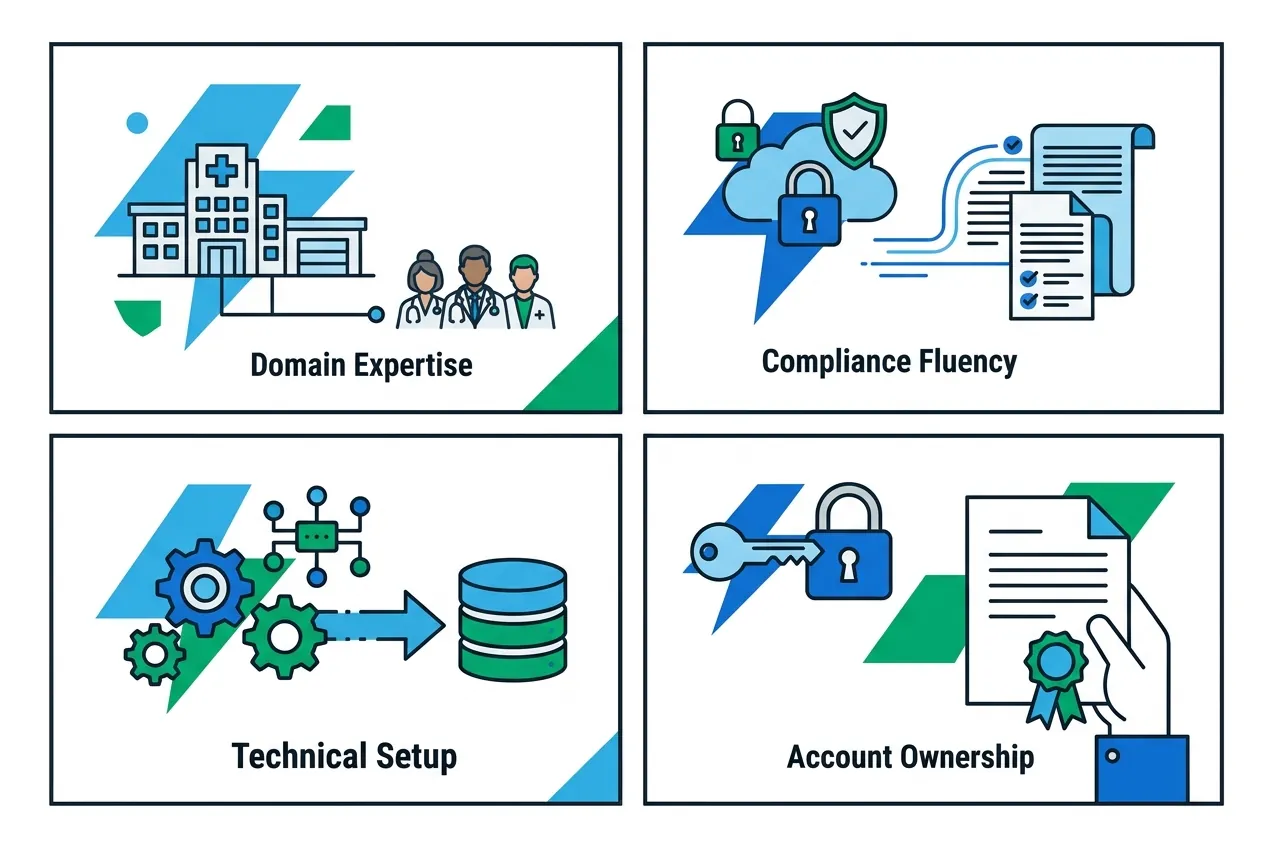
Domain and Operational Expertise.
Evaluate the vendor on prior experience managing high-acuity healthcare ad accounts and scaling multi-location clinical operations. A partner must understand the specific intake challenges of the organizations they serve, whether those are regional hospital networks, dental support organizations, or specialized behavioral health facilities. A former healthcare CMO who ran marketing for a treatment network that grew from 3 to 24 locations brings a radically different perspective than a traditional account manager.
Compliance Fluency.
Require demonstrated knowledge of sensitive ad categories. The vendor must show their exact ad copy pre-approval workflows and explain how they build privacy-first tracking architectures that comply with federal health data standards.
Technical Architecture.
Demand proof that the agency can integrate CRM or EMR intake statuses back into bidding algorithms. Attribution must be tracked to admission, not just to a raw lead. Ask exactly how they execute server-side tagging and offline conversion tracking without violating privacy laws.
Account Ownership.
Verify that the healthcare provider retains full administrative ownership of the Google Ads account, all data assets, and all conversion pipelines from day one. Marketing operations should be transparent, portable, and entirely owned by the brand paying for the media.
Red Flags in Medical Marketing Retainers
Understanding what to avoid is just as critical as knowing what to build. Certain common agency practices signal operational failure, misaligned incentives, or severe compliance liabilities.
Holding Google Ads accounts hostage is a frequent tactic. When an agency insists on building your campaigns inside their proprietary master account, they hold your historical data captive. If you terminate the contract, you lose years of optimization history. Always mandate that campaigns live in an account your organization administratively owns.
Another major red flag is any proposal recommending audience remarketing for sensitive medical conditions. As noted earlier, this violates platform policies and invites account bans. Similarly, avoid any vendor relying solely on automated AI ad copy generation without manual regulatory review. Healthcare advertising requires careful, human-led compliance checks to avoid restricted medical claims.
Refusing to share search query reports or exact negative keyword lists indicates the vendor is hiding massive wasted spend on irrelevant search terms. Finally, reject any proposal that includes unethical promises of fixed lead costs or specific patient admission volumes. A court-certified expert witness in advertising strategy knows that fixed cost outcomes are impossible to predict with absolute certainty in live auction environments, and offering them in healthcare crosses clinical ethical lines.
What to Demand in the First 90 Days
Predictable milestones separate competent operators from disorganized vendors. Healthcare executives should hold their paid media partners accountable to a strict implementation timeline.
The First 30 Days.
The first month must focus entirely on technical foundation and compliance. The agency should complete LegitScript verification if applicable, build out the offline conversion tracking architecture, and establish the server-to-server connection between the intake CRM and Google Ads. Every piece of ad copy and every landing page must pass a rigorous policy review before any media budget is spent.
The First 60 Days.
By month two, the focus shifts to keyword-to-call relevance. The agency should provide transparent search query reports proving that the budget is capturing high-intent commercial traffic. The negative keyword list should expand rapidly based on real intake feedback, actively blocking Medicaid or out-of-state searches if the facility cannot serve those populations.
The First 90 Days.
At the end of the first quarter, the feedback loop between the admissions desk and the marketing dashboard should be fully operational. Bidding algorithms must be fed with actual disposition data. The agency should now be optimizing the account based on cost-per-admission and verified revenue, rather than initial click costs.
Ready to see where your marketing can improve?
Request a free audit of your paid media, landing pages, attribution, and measurement setup. You'll get a straight assessment of where the opportunities are.
or email us at info@marketingpowered.ai