Resources
Multi-Location Marketing: Centralized Strategy and Local Execution
Effective multi location marketing requires a strict division of labor between headquarters and individual facilities. Scaling a healthcare network without upgrading its operational architecture forces regional clinics into internal bidding wars and creates severe attribution blind spots. This guide provides an operating framework to centralize media controls while decentralizing local intake execution.
By Mike Hulick, Founder, Marketing Powered

The structural collapse of expanding facility marketing
Multi-location organizations frequently outgrow their initial marketing infrastructure long before executive leadership recognizes the break. The symptoms usually appear at the local operational level. A facility director reports empty beds or open schedules, yet corporate marketing reports a record number of web leads. The disconnect stems from an architecture that treats twenty distinct physical markets as one homogenized digital entity. When marketing operations fail to segment appropriately, leads are routed outside of viable geographic boundaries or assigned to clinics lacking the specific clinical capacity to admit them.
The operational realities of scaling require deep architectural shifts. The founder of Marketing Powered previously served as a healthcare CMO, directing the marketing expansion for a treatment network that grew from 3 to 24 locations. That growth exposed the hard limitations of decentralized strategies. When regional teams are permitted to manage their own local search visibility or vendor relationships, the parent organization loses control over brand governance and budget efficiency. Facilities end up competing against one another for the same patient inquiries.
A practical cross-location scorecard quickly reveals the depth of this problem. When operators look at a facility-by-facility breakdown, they often find that aggregate corporate metrics obscure localized failures. One clinic might have an artificially low cost per acquisition because it sits in a densely populated, low-competition zone, while a sister facility fifty miles away starves for patient volume due to overlapping campaign targeting. To repair this, organizations must establish strict rules regarding which elements of the marketing machine are controlled by the corporate office and which elements are delegated to the specific clinical sites. If you are trying to troubleshoot specific campaign bottlenecks or agency friction resulting from this kind of expansion, you can explore common breakdowns in our guide to scaling multi-location campaigns.

Centralizing the paid media and compliance machinery
The most critical step in standardizing multi location advertising is the absolute centralization of paid media operations. Decentralized media buying is financially destructive. When different regional managers or local agencies open independent Google Ads accounts, they inevitably bid on identical high-intent search terms within overlapping geographic radii. This internal cannibalization artificially inflates the cost per click and fragments conversion data.
Rigorous centralization eliminates internal bidding wars. The founder of Marketing Powered managed $1.5 to $2M per month in Google Ads across 11+ behavioral and mental health accounts, demonstrating the level of oversight required to maintain efficiency at scale. By consolidating campaigns under a single administrative umbrella, organizations can deploy precise negative keyword lists, define exact geographic exclusion zones, and route search intent to the facility best equipped to handle the specific clinical request.
This level of control requires specialized operational knowledge. As a court-certified expert witness in advertising strategy, the Marketing Powered founder approaches media governance with an emphasis on defensible boundaries and strict budget controls. Centralization allows the parent organization to negotiate better media rates, pool conversion data to accelerate algorithmic learning, and enforce compliance standards across every active market. Headquarters must own the media engine, the conversion tracking architecture, the technology integrations, and the compliance boundaries.
Localizing search visibility and intake operations
While the underlying media machinery must be centralized, the actual conversion environment must remain intensely local. Patients do not want to interact with a faceless national corporate entity when seeking care. They want to know the exact distance to the clinic, the credentials of the local medical staff, and the specific intake process for that physical address. Multi location seo relies entirely on the accurate and localized representation of ground-level reality.
Headquarters should construct and maintain individual landing pages for every physical location. These pages must contain distinct structured data that signals the exact address, hours of operation, and service lines to search engines. A corporate website that simply lists addresses on a single contact page will fail to capture local search intent. Each facility needs its own digital footprint, tightly integrated into the parent domain but uniquely optimized for its specific community. We outline the technical requirements for this architecture in our overview of multi-location healthcare SEO.
Furthermore, the local facility must own the operational truth of intake. Marketing cannot generate admissions if the local staff does not provide real-time data regarding bed availability, clinician schedules, and accepted regional insurance plans. The local team is responsible for updating headquarters on capacity constraints so centralized media budgets can be shifted away from full facilities and redirected toward locations needing census support. Localizing search visibility requires this constant feedback loop between the corporate digital strategy and the immediate operational reality of the clinic floor.
Free Audit
Want a straight read on where your budget is leaking?
Establishing multi-site budget governance
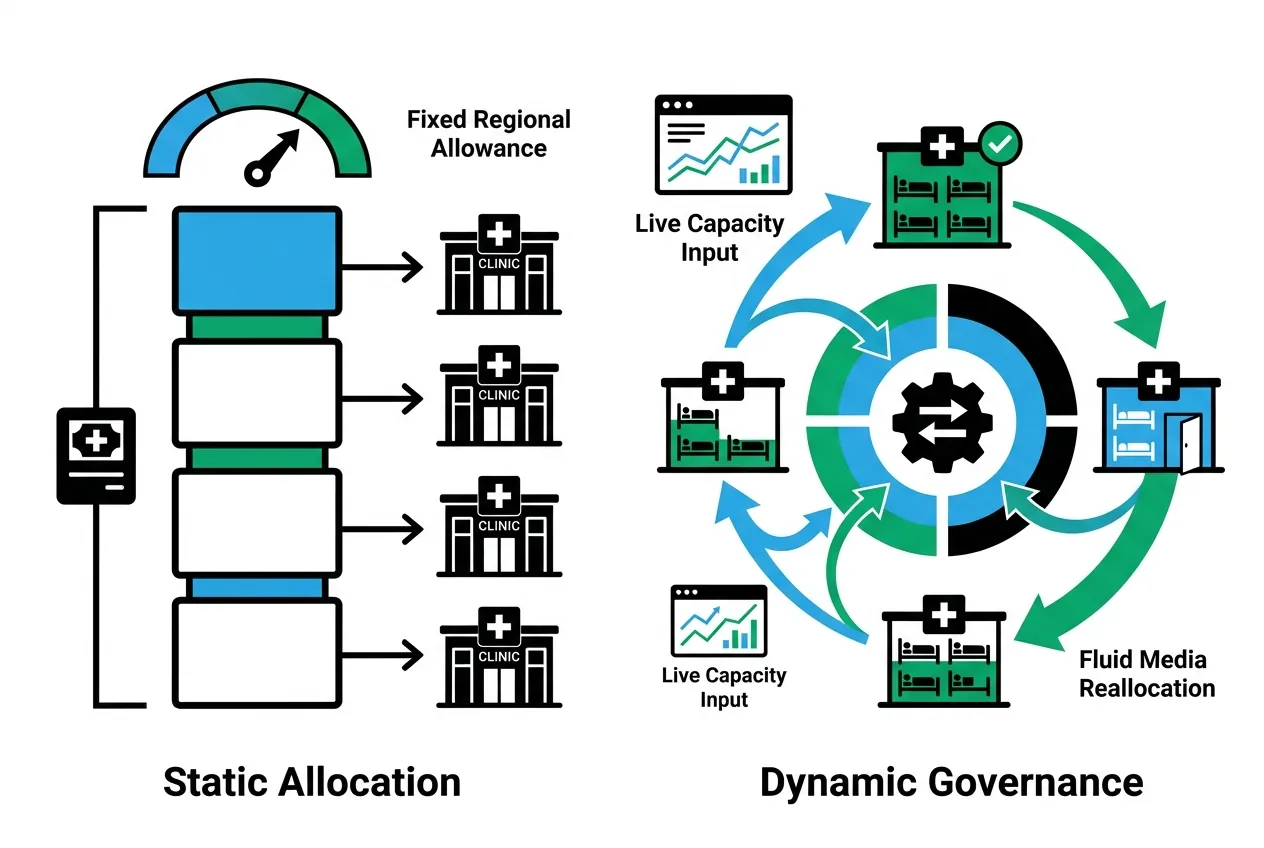
Budget allocation across multiple facilities requires a dynamic, data-driven approach rather than fixed regional allowances. A traditional decentralized model often gives each facility an identical monthly budget, regardless of its immediate capacity, regional search volume, or historical conversion efficiency. This static approach traps capital in saturated markets while underfunding high-growth territories.
A side-by-side comparison of budget methodologies demonstrates the superiority of centralized governance. In a strictly governed model, headquarters views the total media budget as a single fluid resource. Capital is dynamically routed based on live facility capacity and the measured cost per admission in each geographic zone. If a clinic in one state reaches full census, the centralized media team immediately pauses broad acquisition campaigns for that region and reallocates those dollars to a clinic in another state that is currently operating below its target utilization rate.
This governance structure prevents wasted spend. It requires rigorous daily monitoring and a unified reporting dashboard that merges marketing spend data with clinical intake software. Budget governance is not merely an accounting exercise. It is a critical operational lever that ensures marketing dollars are only deployed when there is a corresponding operational ability to convert that demand into a realized business outcome.
Closing the loop with admission attribution
The standard metric of marketing success (cost per lead) is fundamentally flawed when applied to multi-location healthcare. A lead is merely a signal of intent. If a prospective patient submits a web form but resides outside the clinical licensure boundaries of the nearest facility, that lead is useless. If marketing leadership optimizes campaigns solely to drive down the cost per lead, they will inevitably generate a high volume of unqualified inquiries that overwhelm local intake teams.
True accountability requires full-funnel measurement. Attribution must be tracked to admission, not just the initial lead. This standard forces marketing operations to integrate deeply with customer relationship management systems and electronic health records. When a campaign generates a phone call, the tracking architecture must follow that caller through the assessment process, the insurance verification stage, and the eventual physical admission.
By analyzing data at the admission level, organizations can calculate the true cost to acquire a patient for each specific location. This level of granular attribution often reveals that the campaigns producing the highest volume of leads are actually producing the lowest number of admissions. Shifting the optimization target from the top of the funnel to the bottom of the funnel ensures that centralized marketing efforts are directly aligned with local facility revenue and operational stability.

Navigating regulatory boundaries across locations
Regulated healthcare organizations operate under severe platform restrictions that fundamentally alter how multi-location marketing can be executed. Strategies that work in traditional retail or professional services will trigger immediate account suspensions in the behavioral health sector. An internal compliance audit setting must continually map local facility advertising efforts against strict platform verification rules to maintain operational continuity.
Google categorizes healthcare as a sensitive vertical. Advertisers must comply strictly with the Google Ads Policies on Personalized Advertising, which dictate that retargeting and personalized ad audiences based on personal health conditions, medical treatments, or sensitive physiological states are not permitted. Because retargeting is prohibited, multi-site healthcare marketers must capture high-intent demand on the first interaction.
Furthermore, addiction treatment facilities face distinct verification hurdles. Platforms require mandatory merchant verification and compliance with the LegitScript Addiction Treatment Certification Standards prior to serving ads for substance use treatment centers. Every single physical location must pass this certification process. If a regional manager attempts to launch an unverified location, it can jeopardize the advertising standing of the entire corporate parent.
Reputation management at the local level is equally governed by strict regulations. Regulators strictly enforce how facilities can gather and display feedback. Organizations must adhere to the FTC Consumer Reviews and Testimonials Rule, which explicitly prohibits fake consumer reviews, paid reviews requiring sentiment conditions, and review gating. Similarly, local facility directors must follow the Google Maps and Business Profile User Content Policy, which prohibits incentives or selectively soliciting customer feedback based on expected positive outcomes.
To navigate these complexities without exposing protected data, Marketing Powered utilizes an infrastructure built for strict privacy constraints. The firm has been AI-native since 2022 and relies on owned, local AI infrastructure for HIPAA-aware inference. This approach ensures that when processing large datasets to analyze regional conversion trends or audit localized landing page compliance, sensitive operational information remains within secure, owned computing environments rather than being transmitted to public language models.
Questions, Answered.
Headquarters must centralize paid media accounts, budget allocation, compliance monitoring, structured data deployment, and full-funnel attribution technology. This ensures brand consistency, prevents internal bidding wars, and standardizes measurement. Conversely, the parent organization must localize search visibility and intake execution. Each physical facility must maintain distinct local landing pages, exact directory citations, localized review acquisition protocols, and operational control over intake capacity reporting.
Marketing performance across multiple locations must bypass superficial metrics like raw form fills or raw call volume. Organizations should integrate offline conversion tracking to follow inquiries through the CRM or intake software. Performance must be measured by the cost per verified admission at the facility level. This ensures that media dollars are evaluated based on their ability to generate actual scheduled appointments or occupied beds, rather than unqualified top-of-funnel noise.
Google evaluates healthcare campaigns under sensitive vertical policies. Advertisers cannot use remarketing or personalized audience targeting based on user health data. Furthermore, for specific niches like addiction treatment, Google requires rigorous third-party verification for every single facility address before ads can run. Each location must maintain accurate Google Business Profile data and comply strictly with platform rules regarding review solicitation and consumer engagement. Request an acquisition audit
Ready to see where your marketing can improve?
Request a free audit of your paid media, landing pages, attribution, and measurement setup. You'll get a straight assessment of where the opportunities are.
or email us at info@marketingpowered.ai