Resources
Detox Center SEO: Capturing Urgent Intent and Local Visibility
Detox center seo is the specialized practice of engineering a medical detoxification facility digital footprint to capture acute, high-intent search demand from individuals and families in crisis. Unlike long-cycle residential addiction treatment marketing, medical detox search optimization requires immediate geographic proximity signals, validated clinical structured data, and frictionless mobile response paths. Aligning clinical licensure with rigorous technical search visibility allows operators to capture urgent local demand, stabilize bed occupancy, and reduce reliance on volatile paid advertising auctions.
By Mike Hulick, Founder, Marketing Powered

Acute Search Intent Versus Evaluative Rehab Search
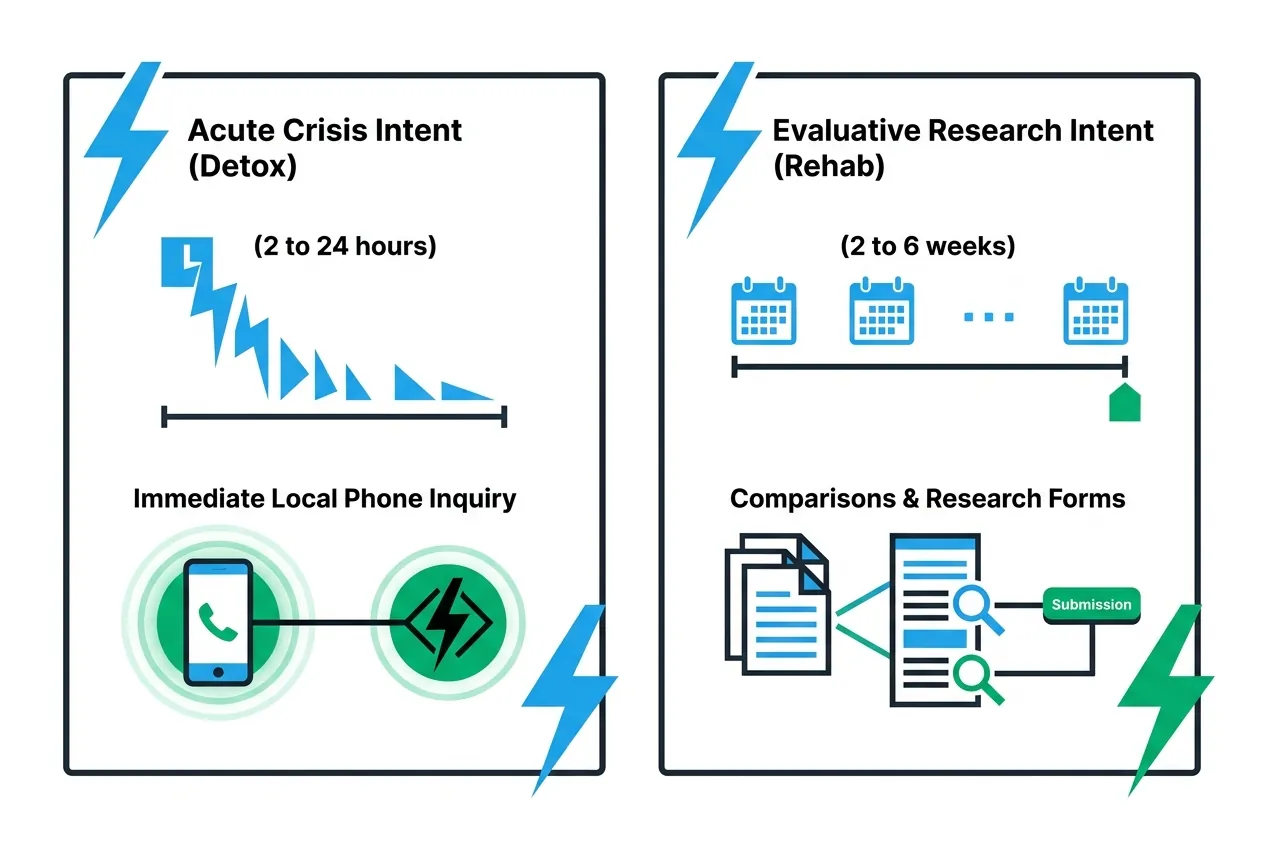
Medical detoxification occupies a unique position within the behavioral healthcare continuum. When a patient, family member, or interventionist searches for medical detoxification services, they are rarely conducting academic research. They are responding to an acute medical emergency, a severe withdrawal episode, or a brief window of willingness that may close within hours. This dynamic creates a search profile characterized by high urgency, tight geographic radiuses, and an immediate requirement for direct communication with an intake coordinator.
Traditional addiction treatment marketing often treats all levels of care as a single funnel. Broad marketing programs attempt to capture prospective clients through long-form educational guides on addiction symptoms, stages of recovery, and therapeutic modalities. While broader rehab SEO initiatives target queries such as "rehab seo" (480 searches per month, Keyword Difficulty 22) or generic residential treatment terms, these searches reflect an evaluative mindset. Prospective clients researching residential stays or intensive outpatient programs compare amenities, therapeutic approaches, insurance acceptances, and clinical accreditations over days or weeks.
Detoxification searches operate under different parameters. Queries targeting detox center seo (110 searches per month, Keyword Difficulty 19) and broader detox program marketing initiatives (320 searches per month, Keyword Difficulty 7) represent acute intent. The user is frequently searching from a mobile device, often late at night or during early morning crisis windows. The clinical intake coordinator answering that call is not scheduling a tour for next month; they are conducting immediate medical triage, assessing withdrawal severity, verifying insurance benefits, and coordinating private transport or hospital transfer within a two- to four-hour operational window.
Because the decision window is compressed, the search journey rarely extends past the top three organic map results or the primary mobile organic listings. If a treatment center website forces a family member through a five-page reading journey or buries its direct clinical intake line behind a multi-step contact form, the user bounces back to the search results and calls the competing facility three miles away. Search engine optimization for detox facilities must be constructed around immediate local accessibility, transparent medical licensure, and direct call routing.
Local Pack Architecture and Google Business Profile Deployment
For an acute medical detox facility, the Google Local 3-Pack is the primary organic patient acquisition vehicle. When an individual searches for "medical detox near me" or "alcohol detox facility [City]," Google uses local proximity, listing prominence, and category relevance to present a localized map cluster above traditional organic links. Securing prime placement within this block requires precise entity configuration aligned with Google Business Profile guidelines.
The first structural requirement is category precision. Treatment providers often dilute their relevance by selecting overly broad or contradictory primary categories. A dedicated medical detox clinic must establish its primary category as "Addiction treatment center" while deploying secondary categories such as "Medical clinic" or "Mental health clinic" only when supported by state Department of Health facility licenses. Google verifies these classifications against external state licensing databases and health authority registries. Misalignment between your digital categories and your physical operating license damages local ranking authority.
Operating hours must reflect actual clinical capability. Search engines heavily weight open status for emergency and medical terms. If your facility admits patients 24 hours a day, seven days a week, your profile must reflect 24/7 operation. However, marking a profile as continuously open requires continuous operational readiness. If an acute crisis caller reaches a voicemail system or an answering service that cannot execute medical intake or triage, the lead is lost, and high user abandonment rates can negatively influence profile behavior metrics.
Multi-location operators face specific architectural challenges. When managing regional networks, operators must avoid the temptation to create artificial listings or claim virtual office suites. Google requires physical staffing and clear exterior signage at every registered location. For organizations that have scaled physical operations across multiple territories, such as a treatment network expanding from 3 to 24 locations, each facility profile must connect to a unique, highly localized website landing page rather than a generic national homepage.
Citations across local health directories must maintain rigorous consistency. Your facility name, physical address, direct local phone number, and National Provider Identifier (NPI) registry details must align perfectly across platforms such as Healthgrades, WebMD, psychology and addiction directories, and regional public health databases. Inconsistencies in room or suite numbers, legacy corporate entities, or mismatched area codes introduce entity ambiguity, depressing your prominence in local map algorithms.
Review acquisition within behavioral healthcare requires careful ethical and legal navigation. Under FTC Guidelines on Consumer Reviews and Endorsements and platform-specific Google review policies, providers cannot offer incentives, manipulate sentiment, or post non-genuine consumer feedback. Furthermore, patient privacy regulations restrict facilities from confirming whether an individual was ever admitted to their care. Operators must establish systematic, non-coercive review workflows that invite alumni or family members to share their experiences voluntarily, building a defensible local reputation profile without compromising clinical confidentiality.
Technical Crawl Quality and Clinical YMYL Structured Data
Search engines evaluate addiction treatment and detoxification websites under the most rigorous Your Money Your Life (YMYL) content standards. Because the guidance provided directly influences patient survival and acute medical outcomes, Google search systems actively assess the technical integrity, medical validity, and clinical authorship of every indexed URL. A detox website built on unstable technical foundations or lacking programmatic medical schema will struggle to secure visibility for competitive clinical terms.
Technical optimization begins with mobile crawl budget and page delivery performance. Prospective clients in withdrawal or family members managing an active domestic crisis rely almost exclusively on mobile devices. If a landing page takes more than 2.5 seconds to achieve Largest Contentful Paint (LCP), or if cumulative layout shifts cause click-to-call buttons to move during page load, conversion drops precipitously. The mobile technical stack must be lean: minimize render-blocking JavaScript, compress critical visual assets, and eliminate intrusive promotional modal windows that obstruct the primary phone number or emergency contact action.
To communicate clinical authority directly to search engine crawlers, detox providers must deploy robust Schema.org structured data. Generic organizations or local business schemas are insufficient for medical facilities. Implementing JSON-LD structured data using the MedicalClinic, SubstanceUseDisorder, and MedicalCondition vocabularies provides explicit semantic context:
Beyond schema, internal link distribution must reflect clinical hierarchy rather than arbitrary content creation. Detox service pages must serve as primary topical hubs. Sub-pages addressing specific substance protocols (such as alcohol withdrawal, benzodiazepine tapering, or synthetic opioid stabilization) must link upward to the core medical detox service page and laterally to relevant admission requirement guides.
This technical linking architecture signals to search engine algorithms that the facility provides a comprehensive, medically monitored continuum rather than fragmented, unvetted blog content.
Free Audit
Want a straight read on where your budget is leaking?
Localized Landing Pages and Geo-Targeted Triage Content
A common failure in detox program marketing is deploying uniform, nationalized copy across regional landing pages. Search algorithms evaluate geographic alignment, while families in crisis evaluate local logistics. A parent seeking immediate medical detox for an adult child needs to know practical details: where the facility is physically situated, what transportation assistance exists, whether staff can facilitate bedside pick-up from a regional emergency department, and how medical intake operates upon arrival.
Geo-targeted landing pages must serve as practical triage centers. When designing localized pages for specific metropolitan areas or neighboring counties, the structure must prioritize operational clarity over generic marketing copy.
Every localized service page should include clear operational indicators:
- Exact Physical Location and Transport Radius: Detail the precise campus address, proximity to major interstate junctions, and available patient transport options within a defined 60- to 90-minute radius.
- Clinical Leadership Profiles: Name the on-site Medical Director, their board certifications (such as the American Board of Addiction Medicine), and nursing coverage ratios (for example, 24/7 on-site RN support).
- Withdrawal Management Protocols: Transparent explanations of the clinical stabilization process, including vital monitoring, pharmacotherapy interventions, and withdrawal discomfort mitigation.
- Insurance and Payment Triage: Explicit listings of commercial in-network insurance relationships, private payment parameters, and verification procedures to eliminate financial friction during an intake call.
When developing localized content, avoid creating thin, repetitive pages that simply swap city names across identical text blocks. Search engines easily identify programmatic doorway pages and will de-index or suppress entire subdirectories for low crawl quality.
Instead, construct each page with unique regional context: mention local hospital coordination networks, local emergency transport procedures, county-specific crisis intervention resources, and verified travel logistics from surrounding population centers. To learn more about structuring specialized behavioral health campaigns, review our operational guide for detox centers.

Call Tracking, Admissions Attribution, and Compliance Infrastructure
Driving search impressions and website sessions is an incomplete exercise if the marketing system cannot connect organic search visibility to actual clinical admissions. In detox operations, a digital lead rarely completes a standard web form. Over 80% of high-intent crisis inquiries occur via direct telephone calls. If your analytics framework fails to tie the inbound phone call back to the originating search query, landing page, and local profile, marketing leadership cannot determine which organic assets are producing occupied beds.
Implementing dynamic number insertion (DNI) across organic touchpoints provides the necessary visibility. By assigning discrete call-tracking pools to specific traffic sources, Google Business Profile direct clicks, organic search sessions, and local citations, intake leadership can isolate exact traffic origins.
However, deploying call tracking within healthcare requires strict adherence to privacy and advertising boundaries. Call recording configurations must comply with two-party consent laws, and dynamic tracking numbers placed on external directories must not corrupt the underlying National Provider Identifier data or core citation consistency needed for local search engine algorithms.
Attribution tracking must extend past the initial call to the final clinical admission. In behavioral health, a substantial volume of incoming calls are clinically or financially unqualified: individuals seeking public assistance services your facility does not provide, out-of-network callers without financial resources, or patients requiring higher-tier medical stabilization. Marketing systems that optimize purely for call volume incentivize agencies to target broad, cheap queries that overwhelm intake desks with unserviceable calls.
By integrating call analytics with the facility Electronic Health Record (EHR) or Customer Relationship Management (CRM) platform, operators establish closed-loop tracking. Every admission is matched against the originating organic entry point. This visibility reveals the true acquisition cost per admission and confirms which clinical landing pages produce viable medical admissions.
Furthermore, healthcare marketing operates under strict regulatory constraints. Under Google's personalized advertising policies for health conditions, providers cannot execute retargeting campaigns to re-engage individuals who visited addiction-related pages. Simultaneously, paid search campaigns require mandatory LegitScript certification, adding ongoing credentialing costs and operational reviews.
Because retargeting is prohibited, the organic search visit must perform immediately. The site architecture, speed, clinical authority, and intake telephone prominence must align to capture the inquiry on the very first interaction.
Common Detox Program Marketing Mistakes and Constraints
Detox center search engine optimization operates under distinct regulatory, clinical, and data constraints. Marketing executives and facility leaders frequently make strategic errors by applying conventional e-commerce or B2B lead-generation tactics to an acute healthcare environment. Identifying these operational pitfalls preserves capital and protects institutional reputation.
The most frequent error is allocating resources toward national informational content sprawl. An agency may produce dozens of articles targeting broad queries like "symptoms of alcohol withdrawal" or "how long does detox take." While these pages may generate thousands of monthly organic impressions, the traffic is distributed across the country. An individual reading a blog post from 1,500 miles away is exceptionally unlikely to travel to your physical facility for acute three-day withdrawal management. The spend produces vanity metrics while leaving regional map packs and localized clinical queries uncaptured.
A second critical mistake is neglecting intake coordination operational realities. Marketing teams often operate in a silo, detached from the admissions department. If search campaigns drive inbound calls during night shifts when phone coverage is handled by third-party services unable to verify insurance or schedule immediate transport, marketing capital is wasted. Search engine visibility must be synchronized with clinical intake staffing schedules, current bed census availability, and transport logistics.
Operators must also understand what search data cannot prove. Organic search rankings and platform impressions do not guarantee bed occupancy or immediate clinical suitability. Keyword tools provide monthly historical estimates, not real-time counts of individuals entering acute medical crises.
Detox admissions depend on real-time factors outside the scope of search algorithms: clinical acuity, co-occurring psychiatric complications, specific medical detox bed availability, in-network medical necessity determinations, and individual patient readiness. Search engine optimization provides a reliable patient discovery channel; clinical and admissions operations must execute the delivery of care.

Email Us
Prefer to send the context directly?
Detox Facility SEO Implementation Checklist
Executing an effective search engine optimization strategy for a medical detoxification facility requires coordinating clinical, technical, and marketing tasks. The following operational matrix outlines the core implementation steps, assigned department responsibilities, and key validation metrics required to build a compliant organic acquisition system.
- Technical Foundation; Action Item: Audit mobile Core Web Vitals; eliminate render-blocking assets and dynamic shift; Responsible Department: Web Development / Technical SEO; Success Metric: LCP under 2.5s; mobile CLS under 0.1
- Entity Schema. Action Item: Deploy MedicalClinic and SubstanceUseDisorder JSON-LD structured data. Responsible Department: Technical SEO. Success Metric: Clean validation in Google Rich Results Test.
- GBP Optimization; Action Item: Reconcile primary category ("Addiction treatment center"), 24/7 hours, and NPI data; Responsible Department: Marketing / Compliance; Success Metric: Verified local status; zero guideline flags
- Citation Health. Action Item: Standardize address, NPI, and phone across major healthcare and public directories. Responsible Department: Marketing Operations. Success Metric: 100% NAP consistency across top 30 directories.
- Localized Landing Pages; Action Item: Build dedicated, unique geo-pages for core 30- to 60-mile operational radius; Responsible Department: Content / Clinical Leadership; Success Metric: Unique clinical content; zero programmatic duplication
- Mobile Conversion. Action Item: Embed persistent click-to-call headers and 24/7 direct triage paths. Responsible Department: UI/UX / Web Development. Success Metric: Call initiation rate improvement on mobile.
- Closed-Loop Attribution. Action Item: Integrate dynamic number insertion (DNI) with EHR/CRM intake logs. Responsible Department: Marketing / Admissions IT. Success Metric: Admission-level attribution across all organic calls.
- Reputation Governance. Action Item: Deploy non-coercive, HIPAA-aware alumni and family review acquisition workflow. Responsible Department: Alumni Relations / Operations. Success Metric: Steady, authentic review growth on Google Business Profile.
Maintaining this operational framework ensures that your facility maintains strong crawl visibility, protects its institutional licensing credentials, and captures local patients at the moment acute medical intervention is required.
Questions, Answered.
Detox facilities rank for clinical queries by establishing strong local proximity signals, configuring technical medical schemas, and developing localized clinical landing pages. Rather than targeting generic national phrases, providers should focus on high-intent local queries such as "medical detox near me" or "[City] alcohol detoxification center." This requires an active, verified Google Business Profile categorized under "Addiction treatment center," consistent citations across recognized healthcare directories, mobile page speeds under 2.5 seconds, and complete structured data using Schema.org MedicalClinic types. Clinical content must detail specific medical withdrawal protocols, state licensure, and medical staff qualifications to satisfy search engine YMYL standards.
Detox center search engine optimization should be evaluated by qualified inquiries and completed clinical admissions, not website traffic or raw form submissions. Because the majority of acute detox inquiries occur over the phone, operators must deploy dynamic number insertion (DNI) pools configured specifically for organic search and local map listings. Inbound calls captured by tracking numbers must be linked directly to admissions records in the facility Electronic Health Record (EHR) or CRM. This closed-loop tracking allows leadership to measure cost per qualified inquiry, insurance verification rates, and cost per verified admission, revealing the true commercial return of organic search channels.
Medical detox SEO addresses acute medical emergencies requiring immediate clinical triage, while general addiction treatment marketing targets evaluative, long-term care decisions. In a medical detox search, the prospective patient or family member operates within a compressed timeline, often making an admission decision within 2 to 24 hours. Consequently, search strategies must prioritize mobile click-to-call mechanics, local 3-Pack visibility, 24/7 operational hours, and rapid regional transit logistics. Conversely, residential or outpatient treatment marketing targets prospective patients researching program models, clinical therapies, and extended recovery amenities over multiple weeks.
No. Under Google's personalized advertising policies regarding health conditions, advertisers are strictly prohibited from building remarketing audiences or serving targeted ads based on an individual's past interaction with substance abuse, medical treatment, or clinical health content. Because retargeting is unavailable, the initial organic landing page visit must provide clear clinical reassurance, immediate medical intake contact numbers, and clear insurance verification workflows to convert the visitor during that initial session.
The recommended primary category for a medical detox facility is "Addiction treatment center." If the facility operates under a specialized state medical clinic license and provides on-site physician-led withdrawal management, "Medical clinic" may be added as a secondary category. Providers should avoid selecting unrelated categories that do not match their state health department operating licenses, as category contradictions can trigger listing suspensions or algorithmic ranking drops.
LegitScript certification is mandatory for running paid advertising campaigns on Google, Meta, and major ad networks, but it is not an explicit technical prerequisite for organic search rankings. However, holding LegitScript certification provides substantial indirect organic value. Search engines evaluate healthcare websites using strict quality standards, and displaying verified certification badges, state operating license numbers, and accredited clinical affiliations establishes the operational credibility required to earn top organic search visibility. Request an acquisition audit
Ready to see where your marketing can improve?
Request a free audit of your paid media, landing pages, attribution, and measurement setup. You'll get a straight assessment of where the opportunities are.
or email us at info@marketingpowered.ai