Capabilities
Drug Rehab SEO for Treatment Providers
If your organization has organic traffic but cannot connect landing pages to qualified inquiries or admissions, rankings alone will not resolve the reporting gap.

When to consider a specialist SEO partner
Marketing Powered’s approach to drug rehab seo starts with search architecture and admissions measurement, rather than treating traffic growth as the end goal. The work focuses on helping people find relevant treatment information, understand their options and reach an appropriate admissions pathway.
For single facilities, multi-location operators and health system programs, the commercial question is the same: which organic demand deserves investment, and what happens after the inquiry?
An agency evaluation makes sense when:
- A new facility or level of care needs a clear place within the website.
- Admissions reports poor-fit inquiries despite steady organic traffic.
- Location pages repeat generic information without explaining facility differences.
- A redesign threatens useful URLs or established conversion paths.
- Reporting cannot distinguish inquiries from scheduled assessments or admissions.
When choosing a drug rehab SEO company, ask for the reasoning behind its priorities. A credible recommendation should connect a specific issue, supporting evidence and a business decision, not simply prescribe more pages.

What the work focuses on
A substantive addiction treatment SEO program should address page architecture, technical crawl issues, contextual links, local visibility, clinical content governance and measurement. Rankings help diagnose visibility. They should not replace an assessment of whether the right people can find the right service and take a useful next step.
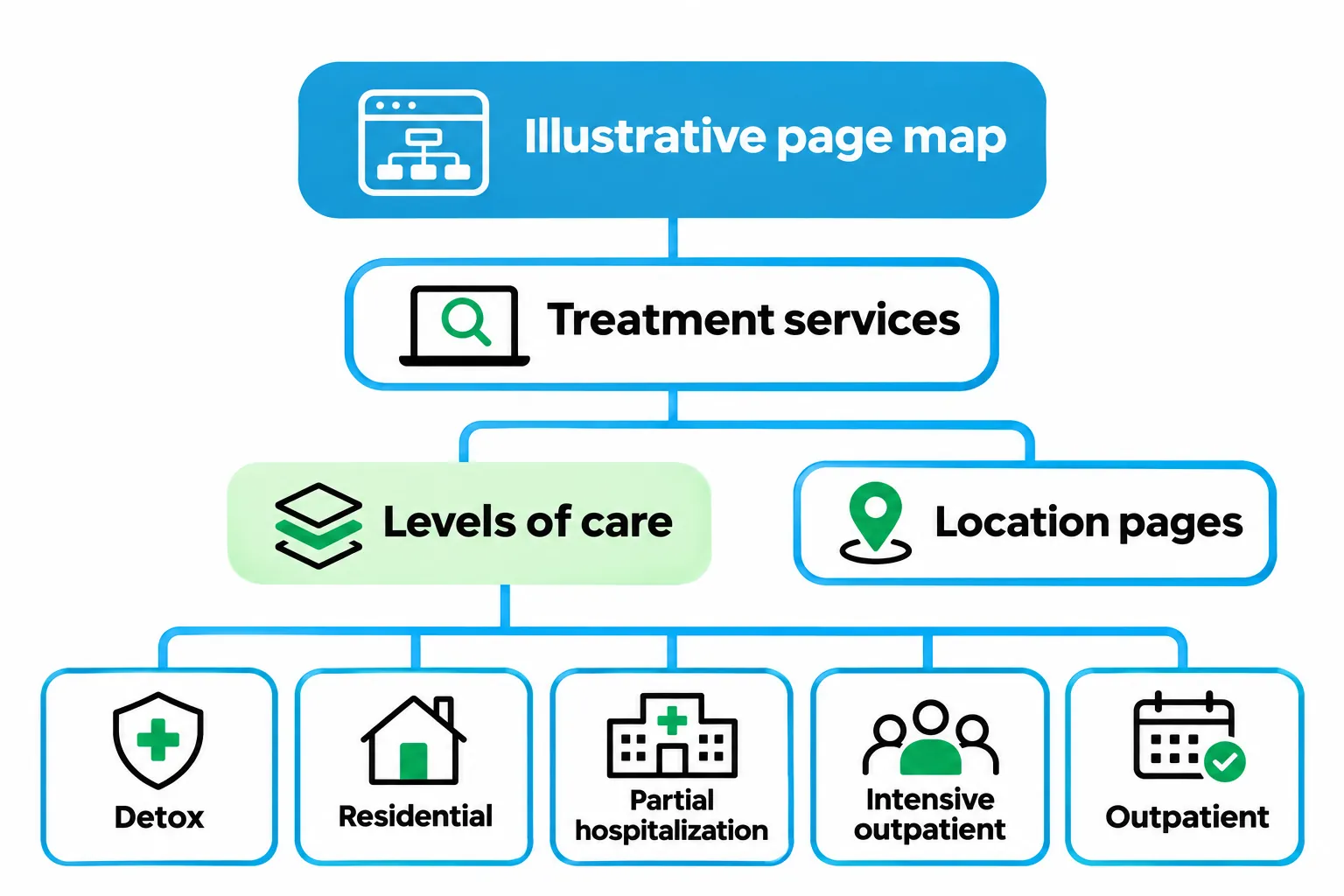
Level-of-care and location architecture
Where services differ materially, distinct pages can explain those differences. Residential treatment, partial hospitalization programs and intensive outpatient programs should not become interchangeable keyword templates.
Create location pages where there is useful, facility-specific information. Connect them to the care actually available there.
This illustrative page model shows the decision logic, not a client result:
- Treatment overview; Main responsibility: Explain available care options; Useful connection: Relevant level-of-care pages
- Level-of-care page; Main responsibility: Explain the program and assessment pathway; Useful connection: Locations offering that care
- Facility page; Main responsibility: Describe that location’s services and access; Useful connection: Appropriate admissions contact
Substance-specific and payer information should reflect actual services and verified participation, not a keyword expansion target.
Technical foundations
Google’s minimum technical requirements include crawler access, a working page and indexable content. Meeting those requirements does not ensure indexing. Google Search technical requirements
Technical work focuses on identifying and prioritizing crawl and indexing issues, duplicate URLs, canonical handling and internal-link gaps. Mobile usability and contact-path testing belong alongside that investigation.
The priority should be the affected admissions pathway, not the size of an automated issue count.
Local search and Business Profiles
Complete, accurate Business Profile information can support visibility in local search results. Google local ranking guidance
Location work should examine profile eligibility, categories, addresses, hours and consistency with the corresponding facility page. Google’s guidelines call for accurate real-world representation and precise location information. Google Business Profile guidelines
For tactical detail, see local SEO for rehab centers. Service priorities should connect Google Maps visibility with the facilities and care pathways your organization actually operates.
Clinical content and source quality
For treatment information, establish reviewer responsibilities, source factual claims and schedule reviews. Keep clinical approval with appropriately qualified reviewers designated by your organization.
Separate program descriptions from clinical advice. Remove unsupported efficacy claims, outdated service details and language that stigmatizes people seeking treatment. Content governance should make ownership clear without implying that an agency replaces clinical judgment.
Search and AI discovery
Google states that established SEO practices remain relevant to AI Overviews and AI Mode, with no additional technical requirements or special optimization necessary. Google AI features documentation
Our recommended focus is clear service descriptions, accessible information and sources readers can inspect. Treat AI-answer visibility as something to observe, not an admission forecast or a separate shortcut.
Measure inquiry quality before expanding traffic
Define a qualified inquiry with admissions leadership. Relevant criteria may include service fit, geography and the organization’s ability to support the person’s access needs.
Keep administrative contacts, duplicate inquiries and job applications separate from prospective treatment inquiries. Record the reasons an inquiry does not progress without treating every non-admission as an SEO failure.
Use this measurement pathway:
Organic landing page → call or form → qualification → scheduled assessment or admission
Google Search Console reports search queries, pages, impressions and clicks. Those measures describe search performance, not admissions outcomes. Google Search Console Performance report
Treat source-to-inquiry attribution as conditional on implementation, permission and data quality. Measure through admission only where authorized data and permitted data flows support it. Keep patient-level information out of advertising and general web-analytics tools. HHS guidance explains that tracking technologies must not create impermissible disclosures of protected health information. HHS tracking technology guidance
Report attribution gaps explicitly. An unknown outcome is not a measured admission.
Free Audit
Want a straight read on where your budget is leaking?
Make the method inspectable
Before approving broader drug rehab search engine optimization work, ask what evidence supports the proposed priority.
A useful explanation connects:
- Page architecture to actual services and location intent.
- Crawl findings to specific affected URLs.
- Internal links to useful navigation between care and facility information.
- Search observations to the relevant market and query.
- Measurement choices to qualification definitions and permitted data flows.
For example, if a facility page attracts inquiries for care unavailable there, investigate the page’s service descriptions and contact routing before adding more geographic pages. That is an illustrative diagnostic scenario, not a reported outcome.
What an acquisition audit examines
An acquisition audit focuses on the relationship between search visibility, treatment and location pages, inquiry quality and available admissions attribution. Its usefulness depends on the questions being investigated and the authorized data available.
Start with the operating problem. Establish which facilities, services and admission pathways matter, who owns content approval and where reporting loses visibility. Agree on access boundaries before sharing data.
From there, distinguish technical problems from content gaps, conversion friction and incomplete measurement. Missing evidence should narrow the conclusions, not be filled with assumptions.

Connect organic visibility to admissions decisions
Examine where search visibility, inquiry quality and admissions measurement may be disconnected. Start with the operating question your current reporting cannot answer.
Request an acquisition audit.
Questions, Answered.
It should connect discoverability with accurate treatment information, usable inquiry paths and outcome measurement. Ask how each proposed activity supports that connection.
Use qualified inquiries, scheduled assessments and admissions where permitted attribution supports them. Keep search visibility metrics as diagnostic inputs, and label incomplete outcome data.
Treat that as an investment decision, not a starting assumption. Evaluate organic and paid demand against service priorities, capacity and available evidence.
Yes. Evaluate each facility’s services, content ownership and reporting needs while preserving useful connections across the organization. Explore the broader approach for substance use disorder treatment providers.
Ready to see where your marketing can improve?
Request a free audit of your paid media, landing pages, attribution, and measurement setup. You'll get a straight assessment of where the opportunities are.
or email us at info@marketingpowered.ai