Resources
Outpatient Rehab SEO for IOP and PHP Programs
Search engine optimization for outpatient addiction treatment operates under distinct operational and geographical constraints compared to residential inpatient care. When prospective patients or their families evaluate an Intensive Outpatient Program (IOP) or Partial Hospitalization Program (PHP), they calculate daily commute times, verify clinical scheduling around work obligations, and confirm insurance network participation. Executing an effective outpatient rehab seo strategy enables treatment facilities to generate qualified, intake-ready local inquiries while establishing durable search authority.
By Mike Hulick, Founder, Marketing Powered
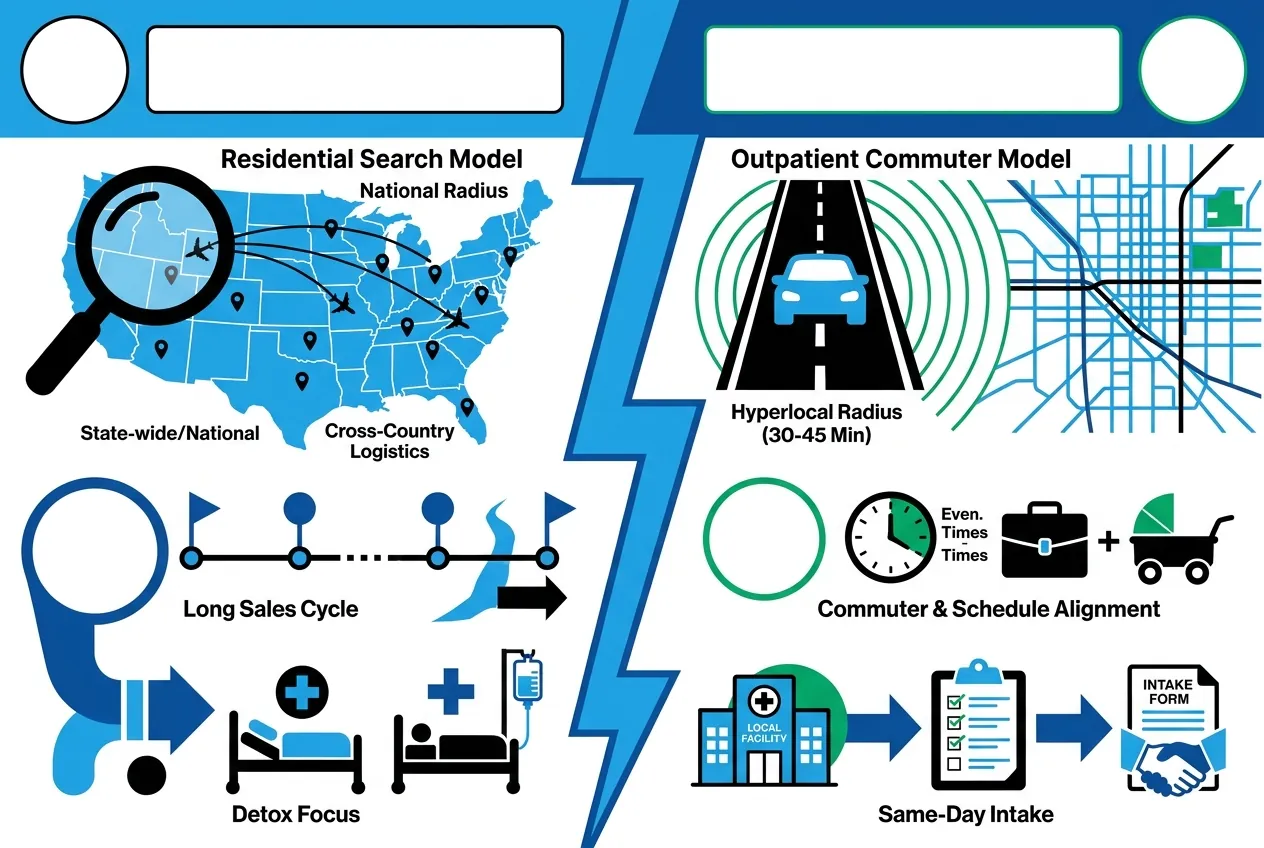
The Commuter Logistics Dividing Outpatient and Inpatient Search
Residential addiction treatment marketing often relies on state-wide or national search queries. In contrast, outpatient addiction treatment is bound by a strict physical perimeter. A patient attending an IOP three evenings per week or a PHP five days per week cannot travel two hours each direction. For admissions directors, inquiries originating outside a 30 to 45-minute driving radius routinely result in abandoned verifications of benefits (VOBs), missed clinical assessments, and low show rates.
Search engines recognize these real-world transportation constraints. When an individual searches for ambulatory clinical care, algorithmic systems prioritize proximity, local entity authority, and regional relevance over broad national authority. The table below illustrates how the search behavior, commercial intent, and intake operations diverge between residential and outpatient settings:
- Geographic Catchment Radius. Inpatient / Residential Programs: Regional, statewide, or national (100+ miles). Outpatient (IOP / PHP) Programs: Hyperlocal commuter corridor (15 to 45 minutes).
- Primary Decision Bottlenecks. Inpatient / Residential Programs: Travel logistics, medical detox needs, room and board. Outpatient (IOP / PHP) Programs: Work schedules, childcare, reliable transportation.
- Primary Category Intent. Inpatient / Residential Programs: "Dual diagnosis residential rehab", "inpatient detox". Outpatient (IOP / PHP) Programs: "Evening IOP near me", "day treatment programs".
- Core Conversion Signal. Inpatient / Residential Programs: Urgent clinical placement, crisis hotline call. Outpatient (IOP / PHP) Programs: Scheduled clinical assessment, local facility tour.
- Regulatory & Ad Limits. Inpatient / Residential Programs: High-cost non-branded paid search auctions. Outpatient (IOP / PHP) Programs: Strict local competition, zero ad retargeting.
Because Google Ads strictly prohibits retargeting for health-related queries, providers cannot remarket to individuals who visit an outpatient landing page without converting. Every organic visit must immediately answer the searcher's core practical questions: where the facility is located, what clinical schedules are offered, what insurance plans are accepted, and how care integrates with daily responsibilities. Treating outpatient search as a smaller version of residential SEO misallocates marketing capital and floods intake lines with unworkable out-of-market inquiries.

Local Entity Architecture and Google Business Profile Optimization
For outpatient addiction treatment centers, organic search visibility begins in the Google Map Pack. A prospective patient searching for day treatment or evening therapy will almost always encounter localized map listings before standard organic web results. Building local entity authority requires rigorous configuration of Google Business Profile (GBP) properties, verified physical addresses, and structured local citations.
First, category selection inside GBP dictates which algorithmic queries trigger your profile. Treatment facilities must identify a primary category that matches their core licensed service:
- Primary Category: Typically "Addiction treatment center" or "Mental health clinic", depending on program licensing and the primary clinical population served.
- Secondary Categories: "Outpatient clinic", "Counseling center", and "Mental health service".
Operators must avoid adding unrelated secondary categories, such as "Holistic medicine practitioner" or "Wellness center", which dilute entity clarity in local search calculations.
Second, the physical premises must reflect legitimate healthcare infrastructure. Google enforces stringent verification protocols on medical and behavioral health locations. Shared commercial office spaces, mail drop locations, and virtual offices frequently trigger algorithmic suspensions or manual profile suspensions. Each outpatient profile must feature clear external and internal signage, a physical reception area, dedicated intake rooms, and a unique local telephone number answered by clinical admissions staff.
Third, local review acquisition must be managed with strict healthcare compliance. Because public patient disclosures touch protected health information (PHI), treatment centers cannot solicit public reviews in exchange for incentives, nor should staff ever confirm that an individual was a patient when responding to reviews. Instead, focus on building standardized processes that invite alumni and family members to review their experience voluntarily, adhering to non-solicitation guidelines while creating steady, authentic review velocity.
Structuring Dedicated IOP and PHP Level of Care Architecture
A common architectural failure in behavioral health web development is grouping all outpatient services onto a single generic URL, such as /programs/outpatient. This consolidated approach weakens search engine comprehension, prevents the site from ranking for distinct clinical queries, and creates friction for patients seeking specific levels of care.
Modern search engines parse healthcare content using semantic relationships that mirror established medical definitions, such as the SAMHSA levels of care guidelines. Intensive Outpatient Programs and Partial Hospitalization Programs serve different clinical needs, require different time commitments, and represent distinct search behaviors.
Partial Hospitalization Program (PHP) Page Architecture
Partial Hospitalization, often referred to as day treatment, represents an intensive level of ambulatory clinical support:
- Clinical Detail: Define the programmatic commitment clearly (typically 5 to 6 hours per day, 5 days per week) with medical monitoring and structured psychiatric stabilization.
- Targeted Intent: Capture queries such as "day treatment programs for substance abuse", "partial hospitalization mental health near me", and "step down from residential treatment".
- Target Audience: Address both self-referrals seeking structured stabilization without overnight boarding and discharge planners at regional inpatient hospitals looking for step-down availability.
Intensive Outpatient Program (IOP) Page Architecture
Intensive Outpatient care provides structured therapy while allowing clients to live at home and maintain professional or educational commitments:
- Clinical Detail: State the exact group and individual therapy expectations (typically 3 hours per session, 3 to 5 days per week), highlighting distinctions between morning and evening programming tracks.
- Targeted Intent: Align landing pages with queries like "evening IOP addiction treatment", "outpatient alcohol counseling for working professionals", and "flexible intensive outpatient programs".
- Target Audience: Address working adults, college students, and parents balancing care with active daily obligations.
Separating these programs into dedicated URLs allows internal linking structures to pass topical equity effectively. To see how these levels of care fit within a comprehensive clinical SEO program, examine our specialized guide on outpatient addiction treatment architecture.
Free Audit
Want a straight read on where your budget is leaking?
Technical Crawl Quality and Search Visibility for Multi-Location Networks
As outpatient networks expand across metropolitan areas, technical SEO architecture dictates whether search engines index location pages accurately or dismiss them as duplicated digital footprints. When an organization scales from a few local facilities to dozens of clinics, engineering clean URL hierarchies and technical data feeds becomes an operational necessity.
Clean URL Taxonomies
Multi-location providers must implement predictable, hierarchical URL patterns. Rather than creating disjointed landing pages, organize content logically:
- Root level: brand.com/locations/
- Market level: brand.com/locations/philadelphia/
- Facility level: brand.com/locations/philadelphia-center-city/
- Level-of-care subpages: brand.com/locations/philadelphia-center-city/iop/
This structural discipline signals to search crawlers that the facility operates as a verified satellite clinic serving a defined commuter zone.
Medical and Local Business Schema Markup
Structured data provides direct, machine-readable validation to search engines regarding the nature of your clinical services. Outpatient facilities should deploy nested JSON-LD schema combining MedicalCondition, MedicalTherapy, and LocalBusiness specifications:
Crawl Budget and Duplicate Content Prevention
Multi-location healthcare groups frequently make the mistake of copying clinical text across multiple facility pages, altering only the city name. Search engine systems identify this templated approach and often remove duplicate regional pages from the primary search index.
Every geographic location page must contain unique clinical leadership bios, specific building navigation details, localized transit directions (including parking and regional transit stops), and clear insurance networks accepted at that specific facility. Maintaining high crawl efficiency ensures that newly launched clinics achieve organic indexation rapidly without diluting the domain's broader topical authority.
Search Intent Mapping Across Clinical Schedules and Program Models
Effective seo for addiction treatment centers requires understanding the searcher's mindset at the moment an inquiry occurs. Outpatient search volume is not driven purely by clinical terminology. It is heavily influenced by personal logistics, crisis thresholds, and professional preservation.
According to verified Semrush US search data from November 2026, core industry terms reflect clear practitioner interest: seo for addiction treatment centers records 320 searches per month with a Keyword Difficulty (KD) of 11, while outpatient rehab seo accounts for 90 searches per month with a KD of 15. The consumer-facing term outpatient addiction treatment carries substantial, ongoing clinical demand across every regional market.
To capture this consumer demand, content teams must map landing pages to the three primary commercial intent vectors:
1. Schedule-Driven Intent
Prospective clients frequently search based on availability rather than clinical classification:
- Search Examples: "Evening rehab near me", "weekend IOP addiction program", "outpatient therapy after 5pm".
- Content Requirement: State program start times, session durations, and schedule flexibility clearly on the page. If your facility runs an evening track on Mondays, Wednesdays, and Thursdays from 6:00 PM to 9:00 PM, display those hours prominently above the page fold.
2. Insurance and Financial Verification Intent
Commercial insurance coverage is the single largest factor determining whether an organic lead becomes an admitted patient:
- Search Examples: "In-network outpatient rehab Blue Cross", "Aetna IOP mental health coverage", "cost of outpatient drug rehab without insurance".
- Content Requirement: Create transparent, insurance-specific landing resources detailing in-network commercial carriers, behavioral health carve-outs, out-of-pocket deductibles, and self-pay alternatives. Do not hide insurance verification options behind generic lead forms.
3. Demographic and Professional Specialization Intent
Individuals often seek clinical environments where they feel safe and understood alongside peers with similar life circumstances:
- Search Examples: "Executive outpatient rehab", "young adult IOP addiction center", "first responder trauma and substance program".
- Content Requirement: Detail specific clinical tracks, dual diagnosis protocols, and peer group compositions without resorting to stigmatizing language.

Conversion Attribution from Organic Inquiry to Verified Admission
A marketing campaign that reports hundreds of monthly web form submissions but fails to generate verified admissions wastes organizational resources. In outpatient behavioral healthcare, measuring marketing return on investment requires connecting front-end search visibility directly to downstream clinical milestones.
Our operational leadership team includes a former healthcare CMO who ran marketing for a treatment network that grew from 3 to 24 locations, managing $1.5 to $2M per month in Google Ads across 11+ behavioral and mental health accounts. Drawing from that large-scale operational background, we emphasize tracking attribution directly to admission, not just initial lead capture.
The Broken Lead Funnel
Traditional marketing metrics stop at the top of the funnel: organic sessions, click-through rates, and unverified form completions. In practice, up to 70% of raw online form submissions for behavioral health services fail basic qualification due to:
- Geographic mismatch (inquiries residing outside the licensed commuter area).
- Incompatible insurance coverage (Medicaid inquiries submitted to commercial out-of-network facilities).
- Mismatched level of care (acutely unstable individuals requiring acute inpatient medical detox).
Building a Compliant Closed-Loop Measurement Framework
To evaluate organic performance accurately, treatment center executives must implement server-side tracking pipelines that integrate with clinical CRM systems while respecting patient privacy.
- Dynamic Call Tracking: Deploy dynamic number insertion (DNI) across all local organic landing pages to track calls back to the referring keyword category and landing page URL.
- Privacy-Aware Data Pipelines: Ensure web analytics configurations do not capture personal identifiable information (PII) or protected health information (PHI). Marketing Powered utilizes owned, local AI infrastructure for HIPAA-aware inference, avoiding external data-sharing risks while analyzing operational conversion trends.
- CRM Milestone Integration: Connect your call tracking and website forms directly into intake systems (such as Salesforce, Sunwave, or Kipu). Tag each inbound opportunity with its organic referral source, tracking the record as it moves through Verification of Benefits (VOB), clinical intake assessment, and confirmed admission.
This closed-loop methodology reveals the true financial return of your outpatient rehab seo investments, distinguishing productive organic pages from high-traffic pages that yield zero clinical admissions.
Email Us
Prefer to send the context directly?
Common Outpatient Search Pitfalls and Governance Constraints
Executing search marketing in regulated behavioral healthcare requires navigating complex ethical, legal, and search engine platform rules. Many outpatient operators incur significant search penalties or waste operational capital by falling into common strategic traps.
Over-Reliance on National Informational Content
Publishing dozens of superficial blog posts explaining what substances are or defining basic withdrawal symptoms rarely produces local outpatient admissions. These informational articles often attract searchers across the globe who are not prospective patients for your local clinic. Marketing teams should redirect resources toward high-intent local service pages, clinical team bios, insurance network guides, and transportation access maps.
Ignoring Advertising and Verification Realities
While organic SEO operates independently of paid search auctions, search visibility exists alongside paid media. To run paid campaigns that complement organic search, behavioral health providers must secure LegitScript addiction treatment certification. Relying exclusively on paid search without an organic foundation leaves an organization vulnerable to auction volatility, where cost-per-click rates regularly spike. A strong organic footprint secures predictable patient acquisition even when paid auctions fluctuate.
Unmonitored Digital Reputation
Google Map rankings correlate heavily with user review signals, profile responsiveness, and geographic prominence. Outpatient networks that neglect their local profiles often suffer from outdated business hours, unaddressed negative feedback from walk-ins, and inaccurate phone routing. Regularly auditing your Google Business Profiles ensures that prospective patients and their families receive accurate intake information during crisis moments.
Outpatient Rehab SEO Implementation Checklist
Executing an effective organic growth program requires coordination across marketing, intake, and executive leadership. Use this operational checklist to evaluate your facility's current search posture:
Technical & Local Entity Foundation
- [ ] Primary Google Business Profile category verified as "Addiction treatment center" or "Mental health clinic".
- [ ] Physical facility location verified with permanent exterior signage and independent commercial lease.
- [ ] Unique, local telephone number assigned to each outpatient clinic address.
- [ ] Valid JSON-LD MedicalClinic schema implemented with defined MedicalTherapy service lines.
- [ ] Mobile page speed optimized with core web vital metrics passing field validation.
Level of Care & Content Architecture
- [ ] Dedicated landing page deployed for Partial Hospitalization Programs (PHP).
- [ ] Dedicated landing page deployed for Intensive Outpatient Programs (IOP).
- [ ] Explicit clinical schedules (morning, evening, weekend tracks) clearly displayed above the page fold.
- [ ] Local transportation options, transit routes, and parking instructions published for commuter clarity.
- [ ] Commercial insurance networks accepted by the clinic detailed with direct verification pathways.
Tracking, Intake & Measurement
- [ ] Dynamic call tracking implemented across organic search channels.
- [ ] Web forms and analytics pipelines configured without capturing sensitive patient PHI.
- [ ] CRM integration configured to pass organic source data to Verification of Benefits (VOB) records.
- [ ] Weekly reporting tracking organic inquiries through to scheduled clinical assessments and admissions.
- [ ] Regular profile audits scheduled to maintain accurate operational hours and review responses.
Questions, Answered.
Outpatient rehab seo is the specialized process of improving organic search engine rankings, local map visibility, and website conversion architecture for ambulatory addiction treatment centers, Intensive Outpatient Programs (IOP), and Partial Hospitalization Programs (PHP). Unlike residential treatment SEO, which captures regional or national demand, outpatient SEO focuses on acquiring patients within a defined daily commuter radius.
Residential search intent centers on campus amenities, medical detoxification, and 24-hour inpatient care, often drawing individuals willing to travel across states. IOP search intent is pragmatic and geographically bound: prospective patients search for local evening or daytime therapy tracks that allow them to continue working, attending school, or living at home while receiving clinical care.
Google prioritizes localized map pack results for ambulatory healthcare searches. Because outpatient clients must commute to a physical facility multiple times each week, search engines surface nearby clinics before standard organic web pages. An optimized Google Business Profile drives high-intent phone calls and direction requests directly from local prospective patients and their families.
Outpatient addiction treatment facilities should deploy JSON-LD structured data using the MedicalClinic schema type. Within this schema, embed availableService properties detailing specific levels of care using the MedicalTherapy schema type for Intensive Outpatient Programs and Partial Hospitalization Programs, along with complete PostalAddress and geo-coordinate attributes.
Marketing performance should be measured by qualified business outcomes rather than raw website impressions or unverified form fills. Outpatient operators should track organic visibility through to phone calls, completed Verifications of Benefits (VOB), scheduled clinical assessments, and verified facility admissions within the local commuter catchment zone. Request an acquisition audit
Ready to see where your marketing can improve?
Request a free audit of your paid media, landing pages, attribution, and measurement setup. You'll get a straight assessment of where the opportunities are.
or email us at info@marketingpowered.ai