Resources
How to Measure Patient Acquisition ROI
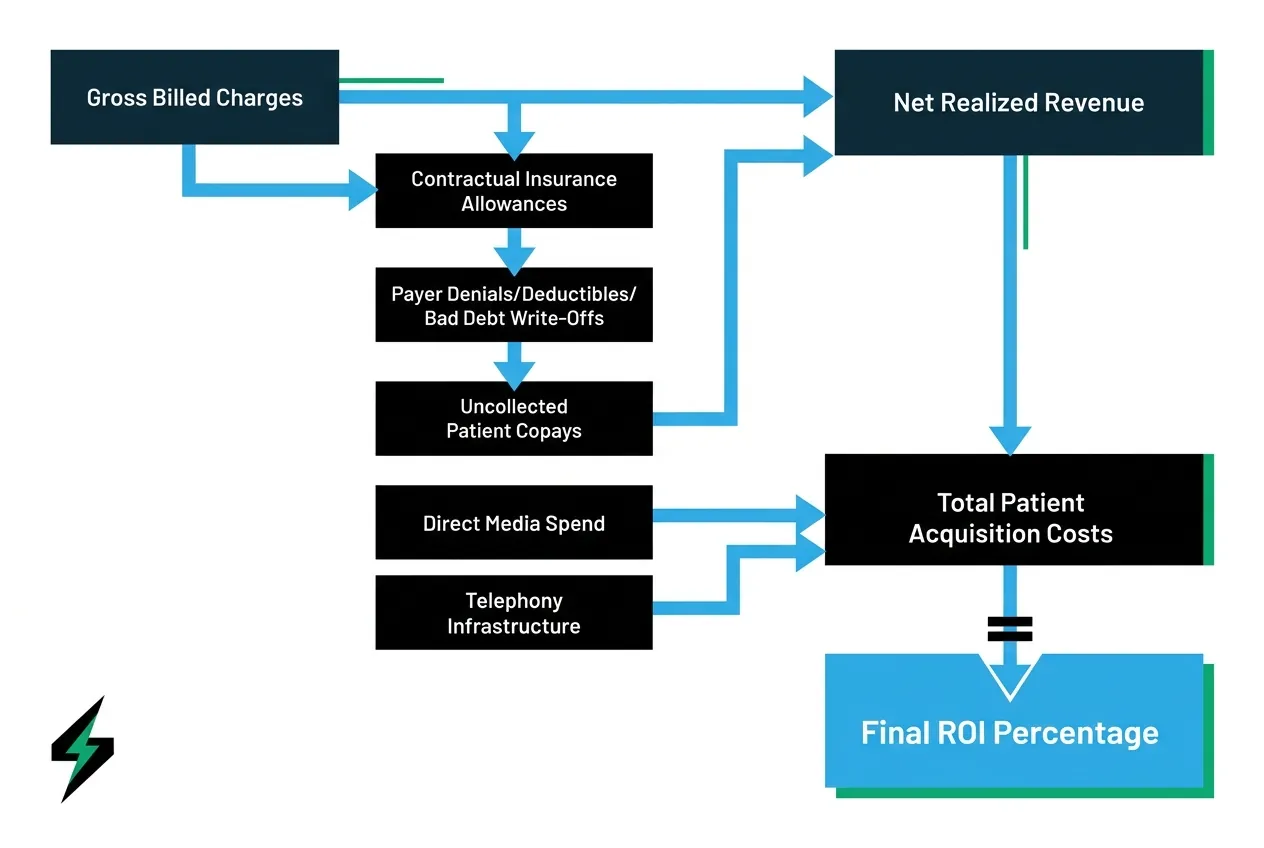
To understand how to measure patient acquisition ROI accurately, healthcare leaders must evaluate net realized revenue from verified clinical admissions against the comprehensive costs required to generate them. Relying on raw form fills, click volumes, or top-of-funnel conversion rates introduces severe blind spots into capital allocation. Real operational returns emerge only when organizations bridge the measurement divide between anonymous digital ad interactions, verified telephony inquiries, and downstream patient encounter records.
By Mike Hulick, Founder, Marketing Powered

The Healthcare Acquisition Formula: True Revenue and Cost Inputs
Evaluating return on investment in healthcare demands a departure from standard e-commerce formulas. In a retail or enterprise software business, a digital transaction closes quickly with settled funds, making revenue recognition straightforward. In specialized healthcare, psychiatric facilities, multi-location clinics, and addiction treatment centers, a digital conversion marks merely the start of a prolonged clinical and financial qualification chain.
This mathematical relationship appears direct, yet its execution falters when organizations miscalculate either the numerator or the denominator.
The Revenue Numerator: Billed Charges Versus Collected Receipts
The primary failure point in healthcare financial modeling is utilizing gross billed charges instead of net collected patient revenue. If a residential treatment program bills commercial insurance $45,000 for a thirty-day stay, that figure represents a gross charge master rate. Depending on payer contracts, in-network allowable rates, out-of-network reimbursements, medical necessity audits, and client deductibles, actual cash collections may average $12,000 to $18,000.
If marketing leadership computes return on investment using the $45,000 gross billed figure, the resulting return calculation is artificially inflated by up to 300 percent. Finance executives recognize this discrepancy immediately, eroding executive confidence in acquisition reporting. Net realized revenue must reflect cash in the bank:
- Realized reimbursement amounts after commercial insurance adjudications and fee allowances.
- Direct cash payments received for private-pay clinical services.
- Subtractions for payer clawbacks, claims disputes, bad debt allowances, and uncollected copayments.
- Adjustments for actual patient length of stay rather than planned duration of treatment.
The Cost Denominator: Building the Fully Loaded Expense Ledger
The denominator requires an equally rigorous standard. Reporting return on ad spend (ROAS) by looking solely at media spend paid to Google or Meta provides a skewed view of unit economics. A functional patient acquisition model relies on a fully loaded acquisition expense ledger comprising five distinct categories:
Direct advertising spend constitutes the foundational line item, covering keyword auctions, display placements, and directory listings.
Telephony and call tracking healthcare software costs represent the second input. In inbound clinical environments where phone calls drive more than 70 percent of high-intent inquiries, the dynamic number insertion pools, call routing engines, and interactive voice response (IVR) platforms must be accounted for directly.
Attribution and analytics software fees form the third cost category. This includes customer relationship management (CRM) software licenses, dedicated data pipeline hosting, intake ticketing solutions, and visualization platforms.
Agency management and consultancy retainers represent the fourth input. Outside specialized media buyers, technical developers, and campaign strategists must be incorporated into the balance sheet alongside direct media purchases.
Intake and contact center labor allocation constitutes the fifth, and most frequently omitted, cost input. Inbound inquiries require human evaluation. If an intake department employs eight specialists dedicated to answering, screening, and running insurance benefits for digital marketing inquiries, the pro-rated payroll, benefits, and shift overhead belong in the acquisition cost denominator.
When a marketing team generates 400 monthly calls that require 200 hours of intake triage, that labor is an operational acquisition cost. Omitting triage labor understates the investment required to move a prospective patient from initial awareness to a completed clinical intake.
Why Lead Volume and CPL Distort True Acquisition Economics
Marketing reports in healthcare frequently highlight vanity metrics. Dashboards display plummeting cost-per-click (CPC) and declining cost-per-lead (CPL) trends, creating an illusion of operational efficiency. In multi-location clinical systems and behavioral health networks, these metrics regularly diverge from admissions, room occupancy, and operating margin.
Consider a multi-location psychiatric provider evaluating two simultaneous Google Ads campaigns running across distinct behavioral service lines.
Campaign A generates 400 inbound leads at a modest $50 CPL. Campaign B produces only 80 leads at an apparent $250 CPL. Under standard agency reporting, Campaign A appears five times more cost-efficient.
Examining the operational pipeline reveals the opposite economic reality. Campaign A drove broad search queries, capturing individuals seeking free support forums, uncontracted state Medicaid coverage, out-of-catchment inquiries, or acute medical needs outside the facility's clinical scope. The intake team spent dozens of hours screening 400 inquiries, yet only four individuals converted into completed admissions. The true cost per admission reached $5,000.
Campaign B targeted exact, high-intent clinical criteria aligned with the facility's clinical capabilities and payer contracts. Of the 80 inquiries, 10 completed admissions, yielding a cost per admission of $2,000. While Campaign A appeared superior on surface metrics, Campaign B delivered 2.5 times the admissions, reduced intake labor waste, and generated superior financial returns.
Top-of-funnel conversion volume obscures the points of operational friction where prospective patients exit the intake funnel:
- Clinical acuity mismatch: Inquiries where patient symptoms exceed the licensure, medical capabilities, or staffing scope of the receiving clinic.
- Payer and financial incompatibility: Prospective patients carrying health plans not accepted by the facility, such as non-contracted managed care organizations, or individuals lacking secondary coverage.
- Catchment geography: Callers seeking physical, in-person clinical programs located outside viable transportation or commuting boundaries.
- Intake response latency: Inquiries abandoned because the contact center failed to connect with the caller within minutes of the initial digital submission.
Focusing acquisition metrics exclusively on cost per lead incentivizes digital media teams to prioritize raw inquiry volume over clinical viability. The intake department becomes burdened with processing unqualified inquiries, generating operational expense while true revenue languishes. Measuring return on investment requires deprecating CPL as a primary metric and anchoring marketing performance directly to verified encounters and admissions. For deeper insights on configuring healthcare attribution models, review our guide on healthcare marketing ROI.
Telephony Infrastructure and Call Tracking Healthcare Deployments
While digital forms and scheduling widgets have expanded in modern digital healthcare, phone calls remain the dominant transaction channel for urgent clinical needs. In behavioral health, addiction recovery, and specialty hospital programs, families and patients in distress reach for the phone. Analyzing patient acquisition requires implementing call tracking healthcare systems that link campaign parameters to conversational intake outcomes without violating regulatory privacy guidelines.
Dynamic Number Insertion (DNI) serves as the technical mechanism for telephony attribution. When a user navigates to a landing page through a digital campaign, dynamic scripts swap the displayed contact number with an isolated tracking line tied to that visitor's unique session. This tracking number preserves source data, including keyword intent, campaign identifier, ad creative variant, and geographic region.
Deploying call tracking in healthcare requires operational precautions that consumer e-commerce brands rarely face:
Privacy Preservation in Telephony Routing
Standard consumer call tracking often relies on third-party vendors that automatically transcribe calls, analyze sentiment, and store unencrypted recordings on public cloud networks. In clinical environments, prospective patients disclose medical histories, therapeutic medications, psychiatric symptoms, and insurance identification numbers within the first two minutes of conversation.
Under guidance issued by the U.S. Department of Health and Human Services, covered entities must manage tracking tools and vendor relationships carefully to avoid unauthorized disclosures of protected health information. Inbound telephony pipelines must be configured so that data routing systems do not expose patient-identifying conversational content or clinical diagnoses to external marketing vendors. Review the regulatory background outlined in the HHS OCR Guidance on Online Tracking Technologies.
Attribution systems must restrict data sharing to operational metadata: call duration, timestamp, geographic telephone prefix, and originating marketing campaign IDs. Recording and transcription capabilities must either be hosted in secure, isolated technical environments governed by executed Business Associate Agreements (BAAs) or disabled entirely to avoid compliance exposure.
Eliminating the Raw Call Duration Metric
A common operational error involves treating call duration as a proxy for lead quality. Marketing agencies frequently report that any phone call lasting longer than three minutes constitutes a qualified lead. In an active intake center, that assumption is regularly incorrect.
A four-minute phone call may consist entirely of an intake coordinator politely explaining that the facility does not accept an out-of-state Medicaid plan, or directing an individual seeking an unrelated medical specialty to a local emergency room. Conversely, a focused two-minute call can result in an immediate intake appointment for a patient possessing verified, active in-network commercial insurance.
Relying on call duration to measure campaign quality skews optimization data. Digital advertising platforms optimize toward extended telephone discussions, inadvertently driving more individuals with complex clinical or financial hurdles that require lengthy explanations from intake staff.
Accurate ROI tracking bridges the gap between the phone system and the intake ticketing platform. When an intake coordinator answers a call, the telephony software must pass the tracking session ID into the CRM record.
The intake agent then marks the outcome based on objective operational criteria: clinical match confirmed, insurance benefits verified, intake assessment scheduled, or patient admitted. This process ties acquisition spend to verifiable clinical milestones rather than arbitrary call lengths.
Free Audit
Want a straight read on where your budget is leaking?
Mapping Click Identifiers to Downstream Clinical Milestones
Connecting top-of-funnel digital ad investments to bottom-of-funnel patient revenue requires establishing a closed-loop data pipeline. In non-regulated industries, web developers install automated pixels from ad networks across their web properties. These pixels track users from page to page, logging when they submit forms or purchase products.
In healthcare, this automated tracking approach introduces significant compliance liability. Healthcare providers cannot allow third-party marketing tags to observe user actions on secure patient portals, scheduling pages, or post-assessment intake screens.
Closing the attribution loop safely requires managing data through an offline conversion workflow. Offline conversion tracking decouples the anonymous digital ad interaction from the downstream clinical workflow, using server-to-server data transfers rather than browser-side tracking scripts.
Stage 1: Anonymous Parameter Capture
When a user clicks an ad on an ad platform like Google Ads, a unique click identifier (such as a Google Click Identifier or GCLID) appends to the landing page destination URL. The website's first-party script captures this parameter and retains it in a secure, local, first-party cookie. This interaction captures only the marketing identifier, completely separate from any health record.
Stage 2: Intake Session Integration
When the visitor calls the dynamic phone number or completes an introductory contact request, the intake management system ingests the click identifier alongside the contact details. The technical infrastructure isolates this click identifier in a metadata field, separate from clinical notes, medical histories, or protected assessments.
Stage 3: Operational Milestone Advancement
Within the intake center, the prospective patient moves through four standard operational gates:
The initial inquiry gate marks the receipt of the inbound contact. The intake team records whether the person reached a live coordinator or abandoned the queue.
The clinical and financial qualification gate confirms whether the individual meets the diagnostic criteria of the facility and possesses an accepted payer mechanism.
The scheduled assessment or intake gate occurs when a qualified prospective patient commits to an intake window and completes pre-admission evaluations.
The verified admission or encounter gate occurs when the individual arrives at the facility, passes through clinical triage, and begins treatment. At this moment, operational value is achieved.
Stage 4: Server-Side Anonymized Sync
Once an admission is marked as complete within the CRM, a secure integration script extracts the associated click identifier, the timestamp, and the net economic valuation of that admission category. This payload is completely scrubbed of personal identifiers. It contains no patient names, medical record numbers, diagnoses, or clinical summaries.
The secure server transmits this anonymized payload back to the advertising platform through an encrypted server-to-server conversion API. The advertising engine registers that a specific click identifier generated an admission worth a precise monetary value.
This process closes the attribution loop without sharing sensitive medical data with third-party tracking scripts. The ad platform's smart bidding algorithms can then prioritize bidding for keyword intent that yields verified clinical admissions, starving ineffective campaigns of ad budget.
Executing this level of closed-loop attribution reflects how our founder approached media efficiency while managing $1.5 to $2M per month in Google Ads across 11+ behavioral and mental health accounts. Tying ad spend to completed admissions transformed marketing from an unverified operational expense into a measurable growth driver. Explore our specialized patient acquisition marketing services to see how these data models function across complex healthcare networks.

Navigating Regulatory Privacy Constraints and Retargeting Bans
Measuring and optimizing patient acquisition ROI requires operating within strict digital advertising boundaries. Consumer goods marketers rely heavily on behavioral retargeting. If an online shopper views a pair of shoes but does not purchase, the marketer builds a custom audience and serves reminder ads across social networks and display placements until the shopper returns.
In regulated healthcare verticals, this retargeting mechanism is prohibited by both ad network policies and federal privacy guidance. Attempting to deploy standard consumer retargeting strategies exposes healthcare organizations to account suspensions and regulatory enforcement.
Google Ads Sensitive Category Restrictions
Google enforces strict standards regarding health in personalized advertising. Under its policies, advertisers cannot target users based on personal hardships, physical health conditions, mental health struggles, or clinical treatments.
This policy prevents healthcare advertisers from creating remarketing lists for individuals who visited depression, trauma, addiction recovery, or oncology service pages.
If a healthcare marketing team deploys an audience pixel to follow visitors who researched addiction treatment programs, Google's policy enforcement mechanisms can suspend the advertising account. Learn more directly from the Google Ads Policy on Personalized Advertising.
Mandatory Regulatory Certifications
For specialized behavioral healthcare organizations providing addiction treatment, Google mandates third-party certification prior to running search advertising. Advertisers must secure and maintain certification through LegitScript, validating that the provider is fully licensed, maintains physical treatment facilities, meets insurance and regulatory standards, and provides transparent clinical services.
Running paid acquisition campaigns without fulfilling these platform-specific certification mandates is impossible. Uncertified accounts face immediate ad disapproval and account suspension. Review the technical requirements detailed within the Google Ads Healthcare and Medicines Policy.
HHS OCR Guidance on Third-Party Tracking Technologies
The U.S. Department of Health and Human Services (HHS) Office for Civil Rights (OCR) issued guidance regarding the deployment of online tracking technologies by HIPAA-covered entities. The guidance highlights that transmitting IP addresses, device identifiers, or unique web behavior linked to visits to healthcare service pages to third-party ad networks without proper authorization or a Business Associate Agreement can constitute an impermissible disclosure of protected health information.
This enforcement reality alters how healthcare acquisition performance must be engineered:
- Retargeting cannot serve as a safety net for ineffective web design. Because marketers cannot serve remarketing ads to unclosed visitors, the initial landing page encounter must provide immediate, friction-free pathways to contact.
- Web platforms must eliminate unvetted tracking scripts. Third-party pixels embedded in headers and footers that broadcast user activity to social networks must be removed from sensitive clinical service pages.
- Measurement must move server-side. Rather than allowing browser tags to communicate data directly to external ad networks, organizations must implement isolated server architectures that scrub and validate all conversion events before transmission.
Marketing Powered's founder, who is a court-certified expert witness in advertising strategy, structured our methodologies around these operational boundaries. Being AI-native since 2022, we maintain owned, local AI infrastructure for HIPAA-aware inference, enabling complex attribution modeling without leaking sensitive patient records to public cloud models. Operating ethically and profitably within regulated healthcare requires embracing these constraints rather than seeking shortcuts around them.
Operationalizing the Intake Pipeline Across Clinical Locations
Accurate acquisition measurement breaks down when the marketing department and the admissions center operate as isolated silos. In multi-location systems, marketing often claims it delivered hundreds of prospective patients, while facility directors complain of vacant beds and empty appointment slots.
Resolving this conflict requires mapping operational milestones consistently across every facility. When an executive manages marketing for a multi-location clinical network, operational variations between facilities become apparent quickly.
Our founder managed marketing for a treatment network that expanded from 3 to 24 locations, observing firsthand how operational variables directly impact acquisition performance. A campaign strategy that produces high admissions in one market can falter in another due to regional payer mixes, intake response speeds, and local facility management.
Operational discrepancies across facilities directly influence acquisition returns in three core areas:
Intake Response Speed and Contact Latency
Inbound healthcare inquiries decay rapidly. A prospective patient or family member reaching out for behavioral healthcare or specialty medical consultations is often in emotional distress. If an inbound form submission sits in an intake inbox for four hours, the individual will contact alternative facilities or abandon the decision entirely.
Data across clinical intake environments demonstrates that calling a prospective patient within five minutes of an online inquiry yields a significantly higher contact rate than delaying by thirty minutes. If Facility A maintains an average contact latency of four minutes, while Facility B averages seventy-five minutes, Facility B will record lower conversion rates and higher costs per admission, despite running identical advertising campaigns. Measuring acquisition ROI accurately requires tracking intake latency alongside media spend to pinpoint operational bottlenecks.
Benefit Verification Velocity
Once an intake specialist verifies that a prospective patient meets clinical criteria, the next hurdle is the verification of benefits (VOB). Prospective patients want to know their financial responsibility: what portion insurance covers, what out-of-pocket deductible applies, and what personal balance remains.
If the financial clearing team takes six hours to verify insurance benefits, prospective patients drop out of the intake pipeline. Leading organizations establish standard operating procedures that return completed verifications within 45 minutes. Improving benefit verification speed directly improves patient show rates, improving acquisition returns without requiring additional media budget.
Standardized Facility Conversion Audits
In multi-location operations, marketing performance must be evaluated facility by facility.
When this metric is monitored weekly, executive leadership can identify whether acquisition failures stem from marketing campaign issues or local intake operations.
If Facility A converts 22 percent of qualified inquiries into admissions while Facility B converts only 8 percent from identical campaigns, the root cause usually lies in operational execution: intake staffing shortages, communication bottlenecks, or local clinical scheduling limits. True acquisition measurement isolates these variables, ensuring marketing budgets are deployed where operational infrastructure can support patient volume.

Email Us
Prefer to send the context directly?
Building a Defensible Patient Acquisition Marketing Dashboard
To present acquisition performance credibly to boards of directors, chief financial officers, and clinical leadership, marketing teams must move away from standard ad-platform screenshots. Executives need an operational scoreboard showing how acquisition capital translates into financial margin and clinical capacity.
A defensible patient acquisition marketing dashboard unifies three data sources into a consolidated reporting view:
First, cost and campaign source data from advertising networks and offline media channels. Second, operational stage metrics and timestamps captured by the intake CRM and telephony infrastructure. Third, billing receipts and collected reimbursements stored within the Electronic Health Record (EHR) and financial practice management software.
Constructing an executive dashboard requires monitoring six core metrics that capture both acquisition efficiency and operational capability:
1. Inbound Lead Qualification Ratio
This metric divides qualified inbound inquiries by total raw inquiries. It provides an immediate assessment of digital campaign precision.
If this ratio falls below 25 percent, media teams are targeting overly broad search terms, running misaligned ad copy, or generating inquiries outside the organization's service area and accepted insurance networks.
2. Intake Contact and Qualification Latency
This measures the elapsed time from a patient's initial web submission or missed call to direct engagement with a qualified intake coordinator. Tracking this alongside admissions data highlights where operational delays impair conversion performance.
3. VOB-to-Admit Velocity
This tracks the percentage of verified insurance policies that progress into completed clinical admissions. A sharp decline in this rate often indicates financial friction, such as unmanageable patient deductibles, clinical scheduling delays, or communication failures by intake staff.
4. Admission Show Rate
Calculated as verified arrivals divided by scheduled intake appointments, this metric monitors intake center effectiveness. High drop-off between scheduling and arrival highlights the need for improved pre-intake communication and patient support.
5. Fully Loaded Cost Per Completed Admission (CPCA)
Calculated by dividing total acquisition expenses (media spend, technology subscriptions, intake labor, and agency retainers) by verified clinical admissions. This figure serves as the definitive unit-economic benchmark for organizational growth.
6. Net Collected Acquisition ROI
The definitive financial metric: net realized collections from an admitted patient cohort minus total acquisition investment, divided by total acquisition investment.
Reporting this metric across thirty-, sixty-, and ninety-day billing cohorts provides leadership with an accurate account of marketing performance and capital returns.
Transitioning to this closed-loop measurement framework elevates marketing from a suspected cost center to an accountable growth driver. It aligns marketing investments directly with clinical operations and financial performance, providing healthcare executives with the operational clarity needed to scale services effectively.
Questions, Answered.
Return on ad spend (ROAS) calculates gross revenue generated divided exclusively by direct advertising media spend. It ignores technology licenses, intake center labor, agency retainers, and the difference between gross billed charges and actual collections. Patient acquisition ROI evaluates net collected cash revenue against fully loaded acquisition expenses, providing a defensible financial metric for executive leadership.
Advertising dashboards rely on browser-level conversion tags that fire whenever a user clicks a phone link or submits an initial form. These platforms cannot determine whether the caller possessed compatible insurance, met clinical criteria, or ever attended an appointment. Relying on platform conversion numbers measures raw inquiry volume rather than verified clinical encounters.
Yes. Compliance requires decoupling marketing click identifiers from protected health information. Organizations must capture click parameters securely, store them in isolated fields within the CRM, and use server-side integrations to transmit anonymized conversion values back to advertising platforms. Third-party marketing pixels should never be placed directly on sensitive clinical or scheduling pages.
Cost per admission varies significantly depending on treatment modality, facility licensure, payer contracts, and geographic region. Outpatient therapy programs may target a cost per admission between $250 and $600, whereas high-acuity residential behavioral health or addiction treatment programs typically see acquisition costs ranging from $1,800 to $4,500 per admission. Evaluating performance against net collected revenue rather than standard benchmarks provides the most reliable indicator of financial health.
Calculate the percentage of intake staff time dedicated to answering, screening, and processing inbound marketing inquiries. Multiply that percentage by the total compensation, benefits, and operational overhead of the intake department, and add that figure into the acquisition expense denominator. Including intake labor ensures acquisition returns reflect true operational costs.
This disparity typically stems from three operational issues: digital campaigns bidding on broad, unqualified symptom keywords; mismatched insurance acceptance criteria on landing pages; or extended intake contact latency that allows prospective patients to seek alternative care options before completing an intake screening. Download the acquisition ROI scorecard
Ready to see where your marketing can improve?
Request a free audit of your paid media, landing pages, attribution, and measurement setup. You'll get a straight assessment of where the opportunities are.
or email us at info@marketingpowered.ai