Resources
Behavioral Health Intake Automation with Human Review
Behavioral health intake automation applies governed digital workflows to capture inquiries, verify insurance benefits, and stage coordination instantly without replacing clinical judgment. In mental health and addiction treatment, response delays cause patients in crisis to seek care elsewhere, yet fully autonomous tools introduce severe diagnostic and privacy hazards. Effective intake pipelines resolve this tension by automating administrative velocity while mandating human approval at critical clinical milestones.
By Mike Hulick, Founder, Marketing Powered

The Operational Tension Between Intake Velocity and Empathy
In behavioral health, an inquiry is fundamentally different from a retail conversion. When an individual or family member reaches out for mental health or substance use disorder treatment, they are frequently navigating acute distress. Operational data shows that inquiry velocity matters immensely; a delay of several hours often means the individual reconsidered, experienced a de-escalation of intent, or reached an alternative facility that answered immediately.
At the same time, deploying fully autonomous bots to manage patient intake creates severe clinical friction. An impersonal, robotic script can alienate a patient who needs authentic validation and immediate stability. More critically, an unmonitored artificial intelligence system cannot reliably discern subtext, medical detoxification risks, or immediate crisis indicators such as active suicidality.
Admissions coordinators working high-volume phone lines face intense operational pressures. Intake staff must navigate phone queues, transcribe insurance policy numbers, log customer relationship management (CRM) notes, and conduct initial clinical screenings simultaneously. When manual processes govern the entire pipeline, staff become overwhelmed, data entry errors compound, and callback times lengthen.
The purpose of intake automation is not to remove humans from the interaction. Rather, it removes the manual data entry, routing friction, and notification lag that prevent admissions coordinators from doing what humans do best: building trust, assessing complex clinical needs, and guiding individuals into appropriate levels of care.

Defining the Human-in-the-Loop Intake Architecture
A defensible intake automation model establishes strict functional boundaries between machine-driven velocity and clinical evaluation. In a governed system, automation owns data capture, verification staging, and operational notifications, while licensed clinicians or trained admissions specialists retain absolute decision-making power over clinical triage and admission qualification.
Administrative automation executes several distinct tasks without requiring immediate human intervention:
- Capturing inbound digital form submissions, phone call metadata, and web inquiries in real time.
- Validating basic contact information and running phone number verification checks to filter out fraudulent entries.
- Staging secure collection of insurance card images and policy identification numbers.
- Triggering verification of benefits (VOB) checks against clearinghouses to confirm active coverage and deductible status.
- Routing inquiry profiles instantly to on-duty intake coordinators based on facility location, program type, and bed capacity.
Human checkpoints must interrupt the automated sequence whenever clinical discretion or patient safety is involved. An automated workflow should never determine whether a patient meets American Society of Addiction Medicine (ASAM) criteria or level-of-care guidelines. Human operators must own:
- Immediate risk assessment, including medical stabilization and suicide risk screening.
- Qualitative evaluation of clinical history, past treatment episodes, and co-occurring presentations.
- Assessment of program fit, facility culture alignment, and clinical milestone readiness.
- Final admission approval and bed assignment scheduling.
By drawing this operational boundary, behavioral healthcare organizations protect patient acquisition ROI while safeguarding clinical standards. Admissions coordinators receive structured, verified patient profiles instead of raw, unvetted leads, allowing them to focus entirely on human connection and clinical assessment during the critical first contact.
Regulatory Boundaries in Healthcare Advertising and Data Privacy
Deploying AI for healthcare marketing and intake requires rigorous technical and regulatory boundaries. Behavioral health operators operate under heightened scrutiny from advertising platforms and federal regulatory agencies. A conversion architecture that ignores these realities risks severe penalties, account suspensions, and privacy breaches.
Paid advertising for addiction and mental health treatment operates under strict constraints. Digital advertising platforms enforce specific policies to protect users searching for sensitive medical care. Under Google Ads Policies: Personalized Advertising, advertising platforms prohibit retargeting, remarketing lists, and personalized audience targeting based on personal hardships, including health conditions, addiction, and mental health challenges.
Because retargeting is prohibited in sensitive healthcare categories, front-end intake pipelines must convert qualified demand during the initial interaction. An operator cannot rely on multi-touch display remarketing to re-engage a lost visitor. Every inbound click represents an unrepeatable investment, making immediate capture, frictionless data entry, and rapid follow-up essential.
Simultaneously, healthcare providers must align digital tracking with federal privacy guidelines. The Department of Health and Human Services (HHS) Office for Civil Rights has issued explicit warnings regarding online tracking tools. According to HHS guidance on online tracking technologies, regulated covered entities may not use third-party tracking technologies that disclose protected health information (PHI), including IP addresses and specific medical search terms, to unauthorized third parties without appropriate authorization or an executed Business Associate Agreement (BAA).
To deploy intake automation safely:
- All intake forms, document portals, and messaging pipelines must operate within HIPAA-aware environments with signed BAAs.
- Analytics tracking scripts must be firewalled from protected health information; ad conversion tags must not receive medical condition parameters or patient identifiers.
- Marketing teams should leverage owned, local AI infrastructure for processing sensitive patient data rather than routing unvetted health inquiries through public, consumer-grade cloud APIs.
- Communications workflows should secure explicit consent before dispatching transactional short message service (SMS) updates or appointment reminders.
Understanding these operational constraints allows treatment networks to design acquisition funnels that maintain compliance while maximizing lead conversion efficiency. Organizations seeking to modernize these pipelines can explore structured frameworks through healthcare marketing automation services.
Free Audit
Want a straight read on where your budget is leaking?
Step-by-Step Architecture: From Initial Ad Click to Admission
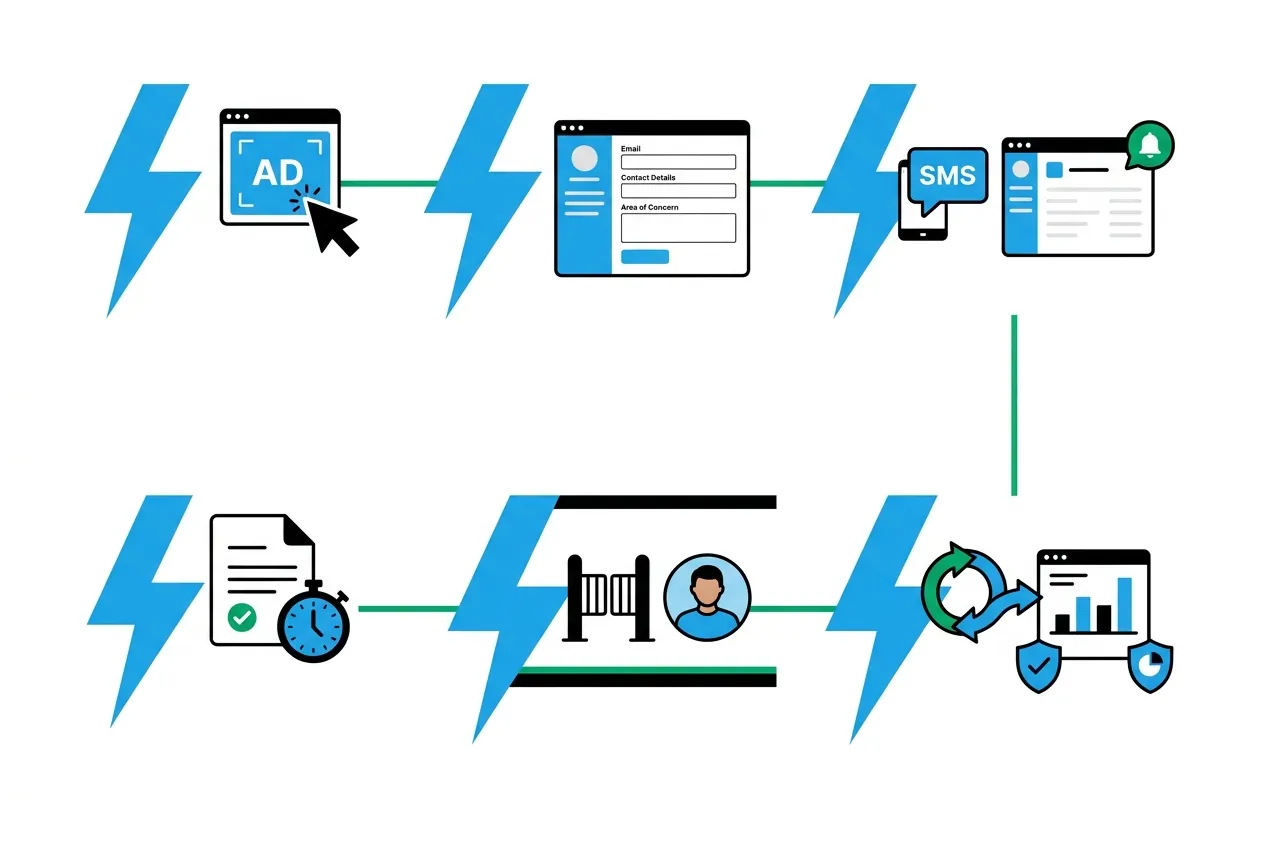
To understand how automated velocity and human checkpoints collaborate, consider the end-to-end journey of an inquiry through a modern behavioral health acquisition funnel.
Stage 1: Dynamic Ingestion and Instant Engagement
A prospective patient clicks a compliant search ad and arrives on a secure landing page. Instead of confronting an exhaustive, 40-field clinical form, they encounter a streamlined interface requesting only essential contact details, primary area of concern, and preferred contact method.
Upon submission, the intake automation engine triggers two parallel actions within seconds. First, it issues an immediate, automated confirmation message via SMS or email acknowledging the submission and providing an immediate direct line to the admissions desk. Second, it dispatches an automated notification to on-duty intake coordinators via desktop CRM alerts or encrypted internal messaging channels.
Stage 2: Automated Benefit Collection and Verification Staging
Concurrently, the system delivers a secure, one-click link allowing the inquiry or their family member to upload insurance card photos directly from a smartphone.
Once submitted, the automation extracts key policy metadata and queries integrated clearinghouse APIs to verify active policy status, copay levels, deductible progress, and pre-authorization requirements. By staging this financial data before an admissions coordinator picks up the phone, the organization eliminates 20 to 30 minutes of manual telephone hold time typically spent calling insurance payers.
Stage 3: Capacity-Aware Routing
Not all treatment centers maintain identical clinical capabilities or open beds. Modern intake automation incorporates capacity-aware demand logic. If an inpatient facility has reached maximum census for adult residential detox but maintains open capacity in an intensive outpatient program (IOP), the system surfaces this context immediately to the admissions team. Inquiries are routed automatically to coordinators specialized in specific programs or facility locations.
Stage 4: The Mandatory Human Clinical Gate
The admissions coordinator initiates contact with the prospective patient. Because administrative details and preliminary benefit checks are pre-populated, the coordinator can devote the conversation entirely to clinical empathy and assessment.
The coordinator completes a comprehensive screening, evaluates detox requirements, assesses behavioral history, and verifies that the individual meets the clinical criteria for the program. The coordinator exercises complete discretion: they may accept the patient for admission, recommend a different level of care within the network, or provide an external referral if the individual requires a higher level of medical acuity than the facility supports.
Stage 5: Closed-Loop Attribution Tracking
Once the coordinator confirms or declines the admission, the intake disposition is logged in the CRM. The operational pipeline transmits a de-identified conversion signal back to the marketing data infrastructure. Marketing leadership evaluates campaigns not on raw web form fills, but on verified, qualified admissions. For executive teams evaluating how well their current admissions workflow aligns with marketing expenditures, the marketing-to-admissions scorecard provides an actionable framework to measure these touchpoints.
Measuring Acquisition Success Beyond Front-End Lead Volume
A common failure mode in healthcare marketing is evaluating campaigns solely on cost per lead (CPL). This metric incentivizes marketing teams to generate high volumes of low-intent web forms that overwhelm intake coordinators with disconnected numbers, out-of-network insurance policies, or clinical inquiries outside the facility's scope of practice.
When admissions staff spend hours sorting through unqualified leads, response times for high-intent, clinically appropriate inquiries deteriorate. True marketing efficiency must be measured against operational outcomes, focusing on patient acquisition ROI and the cost per admitted patient.
Evaluating campaigns by cost per admitted patient requires end-to-end attribution that tracks the patient journey through admission, not just form completion. This approach informs paid media optimization. Rather than bidding aggressively on broad, ambiguous keywords that produce generic inquiries, marketing teams can allocate budget to precise search intents that yield qualified healthcare leads and confirmed bed placements.
Operational efficiency also reflects operational discipline at scale. Marketing Powered's founder managed $1.5 to $2M per month in Google Ads across 11+ behavioral and mental health accounts and served as marketing leadership for a treatment network that expanded from 3 to 24 locations. At that scale, disconnected lead pipelines directly inflate acquisition costs. Connecting front-end advertising directly to structured intake workflows ensures paid media budgets actively serve clinical capacity rather than generating administrative drag.
Four Operational Failure Modes in Follow-Up Automation
While governed follow-up automation resolves critical conversion bottlenecks, poorly architected implementations introduce substantial friction. Healthcare operators must avoid four primary operational failures:
1. Removing Human Judgment from Clinical Triaging
Some vendors market conversational bots designed to conduct autonomous clinical assessments. Permitting an unmonitored algorithm to evaluate patient acuity, determine substance withdrawal risks, or suggest treatment levels introduces catastrophic clinical and legal liability. Automated workflows should never diagnose, triage medical urgency, or assign clinical protocols. Automation must handle data transport and coordination, reserving clinical decisions exclusively for qualified professionals.
2. Aggressive, Inappropriate Automated Outreach Cadences
In consumer e-commerce, aggressive multi-channel automated drip campaigns are commonplace. In behavioral health, sending five automated text messages and three automated voicemails within 24 hours to an individual seeking crisis support feels invasive, coercive, and distressing. Follow-up automation must maintain a respectful, supportive cadence. Communications should be transparent, identify the facility clearly, and offer a friction-free option to speak directly with an admissions coordinator or opt out entirely.
3. Exposing Sensitive Health Data to Third-Party Tracking Pixels
A critical compliance vulnerability occurs when marketing teams install off-the-shelf conversion trackers directly on intake and financial verification pages. If an intake form sends a user's selected treatment category or medical necessity details alongside their IP address to consumer social media platforms or unvetted ad networks, the facility violates federal privacy standards. Intake automation workflows must isolate PHI from public ad networks, utilizing server-side data governance and strict data sanitation protocols.
4. Fragmented Data Silos Between Marketing and Intake Staff
When marketing automation tools operate independently from the admissions CRM, data fractures. Admissions coordinators end up asking patients for information they already submitted on a web form, creating frustration for an individual in distress. Furthermore, without bi-directional data flow, marketing teams cannot identify which search terms or campaigns produce admitted patients versus non-viable inquiries. Integrating the marketing pipeline directly with the intake CRM ensures seamless data handoffs and accurate operational attribution.

Email Us
Prefer to send the context directly?
Behavioral Health Intake Automation Deployment Checklist
Executing a secure, high-converting intake pipeline requires systematic coordination between clinical, marketing, and technical leadership. Use this operational checklist to evaluate your intake automation architecture:
Technical and Privacy Governance
- [ ] Business Associate Agreements (BAAs) are executed with all software vendors handling intake data, CRM workflows, and messaging delivery.
- [ ] Tracking pixels from major ad platforms are audited and removed from all post-inquiry and insurance verification pages.
- [ ] Patient consent for transactional SMS notifications is explicitly captured on initial forms with clear opt-out terms.
- [ ] Telephony and call-recording systems comply with applicable state consent laws and store audio files in encrypted, access-restricted environments.
Workflow and Routing Mechanics
- [ ] Inbound form submissions trigger automated, instant operational alerts to designated admissions coordinators within 60 seconds.
- [ ] Prospective inquiries receive an immediate confirmation SMS displaying a direct callback line and facility identification.
- [ ] Secure mobile document staging allows prospective patients or family members to upload insurance card photos easily.
- [ ] Benefits verification workflows integrate with clearinghouse APIs to stage coverage details prior to outbound human contact.
- [ ] Inquiries are routed dynamically based on real-time facility bed capacity and program availability.
Human-in-the-Loop Safeguards
- [ ] Clear operational protocols dictate that all clinical triage, risk assessments, and admission approvals are performed by licensed clinicians or qualified staff.
- [ ] Fail-safe alerts immediately direct inquiries mentioning active crisis or emergency medical conditions to emergency resources or hotlines.
- [ ] Admissions coordinators review staged insurance and contact data before initiating personal outreach.
- [ ] Final bed placement and program assignment require documented human authorization in the CRM.
Closed-Loop Performance Attribution
- [ ] Intake dispositions (e.g., Qualified, Out of Network, Admitted, Clinically Inappropriate) are systematically logged by admissions staff.
- [ ] De-identified conversion outcomes return to marketing analytics systems to measure true cost per admitted patient.
- [ ] Bidding strategies prioritize campaigns that generate verified admissions over broad form volume.
- [ ] Executive dashboards report on operational velocity, contact rates, benefits verification match rates, and capacity-aware demand.
Questions, Answered.
Human approval must sit squarely in front of all clinical evaluations, risk screenings, and admission decisions. While automation should handle technical routing, benefit verification queries, and instant submission confirmations, a trained admissions coordinator or licensed clinician must conduct the clinical assessment, evaluate medical stability, and determine program eligibility. Automation facilitates operational speed, but human professionals retain absolute control over clinical entry points.
Intake automation should be evaluated on bottom-line clinical and operational metrics rather than front-end form submissions. Key performance indicators include speed to initial human contact, the percentage of completed benefits verifications, cost per clinically qualified lead, and cost per admitted patient. Tracking closed-loop attribution to the point of admission ensures that marketing investments generate sustainable census rather than unmanageable administrative burdens.
Yes, provided the technical architecture strictly adheres to federal privacy regulations and HHS guidance. Regulated entities must ensure that all systems processing patient data operate under signed Business Associate Agreements. Additionally, website tracking technologies must never transmit protected health information or diagnostic inquiries to unauthorized third-party advertising platforms. Maintaining owned, privacy-aware data infrastructure ensures compliance while preserving operational speed.
No. Intake automation eliminates administrative friction such as manual data transcription, phone tag for insurance policy details, and internal notification delays. By automating repetitive administrative tasks, admissions coordinators spend more time conducting empathetic clinical interviews, addressing family concerns, and guiding prospective patients through the complex admissions process. Request an acquisition audit
Ready to see where your marketing can improve?
Request a free audit of your paid media, landing pages, attribution, and measurement setup. You'll get a straight assessment of where the opportunities are.
or email us at info@marketingpowered.ai