Resources
Healthcare Campaign Management Systems: Buy vs Own
A healthcare campaign management system is the centralized operational architecture that plans, routes, measures, and governs patient acquisition across digital advertising channels. For multi-location providers, behavioral health networks, and hospital systems, standard commercial platforms introduce severe data privacy liabilities and attribution blind spots. Deciding whether to license commercial healthcare marketing tools or engineer an owned infrastructure determines how effectively an organization protects patient privacy while tracking acquisition spend directly to admissions.
By Mike Hulick, Founder, Marketing Powered

Core Architecture of a Healthcare Campaign Management System
A standard consumer marketing stack relies on client-side browser pixels, open web hooks, and third-party software subscriptions that broadcast user engagement across commercial networks. In clinical environments, that model breaks down. A compliant healthcare campaign management system must decouple public web activity from patient identity while preserving campaign attribution across paid search, organic traffic, and inbound intake centers.
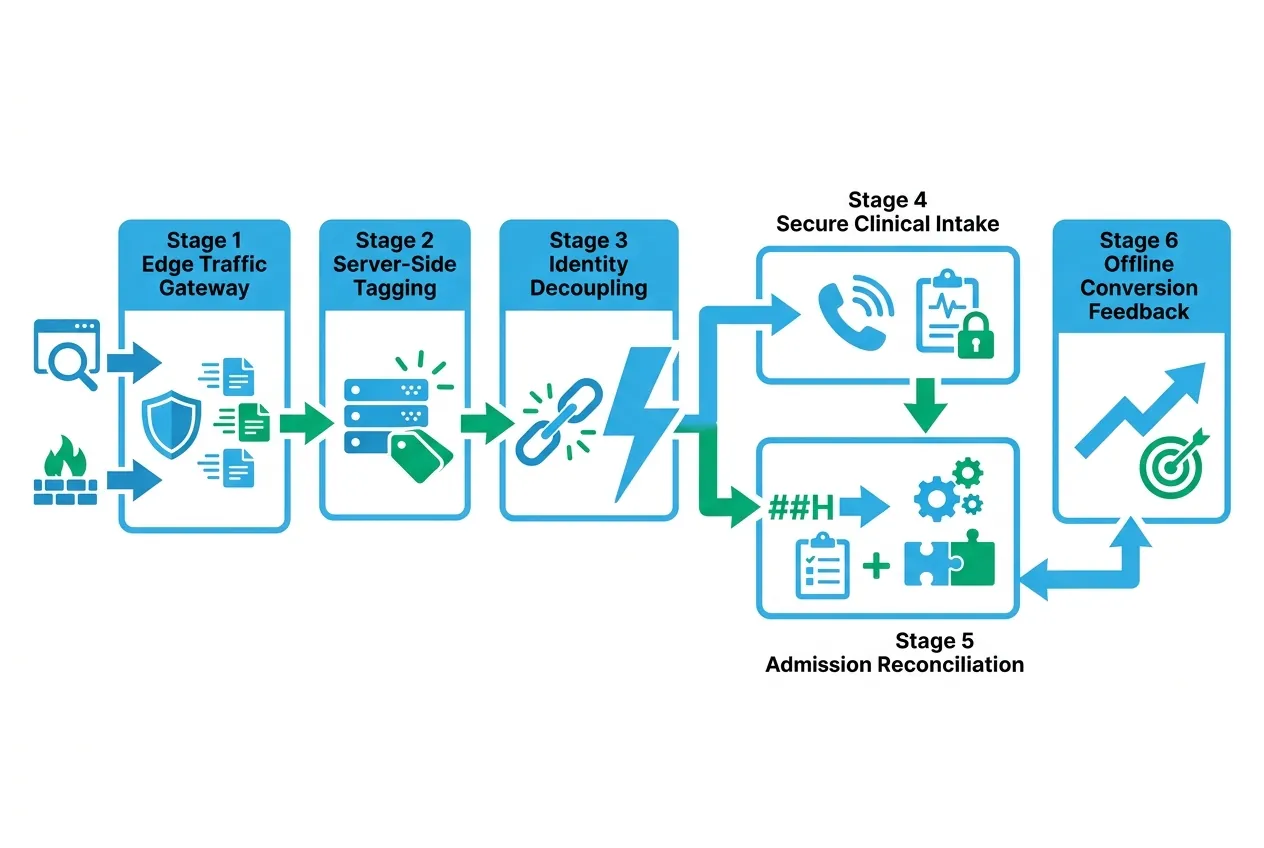
At its foundation, an enterprise healthcare campaign management system unites four functional tiers:
- Edge Traffic Governance: An orchestration layer that intercepts inbound patient traffic, strips identifiable network parameters, and prevents unauthorized client-side scripts from executing on sensitive pages.
- Server-Side Data Routing: A secure processing environment that ingests form submissions, click identifiers, and landing page sessions, standardizing conversion events before dispatching hashed, non-sensitive records to media platforms.
- Clinical Intake Reconciliation: A data bridge linking telephony logs, call center notes, and electronic health record (EHR) admission markers to the initial marketing touchpoint without exposing protected health information (PHI) to third-party ad networks.
- Offline Feedback Dispatch: An automated pipeline that uploads verified admission values back to media buying engines, training machine learning bid models on validated revenue milestones rather than raw inquiries.
Where generic commercial tools treat form submissions and five-second phone calls as successful outcomes, an owned system operates as an end-to-end data pipeline. The physical deployment spans isolated cloud containers or on-premise hardware, secure database instances, and private API connections that keep patient intake workflows separate from third-party vendor access. This structure enables healthcare organizations to deploy healthcare marketing automation that improves operational response times without scattering sensitive intake logs across fragmented SaaS dashboards.
Regulatory Friction in Commercial Healthcare Marketing Software
Healthcare operators face unprecedented scrutiny regarding digital data collection. The U.S. Department of Health and Human Services (HHS) Office for Civil Rights outlined clear boundaries in its guidance on online tracking technologies. The agency warned that deploying third-party tracking scripts on patient-facing web pages, client portals, and scheduling flows can trigger unauthorized disclosures of PHI.
Most commercial healthcare marketing software relies on third-party JavaScript snippets installed directly in the document header of web pages. When a prospective patient visits a page describing specialized clinical services, such as residential detox or acute psychiatric stabilization, commercial pixels automatically collect the visitor's IP address, device fingerprint, and specific URL parameters. If that tracking technology transmits those identifiers to commercial advertising platforms without an executed Business Associate Agreement (BAA) and explicit authorization, the provider incurs substantial regulatory liability.
Mainstream SaaS vendors rarely solve this operational exposure. Typical marketing software providers routinely refuse to execute BAAs covering digital advertising trackers, dynamic call tracking scripts, or conversion pixels. Their business models rely on aggregate data pools and multi-tenant cloud storage. When marketing teams license multiple disconnected platforms for landing pages, web chat, inbound call tracking, and email nurture, they multiply their compliance attack surface.
Each independent vendor represents an unmonitored data pipe. A single unvetted script update pushed by a third-party software provider can suddenly introduce unauthorized trackers onto regulated intake pages, exposing the healthcare organization to regulatory audits, enforcement fines, and public breach notifications.
Buy vs Own: Operational Trade-Offs for Scaling Providers
Choosing whether to buy third-party healthcare marketing software or engineer an owned campaign orchestration system is an operational governance decision. Commercial SaaS delivers rapid deployment, but it introduces long-term margin penalties, vendor lock-in, and compliance vulnerabilities. Building an owned architecture demands technical resources upfront, but it preserves first-party data sovereignty and delivers transparent unit economics.
- Speed to Deployment. Buying Commercial SaaS Platforms: Immediate (days to weeks via turnkey setup). Building an Owned System Architecture: Deliberate (6 to 12 weeks for pipeline engineering).
- Data Sovereignty & Privacy; Buying Commercial SaaS Platforms: Low; data sits in multi-tenant third-party clouds; Building an Owned System Architecture: Complete; data remains inside private enterprise perimeter
- Business Associate Agreements; Buying Commercial SaaS Platforms: Fragmented; many ad tracking tools explicitly refuse BAAs; Building an Owned System Architecture: Fully governed under direct healthcare organization control
- Attribution Depth. Buying Commercial SaaS Platforms: Surface-level (clicks, form fills, raw call duration). Building an Owned System Architecture: Full-funnel (inbound click to qualified clinical admission).
- Ongoing Licensing Cost; Buying Commercial SaaS Platforms: Escalating monthly tiers tied to call volume and locations; Building an Owned System Architecture: Fixed infrastructure compute; zero per-lead SaaS markups
- Customization & Integration; Buying Commercial SaaS Platforms: Rigid; bound to vendor API roadmaps and standard connectors; Building an Owned System Architecture: Total flexibility across internal EHR, CRM, and ad engines
- Ad Engine Bidding Signals. Buying Commercial SaaS Platforms: Generic conversion signals (leads, unverified calls). Building an Owned System Architecture: Value-adjusted bidding based on verified patient admissions.
Licensing commercial healthcare marketing tools presents hidden financial friction as healthcare facilities expand. SaaS vendors routinely price their software based on seat licenses, tracking phone numbers, connected clinic locations, and inbound lead volume. As a provider scales from 3 to 24 locations, software subscription overhead compounds, creating an ongoing operational tax that fails to build enterprise value for the healthcare provider.
In contrast, an owned campaign management framework capitalizes on fixed-cost computing. The enterprise deploys dedicated routing servers and private database repositories that ingest millions of events at negligible incremental cost. More importantly, owning the orchestration layer ensures that the provider retains full data sovereignty. The patient acquisition funnel, conversion logic, and intake performance metrics remain proprietary assets owned exclusively by the healthcare provider rather than sitting on a third-party vendor's rented server.
Free Audit
Want a straight read on where your budget is leaking?
Attribution Realities in Regulated Paid Advertising
Attribution in sensitive healthcare sectors operates under operational constraints that generic marketing tools cannot navigate. Under the Google Ads personalized advertising policy, advertising platforms prohibit remarketing lists, user re-engagement pools, and audience targeting built on sensitive personal health categories. Advertisers cannot retarget individuals who previously visited addiction recovery, mental health, or chronic disease treatment pages.
Furthermore, medical advertisers must clear stringent verification standards under the Google Ads healthcare and medicines policy, including LegitScript certification for applicable behavioral healthcare and addiction treatment providers.
Because retargeting is not permitted in sensitive healthcare environments, digital patient acquisition depends on capturing high-intent search queries at the exact moment of need. Commercial marketing platforms generally optimize campaigns using shallow front-end conversion actions: form submissions, chat initiations, or incoming calls lasting longer than sixty seconds.
In high-acuity behavioral health, substance abuse treatment, and specialized hospital services, shallow conversion metrics obscure actual acquisition performance. Up to 80 percent of initial inquiries may fail clinical intake criteria, lack appropriate commercial insurance coverage, or fall outside the facility's geographic license.
When media teams run automated bidding campaigns against unverified leads, ad engine algorithms optimize for low-intent form fillers rather than admitted patients. An operator managing $1.5 to $2M per month in Google Ads across 11+ behavioral and mental health accounts understands that tracking attribution to admission, not just lead status, is essential for operational survival.
An owned campaign management system integrates with clinical intake logs. When an intake coordinator verifies insurance benefits and admits a patient, the system matches that operational milestone back to the original encrypted ad click identifier (GCLID or WBRAID/GBRAID).
The platform then routes a secure offline conversion adjustment back to Google Ads via server-to-server APIs. The ad platform's automated bidding system receives clean mathematical signals prioritizing actual clinical admissions, cutting wasted ad spend on unqualified inquiries without violating user privacy.

Designing an Owned Infrastructure for Data Sovereignty
Transitioning to an owned healthcare campaign management system does not require building an enterprise software suite from scratch. It requires assembling proven, modern data infrastructure into a private orchestration framework. By coupling private data pipelines with owned AI systems, healthcare organizations maintain complete control over sensitive workflow intelligence and operational analytics.
An owned infrastructure rests on three technical pillars:
1. Isolated Server-Side Tagging Containers
Instead of loading marketing scripts directly in the patient's web browser, the provider deploys a server-side tagging environment hosted inside the organization's own private cloud account. The website dispatches a single, encrypted first-party data stream to this internal gateway.
The server-side gateway inspects every event, scrubs incoming IP addresses, strips user-agent strings, removes high-risk URL paths, and hashes required identifiers before routing clean conversion payloads to third-party ad networks.
2. Zero-PII Offline Identity Graphs
The campaign management database stores incoming click identifiers, session timestamps, and encrypted tracking keys completely separated from clinical medical records. When a prospect contacts the facility, the intake software captures an encrypted operational key.
At no point does the marketing database store medical charts, clinical assessments, or diagnosis codes. When an admission occurs, the system references only the operational key, preserving patient privacy while preserving end-to-end attribution fidelity.
3. Local, Governed Inference and Workflow Automation
Modern healthcare marketing teams leverage machine learning models to analyze anonymized intake transcripts, score call handling velocity, and audit lead response times across multi-location facilities.
Relying on public consumer AI models presents data leakage risks. An owned infrastructure utilizes containerized, local open-source models deployed on internal secure servers. This architecture allows operators to evaluate intake quality and marketing performance without transmitting sensitive operational logs to external AI vendors.

Practical Implementation Framework for Healthcare Operators
Building an owned campaign orchestration system requires cross-functional coordination between executive leadership, marketing operations, IT security, and clinical intake teams. The following four-stage framework establishes an owned healthcare campaign management system while maintaining continuous clinical operations.
Stage 1: Digital Perimeter Audit and Tracker Removal
- Scan all public domains, landing page variants, and patient scheduling paths for active client-side scripts.
- Immediately remove unvetted tracking pixels, third-party heatmaps, and session-recording software from any URL where medical symptoms, scheduling, or clinical intake occurs.
- Audit existing vendor agreements to confirm whether executed BAAs exist for all marketing software touchpoints.
Stage 2: Private Edge Server Deployment
- Provision a dedicated server-side tracking environment within the provider's private cloud infrastructure.
- Map the server-side endpoint to a custom first-party subdomain (for example, data.providername.com).
- Direct all public website analytics and core conversion signals through the first-party endpoint, ensuring third-party networks never execute direct browser code.
Stage 3: Secure Intake and EHR Integration
- Establish an intake tracking protocol that generates an encrypted referral ID whenever an inbound call connects or a private form is submitted.
- Configure the call center CRM or intake platform to attach this encrypted token to the prospective patient's administrative record without exposing it to clinical charts.
- Train intake coordinators to log disposition milestones accurately: initial contact, benefits verified, clinical evaluation passed, and admission finalized.
Stage 4: Closed-Loop Offline Attribution Routing
- Build an automated, privacy-compliant batch script that queries daily intake milestones from the administrative database.
- Match completed admissions against their corresponding encrypted marketing click identifiers.
- Transmit offline conversion events back to Google Ads and media platforms via authenticated Conversions APIs.
- Transition ad campaigns from standard target-CPA (cost-per-acquisition) bidding focused on cheap leads to value-based bidding focused on verified patient admissions.
Questions, Answered.
A healthcare organization should transition from commercial tools to an owned campaign management system when it expands beyond three clinical locations, manages more than $50,000 per month in digital media spend, or offers specialized medical services covered by sensitive-category advertising regulations. At this scale, the financial cost of per-seat SaaS licensing, combined with the legal risks of third-party tracking pixels, makes owned infrastructure substantially more cost-effective and operationally secure.
A healthcare campaign management system must evaluate marketing efficiency through admission-based metrics rather than surface-level cost per lead. Key performance indicators include: Cost per clinically qualified inquiry (inquiries meeting diagnostic and insurance criteria) Lead-to-intake velocity (the elapsed time between inquiry and clinical screening) Cost per verified patient admission (total media and infrastructure spend divided by completed admissions) Return on ad spend calculated against verified admission milestones rather than unverified form completions
No. An owned system can be engineered and deployed in parallel with current marketing operations. The edge routing containers and server-side pipelines are configured and tested on staging subdomains. Once server-side data validation matches or exceeds the precision of legacy pixels, client-side tags are decommissioned without pausing live ad campaigns or disrupting inbound patient inquiries.
An owned system is built directly inside the healthcare organization's private, governed cloud infrastructure. Because the provider owns the servers, databases, and network containers, the organization maintains direct operational control over data governance. Third-party cloud providers (such as Amazon Web Services, Google Cloud Platform, or Microsoft Azure) routinely execute standard enterprise BAAs for their underlying compute and database services, allowing providers to maintain a fully compliant data architecture. Request an acquisition audit
Ready to see where your marketing can improve?
Request a free audit of your paid media, landing pages, attribution, and measurement setup. You'll get a straight assessment of where the opportunities are.
or email us at info@marketingpowered.ai