Capabilities
Healthcare Marketing Automation with Governance
Deploying healthcare marketing automation requires an architecture fundamentally different from consumer software playbooks. Regulated providers cannot expose patient intent to public ad networks or overwhelm admissions teams with unverified form fills. Marketing Powered engineers governed acquisition systems that protect data privacy while connecting qualified patient inquiries directly to verified operational outcomes.

Why Consumer Marketing Automation Fails in Regulated Healthcare
Standard commercial marketing automation platforms rely on frictionless data sharing across ad networks, tracking pixels, and customer relationship management (CRM) software. In retail or business-to-business sectors, a visitor browses a product, triggers a client-side tracking script, and receives automated re-engagement emails alongside retargeted display ads. When applied to clinical environments, this pipeline creates immediate legal, operational, and ethical liabilities.
A patient navigating a behavioral health directory, an addiction treatment center page, or a hospital surgical portal is disclosing sensitive health circumstances. Off-the-shelf automation platforms deploy client-side JavaScript snippets that transmit IP addresses, URLs, and unique browser fingerprints back to third-party advertising systems. This silent data leakage exposes the provider to regulatory enforcement and civil actions.
Beyond privacy risks, consumer workflows degrade clinical operations. Admissions coordinators and intake specialists spend finite hours answering automated, low-intent inquiries generated by generic web forms. When automated pipelines prioritize raw inquiry volume over clinical criteria and geographic eligibility, call center queues fill with unqualified requests. Effective marketing automation for healthcare must isolate data, filter inquiries by operational criteria, and protect clinical staff from administrative overload.
Governance-First Architecture: Containing Trackers and Protecting Data Sovereignty
Sustainable automation in regulated environments starts with structural data containment. Marketing Powered builds acquisition workflows that intercept and process user events before external platforms can access identifiable information. By replacing unmanaged client-side tracking scripts with server-side infrastructure and strict consent gates, healthcare organizations maintain complete control over what information leaves their digital perimeter.
Data sovereignty requires that sensitive processing happens within controlled environments. Rather than sending patient communications or intake logs to multi-tenant cloud systems that repurpose data for external model training, our workflows use owned AI infrastructure for local inference. This keeps private marketing models and qualification logic strictly inside your operational boundary.
This governed framework manages consent dynamically. If a user declines analytics cookies, the system respects that boundary while preserving the operational intake path. Marketing metadata remains strictly separated from clinical intake data. Intake forms route necessary operational fields to the intake team without exposing protected user context to commercial ad tags. The result is a marketing infrastructure that satisfies the technical demands of enterprise IT and legal compliance teams while maintaining high commercial performance.

Intelligent Intake Routing and Operational Decision Support
Generating fifty raw inquiries an hour creates an operational failure if intake coordinators cannot triage them effectively. Marketing Powered replaces generic auto-responder emails with intelligent intake workflows designed to support human decision-making.
Our systems evaluate incoming inquiries against strict clinical criteria, regional licensing, and operational capacity before an intake specialist picks up the phone:
- Geographic and Licensing Verification: Automated routing filters inquiries by state licensing boundaries, directing potential patients exclusively to facilities authorized to treat them.
- Level-of-Care Alignment: Form logic and intake workflows evaluate whether the patient requires residential care, partial hospitalization, or outpatient services, preventing misallocated clinical reviews.
- Insurance and Payer Verification Routing: Inquiries are structured to collect necessary verification parameters upfront, reducing the multi-day back-and-forth typical of manual intake operations.
- Intelligent Call Routing: High-urgency phone inquiries are routed to available intake specialists based on call center shift schedules, minimizing hold times and dropped calls.
By automating qualification rather than broadcast messaging, intake departments focus clinical energy on individuals who meet medical and financial admission criteria.
Ad Platform Restrictions and HHS Tracking Technology Compliance
Healthcare providers operate under strict external advertising and privacy rules that directly shape automation workflows. Managing campaigns safely requires deep familiarity with platform policies and federal oversight.
Google strictly prohibits personalized advertising, remarketing lists, and audience retargeting for personal health conditions, medical treatments, and sensitive health topics. Advertisers who attempt to run automated remarketing campaigns using lists of users who visited addiction, mental health, or specialized clinical pages violate the Google Ads Personalized Advertising Policy. Governed automation relies on contextual search demand, educational authority, and explicit first-party conversion funnels rather than prohibited retargeting loops.
Simultaneously, the US Department of Health and Human Services (HHS) Office for Civil Rights (OCR) issued clear enforcement guidance regarding digital trackers. The HHS Bulletin on Online Tracking Technologies warns covered entities that sharing protected health information (PHI) with tracking tech vendors without a valid Business Associate Agreement or direct patient authorization violates federal privacy rules.
Marketing Powered's founder managed $1.5 to $2M per month in Google Ads across 11+ behavioral and mental health accounts, serving as a former healthcare CMO for a treatment network that grew from 3 to 24 locations. Operating at that scale in Google's sensitive healthcare vertical requires building HIPAA marketing automation workflows that decouple ad attribution from identifiable patient behavior. For specialized treatment providers, our strategies also integrate LegitScript certification compliance, ensuring automated ad workflows maintain continuous regulatory clearance.
Free Audit
Want a straight read on where your budget is leaking?
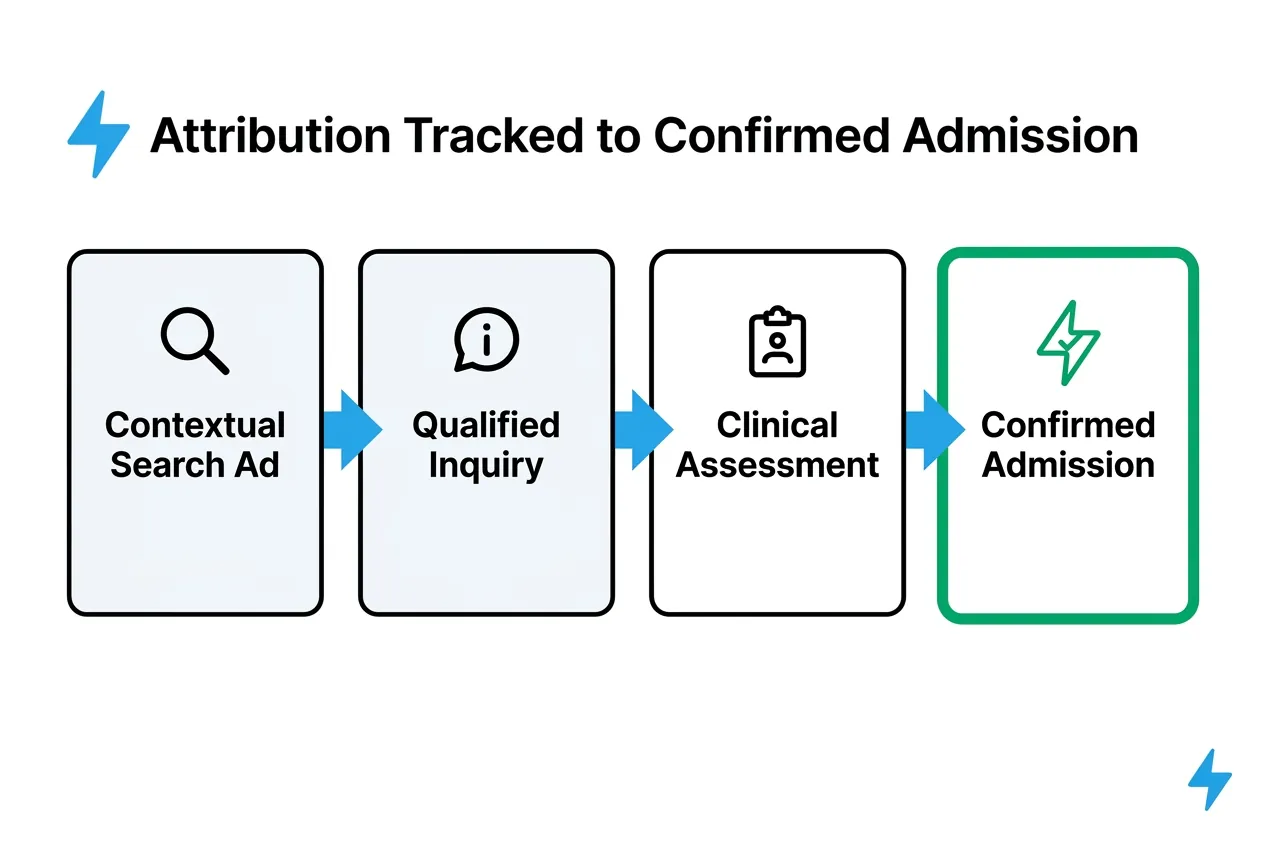
Attribution Tracked to Confirmed Admission, Not Just Inquiries
Most marketing automation agencies measure success through surface-level lead metrics: form fills, chat opens, and click-through rates. In healthcare, an inquiry is not an outcome. A campaign that generates two hundred inquiries at a low cost per lead represents wasted capital if none of those inquiries convert into an attended clinical appointment or an admitted patient.
Marketing Powered aligns marketing automation directly with closed-loop intake reporting. By connecting front-end acquisition data to CRM admission records through privacy-safe identifiers, leadership can observe exactly which channels, campaigns, and ad sets produce admitted patients.
This closed-loop feedback loop informs media allocation. When automated reporting demonstrates that a specific campaign generates high volume but zero admissions, ad spend is reallocated to campaigns that drive qualified intake. Attribution tracked to admission gives executive teams the defensible operational data required to justify acquisition budgets to boards and financial officers. For broader technical implementation guidelines, explore our analysis of governed healthcare marketing systems.
What Onboarding, Technical Deliverables, and Governance Audits Include
Engaging Marketing Powered begins with an operational and technical evaluation of your existing patient acquisition pipeline. We work alongside executive marketing leaders, intake directors, and IT compliance officers to identify exposure points and commercial bottlenecks.
A standard engagement focuses on three technical phases:
- AI Governance Review and Tracker Audit: We map every client-side script, pixel, and webhook across your web properties. We eliminate unmanaged tracking scripts that risk violating HHS guidelines, replacing them with governed server-side event collection.
- Intake Workflow Engineering: We rebuild CRM handoffs and routing logic. Inquiries are filtered by clinical scope, payer compatibility, and regional facility capacity. We establish on-premise inference tools that assist intake coordinators in prioritizing high-intent inquiries.
- Closed-Loop Attribution Setup: We implement secure attribution infrastructure that reconciles marketing campaign data with confirmed admissions and scheduled appointments, providing executive dashboards that measure real acquisition efficiency.
Marketing Powered has been AI-native since 2022, combining technical engineering with executive healthcare experience. Our founder is also a court-certified expert witness in advertising strategy, bringing rigorous evidentiary discipline to every marketing system we deploy.
Questions, Answered.
Healthcare organizations can safely automate inquiry routing, insurance pre-qualification data intake, appointment scheduling reminders, review generation, and internal CRM status updates. Safely automating these workflows requires that data collection uses server-side data containment, secure consent collection, and local or private infrastructure that isolates patient details from public advertising networks.
Automation should be evaluated by downstream operational milestones rather than initial form submissions. Key performance indicators include the qualification rate of incoming inquiries, the percentage of automated handoffs that connect to an intake specialist, the verification-of-benefits completion rate, and verified admissions or attended appointments. Connecting CRM intake milestones back to acquisition channels reveals the true return on marketing spend.
Automated nurture sequences must be handled with extreme care in sensitive healthcare verticals. Sending automated emails based on specific medical conditions or behavioral health topics without explicit, authenticated consent creates regulatory risk. Broadcast patient communications should focus on general facility information, provider credentials, and logistical guidance, avoiding health-specific assumptions or clinical labeling.
No organization or software vendor can issue an official HIPAA certification, as the Department of Health and Human Services does not certify software platforms. Marketing Powered designs, implements, and audits marketing automation workflows to align with statutory HIPAA privacy standards, platform policies, and HHS guidelines through technical safeguards, server-side data control, and secure data handling. Request an acquisition audit
Ready to see where your marketing can improve?
Request a free audit of your paid media, landing pages, attribution, and measurement setup. You'll get a straight assessment of where the opportunities are.
or email us at info@marketingpowered.ai