Resources
HIPAA and Marketing Automation | Provider Checklist
Deploying hipaa compliant marketing automation requires healthcare organizations to establish strict workflow boundaries before any system processes regulated patient data. Without executed agreements and deliberate data exclusion controls, marketing platforms expose treatment providers to severe compliance risks and wasted advertising spend. This operational checklist maps the exact steps marketing and compliance leaders need to protect patient privacy while scaling qualified admissions.
By Mike Hulick, Founder, Marketing Powered

What compliant automation actually permits
Marketing platforms do not possess inherent compliance capabilities straight out of the box. Software vendors may offer architecture capable of protecting data, but the organization controls the execution boundary. True compliance means operations leaders can sit down in a clinical office setting, open a laptop, and definitively map out a workflow diagram that proves protected health information remains isolated from unauthorized third-party trackers.
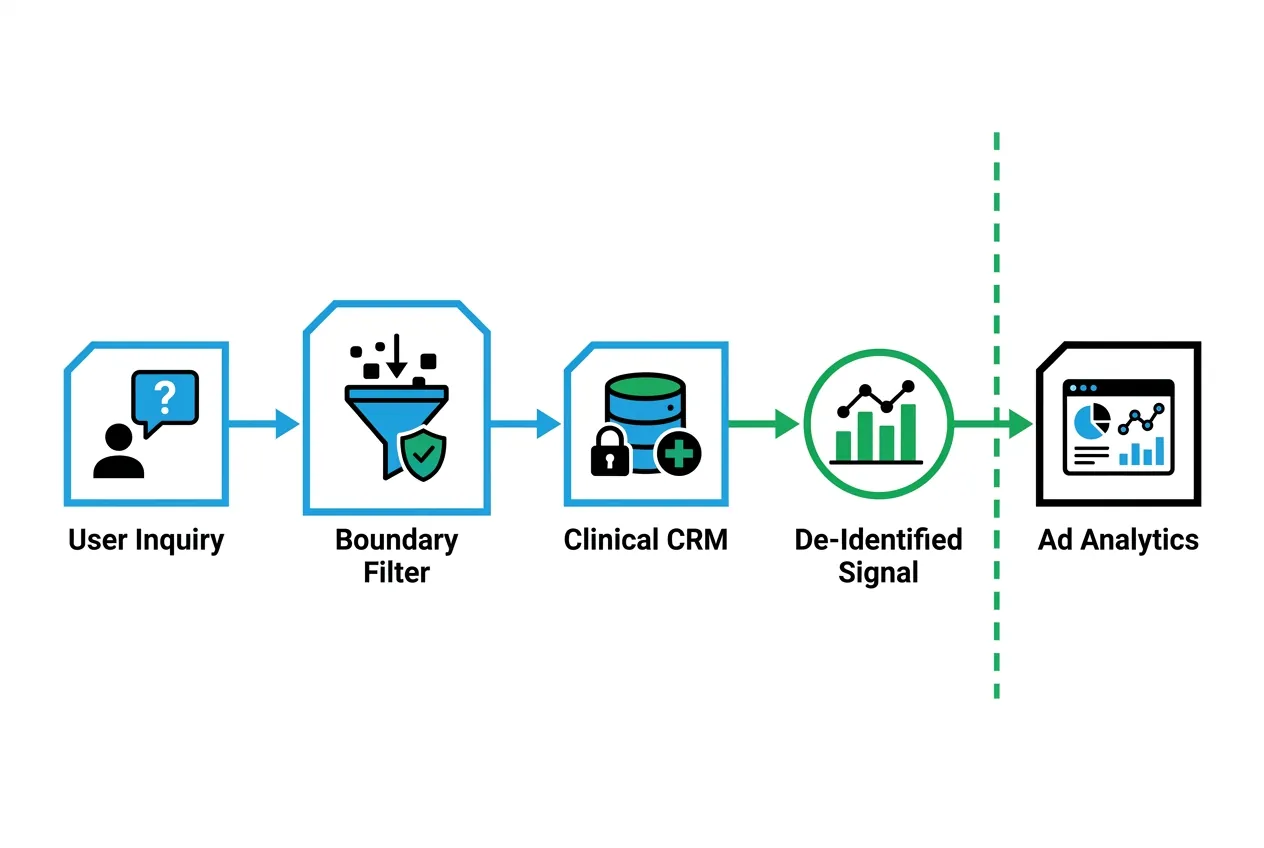
A compliant automated environment permits healthcare marketers to sequence communications, track aggregate conversion data, and route inquiries to intake teams without broadcasting sensitive identifiers back to advertising networks. The automation manages the volume and timing of the communication. The configured boundaries manage the privacy. Healthcare organizations cannot simply connect an email platform to a clinical CRM and assume the data is safe. They must intentionally build gates that scrub identifiers from public-facing analytics while passing necessary clinical context strictly to authorized internal intake systems.
Where patient data enters automated flows
Protected health information often enters marketing systems long before a patient officially begins treatment. Healthcare marketing automation must parse data streams originating from initial web form submissions, dynamically inserted call tracking numbers, and interactive self-assessment quizzes.
When a prospective patient submits an online inquiry for mental health or addiction treatment services, the resulting data payload contains names, phone numbers, and potentially sensitive medical context. The risk occurs when automated marketing software synchronizes this payload with open advertising pixels or consumer-grade email servers. Operators must map the exact point where a de-identified web session transforms into a regulated medical record. If an automation platform utilizes webhooks to transfer a form fill into a customer relationship management system, the data in transit must be encrypted and the endpoints must be tightly controlled by institutional policies.
Required agreements and strict review steps
Healthcare entities cannot transmit regulated data to any software vendor without legal documentation. The baseline requirement is a signed Business Associate Agreement between the treatment provider and the technology vendor. This document legally binds the vendor to secure the data and report any unauthorized access. You can review standard provision requirements directly through the U.S. Department of Health and Human Services.
Signing a document is only the preliminary step. Marketing teams must then conduct a strict technical review to ensure their tracking configurations align with federal guidelines. The Office for Civil Rights has issued specific directives regarding online trackers. Systems must be audited to prevent third-party analytics scripts from capturing IP addresses alongside scheduling requests. Operators must verify that their chosen automation platform encrypts data at rest, logs user access internally, and provides tools to automatically enforce data retention policies over time.
Free Audit
Want a straight read on where your budget is leaking?
Roles for marketing and compliance leaders
Successful deployment requires distinct internal ownership. In a functioning organization, a compliance officer and a marketing director should be able to sit together in a meeting room, examine printed checklist pages, and agree on where marketing oversight ends and clinical privacy begins.
The marketing leader owns the campaign structure, the volume of inquiries, and the cost per acquisition. They design the email sequences and configure the behavioral triggers that nurture leads over time. The compliance officer owns the risk assessment. They audit the data boundary to ensure no personal identifiers leak into the public domain. The operations leader bridges this gap. They ensure that intake staff actually receive the automated information in a usable format that does not slow down the admission process. When these three roles collaborate effectively, the organization scales demand without compromising patient safety.

Measurement reaching calls and admissions
The commercial purpose of automation is accountable business growth. Operators need clear visibility into which campaigns drive real facility admissions rather than just raw lead volume. For healthcare organizations, this requires an advanced approach to measurement that respects privacy boundaries.
The founder of Marketing Powered is a former healthcare CMO who ran marketing for a treatment network that grew from 3 to 24 locations, managing $1.5 to $2M per month in Google Ads across 11+ accounts. This level of scale demands attribution tracked to the actual admission. By utilizing owned, local AI infrastructure for HIPAA-aware inference, operators can analyze intake effectiveness without relying on leaky third-party pixels.
Organizations looking to implement this caliber of tracking often partner with a specialized healthcare marketing automation provider to build secure feedback loops. These loops pass closed-won admission data back into optimization models using safe, aggregated signals rather than individual patient records.
Checklist for initial assessment and actions
Before launching any new marketing campaign or automated sequence, healthcare operators should work through a rigid technical assessment. Use this initial checklist to evaluate current infrastructure readiness.
- Verify that a signed Business Associate Agreement is active for every software tool processing patient inquiries.
- Audit all website headers and footers to ensure no third-party advertising pixels fire on appointment confirmation pages.
- Confirm that web form submission data flows directly to a secure CRM rather than resting in an unsecured content management system database.
- Review automated email nurturing sequences to ensure they do not explicitly state a diagnosis or broadcast sensitive treatment details in plain text.
- Configure call tracking software to scrub personal phone numbers before passing conversion data to external analytics dashboards.
- Implement role-based access controls within the marketing platform so external contractors cannot export patient lists.
- Establish a routine quarterly review to audit which users hold active credentials for the automation software.
- Ensure that any AI tools used for summarizing patient inquiries run on proprietary, local architecture rather than open consumer cloud instances.

Email Us
Prefer to send the context directly?
Comparing workflow paths with and without controls
The practical difference between a compliant setup and a high-risk setup becomes obvious when mapping the data paths side by side. Consider two distinct operational models.
In a workflow lacking required agreements, a user submits a treatment inquiry on a landing page. The marketing platform ingests the name and condition, immediately triggers an open email response, and fires a conversion pixel back to an advertising network. This path alerts external platforms to the user's medical interest and violates federal privacy rules.
In a strictly controlled workflow, the same user submits an inquiry. The data passes through a secure gateway into a protected CRM environment governed by a formal agreement. The system triggers a generalized, secure follow-up communication that requires patient authentication to read sensitive details. The advertising platform receives only a de-identified, aggregated conversion signal indicating a successful action occurred. Organizations that need help constructing these secure architecture maps typically consult a hipaa-conscious marketing agency to build the requisite technical gates.
Questions, Answered.
Yes, but only under strict operational parameters. The automation platform must be covered by a signed Business Associate Agreement. Furthermore, the healthcare organization must configure the system to restrict access, encrypt data in transit, and prevent regulated information from flowing back into unauthorized third-party advertising networks.
Attribution must be tracked to the admission rather than just the initial lead. This requires joining offline clinical CRM data with marketing spend data using secure, aggregated methodologies. Operators must rely on first-party data and server-side conversion tracking to analyze performance without exposing individual patient identities to external advertising algorithms.
HIPAA email marketing requires extreme caution regarding message content. Standard email is generally unencrypted in transit. Automated nurturing campaigns should focus on educational resources, facility information, and logistical next steps. They should never include specific diagnostic information, treatment plans, or sensitive personal details unless utilizing a secure, encrypted patient portal system.
Yes. Major advertising platforms enforce strict rules regarding sensitive health information. For example, Google does not permit personalized advertising or retargeting based on sensitive health conditions, meaning marketers cannot use automated lists to follow users across the web with treatment ads. You can verify these restrictions directly via Google Ads Help. Furthermore, substance use disorder programs face additional federal constraints under 42 CFR Part 2, requiring explicit patient consent for data sharing. Request an acquisition audit
Ready to see where your marketing can improve?
Request a free audit of your paid media, landing pages, attribution, and measurement setup. You'll get a straight assessment of where the opportunities are.
or email us at info@marketingpowered.ai