Resources
How to Choose the Best Mental Health Marketing Agency
The best mental health marketing agency is not a team that celebrates vanity impressions or raw contact forms, but an accountable operating partner that builds compliant patient acquisition infrastructure. Group therapy practices, psychiatry clinics, and outpatient behavioral health centers require acquisition systems engineered around strict privacy standards, sensitive platform rules, and verified clinical appointments. Selecting the right partner means evaluating technical compliance, intake workflow alignment, and full-funnel attribution rather than superficial creative portfolios.
By Mike Hulick, Founder, Marketing Powered

Why Mental Health Marketing Defeats Generalist Agencies
Generalist marketing agencies often treat behavioral health practices like direct-to-consumer e-commerce brands or local home-service companies. In a standard retail funnel, an agency drives broad traffic to a landing page, fires retargeting pixels across social channels, and hands off email leads to a sales team. When applied to outpatient psychiatry, specialized therapy, or adolescent mental health clinics, that playbook fails immediately.
In a clinical setting, an intake coordinator sits at a workstation managing complex schedules, EHR records, and incoming phone calls. When an agency runs uncalibrated search campaigns or generic lead forms, the clinic inbox fills with mismatched inquiries. Prospective patients call seeking services the practice does not offer, request Medicaid when the clinic is private-pay or commercial in-network only, or reside outside the state where clinicians hold active licensure.
Each unqualified inquiry consumes fifteen to twenty minutes of clinical intake time. Instead of conducting meaningful consultations with individuals who match the practice's clinical scope, intake staff spend hours triaging dead ends. The cost of a bad marketing partner is never just wasted ad spend. It is the operational drag placed on front-office staff and the clinical vacancy left on provider calendars.
Specialized marketing requires deep familiarity with clinical service lines, commercial insurance mechanics, self-pay thresholds, and state licensure boundaries. Marketing Powered's founder brings direct experience as a former healthcare CMO who ran marketing for a treatment network that grew from 3 to 24 locations, managing $1.5 to $2M per month in Google Ads across 11+ behavioral and mental health accounts. At that operational scale, campaign strategy must directly reflect the physical reality of provider schedules and intake desk capacity.

Compliance and Platform Realities: Non-Negotiable Advertising Boundaries
Evaluating any mental health digital marketing agency starts with a technical examination of compliance. Healthcare marketing operates under legal and platform constraints that do not exist in traditional commercial advertising. If an agency cannot explain these boundaries during an initial discovery call, they represent an active liability to your practice.
First, major advertising networks strictly restrict health-related audience targeting. Under the Google Ads Personalized Advertising Policy, advertisers are prohibited from using remarketing, retargeting lists, or personalized targeting based on sensitive personal categories, including physical or mental health conditions, clinical treatments, or personal hardships. An agency that suggests running retargeting display ads to follow people who visited your depression or trauma treatment pages is proposing a direct violation of Google policy, which can lead to immediate ad account suspension.
Second, regulatory scrutiny surrounding digital tracking technologies has transformed healthcare web analytics. The HHS Office for Civil Rights guidance on online tracking technologies outlines serious restrictions on transmitting protected health information (PHI), including IP addresses and appointment booking interactions, to unauthorized third-party tracking scripts. Standard tracking tags from Meta, TikTok, or unconfigured Google Analytics implementations can inadvertently transmit sensitive user data when prospective patients seek mental health support. A competent agency must implement server-side tracking, strict data minimization protocols, and Business Associate Agreements where applicable.
Third, dual-diagnosis and specialized treatment campaigns intersect with third-party certification mandates. Google and Meta require LegitScript certification for advertisers promoting substance use disorder and addiction services. If your practice treats co-occurring disorders, your agency must understand how service taxonomy impacts ad approval and account eligibility.
To protect client data while using modern automation, Marketing Powered has been AI-native since 2022, utilizing owned, local AI infrastructure for HIPAA-aware inference. Building acquisition systems for Google's sensitive healthcare vertical requires deep technical knowledge of how to drive intent-based search demand without relying on prohibited audience tracking.
Full-Funnel Attribution: From Initial Search to Attended Intake
The fundamental disconnect between practice executives and marketing agencies lies in conversion definition. Generalist agencies optimize for top-of-funnel conversion events: button clicks, contact form submissions, or automated lead-generation form responses. Clinical directors optimize for kept appointments, clinical appropriateness, and ongoing care continuity.
A patient looking for specialized care, such as dialectical behavior therapy or treatment-resistant depression management, conducts deep, problem-aware search queries. When they land on an informative, well-architected page, their primary conversion action is rarely a casual contact form. It is a direct phone call to intake or a confirmed booking through an online scheduling platform.
True marketing accountability tracks attribution to admission or attended appointment, not just raw leads. Connecting ad click data to downstream intake milestones requires an integrated conversion tracking system. Modern setups use HIPAA-aware call tracking, dynamic number insertion, and secure web hooks connecting scheduling software to marketing analytics without leaking patient identifiers.
When your marketing data connects directly to clinical booking outcomes, ad budget allocation shifts. Campaigns that appear expensive on a cost-per-lead basis frequently deliver the lowest cost per attended intake because they capture patients with urgent clinical need and compatible coverage. Conversely, campaigns generating inexpensive web forms often produce uncontactable leads that drain administrative resources. Learn more about structural patient acquisition modeling in our guide to mental health practice marketing.
Agency Comparison Framework: Generalist Firms vs. Specialized Healthcare Operators
To determine whether a vendor possesses the operational capabilities required for clinical growth, practices can use a direct agency comparison framework. Evaluating an agency requires looking past slick sales decks to analyze how their technical architecture handles privacy, intent capture, and analytics.
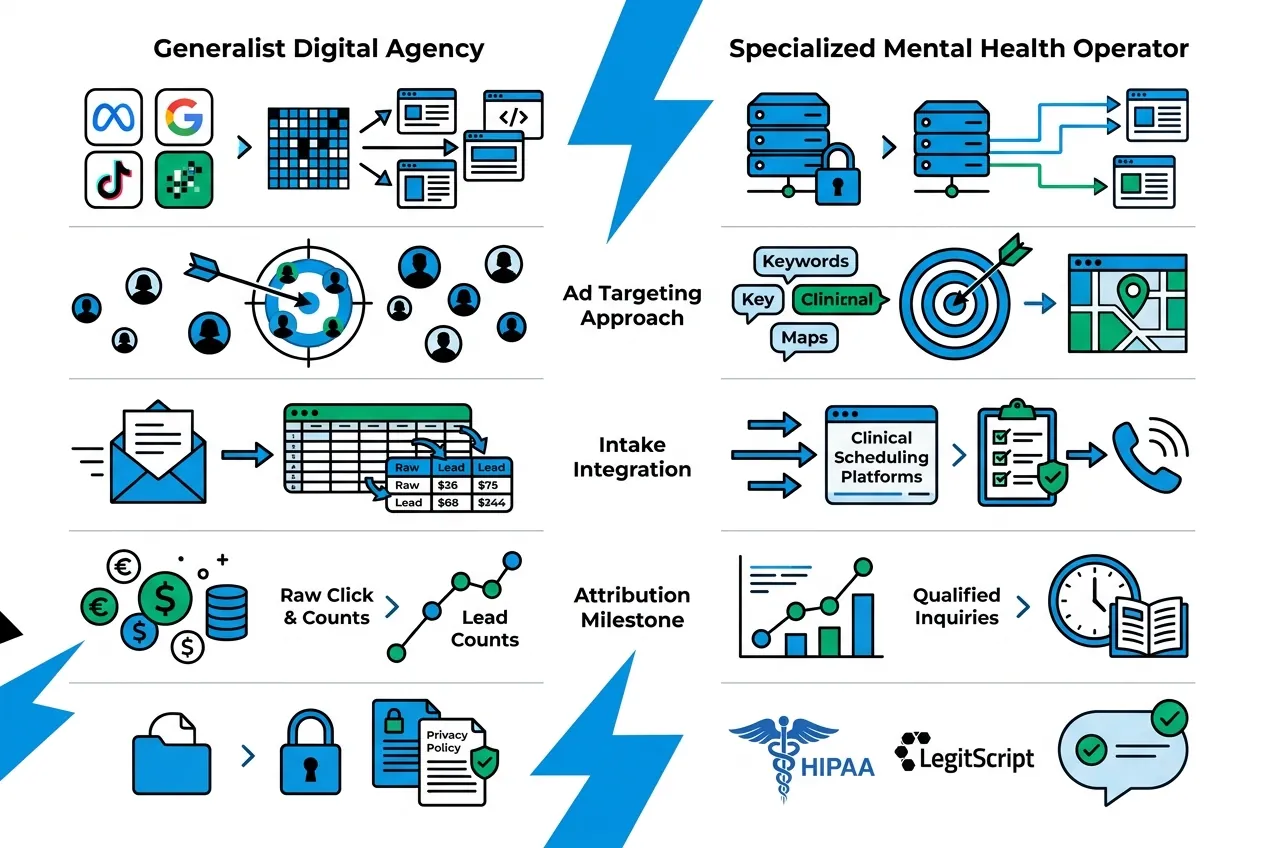
The following evaluation matrix outlines the structural differences between generalist digital marketing firms and specialized healthcare acquisition partners:
- Tracking and Pixels. Generalist Digital Agency: Installs standard Meta, Google, and TikTok client-side tags on all pages. Specialized Mental Health Operator: Configures server-side data routing and strict data hygiene aligned with HHS tracking guidelines.
- Ad Targeting Approach; Generalist Digital Agency: Attempts behavioral retargeting and broad audience lookalikes.; Specialized Mental Health Operator: Focuses on high-intent search keywords and local visibility; complies with Google sensitive category rules.
- Intake Integration. Generalist Digital Agency: Relies on email notifications or spreadsheets containing raw lead data. Specialized Mental Health Operator: Integrates directly with secure intake workflows, call tracking, and clinical scheduling platforms.
- Attribution Milestone. Generalist Digital Agency: Measures cost per click (CPC) and cost per raw lead (CPL). Specialized Mental Health Operator: Measures cost per qualified inquiry and cost per attended intake consultation.
- Regulatory Knowledge; Generalist Digital Agency: Assumes standard consumer privacy terms apply to healthcare sites.; Specialized Mental Health Operator: LegitScript-aware and HIPAA-aware; experienced with sensitive ad category restrictions.
- Clinical Understanding. Generalist Digital Agency: Treats all therapy inquiries as interchangeable consumer leads. Specialized Mental Health Operator: Aligns campaigns by clinical acuity, provider specialty, payer mix, and physical clinic capacity.
When interviewing agencies, examine their team composition. Do their media buyers understand the difference between intensive outpatient programs (IOP) and weekly outpatient therapy? Can their technical leads articulate how they capture patient intent without violating platform policies? An agency comparison should center on operational rigor rather than generic promises.
Free Audit
Want a straight read on where your budget is leaking?
Six Critical Screening Questions for Practice Leadership
Before signing an agency contract, practice owners and clinical directors should conduct a technical screening. Use these six targeted questions to separate qualified healthcare marketing partners from generalist agencies:
1. How do you structure search campaigns without using remarketing or audience lookalikes?
Because Google Ads explicitly bans retargeting for physical and mental health conditions, the agency must have a sophisticated strategy for capturing high-intent search traffic on the first interaction. Look for deep keyword clustering, localized landing environments, transparent negative keyword strategies, and high-quality educational content that converts on initial discovery.
2. What specific safeguards do you install to prevent third-party tracking scripts from capturing PHI?
Listen for technical specificity. The agency should discuss server-side Google Tag Manager implementations, consent management platforms, scrubbing URL parameters of sensitive search terms, and the elimination of unauthorized client-side pixels on intake forms.
3. How do you integrate with our front-desk phone operations and scheduling systems?
An agency that ignores phone calls misses the primary conversion channel for mental health practices. They should provide a secure call tracking architecture that monitors intake call volume, duration, and qualification rates while protecting caller privacy.
4. What is your framework for managing LegitScript certification and policy appeals?
If your clinic expands into dual diagnosis, addiction psychiatry, or intensive behavioral health programs, advertising eligibility hinges on certification. The agency should explain the exact documentation required and describe their process for handling ad disapprovals related to healthcare policy flags. Marketing Powered's founder is a court-certified expert witness in advertising strategy, bringing legal-grade scrutiny to advertising compliance and platform disputes.
5. How do you adjust marketing spend based on clinician calendar capacity?
Clinics frequently face capacity imbalances: one specialty may have a four-week waitlist while an adolescent clinician has immediate openings. The agency should demonstrate how their campaign management links directly to provider schedules, enabling quick budget reallocations across specific service lines.
6. Where is your AI and analytics infrastructure hosted?
Agencies increasingly use generative artificial intelligence to draft content and analyze marketing data. Ask whether patient inquiry data or operational metrics are sent to public cloud AI tools. A compliant partner uses owned or private environments configured to protect data integrity.
Operational Pitfalls That Drain Clinical Practice Ad Budgets
Clinical practices waste substantial capital on digital campaigns due to avoidable operational errors. Recognizing these failure points enables practice leadership to audit their existing vendor or avoid costly mistakes when launching new initiatives.
One common breakdown occurs in the routing of incoming patient calls. An agency can build a technically sound campaign that drives dozens of high-intent phone inquiries each week. However, if the clinic routes those calls to a multi-tiered automated phone tree or lets them roll to general voicemail, the conversion rate drops near zero. Prospective patients seeking mental health support often hang up if an empathetic human does not answer within three rings. If your agency does not measure answered call rates, call handling times, and intake follow-up velocity, your media investment is undermined by operational friction.
Another frequent failure point involves misaligned landing page architecture. Practices often direct paid search traffic to their homepage. A homepage serves many audiences: existing patients checking portal links, job applicants viewing careers, and clinical peers seeking referral contacts. When a patient searching for specialized anxiety treatment lands on a generic homepage, they must navigate a maze of menus to find relevant care details. Dedicated, service-specific landing environments that present clear clinical scope, credentialed provider bios, accepted insurance plans, and simple intake steps consistently outperform generic websites.
A third operational mistake is failing to adapt campaigns to payer networks. A campaign that generates twenty inquiries from patients with out-of-network benefits is counterproductive if your practice operates strictly as an in-network provider. Marketing campaigns must explicitly filter for insurance alignment within ad copy, landing pages, and pre-screening forms before an intake consultation occurs. For a complete review of our dedicated services for outpatient practices, explore our specialized solutions for mental health organizations.
Questions, Answered.
The best mental health marketing agency specializes in healthcare privacy laws, advertising network policies, and clinical intake operations. Unlike general agencies that optimize for clicks or raw form submissions, a specialized agency optimizes for qualified patient calls, completed intake assessments, and attended appointments while remaining fully compliant with Google Ads sensitive categories policies and federal tracking technology guidelines.
Marketing budgets vary based on local market competition, clinician capacity, and payer models (in-network commercial insurance versus private pay). Outpatient practices typically allocate between 5% and 10% of gross revenue to marketing when maintaining caseloads, and 12% to 18% when aggressively scaling clinician headcount or launching new physical locations. Budgets must be evaluated against the lifetime value of an ongoing patient and the cost per attended intake session.
No. Google Ads explicitly prohibits remarketing and personalized targeting based on physical or mental health status under its Personalized Advertising policies. Furthermore, placing standard social media tracking pixels on therapy landing pages introduces severe privacy liabilities under HHS OCR online tracking guidance. A specialized agency drives patient volume through high-intent search, technical search engine optimization, and compliant local discovery rather than behavioral retargeting.
Paid search campaigns on platforms like Google can generate qualified intake calls within the first two to three weeks of launch, provided tracking infrastructure, landing pages, and intake workflows are properly aligned. Organic search engine optimization, content authority, and local map pack optimization typically require three to six months to establish consistent, scalable patient demand.
Clinical directors should focus on four core operational metrics: cost per qualified intake call, intake-to-assessment show rate, cost per attended first appointment (true patient acquisition cost), and provider schedule utilization percentage. Metrics such as impressions, click-through rates, and raw web visits should be monitored by the media team as secondary diagnostic indicators rather than primary business outcomes. Request an acquisition audit
Ready to see where your marketing can improve?
Request a free audit of your paid media, landing pages, attribution, and measurement setup. You'll get a straight assessment of where the opportunities are.
or email us at info@marketingpowered.ai