Resources
AI Search and Patient Acquisition for Healthcare
AI search optimization healthcare requires clinical organizations to structure digital assets, schema markup, and verifiable entity profiles so answer engines can parse and cite them accurately. Modern generative interfaces synthesize direct recommendations rather than presenting simple lists of web links, fundamentally altering how prospective patients select providers. Healthcare systems and specialized behavioral health networks must align their digital footprints with programmatic retrieval standards while connecting discovery directly to qualified admissions.
By Mike Hulick, Founder, Marketing Powered

How Generative Engines Ingest Healthcare Data and Clinical Entities
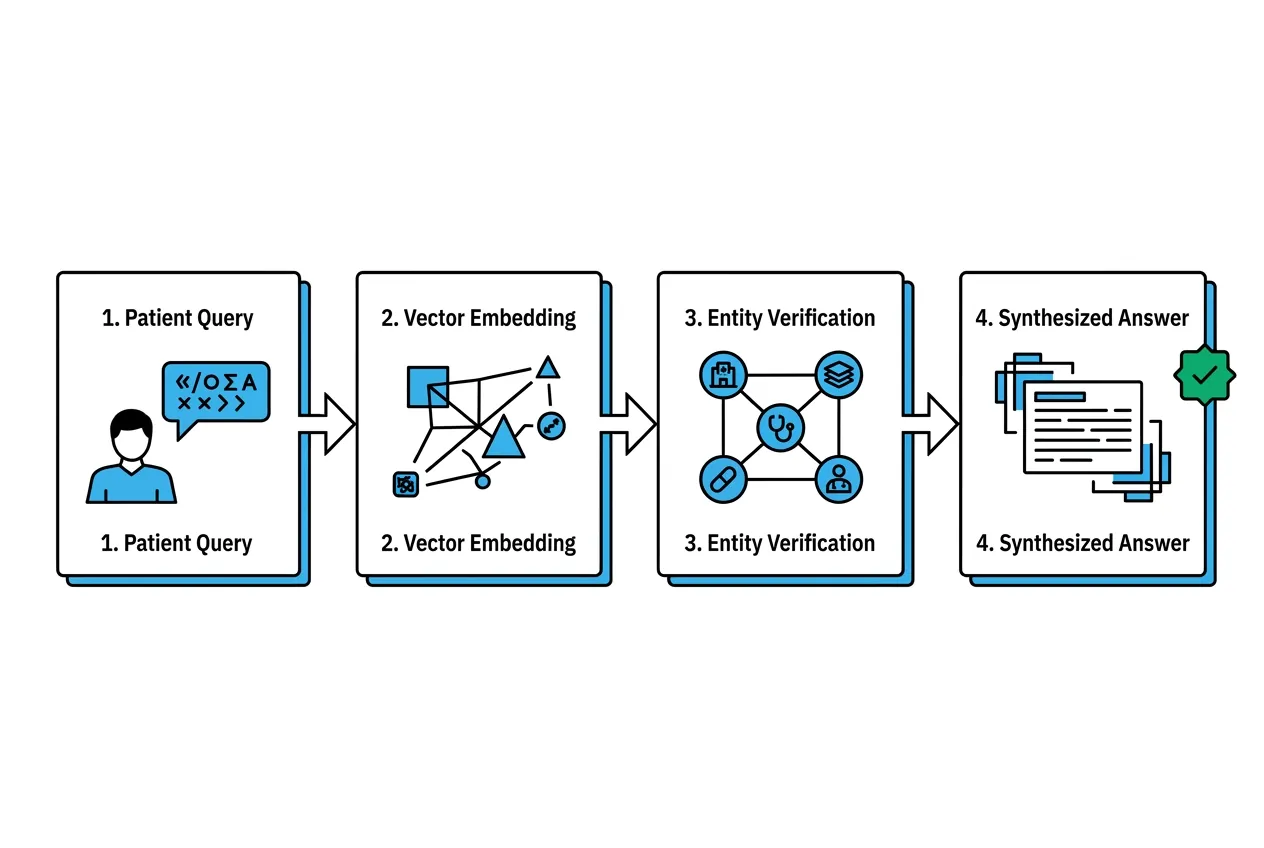
Conversational interfaces, search engine overview snapshots, and large language models do not crawl the internet like traditional search engine indexers. In standard organic search, a spider scans a document for keyword frequencies, metadata tags, and incoming backlink signals to determine where that URL sits on a results page. Generative platforms function through retrieval-augmented generation and vector embeddings. When a prospective patient or family member enters a complex query about specialized care, the engine converts that natural language question into mathematical vectors. It searches high-dimensional vector spaces to locate relevant, semantically dense nodes of information before passing those retrieved chunks to a transformer model for real-time synthesis.
Inside this retrieval process, the model references internal knowledge bases, verified web sources, and interconnected entity repositories. An entity is not a keyword. It is a distinct, well-defined concept, person, clinic, or medical treatment registered across trusted databases. For example, a specialized psychiatric treatment facility is an entity tied to specific National Provider Identifier records, state medical licenses, geographic locations, and clinical modalities. Language models cross-reference unstructured site copy with external structured data to verify whether a facility actually provides the specialized care it claims. When an answer engine constructs a response to an inquiry such as residential depression programs with dual diagnosis capabilities, it relies on corroborated entity identity rather than on-page keyword repetition.
This structural shift transforms organic patient acquisition from surface-level search engine optimization into deep answer engine optimization healthcare strategy. The operational challenge is making sure your medical business architecture mirrors how retrieval models read, evaluate, and extract truth. If your service pages present ambiguous clinical copy, lack medical review verification, or fail to define relationships between treating physicians and specialized programs, retrieval models bypass your facility in favor of sources that offer clear, structured facts.
Critical Discovery Nuances in Mental Health and Behavioral Services
The patient discovery pathway in behavioral health and addiction medicine operates under extreme psychological pressure and strict operational urgency. Unlike elective medical procedures or outpatient dental care, behavioral healthcare queries frequently occur during acute family distress. A family member searching for adolescent crisis stabilization or medical detoxification needs definitive answers about facility safety, level of care, clinical staffing, and operational intake procedures. When an AI answer engine synthesizes an overview of treatment options, ambiguous information directly prevents a conversion.
Generative platforms evaluate clinical authority through distinct validation layers. If a search engine overview presents treatment options for substance use disorders, its extraction filters prioritize sources with clear regulatory compliance and verified clinical governance. Search engines maintain strict standards for addiction treatment providers to protect vulnerable users from deceptive practices. In the United States, advertising addiction treatment programs requires explicit credentialing through the Google Healthcare advertising certification, which mandates verification through LegitScript certification.
Answer engines apply similar factual scrutiny organically. While organic discovery does not run through paid ad review workflows, the retrieval models that supply generative answers draw heavily from authoritative entity networks and verified commercial registries. When your facility operates residential addiction services or partial hospitalization programs, your technical profile must present consistent accreditation from organizations such as The Joint Commission or CARF across all indexed assets. If your clinical credentials, facility licensing, and medical director affiliations show discrepancies across the web, language models lose factual confidence. Under high uncertainty, retrieval models default to quoting academic medical institutions or established hospital directories rather than independent treatment centers.
Operational leaders must also understand that generative search interfaces eliminate standard browsing paths. In traditional search, a user visits four or five facility websites, views photo galleries, and reads staff bios before calling an admissions line. In an AI-synthesized search environment, the model reads those four or five sites on behalf of the user, summarizes their clinical differences, highlights their reported staff-to-patient ratios, and presents direct conclusions. If your clinical site lacks concrete, factual descriptions of your therapeutic modalities and level of care criteria, the generative interface cannot synthesize your strengths. The outcome is complete omission from the patient's consideration set.
Regulatory Boundaries: Sensitive Categories, Tracking, and Retargeting Limits
Deploying an advanced digital patient acquisition strategy requires strict adherence to privacy regulations and ad platform policies. Healthcare marketing executives cannot rely on the standard consumer marketing playbook of aggressive tracking pixels, audience remarketing lists, and lookalike modeling. Advertising platforms actively restrict these tools when applied to health conditions, while federal regulators penalize unauthorized health data sharing.
Under the Google Personalized advertising policies, advertisers are prohibited from serving remarketing ads based on sensitive personal categories. This restriction explicitly covers:
- Physical or mental health conditions, including chronic diseases and acute medical procedures
- Substance use disorders, rehabilitation programs, and addiction support services
- Mental health treatments, psychotherapy, and psychiatric facilities
- Traumatic health conditions and personal health distress
Because remarketing to prior visitors of a behavioral health or hospital service page is prohibited, healthcare organizations cannot rely on second-chance advertising to recover unconverted web traffic. Every visit generated through LLM discovery and AI search must capture intent on the primary interaction. If an answer engine surfaces your facility and a prospective patient clicks your link, your digital intake pathway must deliver immediate, frictionless contact with your clinical admissions team.
Simultaneously, marketing teams must navigate federal data privacy standards regarding website tracking technologies. The Office for Civil Rights at the U.S. Department of Health and Human Services issued comprehensive guidance on the use of tracking technologies under the HHS HIPAA Privacy Rule online tracking guidance. This guidance clarifies that covered entities and business associates cannot deploy third-party trackers, pixels, or analytics tools on patient-facing web properties if those scripts transmit protected health information, such as IP addresses coupled with medical search behavior, to third-party ad networks without individual authorization or a valid Business Associate Agreement.
These regulatory boundaries reinforce why AI search optimization healthcare strategy must prioritize owned digital assets. Third-party ad trackers carry legal risk and restricted functionality. In contrast, structuring authoritative, privacy-safe web architecture ensures that answer engines accurately cite your treatment services without exposing your organization to regulatory penalties. For hospital systems managing hundreds of clinical specialties, detailed implementation frameworks can be explored within our hospital marketing guide.
Free Audit
Want a straight read on where your budget is leaking?
Structuring Schema, Entities, and Clinical Authority for LLM Discovery
To earn consistent placement within generative search overviews and conversational discovery engines, healthcare providers must structure their data so machines can parse clinical reality without ambiguity. Search engine crawlers and language models do not guess your qualifications; they look for explicit semantic code. The baseline standard for this technical layer is Schema.org structured data implemented through JSON-LD.
A technical team must build nested, interconnected schema types that link the parent organization to physical locations, specific clinical service lines, and individual medical providers. Generic schemas like LocalBusiness or Organization are insufficient for medical discovery. Healthcare organizations should utilize specific medical schema definitions, including MedicalBusiness, MedicalCondition, MedicalTherapy, and Physician.
To configure your web properties for accurate retrieval extraction, your technical and content teams should follow a strict technical implementation plan:
- Build Multi-Layered JSON-LD Schema Graphs: Embed nested JSON-LD scripts on every clinical page. Ensure that each MedicalTherapy schema links directly to its corresponding MedicalCondition schema using the possibleTreatment property. For example, if your facility offers Dialectical Behavior Therapy, link that entity explicitly to Borderline Personality Disorder and Major Depressive Disorder.
- Anchor Physician and Staff Profiles with Authoritative URIs: Avoid publishing physician bios that exist only as isolated text. Include the sameAs schema property pointing directly to verifiable third-party databases, such as the practitioner's official state medical licensing registry profile, their NPI registry entry, and academic profiles on PubMed or Doximity.
- Formalize Level-of-Care Taxonomies: When detailing clinical programs, use standardized medical ontologies rather than colloquial marketing terms. If operating an addiction treatment facility, explicitly define your programs in alignment with the American Society of Addiction Medicine levels of care (such as ASAM Level 3.5 for Clinically Managed High-Intensity Residential Services). This allows the language model to categorize your facility correctly when answering specific clinical inquiries.
- Implement Explicit Editorial Byline and Review Declarations: Add reviewedBy and author properties to every piece of educational medical copy. Connect those properties to authenticated clinical directors or board-certified physicians within your organization.
- Establish Clean Site Architecture and Canonical Entity Hubs: Construct clear URL paths that group conditions, treatments, and locations systematically. Do not scatter references to a single clinical program across multiple disconnected URLs. Create an authoritative canonical page for each core service line that houses the complete entity definition, verified intake phone number, and clinical staff associations.
When retrieval models parse a website constructed with this level of structural precision, vector embeddings align directly with high-intent patient queries. The model does not need to speculate whether your psychiatric hospital treats adolescent patients; the nested schema graph confirms it definitively.

Connecting AI Engine Visibility to Verified Admissions and Revenue
Securing citations in AI Overviews or generative answer summaries is an intermediate technical outcome. For healthcare executives, marketing visibility is meaningless if it fails to produce qualified patient intake, completed clinical assessments, and verified admissions. The primary commercial risk of modern search optimization is optimizing for zero-click visibility that satisfies casual searchers but delivers no operational volume to your intake team.
To convert generative visibility into patient admissions, healthcare organizations must overhaul their intake pathways. When an answer engine cites a treatment facility, the user who clicks through arrives with high informational awareness. They have already read a machine-generated summary of your services, treatment philosophy, and location. They do not want to navigate generic homepages or browse promotional slogans. They need direct access to admissions verification, bed availability, commercial insurance verification, and confidential phone consultations.
Attribution models must adapt to this discovery environment. Traditional digital marketing relies on multi-touch attribution powered by web cookies and ad platform tracking scripts. Because federal privacy enforcement and platform policies restrict these tracking methods in sensitive healthcare verticals, marketing leaders must transition to offline conversion reconciliation and privacy-safe attribution.
Closed-loop attribution connects initial organic and paid referral channels to electronic health records or CRM intake records without exposing protected health information to external ad servers. By capturing privacy-safe campaign identifiers, referral domain data, and dedicated dynamic routing numbers at the point of intake, marketing teams track the pipeline from the initial search interaction to a completed clinical admission.
In commercial execution, this distinction separates operational marketing from superficial vanity reporting. A marketing dashboard showing rising impressions in conversational engines means nothing if average daily census remains stagnant. Success in AI search optimization healthcare must be audited through qualified intake calls, clinically eligible inquiries, verified insurance benefits checks, and confirmed admissions.
Data Sovereignty and Owned Infrastructure in Healthcare Marketing
As healthcare systems evaluate artificial intelligence tools to optimize marketing workflows, analyze search data, and summarize clinical content, data sovereignty becomes a critical operational requirement. Commercial generative platforms and public cloud APIs frequently operate under terms of service that allow the provider to log prompts, retain interaction histories, or utilize customer inputs to train future models. Feeding proprietary intake patterns, patient interaction notes, or competitive growth strategies into public consumer models introduces legal, operational, and intellectual property vulnerabilities.
Healthcare organizations require owned AI infrastructure and private inference workflows. Data sovereignty means your organization maintains total legal, physical, and technical control over the computational systems that process your marketing intelligence. Instead of sending sensitive operational inquiries through public cloud endpoints, forward-thinking healthcare systems deploy open-weight, locally hosted language models running on dedicated computing infrastructure.
Implementing private marketing models on owned computing hardware provides significant enterprise advantages:
- Total Data Privacy and Compliance Control: Processing marketing analyses, patient sentiment trends, and content optimization tasks locally ensures that no operational data escapes your secure environment. This eliminates the risk of inadvertent data transmission to third-party model providers.
- Audited AI Governance and Process Ownership: An AI governance review allows your clinical leadership and legal counsel to inspect the exact prompts, system instructions, and training weights used to generate clinical marketing content. You maintain an immutable audit trail of how content was drafted, reviewed, and published.
- Immunity from External API Policy Shifts: Commercial software-as-a-service providers routinely alter their content policies, pricing structures, and usage restrictions. Operating on-premise inference provides operational continuity, protecting your marketing automation systems from sudden platform deprecations.
- Customized Clinical Fine-Tuning: Owned infrastructure allows organizations to fine-tune private models on their specific clinical philosophies, local facility capabilities, and proprietary intake workflows. The resulting content matches your brand's clinical authority without generic phrasing.
By decoupling healthcare growth operations from public cloud dependencies, organizations establish defensible, compliant marketing engines. You can review how technical governance frameworks intersect with growth strategy within our analysis of AI governance for healthcare marketing.

Email Us
Prefer to send the context directly?
Practical Mistakes and What AI Search Data Cannot Prove
As healthcare marketing teams pivot toward generative discovery, several operational errors repeatedly degrade campaign performance. Understanding these structural mistakes prevents organizations from wasting capital on ineffective optimization tactics:
- Mistake 1: Treating Answer Engine Optimization as a Content Mill: Flooding your domain with hundreds of machine-generated, generic articles answering basic medical questions degrades your search standing. Generative models prioritize information gain. If your articles simply rephrase existing medical encyclopedia entries without introducing original clinical perspectives, practitioner credentials, or validated facility details, retrieval systems ignore them entirely.
- Mistake 2: Assuming Mentions in AI Overviews Equate to Immediate Admissions: Seeing your clinic cited in a search engine answer box is an informational win, but it does not represent an intake conversion. Generative answers frequently answer informational queries so thoroughly that the searcher never clicks through to any cited facility. Measuring discovery success by citation frequency alone produces inaccurate budget projections.
- Mistake 3: Deploying Prohibited Ad Tactics in Regulated Verticals: Attempting to force retargeting campaigns around sensitive medical categories using secondary ad networks or unverified tracking scripts exposes organizations to immediate policy bans under Google Ads Healthcare and medicines policy and severe enforcement under state consumer privacy regulations.
- Mistake 4: Failing to Align Marketing Claims with Clinical Intake Reality: When generative engines summarize your service offerings, they present explicit factual assertions about what your facility treats. If your website claims expertise in acute co-occurring disorders, but your clinical intake team turns those patients away due to licensing constraints, you create operational waste. On-page clinical definitions must mirror intake admission criteria.
- Mistake 5: Neglecting Local Google Business Profile and Map Integrations: AI search engines frequently ground healthcare recommendations in geographic proximity and verified local map listings. If your physical facility addresses, operating hours, and local telephone routing are inconsistent across map directories and state health databases, generative models cannot confirm your facility's physical existence.
Evaluating search data requires scientific discipline. Analytics tools can show estimated search volume, but current industry platforms cannot track the precise number of times your brand was synthesized inside a conversational prompt session. Relying on speculative generative metrics leads to flawed resource allocation. Marketing leadership must maintain absolute focus on verifiable business outcomes: qualified admissions calls, completed intake assessments, and verified patient admissions.
Questions, Answered.
AI search shifts discovery from scrolling through lists of website links to receiving synthesized direct answers. Instead of comparing four or five separate facility websites, prospective patients and their families read concise overviews generated by the search engine. These overviews compare clinical specialties, therapeutic modalities, accreditations, and geographic locations. To be included in these synthesized answers, treatment providers must structure their online data so retrieval models can easily verify their clinical authority, physical facilities, and treatment programs.
AI search visibility must be measured through privacy-safe offline attribution rather than vanity impression metrics. Healthcare organizations should monitor how generative citations drive traffic to dedicated, canonical clinical service hubs. From there, intake should be tracked using HIPAA-aware call routing and secure CRM intake reconciliation. The primary metrics of success are qualified intake inquiries, clinical assessments scheduled, and confirmed patient admissions, rather than the frequency of AI Overview mentions.
No. Under the Google Personalized advertising policies, advertising platforms strictly prohibit remarketing and audience targeting based on personal health conditions, mental health struggles, and substance use disorders. Because healthcare providers cannot retarget visitors who bounce, landing environments connected to AI search citations must be optimized to convert prospective patients or their families on their initial visit through clear, immediate clinical intake pathways.
Standard SEO focuses primarily on keyword density, backlink quantities, and meta tags designed to rank specific URLs within organic search listings. Answer engine optimization in healthcare focuses on entity validation, structured data relationships (using MedicalBusiness and Physician schemas), clinical fact corroboration across state registries, and authoritative content formatting that retrieval-augmented generation systems can extract and synthesize. AEO prioritizes factual credibility and machine readability over keyword volume.
Data sovereignty ensures that all internal operational metrics, patient inquiry patterns, and proprietary marketing workflows remain under your organization's complete technical and legal control. Relying on public cloud AI platforms risks exposing confidential intake data or intellectual property to third-party vendor training databases. By utilizing owned computing infrastructure and private, locally deployed models, healthcare providers ensure total compliance with federal privacy standards while eliminating external platform dependencies. Request an acquisition audit
Ready to see where your marketing can improve?
Request a free audit of your paid media, landing pages, attribution, and measurement setup. You'll get a straight assessment of where the opportunities are.
or email us at info@marketingpowered.ai