Resources
Healthcare CRM Integration for Marketing Attribution
Healthcare CRM integration connects digital marketing campaigns, call tracking systems, and clinical intake software into a closed-loop attribution architecture. Rather than optimizing paid media for raw phone calls or web inquiries, this integration ties specific ad interactions directly to verified operational milestones such as benefits verification, clinical qualification, and facility admission. When implemented with privacy-safe offline conversion tracking, healthcare providers can train automated bidding systems on qualified admissions while maintaining strict regulatory compliance.
By Mike Hulick, Founder, Marketing Powered

Why Disconnected Intake Records Skew Healthcare Acquisition Spend
Digital marketing campaigns for hospitals, addiction treatment centers, and behavioral health facilities fail most frequently at the handoff between marketing platforms and operational records. When an ad agency runs campaigns inside Google Ads or Meta Ads, platform algorithms judge performance entirely on shallow website triggers: a button tap, a form submission, or a telephone call lasting longer than sixty seconds. The ad platform counts every one of these events as an unqualified success, automatically allocating budget toward the search queries and audiences that produce them at the lowest front-end cost.
Admissions coordinators, medical directors, and financial intake teams live in a completely different operational reality. In residential mental health and substance abuse treatment, upwards of 70 percent of inbound inquiries fail basic intake criteria due to out-of-network commercial insurance, Medicaid status at an exclusively private facility, clinical acuity requiring acute medical stabilization, or lack of physical bed capacity. When intake records remain isolated from ad platforms, media algorithms aggressively bid on unqualified volume. Marketing reports record a decreasing cost per lead, while intake teams experience burnout fielding calls they cannot admit, and executive leadership sees customer acquisition costs rise.
Closing this gap requires treating the intake CRM as the ultimate source of truth for all marketing optimization. When campaign identifiers pass seamlessly into intake records, marketing teams can stop reporting on vanity metrics like form fills and raw call volume. Instead, media budgets align directly with facility census requirements and qualified admissions.

Navigating Regulatory Boundaries Across HHS and Ad Platforms
Building a healthcare CRM integration requires strict adherence to privacy rules governing protected health information (PHI) and digital tracking technologies. The U.S. Department of Health and Human Services (HHS) Office for Civil Rights outlines clear restrictions in its guidance on online tracking technologies. HHS warns covered entities that unauthenticated public website interactions linking a user's IP address, device identifier, or browsing behavior to specific medical conditions or healthcare intent can constitute an impermissible disclosure of PHI if transmitted to third-party ad platforms without patient authorization or a valid Business Associate Agreement (BAA).
Simultaneously, advertising networks enforce stringent platform policies for medical and behavioral health categories. The Google Ads Personalized Advertising policy explicitly prohibits retargeting, remarketing lists, and interest-based profiling based on physical or mental health conditions, clinical treatments, or sensitive personal struggles. Furthermore, Google's Healthcare and Medicines policy and mandatory LegitScript certification for addiction treatment providers require that all tracking data respect user privacy and sensitive category boundaries.
These dual regulatory constraints mean healthcare organizations cannot simply place standard browser-side pixels across their patient scheduling pages, intake portals, or electronic health records (EHR). Client-side tracking scripts that transmit URLs containing diagnostic strings or patient form values directly violate federal guidelines. Defensible attribution demands a server-side architecture. In this design, tracking identifiers remain completely separated from clinical evaluations, and data handoffs occur through secure offline APIs rather than direct client-side tracking tags. Providers looking to build this framework can learn more about privacy-first measurement through analytics and attribution services.
Telephony and Dynamic Number Insertion to CRM Mapping
Because phone calls represent the vast majority of qualified healthcare inquiries, dynamic call tracking is the critical technical link between front-end ad spend and back-end intake operations. A modern call tracking CRM workflow relies on Dynamic Number Insertion (DNI). When a visitor arrives on a healthcare provider's website, dynamic JavaScript swaps the static phone number with a unique tracking number assigned from a designated pool.
During that browser session, the telephony platform records the ad click parameters, including the Google Click Identifier (GCLID), campaign name, ad group, and search keyword. When the visitor dials the number, the telephony system matches the call to the active web session. At the exact moment the call rings into the contact center, an automated webhook creates or updates a record inside the healthcare CRM.
This programmatic handoff ensures that the admissions coordinator never has to ask administrative questions like, "What search term did you type to find us today?" The session parameters populate dedicated attribution fields within the CRM record automatically. By capturing these technical parameters at the first touchpoint, the organization establishes a verified link between the ad impression and the caller before any clinical intake data is entered.
Free Audit
Want a straight read on where your budget is leaking?
Standardizing an Admissions Milestone Disposition Taxonomy
A healthcare CRM integration fails if intake coordinators use non-standardized statuses or write critical admission stages in unstructured text notes. Bidding algorithms require structured, binary milestone data to determine whether an ad click generated a valuable operational result. Healthcare facilities must establish a clear disposition taxonomy that mirrors the clinical and financial verification funnel.
A robust admissions disposition hierarchy contains distinct stages:
- Inbound Inquiry: The raw telephone call, chat session, or contact form captured by the system.
- Non-Admissions Contact: Calls from vendors, existing patients, job applicants, or billing questions, which must be flagged to prevent ad algorithms from optimizing for administrative overhead.
- Pre-Qualified Intake: The caller meets basic clinical criteria and geographic proximity, indicating legitimate care-seeking intent.
- Verification of Benefits (VOB) Submitted: The prospective patient provides insurance details or payment options for financial clearance.
- VOB Approved / Clinically Accepted: The facility verifies insurance coverage, and the clinical team clears the patient for admission.
- Admitted to Facility: The patient arrives on-site, completes physical intake, and occupies a bed.
Media algorithms should not optimize for Stage 1. Instead, advanced healthcare marketing automation workflows train platform smart bidding strategies on Stages 3, 5, and 6. Optimizing for pre-qualified inquiries and verified benefits teaches ad networks to suppress low-intent, out-of-network search queries while aggressively bidding up high-intent searches that convert into admitted patients.
Passing Offline Conversions Upstream Without Exposing PHI
The core technical challenge in healthcare marketing attribution is sending milestone signals back to Google Ads, Meta Ads, or analytics engines without disclosing clinical diagnoses or protected identifiers. Exporting patient names, phone numbers, or insurance details into an ad network violates federal privacy standards.
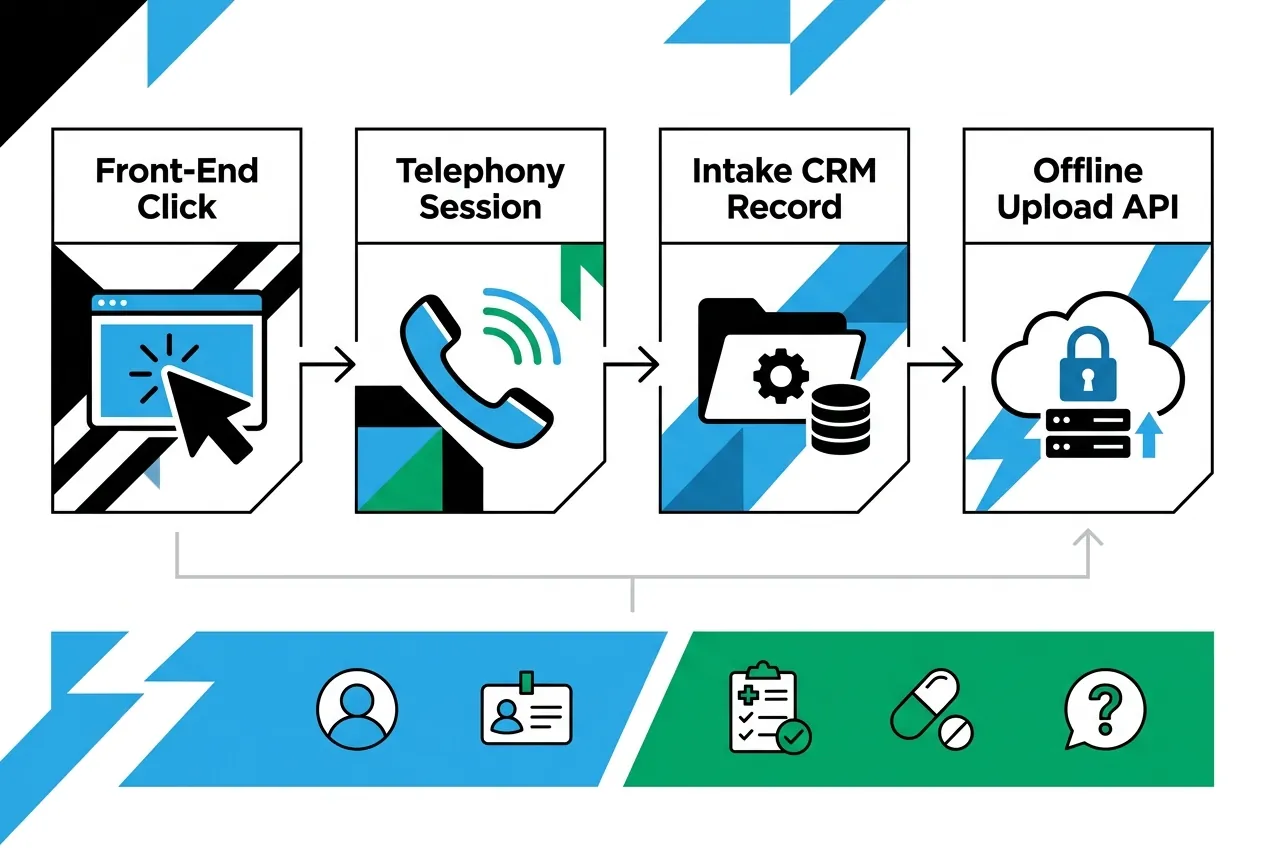
The compliant solution is an offline conversion tracking architecture utilizing pseudo-anonymized identifiers.
- Front-End Click. Permitted Tracking Identifiers: GCLID, WBRAID, GBRAID, UTM parameters. Prohibited Healthcare Attributes: Patient Name, IP tied to treatment query.
- Telephony Session. Permitted Tracking Identifiers: Call duration, Call UUID, Timestamp. Prohibited Healthcare Attributes: Call audio recording containing medical history.
- Intake CRM Record. Permitted Tracking Identifiers: Lead ID, Milestone Status (VOB, Admitted). Prohibited Healthcare Attributes: Medical diagnosis, Medication list, Clinician notes.
- Offline Upload API. Permitted Tracking Identifiers: Hashed Lead ID, GCLID, Conversion Value. Prohibited Healthcare Attributes: Patient Name, SSN, Insurance Policy Number, PHI.
When an admission occurs, the CRM triggers an automated script that extracts only two pieces of information: the original ad click identifier (such as the GCLID) and the timestamp of the milestone event. It assigns a conversion action name (such as "Patient Admission") and, if appropriate, a static conversion value. No clinical notes, medical codes, or patient names are ever included in the payload.
This payload transmits directly to the advertising platform via a server-to-server offline conversion API. Because the ad network receives only its own internal click identifier and a generic event label, it connects the conversion to the initiating ad auction without receiving protected medical data. In operations managing $1.5 to $2M per month in Google Ads across 11+ behavioral and mental health accounts, this closed-loop offline feedback mechanism prevents algorithm drift and keeps acquisition teams focused entirely on verified patient admissions.
Implementation Architecture Across Operations, IT, and Marketing
Deploying an integrated CRM attribution framework requires coordination across executive leadership, clinical operations, IT engineering, and media management. Assigning explicit ownership across teams prevents technical lapses and data leakage.
Marketing Operations
The marketing team defines the parameter structure, builds campaign naming conventions, provisions tracking numbers, and creates offline conversion actions inside ad accounts. Marketing ensures that dynamic tracking scripts load asynchronously without slowing down landing page performance.
IT and Data Engineering
IT manages the API connections between the telephony provider, intake CRM, and external endpoints. They ensure all data transfers occur over encrypted protocols, verify that Business Associate Agreements are executed with eligible software vendors, and audit database user permissions so that non-clinical marketing staff cannot view sensitive medical evaluations.
Admissions and Contact Center Leadership
Intake leadership trains coordinators to maintain structured data entry. If an admissions coordinator fails to update a status from "Inquiry" to "Admitted," the loop breaks, and ad algorithms starve for positive conversion signals. Regular disposition audits ensure that every answered call receives an accurate status within twenty-four hours of contact.
Email Us
Prefer to send the context directly?
Common Healthcare Integration Pitfalls and Data Limitations
Healthcare CRM integrations provide powerful optimization data, but operators must understand their inherent limitations. Attribution data reveals correlation and operational progression, but it cannot explain every variable in a complex clinical decision.
First, phone attribution windows in healthcare are often lengthy. While an e-commerce transaction occurs minutes after an ad click, a behavioral health or elective surgery admission can take two to six weeks from initial inquiry. If your offline conversion window inside Google Ads is configured for a standard thirty-day window, admissions occurring after day thirty-one will fail to attribute back to the originating campaign. Setting appropriate attribution lookback windows is essential for accurate modeling.
Second, multi-touch journeys frequently bypass clean tracking parameters. A family member might research a facility on a mobile device via paid search, bookmark the URL, and later call directly from an un-tracked desktop browser. While dynamic telephony captures direct sessions, cross-device journeys without persistent identifiers can leave conversion gaps.
Finally, marketing data cannot diagnose operational failures within the admissions department. If an ad campaign generates high volumes of clinically qualified leads with verified commercial insurance, but admissions volume remains flat, the root issue often lies in call center response times, coordinator empathy, or bed availability rather than ad targeting. Attribution reveals where opportunities enter and exit the funnel; it does not replace operational management.

Healthcare CRM Integration Readiness Checklist
Before connecting media campaigns to an intake CRM, healthcare operators should evaluate their infrastructure against this operational checklist:
- [ ] Privacy Architecture Review: Client-side tracking pixels removed from all patient portals, clinical intake forms, and password-protected portals in accordance with HHS guidance.
- [ ] Dynamic Telephony Provisioning: Sufficient tracking phone numbers provisioned in dynamic pools to handle peak concurrent website visitors without session collisions.
- [ ] URL Parameter Standardization: Consistent UTM parameter structure, auto-tagging enabled for Google Ads (GCLID), and server-side capture configured for paid traffic.
- [ ] Structured CRM Disposition Schema: Mandatory dropdown fields established in the CRM for pre-qualification, benefits verification, clinical acceptance, and admission.
- [ ] Data Hygiene Governance: Workflow automation alerting intake directors to records missing dispositions after twenty-four hours.
- [ ] Secure Offline Handoff: Server-to-server offline conversion pipeline established to transmit conversion identifiers back to ad platforms without attaching medical or identifying patient details.
- [ ] Business Associate Agreements: Executed BAAs in place with all middleware, telephony, and CRM vendors handling operational data.
Questions, Answered.
To maintain closed-loop attribution without violating patient privacy, the intake handoff must capture the ad click identifier (such as Google Click ID or GCLID), campaign identifier, ad group, search keyword, and landing page path alongside the telephony call UUID. These technical session attributes must be stored in isolated, non-clinical fields within the CRM. Personal identifiers such as caller name, phone number, and street address should remain separated from ad platform tracking fields, and clinical notes must never be merged into attribution tables.
Measurement should occur across a tiered conversion funnel rather than a single metric. Healthcare organizations should track cost per pre-qualified inquiry, cost per verified benefit (VOB), and customer acquisition cost (CAC) per admitted patient. If an integration is successful, the volume of unqualified, low-intent inquiries will decline as smart bidding models adjust, while the ratio of pre-qualified calls to admitted patients will increase, lowering overall acquisition costs per admission.
Under current HHS guidelines, placing standard, unconfigured third-party advertising pixels on web pages where users enter personal health information or seek specialized treatment presents significant regulatory liability. Transmitting user IP addresses combined with health-related page visits to third-party ad networks without explicit patient authorization or a valid BAA can constitute an unauthorized disclosure of PHI. Secure integrations rely on server-side tracking and offline conversion APIs rather than client-side browser pixels.
Most ad platform smart bidding algorithms require thirty to fifty conversion events per campaign within a thirty-day window to effectively optimize. For high-volume facilities, algorithmic improvements can appear within two to four weeks after offline conversion feeds are activated. For lower-volume facilities, aggregating conversion goals to include upstream qualified milestones—such as benefits verification alongside completed admissions—ensures that bidding engines receive enough data density to optimize targeting without experiencing performance lag. Request an acquisition audit
Ready to see where your marketing can improve?
Request a free audit of your paid media, landing pages, attribution, and measurement setup. You'll get a straight assessment of where the opportunities are.
or email us at info@marketingpowered.ai