Capabilities
Patient Acquisition Marketing That Connects to Revenue
I'll verify the policy and measurement claims first, then rewrite the page to the required layout.Meta title: Patient Acquisition Marketing That Connects to Revenue

Who needs patient acquisition marketing
Patient acquisition marketing should be judged by cost per admitted patient or kept appointment, read against the capacity to serve that person. Identify who owns the link between inquiries and admissions before adding spend. The same question applies to treatment centers and to hospitals, health systems, and other multi-site providers.
Picture a Monday meeting at a multi-site provider. The CMO has calls, forms, and cost per inquiry by location. The admissions or scheduling lead has census, open beds, or unfilled slots. The CEO wants to know which spend produced a placed patient. The reports do not share a definition of a useful inquiry, so a rise in calls can sit next to a flat census.
An outside partner is worth a look when inquiry volume holds and admissions do not, when spend rises without a change in census or kept appointments, when locations cannot be compared, or when the in-house team cannot see what happened after the call. It is the wrong next step when calls go unanswered, follow-up is slow, or the team cannot place the inquiries already arriving. More media then raises the cost of a handling problem. Compare intake responsiveness with inquiry flow before treating media as the constraint.

What an operator diagnosis reviews
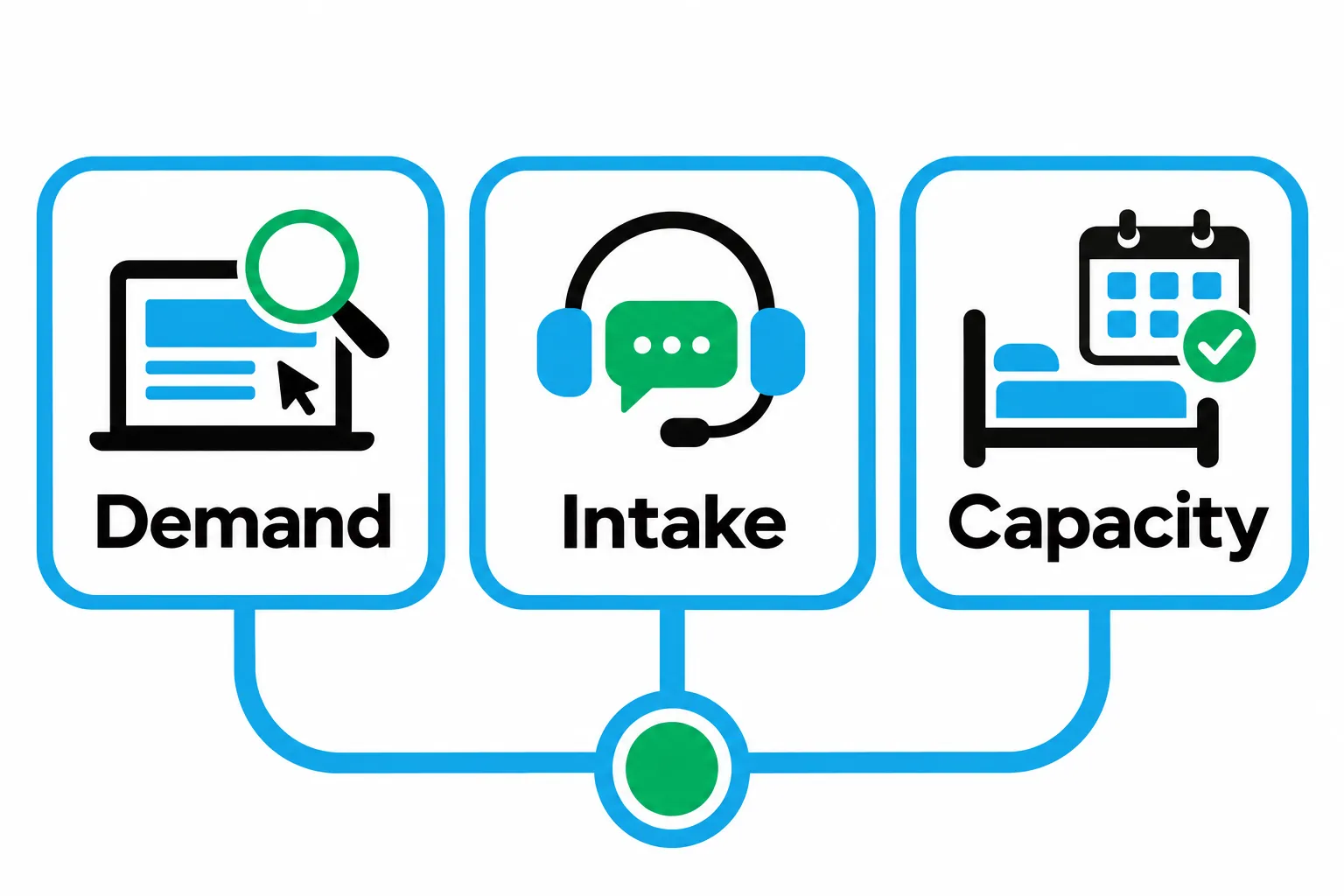
Review demand, intake and capacity together. Review the handoffs between these functions, not just each channel.
Demand
Channel mix, search and paid capture, landing pages, and location structure. The practical test is whether spend reaches people looking for services that location can deliver.
Intake
Who answers, how quickly, and the code recorded when the inquiry ends. Without a disposition on every inquiry, poor targeting and slow handling stay mixed together.
Capacity
Open beds, clinician time, or appointment slots, by location. Demand bought without that check can hit a ceiling, or it can stay thin while slots sit open. Treat those as planning risks to test at each site, not as a slogan.
How to evaluate an acquisition partner
Ask any partner, including Marketing Powered, for five answers before an engagement is defined.
- The written definition of a qualified admission, and who in operations agreed to it.
- How intake dispositions are recorded and reported.
- How open capacity changes budget decisions by location.
- What can and cannot be measured under platform rules and privacy limits.
- Who owns the accounts, tracking, and data if the relationship ends.
If those answers are missing, the report describes activity, not acquisition. Our founder is a former healthcare CMO who ran marketing for a treatment network that grew from 3 to 24 locations and managed $1.5 to $2M per month in Google Ads across 11+ behavioral and mental health accounts. That is the founder's operating history, not an agency client result.
Free Audit
Want a straight read on where your budget is leaking?
How measurement connects spend to outcomes
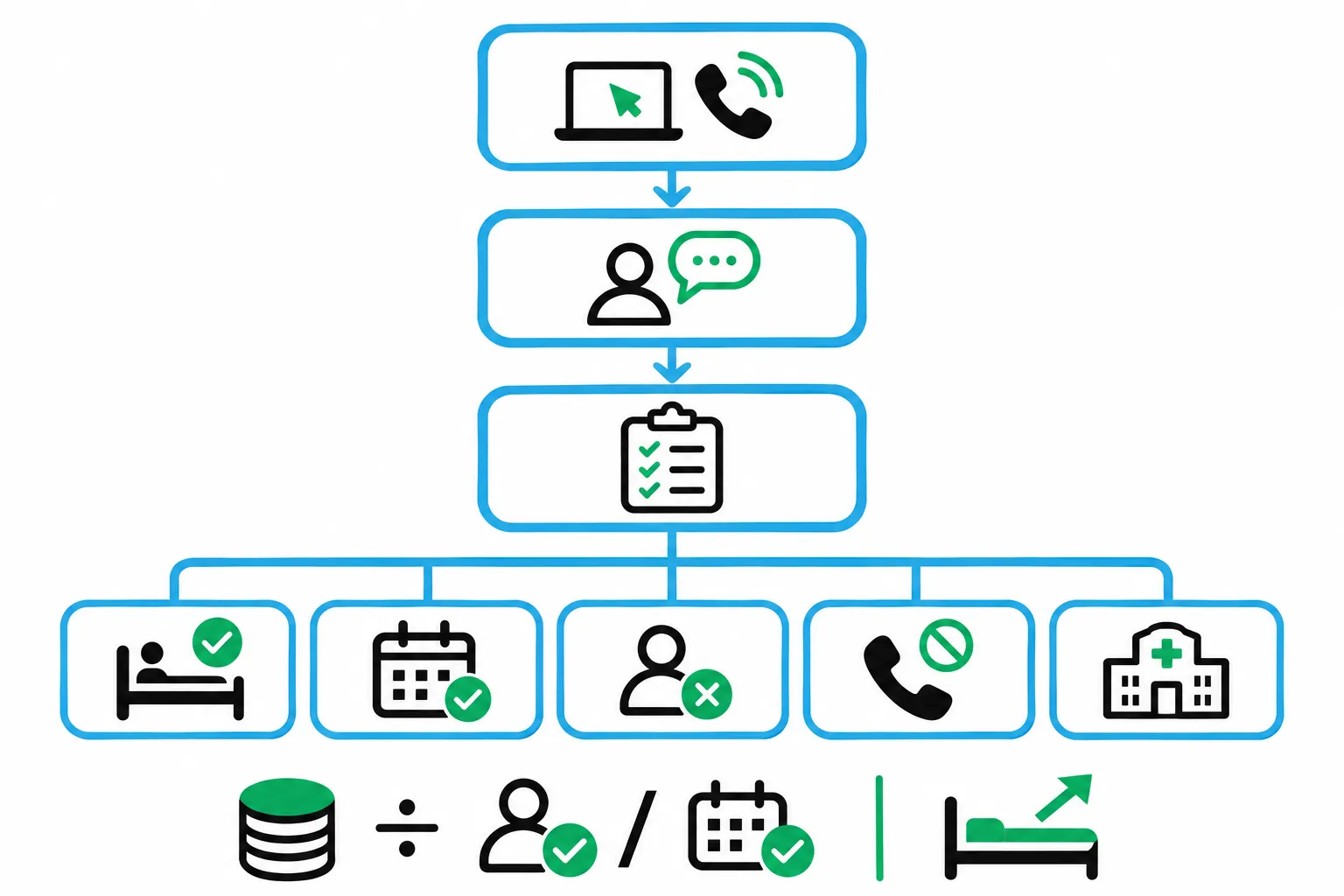
Measure from a qualified inquiry to an admission or a kept appointment. Agree on one written definition of qualified with operations, not with marketing alone. Record a disposition for every inquiry. Count a scheduled appointment as an intermediate stage. Count a kept appointment or an admission as the outcome. Then read spend against that outcome and against capacity at that location in that period.
A scheduled appointment shows that intake offered a time. It is not yet a kept visit, and it is not collected revenue. Collected revenue depends on payer mix, length of stay or visit, and billing data a marketing system may not be authorized to receive. Where authorized data supports it, attribution can connect spend to an admission or a kept appointment. That is the operating link. It is not the same figure as booked revenue.
Our attribution focus is admissions, not just leads, with measurement limits made explicit. Record dispositions to connect attributable spend with observed outcomes and make unmatched spend and missing outcomes explicit. Useful disposition labels, with no volume implied, include admitted, appointment kept, appointment scheduled and not yet kept, not a fit, no contact, chose another provider, and unmatched or missing outcome.
Joining campaign, call-tracking, and CRM events is covered on the analytics and attribution page. Search, paid media, and landing-page conversion are demand-capture work. This page sets the commercial test those channels should answer to.
How capacity should shape the plan
Account for available appointment capacity before the budget is set. Compare open beds, clinician availability, or appointment slots with recent inquiry flow. Compare capacity with inquiry flow before increasing or reallocating spend.
A location that cannot place more patients and a location with open slots are different decisions. In the first, extra inquiries may wait, age out, or be turned away. In the second, the gap may be search coverage, the landing page, or how fast intake responds. For a multi-site group, one definition of qualified is what makes those locations comparable. Marketing does not make clinical determinations. Clinical screening stays with qualified staff.
What the work focuses on
Acquisition work focuses on conversion definitions, intake dispositions, measurement gaps, data governance and spend allocation against available capacity. Engagement scope depends on the organization’s systems and authorized data.
There is no fixed package, timeline, or price on this page. A useful internal starting point is narrow: one written definition of a qualified admission, a disposition on every inquiry, and a comparison of spend with open capacity by location. Do not submit patient records or patient-identifying information with an acquisition audit request.
Email Us
Prefer to send the context directly?
Governance and platform limits
Measurement plans must account for applicable platform restrictions. Two paths have to stay distinct: what the organization’s own intake system may record, and what an ad platform will accept.
Google treats health as a sensitive interest category, including physical or mental health conditions and products, services, or procedures used to treat or manage chronic conditions. For promotions in that category, advertiser-curated audiences cannot be used. That set includes Customer Match, your data segments, audience expansion, and lookalike segments. Predefined Google audiences can still be used. Marketing Powered is built for Google’s sensitive healthcare vertical, where retargeting is not permitted. That positioning follows this rule: standard retargeting lists are advertiser-curated audiences. Health in personalized advertising
Google’s customer data policies state that conversions related to sensitive categories cannot be used for measurement in enhanced conversions or store sales uploads. Health or medical information, such as purchases of medical services, prescription drugs, or medical devices, is one of those categories. The limit is specific to those products. It is not a ban on every other form of healthcare measurement. Customer data policies
- Intake or CRM record. What it can show: Inquiry, disposition, scheduled appointment, kept appointment, or admission. What it should not carry: Patient records or patient-identifying details sent with a marketing request.
- Ad platform reporting. What it can show: Campaign and click data, within that product’s rules. What it should not carry: Health or medical conversion details in enhanced conversions or store sales uploads.
- Follow-up. What it can show: Direct contact by the organization’s intake team, where its own policies allow. What it should not carry: Advertiser-curated retargeting for a sensitive health promotion on Google Ads.
Other ad platforms set their own sensitive-category rules. Those rules change. Read the current policy for the product in use rather than relying on a summary.
Healthcare tracking also has to be reviewed against permitted uses and disclosures of protected health information. HHS states that regulated entities are not permitted to use tracking technologies in a manner that would result in impermissible disclosures of PHI to tracking technology vendors. On June 20, 2024, a federal court vacated the portion of that guidance which said HIPAA obligations are triggered merely because a technology connects an IP address with a visit to an unauthenticated public webpage about specific health conditions or healthcare providers. A public-page visit is not automatically PHI. Information collected when someone schedules care, such as an email address or a reason for seeking care, can still fall under the HIPAA Rules when a regulated entity is involved. HHS online tracking guidance
Applicable privacy obligations depend on the organization, data and proposed disclosures. This page does not provide legal advice or certify compliance. Marketing Powered is LegitScript-aware for applicable treatment advertisers. Certification rules depend on the service and the platform, and they should be confirmed from the current source before launch.
Owned, local AI infrastructure for HIPAA-aware inference supports control and deployment flexibility. It does not change who owns client data, and it does not mean every workload runs on those systems.
Questions, Answered.
It is the planning, paid media, search, conversion, and measurement work that brings prospective patients to intake and tracks them to an admission or a kept appointment. A scheduled appointment is an intermediate stage, not the outcome.
On this page, admissions marketing refers to inquiry handling, follow-up and conversion to admission. Patient acquisition marketing includes that work and adds demand capture, capacity planning, and measurement across locations.
Use one written definition of qualified, record a disposition for every inquiry, and compare spend with admissions or kept appointments and with open capacity. A qualified call is not an admission. Unmatched spend and missing outcomes should stay visible.
Compare open slots or beds with inquiry flow before increasing or reallocating spend. A full schedule and an open schedule call for different plans, even when inquiry volume looks similar.
Yes. Hospitals, health systems, healthcare services, and other regulated or multi-location organizations share the reporting gap between inquiry and a placed patient or kept appointment. Fit is assessed before an engagement is defined.
Attribution is tracked to admission, not just lead, with measurement limits made explicit. What you can see depends on authorized data, intake handling, and capacity. Request an acquisition audit to discuss your acquisition measurement gaps. Do not submit patient records or patient-identifying information with that request. Request an acquisition audit
Ready to see where your marketing can improve?
Request a free audit of your paid media, landing pages, attribution, and measurement setup. You'll get a straight assessment of where the opportunities are.
or email us at info@marketingpowered.ai