Who We Help
Detox Program Marketing That Supports Admissions
A busy admissions line does not tell you whether marketing is working. Before increasing spend, establish whether inquiries match your services, whether intake can respond and whether the program has capacity to accept appropriate admissions.

When to bring in a detox marketing agency
Detox program marketing should connect those operating decisions to acquisition. Start with a shared definition of a qualified inquiry, then build campaigns, contact paths and reporting around it.
Build acquisition planning around paid media, search visibility, conversion systems and authorized measurement. Marketing Powered tracks attribution through admission where authorized data supports it. The starting point is the admissions bottleneck, not another campaign.
Outside support is worth considering when leadership cannot explain the relationship between marketing investment and admissions activity.
Look for these gaps:
- Calls increase without a corresponding explanation of admission outcomes.
- Marketing and admissions disagree about inquiry quality.
- Reporting stops at form submissions or answered calls.
- Location-level availability does not inform spending.
- Budget decisions depend entirely on advertising-platform conversions.
These are useful diagnostic questions for independent detox programs, multi-location operators and hospital-based service lines.
There is also a reason to delay expansion. If intake cannot meet its own response standard, fix coverage and routing before buying additional demand.
Ask a prospective agency to distinguish acquisition problems from operating constraints. Its proposed approach should identify dependencies, explain measurement limits and allow for the possibility that more media is not the next investment.

Where detox acquisition breaks down
Calls arrive without a workable intake path
Review staffing, routing, after-hours procedures and ownership of availability updates. Treat an open bed and a staffed admissions process as separate inputs.
Do not advertise immediate availability unless the program can substantiate that message and keep it current.
Insurance fit remains unresolved
Explain payment pathways accurately without presenting preliminary insurance information as completed benefits verification.
Keep payment fit, clinical appropriateness and capacity separate in reporting. One broad “unqualified” category makes it harder to identify which decision needs attention.
Reporting ends at the inquiry
Record whether contact occurred, what admissions determined and what happened next. Distinguish a scheduled assessment from a completed admission.
For organizations with multiple treatment services, connect detox acquisition to the broader substance use disorder marketing plan, while retaining service-specific qualification and capacity decisions.
How should a detox program prioritize qualified inquiries?
Prioritize timely human follow-up using the person’s stated timeline, requested service, location, preliminary payment pathway and the program’s ability to respond. Agree on these criteria with admissions and clinical leadership. Marketing qualification should organize follow-up, not make clinical decisions or determine access to care.
Document:
- Stated intent: Which service is requested, and when?
- Location fit: Can the program reasonably serve the inquiry?
- Payment pathway: What remains unverified?
- Operational readiness: What is known about intake coverage and capacity?
- Response ownership: Who handles the next step, and by when?
Keep uncertainty visible. “Not yet verified” is different from “not a fit.”.
An illustrative inquiry-to-admission workflow:
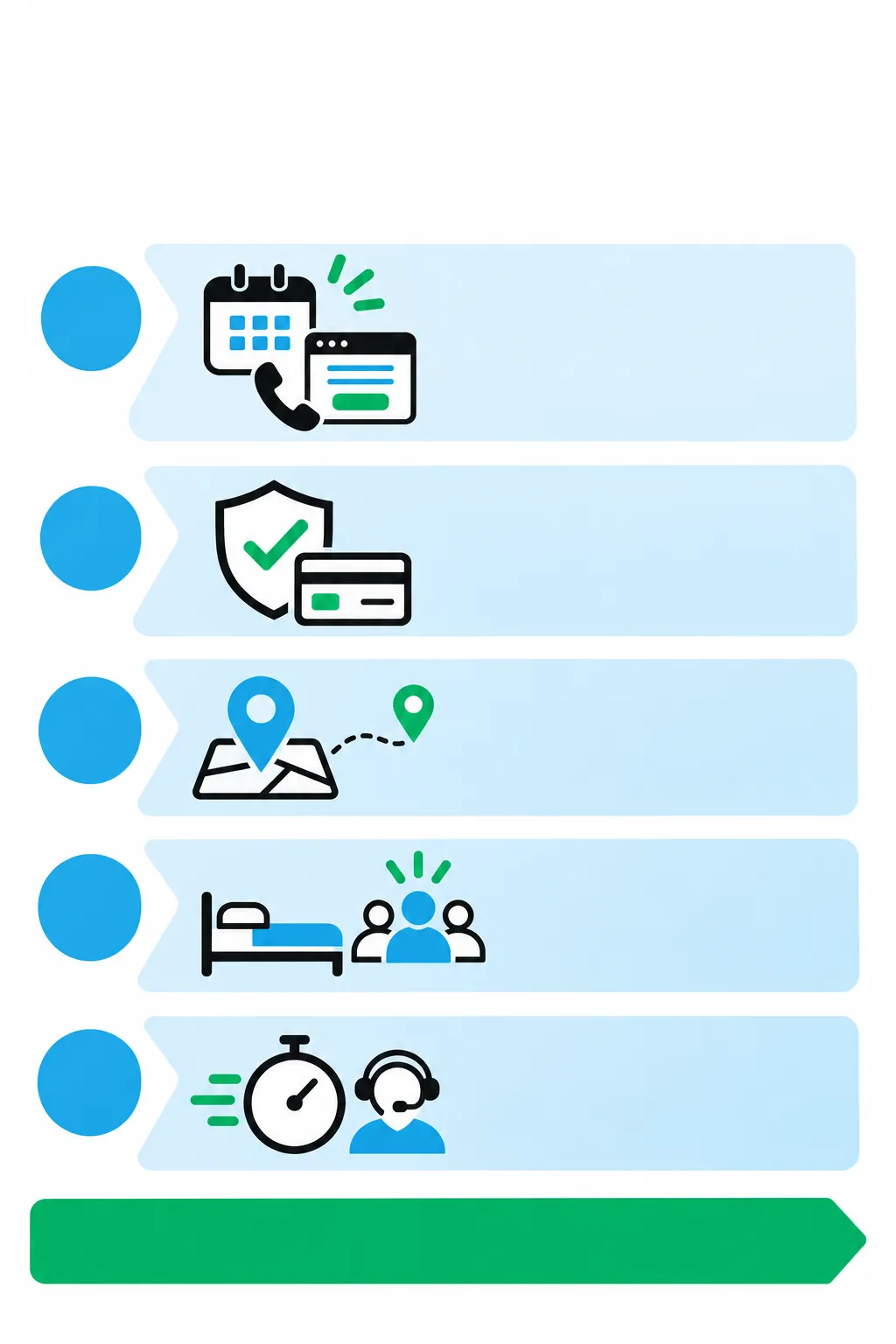
- Receive the inquiry.
- Make human contact.
- Document preliminary qualification.
- Complete appropriate clinical and benefits reviews.
- Record admission, scheduled assessment or another disposition.
Illustrative workflow, not patient or client data. Steps may overlap or occur in a different order.
Free Audit
Want a straight read on where your budget is leaking?
An acquisition model built around intake readiness
Intent-led paid media
Start with the service requested, geography and an accurate contact path. Separate campaign decisions when facilities have different services, coverage or operating constraints.
For U.S. recovery-oriented drug and alcohol addiction services advertising, Google requires LegitScript certification and Google certification. Establish eligibility before planning activation. Google Ads healthcare policy
Evaluate other platforms independently. LegitScript identifies Google and Meta advertising eligibility as certification benefits, subject to platform policies; certification alone does not establish advertising approval. LegitScript certification FAQ
Search visibility and conversion paths
Make service descriptions, locations, payment expectations and contact options easy to understand. Test the mobile journey from landing page to call or approved form submission.
Match messaging to what intake can substantiate. Avoid language that suggests clinical acceptance before assessment.
For organic visibility, focus on accurate location information, useful service content and clear navigation. Evaluate traffic alongside qualified inquiries rather than treating visits as the outcome.
Capacity-sensitive budget decisions
Define who supplies operational updates, how current those updates must be and which changes require approval. Do not assume advertising systems have access to live bed availability.
Illustrative capacity decision guide.
- Coverage and capacity confirmed; Planning response to consider: Evaluate additional eligible demand
- Intake coverage limited; Planning response to consider: Review scheduling, routing and response ownership
- Availability uncertain; Planning response to consider: Confirm conditions before expanding spend
- A location cannot accept an inquiry; Planning response to consider: Follow an approved routing process where appropriate
Planning guidance, not a live capacity feed or automated feature.
For multi-location operators, make these decisions by facility. Do not use a network average to substitute for local readiness.
First-party data and intake connections
Define the source data and dispositions needed for reporting before selecting integrations. Scope call tracking, CRM connections and intake automation around approved access and actual system capabilities.
Treat recording, transcription and AI analysis as separate decisions, each requiring an explicit purpose and documented handling boundaries.
How should detox program marketing be measured?
Measure qualified inquiries, intake progression and verified admissions against the associated spending and acquisition sources. Keep scheduled assessments separate from admissions. Show missing records, reporting delays and attribution limits rather than presenting incomplete tracking as a complete result.
Illustrative admissions measurement framework.
- Unique inquiries; Definition to establish: Contacts after documented duplicate and irrelevant-contact exclusions
- Qualified inquiries; Definition to establish: Contacts meeting agreed preliminary criteria
- Response performance; Definition to establish: Answered contacts and follow-up against the program’s standard
- Benefits verification; Definition to establish: Completed review, separate from initial insurance interest
- Scheduled assessments; Definition to establish: Booked next steps, not completed admissions
- Verified admissions; Definition to establish: Admissions confirmed through authorized records
- Acquisition cost; Definition to establish: Defined spending divided by the specified outcome
Illustrative reporting structure. No performance figures or client records are shown.
Specify whether acquisition cost includes media alone or also management, technology and other acquisition expenses. Compare consistent inquiry cohorts and allow time for outcomes to develop.
Document non-admission reasons where appropriate and authorized. Capacity constraints, payment mismatch and inability to reconnect should lead to different decisions.
Keep internal attribution separate from advertising-platform data sharing. Design the executive report around authorized information, not around exporting admission details to platforms.

Governance before activation
Targeting and marketing compliance
Google prohibits advertiser-curated audiences, including Customer Match and remarketing data segments, for sensitive-interest advertising. Its health category includes addiction-related counseling. Do not base detox acquisition on retargeting treatment-page visitors. Google targeting restrictions Google health targeting policy
Privacy and tracking boundaries
HHS states that disclosures of protected health information to tracking vendors require an applicable Privacy Rule permission. An ordinary privacy notice or cookie banner does not itself authorize those disclosures. Review actual data flows before installing tags or exporting events. HHS tracking technology guidance
Part 2 rules also protect substance use disorder records associated with qualifying federally assisted programs. Determine applicability before defining access, processing and disclosure practices. HHS Part 2 overview
Assign owners for service claims, payment language, permissions, tracking changes and campaign approval. Document storage, retention and outside-provider involvement.
Owned infrastructure with explicit limits
Marketing Powered has owned, local AI infrastructure for HIPAA-aware inference. Define any proposed deployment by where information is stored, processed and accessed.
Owned infrastructure does not mean every workload runs locally, all information stays offline or infrastructure ownership changes client data ownership.
Email Us
Prefer to send the context directly?
Operator experience behind the approach
Marketing Powered’s founder is a former healthcare CMO who ran marketing for a treatment network. That is the founder’s operating history, not an agency client result.
The planning principle is straightforward: assess staffing, location differences, data access and admissions readiness before expanding spend. Evaluate an acquisition partner on how clearly it connects those inputs to investment decisions.
What to define during onboarding and audit scoping
Begin with service scope, locations, payment pathways, intake coverage and the current qualification definition.
Define the review scope before work begins. Consider campaign structure, search intent, geographic fit, landing pages, contact paths, intake routing, measurement gaps and policy dependencies.
Agree which outputs belong in scope, such as a written diagnosis, qualification framework, measurement map or prioritized recommendations. These should reflect the actual problem, not a preset package.
Establish implementation responsibilities and the conditions for changing budgets. Start access discussions with account settings, system maps and aggregate reporting. Leave patient records and recordings out of the initial request.
Request an acquisition audit
Start with the decision leadership needs to make: expand demand, improve intake response or repair measurement.
Share your program locations, current channels and intake coverage hours. Keep patient-identifying information out of the request.
Request an acquisition audit to scope the acquisition problem before committing more budget.
Questions, Answered.
It is acquisition planning that connects visibility, paid media, contact paths and intake handoffs with qualified inquiries and measurable admissions activity.
Build the plan around the detox program’s own services, capacity, intake coverage and admission requirements. Review those differences before reusing another service line’s messaging or conversion definitions.
Account for media, creative, landing pages, measurement, technology and management. Set proposed spending against operating capacity and measurement readiness. Label forecasts as estimates, not measured performance.
Evaluate eligible paid search, organic and local visibility, and referral demand against service-area fit and admissions outcomes. Give each channel a defined role before allocating budget.
Marketing Powered tracks attribution through admission where authorized data supports it. Where access or matching is incomplete, identify the gap rather than substituting call counts for admissions.
Ready to see where your marketing can improve?
Request a free audit of your paid media, landing pages, attribution, and measurement setup. You'll get a straight assessment of where the opportunities are.
or email us at info@marketingpowered.ai