Resources
Hospital Marketing Ideas with Operational Measurement
Evaluating practical hospital marketing ideas requires looking beyond standard brand awareness campaigns to address clinical scheduling capacity, intake coordination, and downstream encounter tracking. Health systems encounter significant operational waste when promotional initiatives generate inquiries that clinics cannot schedule or that contact centers fail to convert. Sustainable patient growth occurs when marketing investments align directly with verified clinical workflows, departmental margin contribution, and accountable measurement.
By Mike Hulick, Founder, Marketing Powered

1. Align Service-Line Paid Search with Clinic Capacity
Hospital digital marketing frequently stumbles by treating every department with a uniform campaign schedule. Running patient acquisition campaigns for joint replacement or interventional cardiology while surgeons face an eight-week operating room backlog inflates patient acquisition costs and drives prospective patients to competing networks. Paid media must function as a responsive valve that opens or constricts based on provider availability, clinic schedule openings, and geographic priority.
In a well-orchestrated deployment, the media buyer works directly from clinical scheduling reports rather than static annual budgets. When an orthopedic clinic adds a physician assistant or expands outpatient procedural slots at an ambulatory surgery center, search campaigns targeting high-intent condition and procedure terms ramp up immediately. Conversely, when a service line approaches full capacity, media spend shifts toward emerging programs or locations with open appointment inventory.
High-intent search capture is particularly critical because health systems face strict advertising boundaries. Under the Google Ads policy on personalized advertising, healthcare advertisers cannot deploy remarketing lists or retarget users based on personal health conditions, medical procedures, or clinical facilities. Because retargeting is prohibited across sensitive medical categories, campaigns must be constructed to facilitate immediate, single-session conversions. Paid search ads targeting active symptom and treatment queries must direct users to dedicated, fast-loading service-line pages featuring verified provider credentials, clear insurance acceptance details, and immediate scheduling pathways.
For multi-facility systems, this level of precision requires deep operational discipline. Marketing Powered draws on the direct background of its founder, a former healthcare CMO who ran marketing for a treatment network that grew from 3 to 24 locations and managed $1.5 to $2M per month in Google Ads across 11+ behavioral and mental health accounts. That operational scale confirms that patient acquisition efficiency depends on connecting media investments directly to operational capacity rather than spending toward arbitrary impression quotas.

2. Decentralize Local Search for Multi-Campus Health Systems
Patients rarely select healthcare providers based on an abstract health system brand. Instead, they choose specific facilities, urgent care clinics, and specialized physicians based on geographic convenience, verified reputation, and immediate access. Marketing for hospitals must therefore separate overarching parent brand promotion from granular, location-specific campaigns that reflect actual physical access points.
Every physical access point requires its own distinct presence in local directory ecosystems and search engines. A regional medical center with five satellite clinics, three imaging centers, and two urgent care sites cannot rely on a single consolidated profile. Each facility requires a verified Google Business Profile linked to its specific physical address, local phone number, operational hours, and departmental categories. Practicing physicians should maintain individual practitioner listings nested within their primary practice location to capture direct provider search demand.
Structured data plays an essential role in communicating this architecture to search engine algorithms and generative answer engines. Web teams should mark up hospital service lines and clinical pages using Schema.org specifications such as Hospital, MedicalClinic, and Physician. Integrating specific accepted health plans, clinical specialties, and direct booking links into this code provides search engines with clear machine-readable context.
Local visibility also requires an active, compliant reputation process. Under Google's policies on user-contributed content, health systems cannot offer incentives for reviews, filter negative reviews, or mandate review collection quotas for clinical staff. Establishing post-discharge communication workflows that invite verified patients to share their honest feedback builds durable local search visibility across every campus without risking platform penalties or regulatory scrutiny.
3. Manage Regulated and Sensitive Care Lines with Strict Privacy Safeguards
Certain hospital service lines operate under heightened legal and regulatory constraints that require specialized campaign design. Psychiatric units, addiction stabilization clinics, medical detox facilities, and outpatient mental health clinics cannot be treated like routine elective services.
Digital campaigns promoting specialized substance use disorder programs face platform-level verification mandates. For instance, Google enforces the Google Ads healthcare policy on addiction services, which requires advertisers offering addiction treatment to secure LegitScript certification prior to running search or display campaigns. Marketing Powered operates with full LegitScript awareness and builds campaigns designed to meet strict regulatory boundaries from day one.
Digital tracking technology represents an equally critical compliance focus. The HHS bulletin on online tracking technologies cautions HIPAA-covered entities against deploying third-party tracking scripts, social media pixels, or unmanaged analytics tags on unauthenticated and authenticated patient portals. If an analytics pixel transmits protected health information (PHI)—such as an IP address paired with a search query for a specific oncology or psychiatric condition—without an executed Business Associate Agreement or signed HIPAA authorization, the health system faces serious compliance exposure.
Mitigating this risk requires strict data governance. Marketing Powered utilizes an owned, local AI infrastructure for HIPAA-aware inference, keeping sensitive prompt engineering, internal operational workflows, and health system data within strict sovereign control. For patient acquisition campaigns, health systems must transition away from standard third-party marketing tags toward server-side tracking, verified consent-management systems, and privacy-first data architectures that measure digital performance without sending sensitive medical queries to third-party ad networks.
Free Audit
Want a straight read on where your budget is leaking?
4. Eliminate Intake Friction Between Lead Generation and Scheduled Encounters
A significant point of failure in hospital marketing occurs at the contact center or intake desk. A health system can run an effective digital campaign that drives thousands of qualified phone inquiries and appointment requests, only to lose those patients to prolonged hold times, complex Interactive Voice Response (IVR) phone trees, and delayed callbacks.
A caller seeking an evaluation for chronic back pain or behavioral health stabilization will not wait on hold for twelve minutes. If forced through an impersonal phone system that drops their call or requires leaving a voicemail, they will hang up and call the next facility in their insurance network. Marketing leadership must treat the contact center as an essential component of the marketing conversion system.
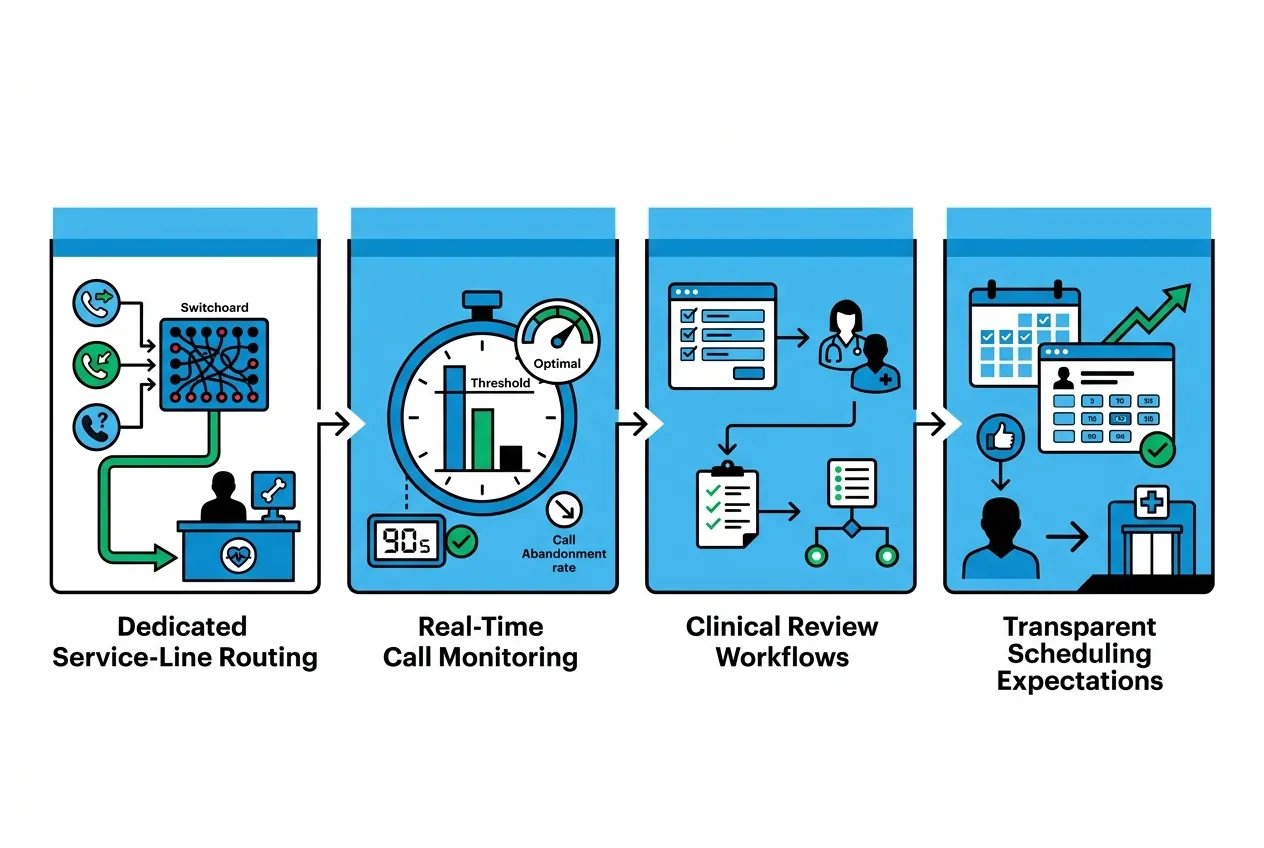
To diagnose and resolve intake friction, implement these operational practices:
- Dedicated Service-Line Call Routing: Avoid directing campaign traffic to the hospital's central switchboard. Route campaign numbers to dedicated intake coordinators trained specifically on the clinical service line, accepted insurance networks, and immediate appointment availability.
- Real-Time Call Monitoring and Hold-Time Benchmarks: Track call abandonment rates, average speed to answer, and time-to-first-touch on digital appointment requests. If hold times exceed 90 seconds, campaign budgets should be adjusted or temporary intake staffing allocated to protect the media investment.
- Clinical Review Workflows for Web Intake: Digital scheduling forms must integrate directly into the electronic health record (EHR) scheduling queue or trigger automated intake tasks for staff follow-up within 15 minutes during standard operational hours.
- Transparent Scheduling Expectations: If an appointment slot cannot be confirmed immediately online, provide the user with clear timeframes indicating when an intake nurse or patient navigator will return their call.
For an extensive analysis of foundational infrastructure, review our hospital marketing guide to align organizational structure with multi-channel acquisition.
5. Implement Centralized Multi-Site Reporting and Admission Attribution
Healthcare marketing teams often rely on proxy metrics such as cost-per-click, impressions, and top-of-funnel web visits to report performance to hospital boards. While these numbers illustrate digital reach, they do not prove clinical volume growth or justify departmental marketing allocations.
Sustainable health system demand requires centralized multi-site reporting that links media spend directly to scheduled appointments, arrived encounters, and completed patient admissions. Because standard conversion tracking stops at the website form fill or completed phone call, marketing teams frequently optimize for low-cost leads that fail to arrive for clinical care.
Closing this attribution loop requires connecting contact center telephony and digital scheduling systems back to campaign tracking identifiers in a privacy-preserving manner. By tracking qualified calls through to patient registration and clinical encounters, the marketing team can evaluate the true acquisition economics across individual campuses.
Evaluating marketing performance through down-funnel metrics alters media buying strategy:
- Campaigns producing inexpensive phone inquiries often yield low arrival rates due to out-of-network insurance mix or misaligned clinical expectations.
- Campaigns targeting specific, complex medical conditions may generate higher initial acquisition costs per inquiry, but deliver substantially higher encounter completion rates and downstream contribution margin.
- When attribution is tracked to admission rather than just the initial lead, marketing directors can confidently reallocate media dollars from underperforming awareness tactics into high-intent service lines that drive verified patient encounters.
For detailed breakdowns on structuring campaigns for high-margin departments, explore our guide on hospital service-line marketing.
6. Build High-Value Educational Content Around the Patient Care Journey
While paid media captures acute, immediate-need demand, long-term brand equity and organic search demand depend on authoritative educational content that answers critical patient questions. Patients researching complex diagnoses, surgical procedures, or chronic symptom management require comprehensive, understandable clinical information long before they book a consultation.
Content initiatives must center around structured clinical pathways rather than disjointed medical blog posts. Collaborate with service-line medical directors, nurse navigators, and clinical specialists to build authoritative resource hubs that outline:
- Step-by-step preparation guides for surgical interventions and diagnostic procedures.
- Objective comparisons between conservative therapeutic interventions and surgical options.
- Clear breakdowns of recovery timelines, rehabilitation requirements, and post-discharge expectations.
- Direct video introductions from attending physicians explaining their treatment philosophies and clinical expertise.
To maintain clinical governance, establish formal clinical review workflows for every piece of published content. Each guide should identify the reviewing physician, their medical credentials, and the date of the most recent clinical evaluation. This practice establishes authority for search engine quality raters and prospective patients while ensuring all public health messaging remains clinically sound and compliant with organizational standards.

Email Us
Prefer to send the context directly?
7. Departmental Implementation Framework and Operational Ownership
Executing hospital marketing ideas effectively requires clear accountability across administrative, marketing, and clinical teams. Without cross-functional alignment, campaigns face operational bottlenecks, compliance delays, and broken scheduling processes.
Use this operational matrix to assign responsibilities across key campaign phases:
- Phase 1: Capacity Planning. Marketing Operation: Audit clinical appointment inventory and provider availability across key service lines. Responsible Stakeholders: Service-Line Directors, Clinic Practice Managers, Marketing Director. Key Operational Output: Weekly open-slot report identifying priority departments and excess provider capacity.
- Phase 2: Regulatory Review. Marketing Operation: Validate tracking scripts, privacy notices, and ad copy against HIPAA and platform policies. Responsible Stakeholders: Compliance Officer, Legal Counsel, Digital Marketing Lead. Key Operational Output: Approved tag management plan and LegitScript certification verification where applicable.
- Phase 3: Campaign Build. Marketing Operation: Launch location-specific search campaigns and optimize structured Google Business Profiles. Responsible Stakeholders: Media Buyers, Technical SEO Specialist, Web Operations Team. Key Operational Output: Dedicated service-line pages, Schema markup, and campaign-specific tracking numbers.
- Phase 4: Intake Integration. Marketing Operation: Implement dedicated call routing, queue priorities, and digital lead handling protocols. Responsible Stakeholders: Contact Center Manager, Patient Navigators, CRM Administrator. Key Operational Output: Dedicated intake queues, sub-90-second answer standards, and EHR scheduling workflows.
- Phase 5: Attribution Audit. Marketing Operation: Match campaign identifiers with arrived appointments and verified hospital admissions. Responsible Stakeholders: Marketing Analytics Lead, Revenue Cycle Analysts, CMO. Key Operational Output: Monthly multi-site dashboard reporting cost per scheduled visit and cost per admission.
Reviewing this framework on a monthly basis ensures that marketing investments adjust to shifting operational realities, emerging clinical service lines, and real-time physician staffing changes.
Questions, Answered.
The most reliable hospital marketing ideas focus on high-intent paid search campaigns tied directly to immediate clinic scheduling capacity, optimized local entity search profiles for individual facilities and physicians, and direct intake call routing that eliminates wait times. Capturing active patient search intent at the exact moment care is sought delivers faster, more measurable appointment volume than broad brand awareness campaigns.
Measurement should connect digital campaign interactions through to patient scheduling records and clinical arrival data. By assigning unique, privacy-safe tracking identifiers to dedicated service-line phone numbers and secure online scheduling portals, health systems can trace acquisition costs past the initial phone inquiry to the verified clinic appointment or inpatient admission.
Under guidance from the Department of Health and Human Services (HHS), hospital digital marketing teams cannot deploy standard third-party advertising pixels on unauthenticated or authenticated patient web pages if those tools transmit protected health information (PHI) to unauthorized vendors. Health systems must utilize server-side tracking, strict consent management architectures, and privacy-first data environments to measure ad performance without transmitting identifiable patient data to commercial ad platforms.
Platform rules, including Google's policies on personalized advertising, strictly prohibit advertisers from creating remarketing lists or serving targeted ads based on personal health status, medical conditions, or clinical treatments. Because health systems cannot rely on retargeting users who visited a condition page, initial landing pages must provide complete information, clear provider credentials, and immediate, friction-free scheduling pathways in a single session. Request an acquisition audit
Ready to see where your marketing can improve?
Request a free audit of your paid media, landing pages, attribution, and measurement setup. You'll get a straight assessment of where the opportunities are.
or email us at info@marketingpowered.ai