Guide
Understanding HIPAA-Compliant Marketing
How healthcare organizations protect patient data while building effective marketing programs

The Importance of HIPAA Compliance in Marketing
HIPAA-compliant marketing is not optional for healthcare organizations. It is a legal requirement that shapes every patient interaction, from the first ad impression to the final follow-up email. The Health Insurance Portability and Accountability Act establishes strict boundaries around how Protected Health Information (PHI) can be used, disclosed, and safeguarded. Marketing teams that ignore these boundaries expose their organizations to federal enforcement actions, civil penalties, and irreparable damage to patient trust.
The regulatory environment has intensified since 2022. The HHS Office for Civil Rights has issued specific guidance on tracking technologies, making clear that common marketing tools like pixels, cookies, and analytics platforms can create HIPAA violations when they transmit PHI to third parties without proper authorization. Even IP addresses combined with health condition information can constitute PHI under the right circumstances.
For healthcare executives, the stakes extend beyond fines. A single compliance failure can trigger mandatory breach notifications, media coverage, and long-term reputation damage that undermines patient acquisition for years. Organizations operating in behavioral health marketing face additional scrutiny because of the sensitive nature of addiction and mental health treatment.
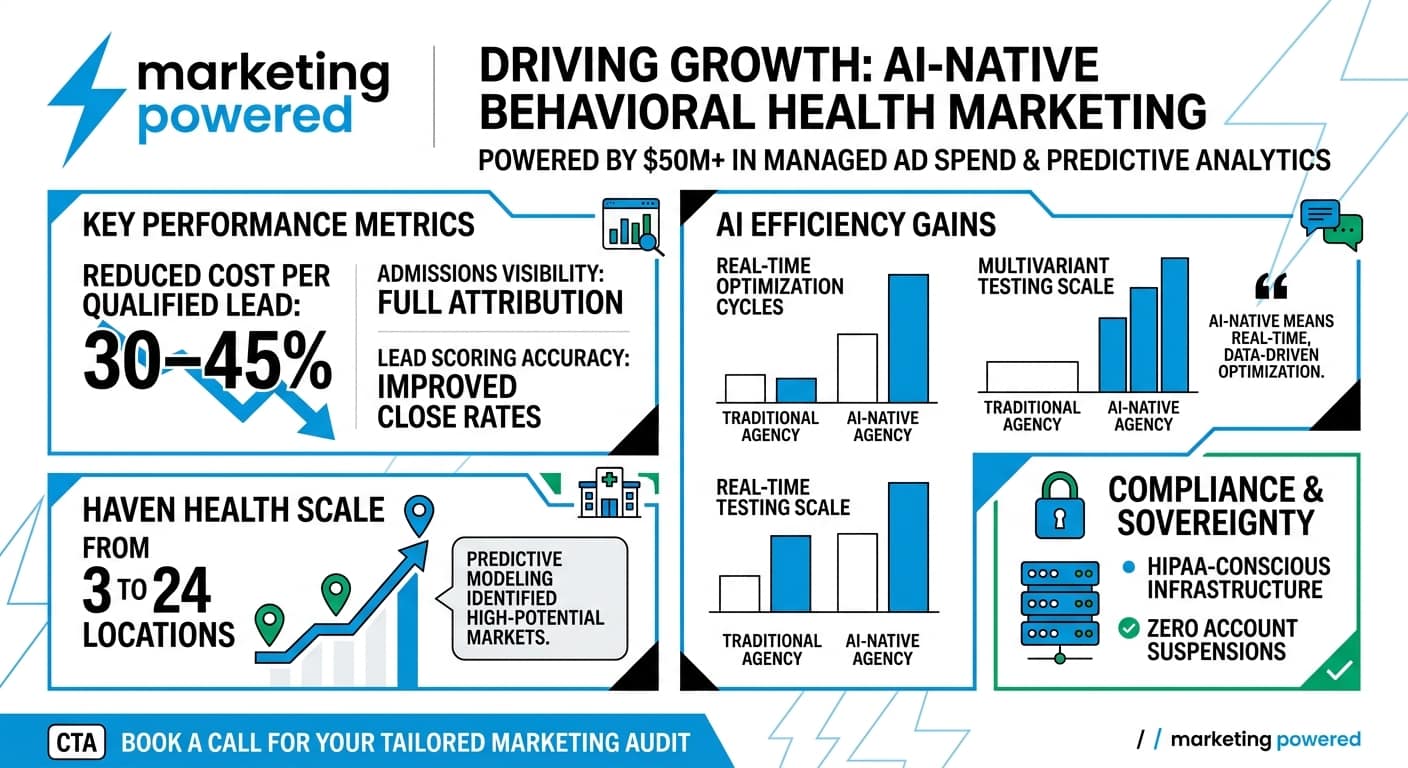
Marketing Powered approaches this reality with operator-level experience: $50M+ managed in behavioral health and mental health media spend, with HIPAA awareness built into every campaign structure. The difference between agencies that understand HIPAA-compliant healthcare marketing and those that do not becomes apparent the first time a compliance question arises.
Key HIPAA Marketing Rules to Follow
HIPAA marketing rules center on one principle: patient authorization. Under the Privacy Rule, covered entities cannot use or disclose PHI for marketing purposes without prior written authorization from the patient. This applies regardless of channel, whether you are running Google Ads, sending email campaigns, or retargeting website visitors.
The authorization requirement has specific exceptions that marketers must understand:
- Face-to-face communications with patients do not require separate marketing authorization.
- Promotional gifts of nominal value can be distributed without authorization.
- Refill reminders and communications about currently prescribed medications are permitted.
- Treatment alternatives or health-related products offered by the covered entity may be communicated under certain conditions.
Data Handling Across Channels
The rules become more complex when applied to digital channels. Email marketing requires explicit consent and secure transmission. Social media advertising cannot leverage PHI for targeting, even if the patient voluntarily shared health information on a platform. Website analytics must be configured to prevent PHI from being captured and transmitted to third-party servers.
Google Ads restricts advertisers in healthcare verticals from using personalized advertising. Behavioral health and addiction treatment fall under sensitive categories that prohibit remarketing entirely. Organizations running paid media in these verticals need partners who understand how to build compliant campaign architectures from the ground up.
Marketing HIPAA compliance also extends to Business Associate Agreements (BAAs). Any vendor that handles PHI on behalf of a covered entity must sign a BAA and maintain appropriate safeguards. This includes marketing agencies, CRM platforms, email service providers, and analytics tools.
Free Audit
Want a straight read on where your budget is leaking?
Risks of Non-Compliance in Healthcare Marketing
The consequences of HIPAA violations in marketing are not theoretical. The HHS Office for Civil Rights has pursued enforcement actions against healthcare organizations for improper use of tracking technologies, unauthorized disclosures through marketing campaigns, and failure to secure patient data in digital communications.
Civil monetary penalties under HIPAA range from $100 to $50,000 per violation, with annual caps reaching $1.5 million per violation category. Penalties have increased significantly in recent years as OCR has expanded its focus to digital health technologies and marketing practices.
Real-World Compliance Failures in Healthcare Marketing
Several healthcare organizations have faced enforcement actions specifically related to marketing activities. A health system disclosed PHI through its patient portal's appointment reminder feature, which was accessible to unauthorized third-party tracking scripts. A behavioral health provider used Meta Pixel without proper configuration, transmitting patient IP addresses and appointment information to an advertising platform's infrastructure. A hospital marketing team uploaded patient lists to advertising platforms for custom audience targeting without obtaining proper authorization.
These failures share common patterns: inadequate technical safeguards, insufficient vendor oversight, and marketing teams operating without compliance guidance. The risk of PHI in marketing is highest when organizations treat digital advertising like any other industry without accounting for healthcare's unique regulatory requirements.
Beyond federal penalties, HIPAA violations trigger state attorney general investigations, class action lawsuits, and mandatory breach notifications that alert patients and media to the failure. For organizations building healthcare web properties, compliance must be architected into the foundation, not added as an afterthought.
How to Implement HIPAA-Compliant Marketing Strategies
Building HIPAA marketing rules into your marketing operations requires systematic changes across technology, process, and vendor relationships. The goal is not to eliminate digital marketing but to execute it within compliant boundaries.
Email Us
Prefer to send the context directly?
Technical Safeguards for HIPAA Marketing
Start with your website infrastructure. Audit all tracking scripts, pixels, and analytics tools to identify which ones collect data that could constitute PHI. Remove or reconfigure tools that transmit identifiable health information to third parties. Implement consent management platforms that give patients control over data collection.
Server-side tracking offers a compliant alternative to client-side pixels for organizations that need campaign attribution. By processing data on your own servers before transmitting to advertising platforms, you can strip PHI and maintain compliance while preserving marketing insights. This requires technical expertise that most in-house teams lack.
Process Controls for Marketing HIPAA Compliance
Establish clear workflows for marketing authorization. Any campaign that uses patient information for targeting or personalization requires documented consent that meets HIPAA's authorization requirements. Train marketing staff on what constitutes PHI and how to handle patient data appropriately.
Build compliance review into your campaign launch process. Before any new marketing initiative goes live, verify that data flows have been mapped, vendor agreements are in place, and authorization requirements have been met.
Attribution Without PHI in Healthcare Campaigns
Effective healthcare marketing requires understanding which channels drive admissions or appointments. Marketing Powered has developed attribution methodologies that track performance through to admission without compromising patient privacy. With $1.5M to $2M monthly in managed Google Ads and attribution tracked through to admission, we have proven that compliance and performance measurement can coexist.
Our case studies demonstrate how this works in practice across behavioral health and mental health organizations, delivering measurable results without exposing patient data to unauthorized third parties.
Strategy
Want to start with a quick message?
Evaluating HIPAA-Compliant Marketing Agencies
Not every marketing agency understands healthcare data marketing at the level your organization requires. When evaluating potential partners, focus on demonstrated compliance experience rather than general healthcare industry exposure.
Questions to ask during agency evaluation:
- Have you signed Business Associate Agreements with healthcare clients? If so, how many are currently active?
- What technical safeguards do you maintain for handling PHI in marketing operations?
- How do you structure paid media campaigns to comply with sensitive vertical restrictions?
- Can you demonstrate attribution tracking that does not rely on PHI transmission to third-party platforms?
- What compliance training do your team members receive, and how frequently is it updated?
What Sets Qualified HIPAA Marketing Partners Apart
Agencies with genuine HIPAA awareness operate differently. They maintain their own compliant infrastructure rather than relying on standard marketing tools. They understand LegitScript certification requirements for addiction treatment advertising. They can explain exactly how data flows through their systems and what safeguards protect patient information at each step.
Marketing Powered brings operator-level credibility to these conversations: court-certified marketing expert, AI-native infrastructure since 2022, and the experience of scaling a behavioral health organization from 3 to 24 locations. Our approach reflects a commitment to building systems that meet healthcare's unique requirements.
The difference between a generic agency and a specialized partner becomes clear when compliance questions arise. You need a team that has already solved these problems, not one that will learn on your account.
Request a HIPAA Compliance Audit
Your marketing program should drive growth without creating compliance exposure. Marketing Powered brings $50M+ in managed healthcare media spend and the technical infrastructure to execute campaigns that protect patient data while delivering measurable results. Let's discuss your current strategy, compliance posture, lead quality, and channel mix.
Questions, Answered.
Effective HIPAA-compliant marketing prioritizes consent-based communication, secure data handling, and channel strategies that do not require PHI for targeting. Focus on contextual advertising, first-party data with proper authorization, and server-side tracking that strips identifiable information before transmitting to advertising platforms. Email marketing should use encrypted transmission and documented opt-in consent that meets HIPAA authorization requirements.
HIPAA restricts how patient data can be used for targeting, personalization, and measurement. Campaigns cannot use PHI for audience building without explicit authorization. Common tools like Meta Pixel and Google Analytics require careful configuration or removal to prevent unauthorized PHI transmission. Remarketing is prohibited for behavioral health and restricted for other healthcare categories under Google and Meta advertising policies.
The primary risks include unauthorized disclosure of PHI through tracking technologies, improper use of patient data for advertising targeting, failure to secure BAAs with marketing vendors, and inadequate consent documentation. These failures can result in civil penalties up to $1.5 million per violation category, mandatory breach notifications, state enforcement actions, and lasting damage to patient trust.
Qualified agencies maintain HIPAA-compliant infrastructure, execute Business Associate Agreements with healthcare clients, implement technical safeguards for data handling, and train staff on PHI recognition and handling requirements. They conduct regular compliance audits, document data flows, and build campaign architectures that achieve marketing objectives without transmitting protected information to unauthorized parties.
Ready to see what AI-native marketing can do for your treatment center?
Request a free audit of your paid media, landing pages, attribution, and compliance posture. You'll get a straight assessment of where the opportunities are.
or email us at info@marketingpowered.ai