Guide
Google Ads Match Types: A 2026 Strategy Guide for Behavioral Health Marketers
A strategic framework for behavioral health marketers managing high-stakes PPC campaigns
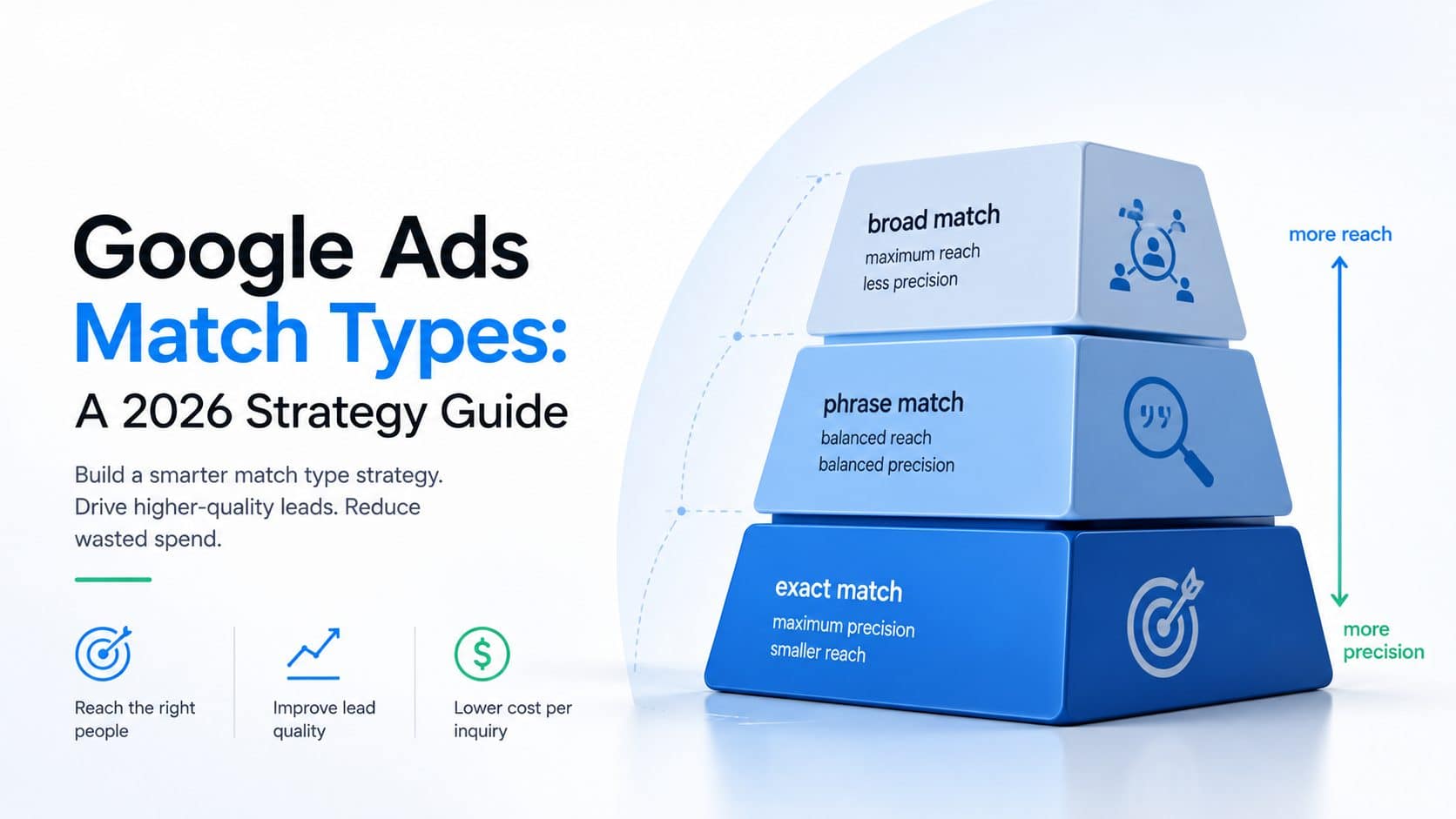
What Are Google Ads Match Types?
Google Ads match types determine which user searches trigger your ads. They function as targeting filters that tell Google how closely a search query must align with your keyword before your ad becomes eligible to appear. The spectrum runs from broad match (maximum reach, minimum control) to exact match (maximum control, minimum reach), with phrase match sitting in between.
For behavioral health marketers operating under Google's healthcare advertising restrictions, match types become your primary lever for targeting precision. Unlike e-commerce or SaaS verticals, behavioral health advertisers cannot rely on retargeting or many audience targeting tools. Match types carry more strategic weight as a result.
Getting match types right means better lead quality, lower cost per admission inquiry, and fewer wasted impressions. Getting them wrong means burning budget on clicks from people who will never become patients. The stakes are high enough that match type strategy deserves deliberate attention, not default settings.
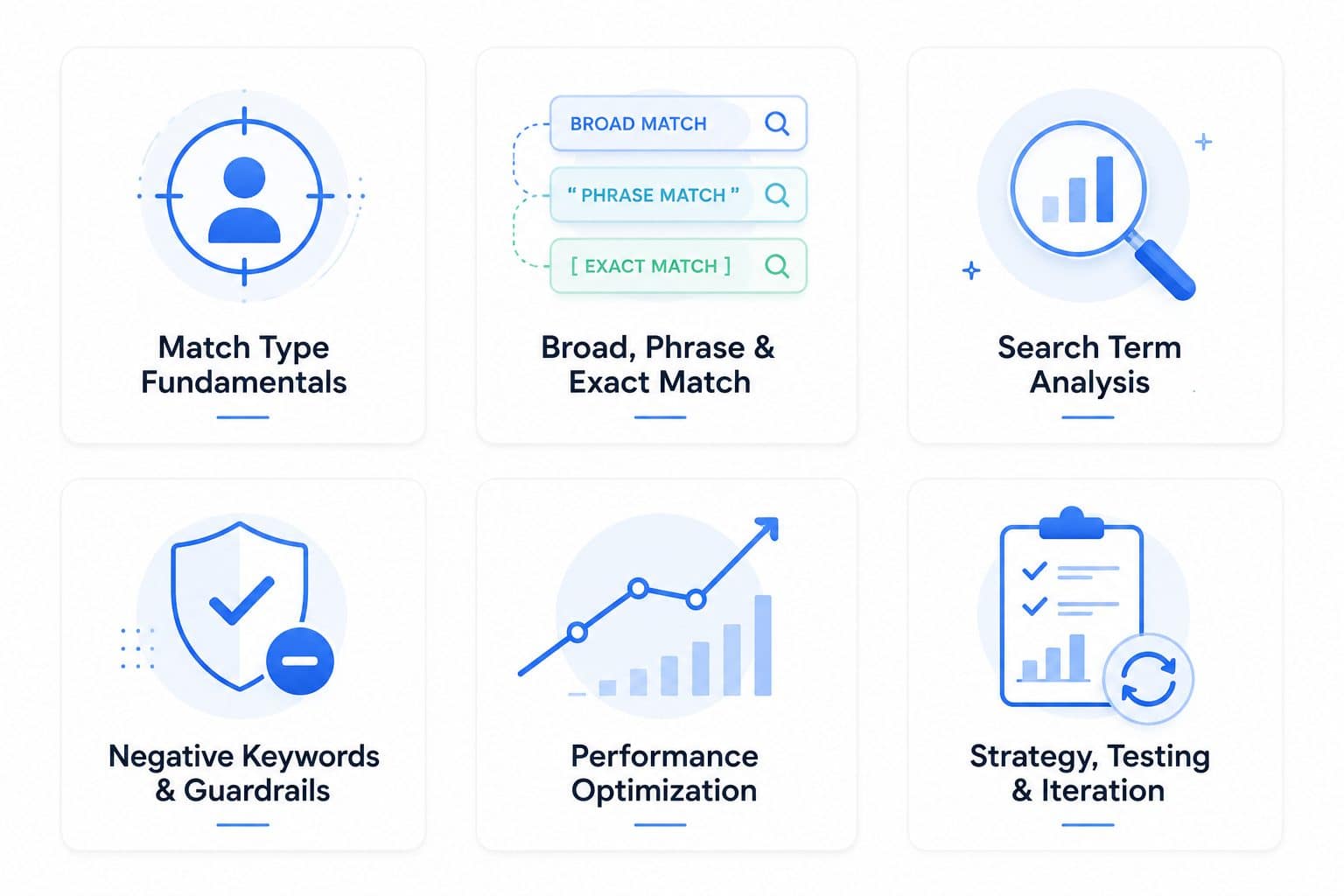
The Three Core Match Types Explained
Each match type serves a distinct purpose in your campaign architecture. Understanding when to deploy each one separates efficient accounts from those wasting spend on irrelevant traffic.
Broad Match Keywords
Broad match casts the widest net. A broad match keyword like 'addiction treatment' might trigger ads for 'substance abuse help,' 'rehab facilities near me,' or 'how to stop drinking.' Google uses its AI to interpret what it considers related searches, which means your ad can appear for queries that do not contain your keyword at all.
The upside is discovery. Broad match combined with Smart Bidding can surface high-intent queries you never anticipated. The downside is waste. Without guardrails, broad match will spend budget on informational searches, competitor research, and queries with zero commercial intent.
Broad match keywords work best when paired with aggressive negative keyword lists, audience signal layers, and weekly search term audits. Deploying broad match without these safeguards is one of the fastest ways to exhaust a behavioral health PPC budget without driving qualified leads.
Phrase Match in Google Ads
Phrase match requires the search to include the meaning of your keyword in the order you specify. For the phrase match keyword "alcohol rehab center," your ad could trigger on 'alcohol rehab center in California' or 'affordable alcohol rehab center' but not 'center for alcohol education.'
Phrase match delivers a middle ground: broader reach than exact, more control than broad. For treatment center campaigns, phrase match often performs well on high-intent modifier combinations involving location terms, insurance references, or specific treatment modalities. It captures natural language variations without opening the door to entirely unrelated queries.
Exact Match Targeting
Exact match shows your ad only when the search matches the precise meaning of your keyword. The keyword [alcohol rehab center] triggers on 'alcohol rehab center' and close variants like 'alcohol rehabilitation center' but excludes searches with additional words that shift intent.
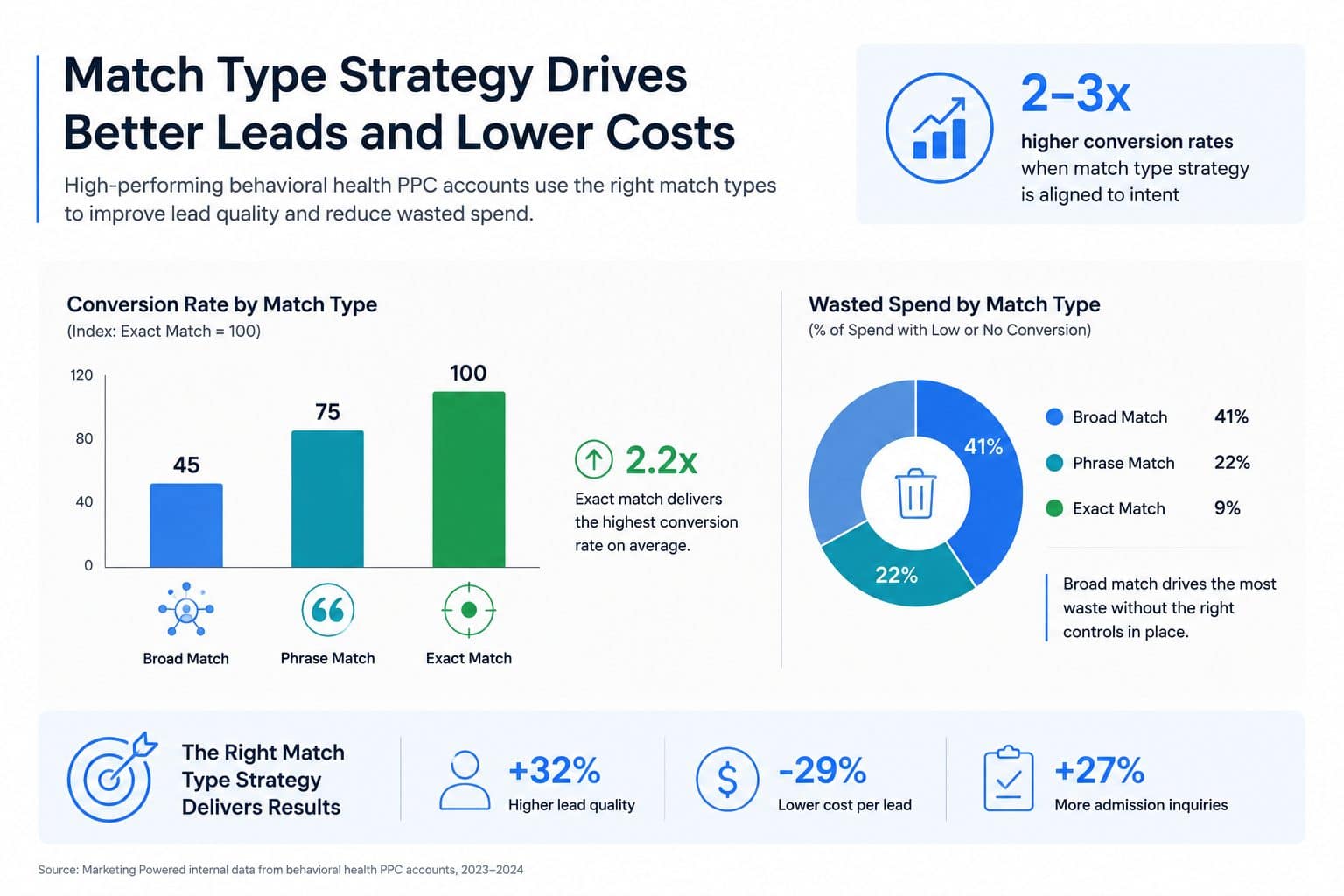
Exact match delivers the highest relevance and typically the best conversion rates. The tradeoff is volume. For behavioral health accounts spending $100K or more monthly, exact match alone cannot capture enough qualified searches to sustain efficient growth. The strategic question is how to layer match types so exact match handles your highest-value terms while phrase and broad expand reach deliberately.
Match Type Strategy for 2026
An effective match type strategy in 2026 requires acknowledging how Google's algorithm has evolved. The platform's AI now interprets intent more aggressively than it did even two years ago, which changes how broad match behaves and what phrase match captures. Static keyword lists built for 2022 are underperforming in today's environment.
A tiered match type architecture remains the most reliable approach. Apply exact match to your highest-intent, highest-value keywords: facility brand terms, 'rehab near [city],' and specific treatment modality searches. Layer phrase match on broader treatment terms where you want to capture natural language variations. Reserve broad match for discovery campaigns with conservative bids, aggressive negative keyword lists, and audience signal overlays.
Audience signals amplify match type precision. While retargeting is restricted in the behavioral health vertical, in-market audiences for addiction treatment services and custom intent audiences can still be applied to broad match campaigns as targeting or observation layers. This gives Google's algorithm guidance on which users to prioritize, reducing irrelevant impressions without sacrificing the discovery value of broad match.
Search term mining should be a weekly discipline, not a quarterly project. Every broad match campaign generates search term data that reveals what real users are actually typing. High-performing queries get promoted to phrase or exact match. Irrelevant queries become negative keywords. This feedback loop is how sophisticated accounts compound efficiency over time.
Free Audit
Want a straight read on where your budget is leaking?
Negative Keywords: The Essential Guardrail
Negative keywords prevent specific queries from triggering your ads. Without them, even the tightest match type strategy will leak budget to unwanted traffic. For behavioral health accounts, negative keywords are not optional; they are foundational.
The behavioral health vertical has predictable negative keyword patterns. Terms like 'free,' 'jobs,' 'salary,' 'definition,' 'wikipedia,' and 'DIY' consistently signal non-converting intent. Competitor names should be excluded unless you are running deliberate conquest campaigns. Educational and informational modifiers indicating research rather than purchase intent should also be blocked.
Build a master negative keyword list at the account level for universal exclusions. Add campaign-level negatives for terms that are acceptable in some campaigns but not others. Review search terms weekly and add negatives proactively. Accounts without disciplined negative keyword management routinely see 15 to 25 percent of spend going to irrelevant clicks. In a vertical where cost per click can exceed $50 for high-intent terms, that waste compounds quickly.
Advanced Tactics: DSAs and Audience Layering
Dynamic Search Ads use your website content to automatically target relevant searches. For treatment centers with location pages, modality pages, and condition-specific content, DSAs can surface long-tail queries that manual keyword research misses. Run DSAs in separate campaigns with conservative budgets, and mine their search term reports for keyword expansion opportunities. They function as a discovery layer on top of your core match type architecture.
Layering audiences onto match type campaigns adds a second dimension of precision. Google's in-market audiences for addiction treatment services can be applied as observation layers to see which segments convert best, or as targeting layers to limit impressions to users Google identifies as actively researching treatment. The targeting layer approach pairs well with broad match, providing algorithmic guardrails that pure keyword targeting cannot deliver.
Attribution discipline across match types is equally important. A broad match campaign may show a high cost per click but generate the first touchpoint that leads to an exact match conversion later in the same session or across sessions. Evaluating match type performance on last-click metrics alone leads to systematic underinvestment in discovery campaigns and over-reliance on exact match. Full-funnel attribution, tracked through to admission inquiry or call, reveals the true contribution of each match type to your census goals.
A Practical Framework for Building Your Match Type Strategy
A complete match type strategy aligns keyword targeting with business goals, compliance requirements, and budget realities. For behavioral health treatment centers, that means starting with the right foundation before optimizing match type distribution.
First, ensure conversion tracking measures what matters. Before adjusting match types, verify you are tracking qualified calls and form submissions tied to admission inquiries, not just clicks or generic page visits. Match type optimization without conversion data is guesswork.
Second, audit your current match type distribution. Most accounts we inherit are over-indexed on broad match without adequate negative keyword protection, or under-indexed on exact match for high-value terms. A structured audit reveals where budget is leaking and where opportunity is being left on the table.
Third, layer intentionally. Exact match for brand and high-intent treatment terms. Phrase match for location and modality variations. Broad match for discovery, heavily protected by negatives and audience signals.
Fourth, review and refine weekly. Search term reports are the feedback mechanism. Consistent mining separates accounts that improve month over month from accounts that plateau.
- Apply exact match to brand terms, facility-specific queries, and highest-converting treatment keywords
- Use phrase match for location modifiers, insurance references, and treatment modality variations
- Deploy broad match only with negative keyword lists, audience signals, and weekly search term review
- Build a master negative keyword list at the account level and layer campaign-specific exclusions
- Track attribution through to admission inquiry to evaluate true match type contribution
Email Us
Prefer to send the context directly?
Get a Match Type Strategy Built for Behavioral Health
Our team has managed over $50M in behavioral health and mental health media spend. We understand the compliance constraints, the high-stakes keyword landscape, and the attribution complexity that comes with treatment center marketing. If your current match type strategy is not delivering the lead quality you need, let's talk about what a more precise approach could look like for your account.
Questions, Answered.
Google Ads match types are settings that control which user searches can trigger your ads. They range from broad match, which shows ads for searches Google considers related to your keyword, to exact match, which shows ads only for searches matching your keyword's precise meaning. Match types directly influence ad visibility, click volume, and budget efficiency by determining how closely targeting aligns with user intent.
Broad match keywords trigger your ads for searches Google considers related to your keyword, even if the search does not contain your exact terms. The benefit is discovery: you can reach queries you did not anticipate. The risk is wasted spend on low-intent searches. Behavioral health accounts using broad match need aggressive negative keyword lists, audience signal overlays, and weekly search term monitoring to keep broad match efficient.
Phrase match requires the search to include your keyword's meaning in order, while allowing additional words before or after it. Exact match requires the search to match your keyword's precise meaning with minimal variation. Phrase match delivers more volume with moderate control. Exact match delivers the highest relevance but the lowest volume. Most effective accounts layer both match types based on keyword intent and value.
A match type strategy is a deliberate plan for which match types to apply to which keywords based on intent, volume, compliance requirements, and budget goals. Effective strategies apply exact match to high-value terms, phrase match to broader variations, and broad match for discovery with strong negative keyword protection and audience signal overlays. The strategy should be reviewed and refined weekly based on search term data.
Negative keywords prevent irrelevant searches from triggering your ads, acting as a guardrail for broader match types. Without them, broad and phrase match campaigns will spend budget on informational searches, job seekers, and competitor researchers who will never convert. In behavioral health PPC, where cost per click can exceed $50, disciplined negative keyword management typically recovers 15 to 25 percent of budget that would otherwise go to non-converting traffic.
Google's AI-driven intent matching has become more aggressive, meaning broad match now reaches a wider range of semantically related searches than it did in previous years, and phrase match captures more natural language variations. This makes negative keyword discipline and audience signal layering more important than ever. Accounts relying on keyword lists built two or more years ago are likely experiencing match type drift that is inflating costs and reducing lead quality.
Ready to see what AI-native marketing can do for your treatment center?
Request a free audit of your paid media, landing pages, attribution, and compliance posture. You'll get a straight assessment of where the opportunities are.
or email us at info@marketingpowered.ai