Guide
Comprehensive Guide to Mental Health Marketing Strategies
Strategic frameworks for mental health practices that need qualified leads, compliant campaigns, and marketing partners who understand the category.

Why Standard Agency Playbooks Fail Mental Health Practices
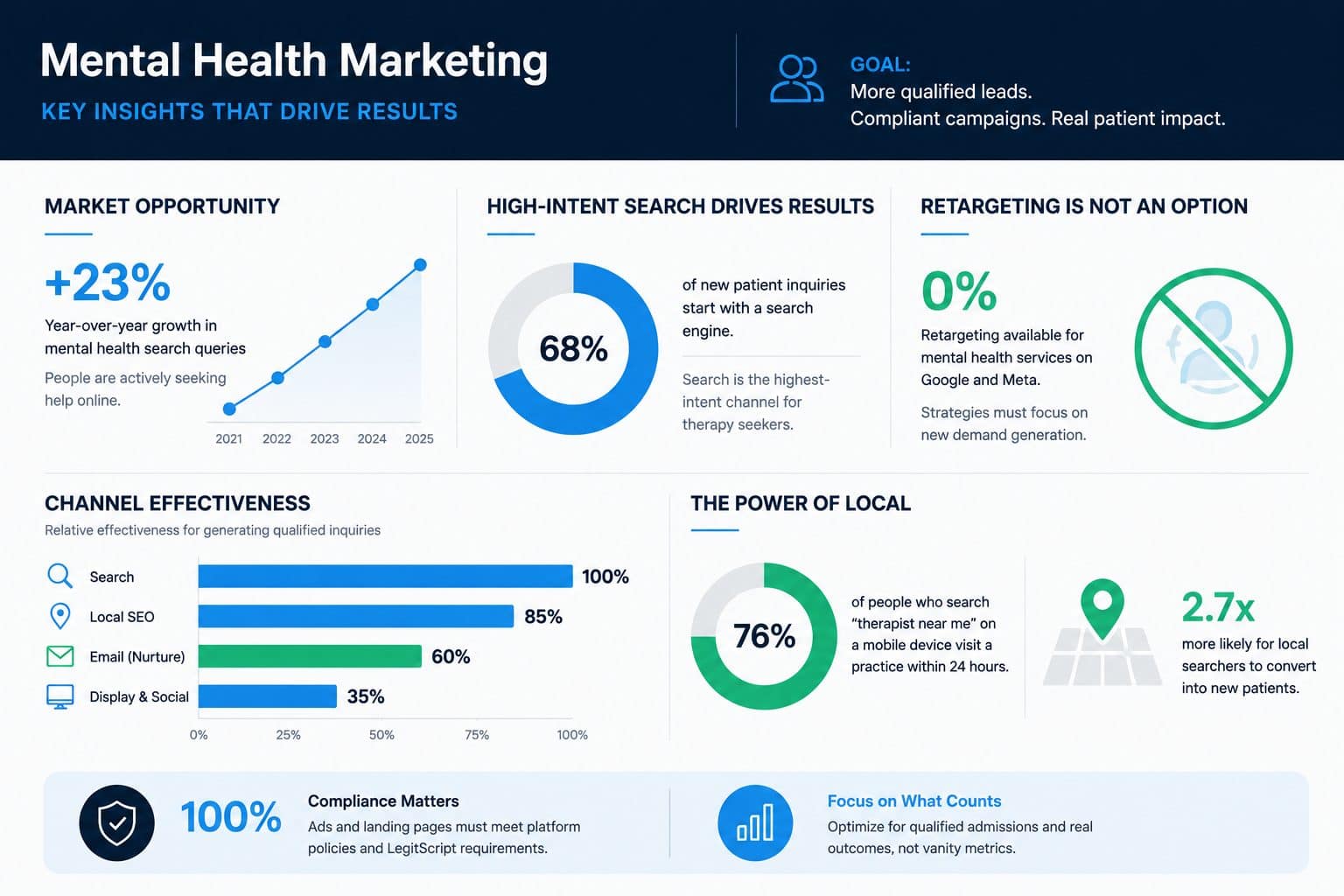
Mental health marketing operates under constraints that most agencies never encounter. Google classifies mental health services as a sensitive healthcare vertical, which eliminates retargeting entirely. Meta enforces strict limitations on health-related targeting. LegitScript certification requirements add another layer of scrutiny. These are not minor inconveniences. They fundamentally change how campaigns must be structured.
Most marketing agencies approach mental health practices the same way they approach dentists or chiropractors. They propose retargeting funnels, broad demographic targeting, and conversion-focused landing pages that make claims about outcomes. This approach fails compliance review, wastes budget on disapproved ads, and generates leads that never convert to actual patients.
The mental health sector requires marketing partners who understand clinical sensitivity, regulatory boundaries, and the longer decision cycles typical of therapy seekers. A person researching anxiety treatment is not making the same purchase decision as someone shopping for a new mattress. The messaging, the funnel structure, and the attribution model all need to reflect that reality.
This guide draws from experience managing over $50M in lifetime ad spend across behavioral health and mental health verticals. The strategies here are built on what actually works when you cannot retarget, when compliance teams review every ad, and when the goal is qualified admissions rather than vanity metrics. Mental health practice marketing demands this level of specialization.
Channel Selection and Optimization for Therapy Practices
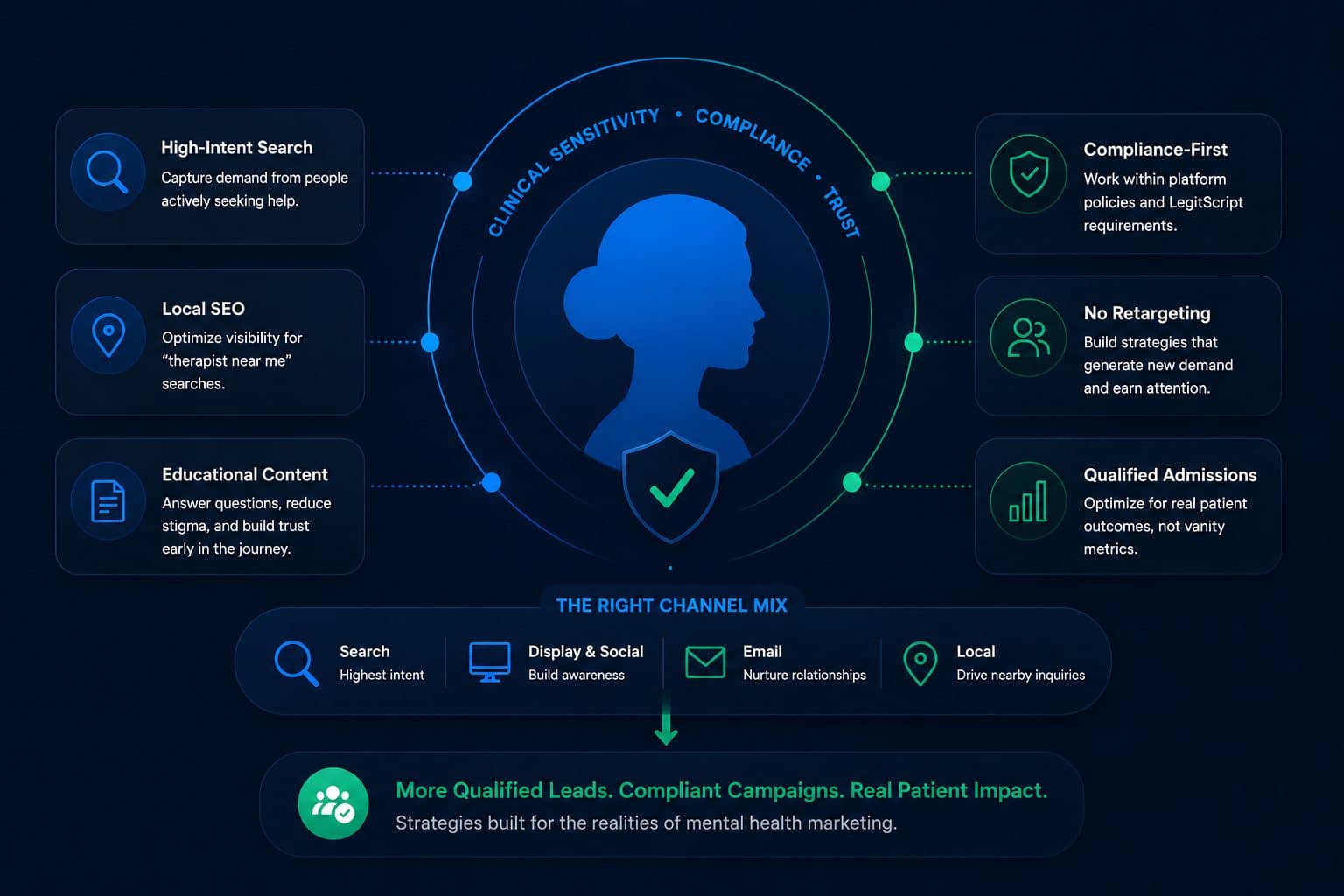
Mental health digital marketing requires a different channel mix than other healthcare verticals. Search remains the highest-intent channel because people actively seeking therapy or psychiatric services are already problem-aware. Display and social function as awareness channels, but face severe targeting restrictions. Email works well for nurturing existing patient relationships, but cannot be used for acquisition in the same way retail brands use it.
Search engine optimization forms the foundation of sustainable mental health marketing. When someone searches 'anxiety therapist near me' or 'depression treatment options,' organic visibility drives traffic without the per-click costs that strain smaller practice budgets. According to Search Engine Journal's analysis of healthcare search behavior, medical and mental health queries continue to grow year over year, and practices with strong local SEO capture a disproportionate share of new patient inquiries.
Paid search through Google Ads remains effective but requires careful execution. Google's healthcare and medicines policy prohibits certain targeting methods and ad formats. Campaigns must be structured around condition-related keywords with compliant landing pages that avoid outcome guarantees. The paid media strategies that work in mental health look different from standard PPC playbooks.
- Local SEO optimization: Google Business Profile completeness, local citations, and review velocity directly impact visibility for 'therapist near me' searches.
- Content marketing: Educational content addressing specific conditions builds authority and captures long-tail search traffic from people researching symptoms and treatment options.
- Paid search structure: Single keyword ad groups, tight geographic targeting, and compliant ad copy that focuses on accessibility rather than outcomes.
- Social media presence: Organic content that educates and destigmatizes rather than direct-response advertising, which faces platform restrictions.
Messaging, Channels, and Timing for Mental Health Audiences
Mental health marketing campaigns succeed when they meet prospective patients where they are in their decision journey. Someone who just realized they might benefit from therapy is not ready to book an intake appointment. Someone who has been researching therapists for three weeks is. Campaigns must address both audiences with appropriate messaging and calls to action.
Effective campaign messaging in mental health centers on accessibility, understanding, and professionalism. Avoid clinical jargon that creates distance. Avoid overly casual language that undermines credibility. The tone should feel like a knowledgeable professional who takes the work seriously but does not make it intimidating. Campaign creative should reflect the actual patient experience rather than stock imagery that feels generic.
Channel selection depends on budget and practice specialty. A tele-mental health platform with national reach can invest in broader paid campaigns. A solo practitioner in a specific metro needs hyper-local targeting. IOP and PHP programs require different messaging than individual therapy practices because they serve patients at different acuity levels.
Timing matters more in mental health than in most verticals. Searches for mental health services spike during January (post-holiday), September (back-to-school stress), and during periods of social uncertainty. Campaign budgets should flex to capture these demand windows rather than running flat throughout the year. Attribution modeling must account for the longer consideration periods typical of therapy seekers, often 30 to 90 days from first touch to booked appointment.
Free Audit
Want a straight read on where your budget is leaking?
HIPAA, LegitScript, and Platform Policies That Shape What You Can Do
Compliance is not optional in mental health marketing. It shapes every campaign decision from targeting to creative to landing page structure. Understanding these constraints is the difference between campaigns that run profitably and campaigns that get disapproved, waste budget, or create legal exposure.
HIPAA applies to marketing when protected health information is involved. Marketing emails to current patients require compliant consent frameworks. Website forms must be configured properly. Testimonials and success stories require careful handling. The HHS guidance on marketing and HIPAA defines what qualifies as marketing versus treatment communications. Practices that blur this line face regulatory risk.
Google Ads treats mental health as a sensitive healthcare vertical under its personalized advertising policies. This means no remarketing to people who have visited your site, no custom audience targeting based on health conditions, and no personalized ads based on sensitive categories. Campaigns must rely on contextual and keyword-based targeting instead.
LegitScript certification is required for certain addiction treatment advertising, but also signals legitimacy for mental health practices. Google and Meta both reference LegitScript standards in their enforcement. Even when certification is not required, operating within LegitScript guidelines reduces disapproval risk and builds credibility with referral partners who verify these credentials.
From Marketing Spend to Booked Appointments
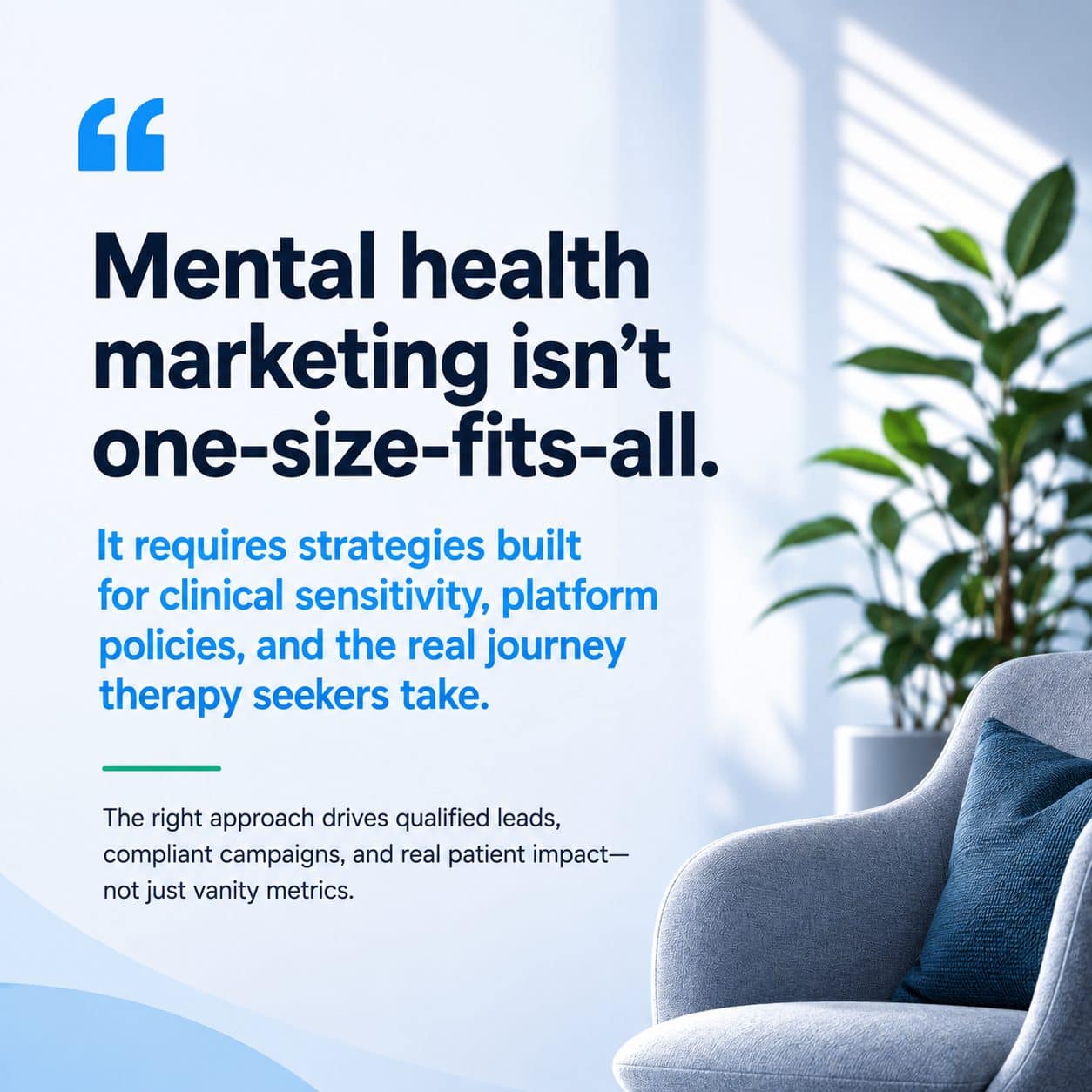
Marketing activity means nothing if it does not convert to actual patients. Mental health practices often struggle with the gap between website traffic and booked appointments. The problem is usually not the marketing. It is the conversion infrastructure: the website, the forms, the phone handling, and the intake process.
Website conversion optimization starts with page load speed and mobile experience. According to Google's Core Web Vitals research, sites that meet performance thresholds see measurably higher engagement. Mental health practices with outdated web development often lose visitors before they ever see the intake form.
Form design matters. Mental health forms should ask for the minimum information needed to qualify and schedule. Every additional field creates friction. Phone numbers should be prominent. Click-to-call should be enabled on mobile. Chat widgets can help, but must be staffed consistently, or they create worse experiences than no chat at all.
Attribution tracking connects marketing spend to actual outcomes. Marketing Powered tracks attribution through to admission, not just to form fill. This level of tracking requires proper CRM integration, call tracking, and conversion modeling. When you know which campaigns and keywords generate patients who actually complete intake, you can optimize budgets toward what works.
The practices that succeed in mental health marketing treat it as a system, not a series of disconnected tactics. Paid media drives qualified traffic. SEO captures intent-based searches. The website converts visitors into leads. The intake process converts leads into patients. Each component must work, and the connections between them must be measured. Our AI-native infrastructure enables this level of integrated optimization across every touchpoint.
Ready to Improve Your Mental Health Marketing?
Request an audit to discuss your current marketing strategy, compliance posture, lead quality, and channel mix. We will review what is working, identify gaps, and outline a path to better results.
Questions, Answered.
The most effective strategies combine search engine optimization for local visibility, compliant paid search campaigns targeting condition-specific keywords, and content marketing that builds authority around treatment approaches. Digital channels generally outperform traditional advertising for mental health because they capture people actively searching for help. The key is adapting each strategy to the compliance constraints of the mental health vertical, particularly the inability to retarget website visitors.
Digital marketing extends a practice's reach beyond referral networks to capture people actively searching for mental health services. It enables precise geographic targeting, measurable cost-per-lead tracking, and the ability to adjust campaigns based on what generates actual appointments. For practices looking to grow beyond word-of-mouth, digital marketing provides a scalable patient acquisition channel with clear attribution from ad spend to booked intake.
The primary challenges are compliance restrictions, audience sensitivity, and attribution complexity. Google and Meta classify mental health as a sensitive vertical, eliminating retargeting and limiting targeting options. Messaging must resonate with people in difficult situations without making outcome claims. Attribution is harder because decision cycles are longer than typical consumer purchases, often spanning 30 to 90 days from first search to booked appointment.
Compliance protects both the practice and prospective patients. HIPAA violations carry significant financial penalties. Ad platform policy violations result in disapproved campaigns and potentially suspended accounts. Beyond legal exposure, compliance builds trust with patients who expect mental health providers to handle their information and their care responsibly. Practices that cut corners on compliance eventually face consequences that outweigh any short-term gains.
Evaluate agencies on three criteria: vertical experience, compliance awareness, and attribution discipline. Ask how much they have managed specifically in mental health or behavioral health. Ask how they handle Google's sensitive healthcare policies and HIPAA considerations. Ask how they track results beyond clicks and form fills. An agency that has scaled practices in this vertical will have specific answers. An agency that treats mental health like any other client will give generic responses.
Ready to see what AI-native marketing can do for your treatment center?
Request a free audit of your paid media, landing pages, attribution, and compliance posture. You'll get a straight assessment of where the opportunities are.
or email us at info@marketingpowered.ai