Capabilities
Comprehensive Marketing Tracking Implementation for Growth
Precise analytics infrastructure built for behavioral health compliance and marketing performance.

Understanding Marketing Tracking Implementation
Marketing tracking implementation determines whether your behavioral health center operates on accurate data or expensive guesswork. When tracking is configured correctly, every dollar you spend on paid media, every form submission, and every phone call connects back to the campaign, ad group, and keyword that generated it. When it fails, you make budget decisions based on incomplete information.
For treatment centers, the stakes extend beyond marketing performance. Behavioral health operates under compliance in tracking systems that most agencies never encounter. HIPAA requirements govern how patient data flows through your analytics stack. LegitScript certification standards restrict what you can track and how you can use that data for advertising. Google's sensitive vertical policies limit retargeting entirely.
Proper marketing tracking implementation addresses three priorities simultaneously: data accuracy for campaign optimization, compliance with healthcare regulations, and attribution clarity from first click through admission. At Marketing Powered, we have managed over $50M in behavioral health and mental health media spend. That scale taught us where tracking breaks down in this vertical and how to build infrastructure that holds up under scrutiny.
The difference between a tracking setup that works and one that creates liability often comes down to configuration details. Event parameters, data layer variables, consent mode settings, and server-side routing all interact. Miss one element, and your attribution model tells you the wrong story about which campaigns drive admissions.
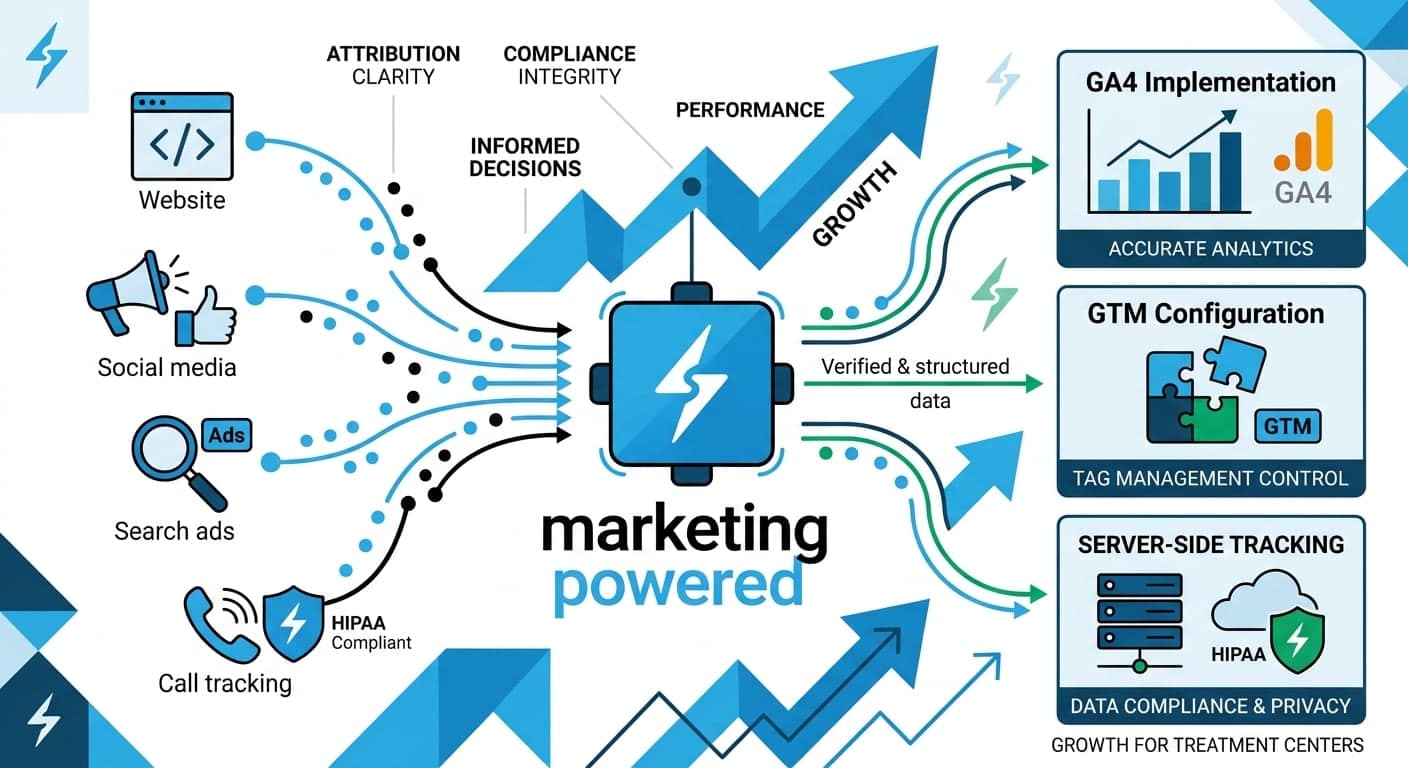
GA4 Implementation Services
Google Analytics 4 replaced Universal Analytics as Google's primary analytics platform, and the migration created challenges for treatment centers that had years of historical data in the old system. GA4 operates on an entirely different data model: event-based rather than session-based, with machine learning filling gaps where cookies fail. That architecture requires a ground-up approach to implementation, not a simple migration.
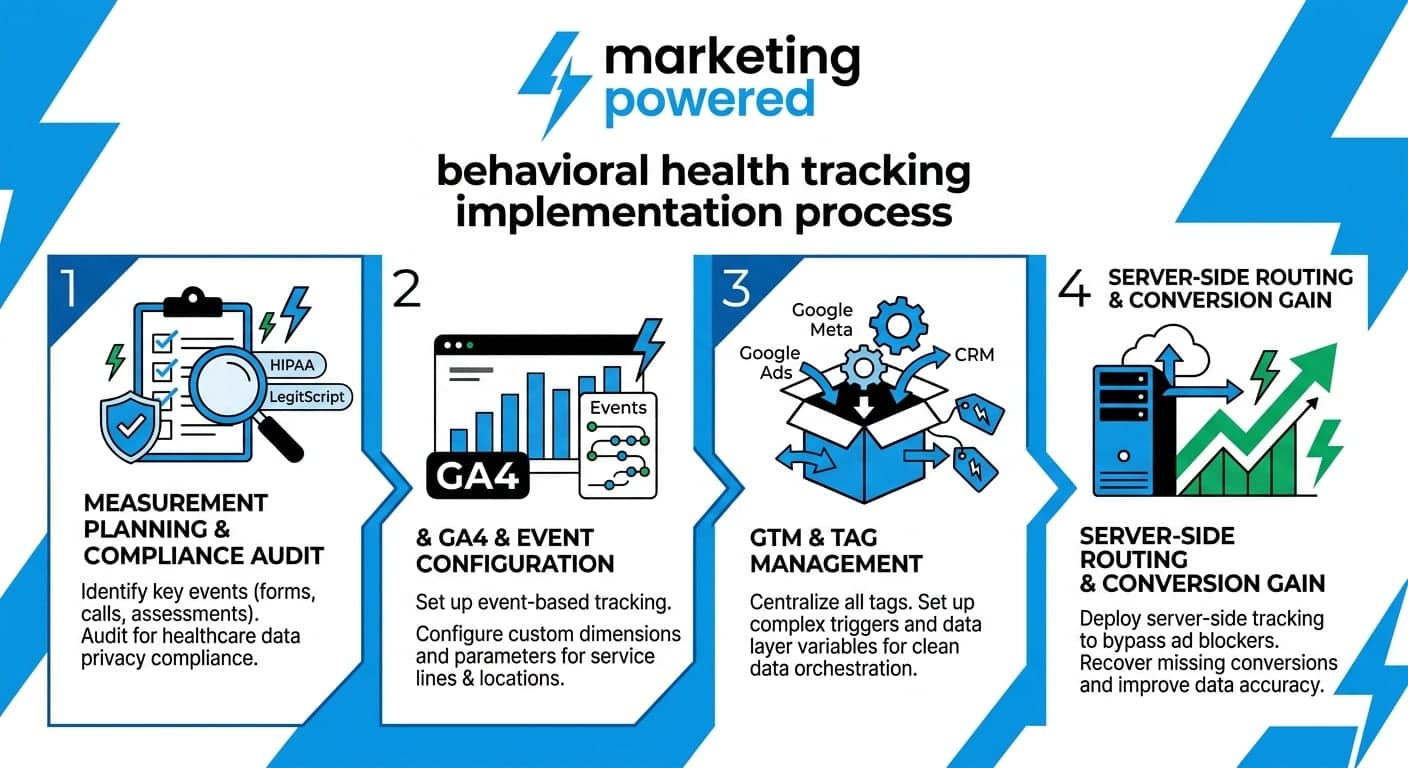
Our GA4 implementation process starts with measurement planning. We work with your marketing and admissions teams to identify the specific events that matter: form submissions, phone calls, chat initiations, assessment completions, and downstream admission data. Each event gets configured with parameters that let you segment by location, service line, insurance type, and campaign source.
Beyond basic event tracking, GA4 offers customization options that most agencies skip. Custom dimensions let you track business-specific attributes. User properties enable cohort analysis across the patient journey. Audiences built on predictive metrics can inform your behavioral health marketing strategies even without retargeting.
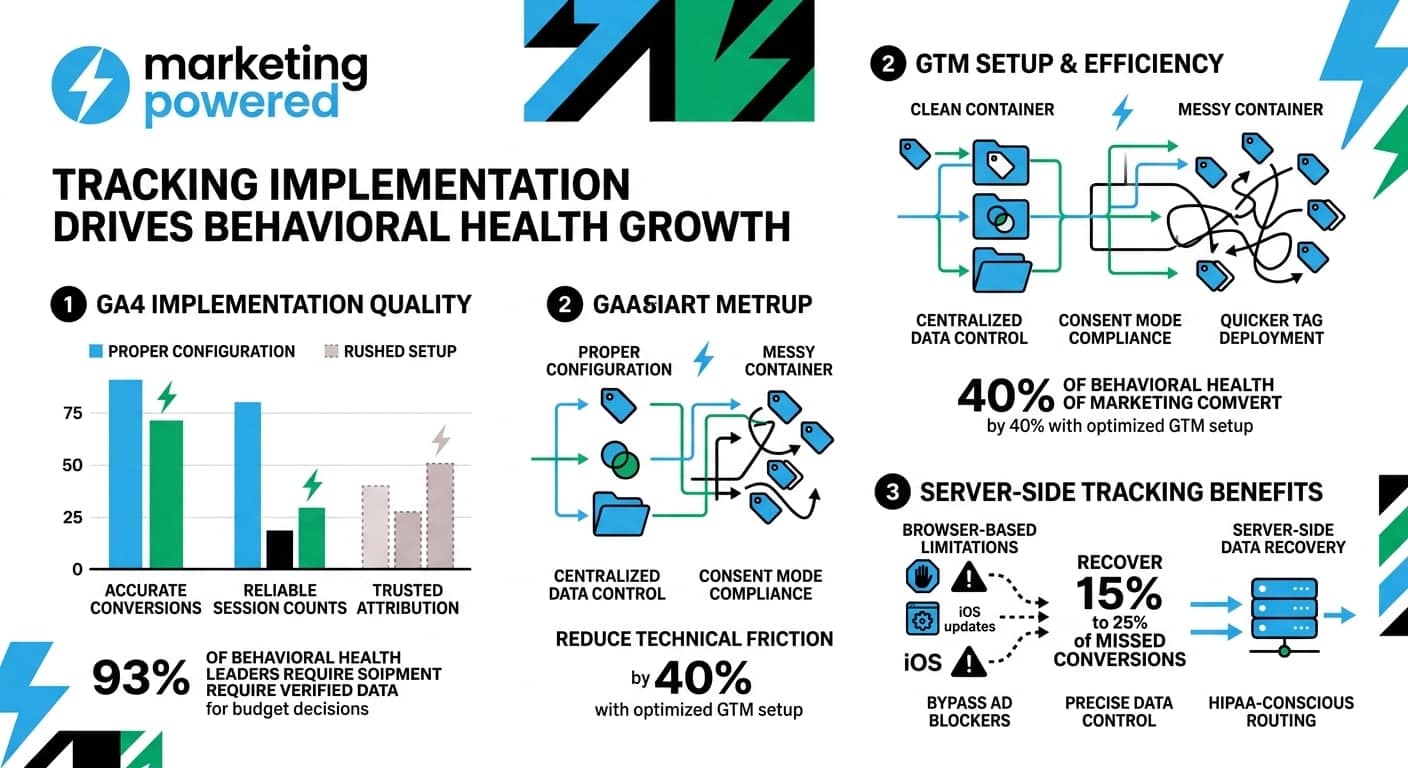
Implementation quality shows in the data. A properly configured GA4 property gives you accurate session counts, reliable conversion tracking, and attribution paths you can trust. A rushed setup produces inflated numbers, missing conversions, and reports that contradict your CRM. We have seen treatment centers make six-figure budget decisions based on GA4 data that was wrong because no one validated the implementation. According to Google's own documentation, GA4's event-based model requires deliberate configuration to match your business objectives.
GTM Configuration and Setup
Google Tag Manager sits between your website and your analytics, advertising, and marketing platforms. It controls what data gets collected, when it fires, and where it goes. For behavioral health centers running campaigns across Google Ads, Meta, and multiple analytics tools, the GTM setup complexity compounds quickly.
A clean GTM container follows predictable patterns. Tags fire on specific triggers. Variables pull data from consistent sources. Naming conventions let anyone on the team understand what each element does. Folders organize tags by function. Version control documents every change. These standards sound basic, but we regularly audit containers from other agencies that have duplicate tags, broken triggers, and no documentation.
Integration with existing marketing systems requires mapping data flows. Your CRM needs lead source information. Your call tracking platform needs to pass conversion data back to ad platforms. Your analytics in behavioral health needs consistent user identification across sessions. GTM orchestrates all of these connections when configured correctly.
The technical setup matters less than the outcome: accurate data flowing to every platform that needs it, with consent controls that respect user privacy and comply with regulations. We configure GTM containers to work with Google Consent Mode v2, ensuring that your tracking adapts appropriately based on user consent status. For treatment centers, this is not optional. Google's healthcare and medicines policy requires careful handling of health-related data.
Free Audit
Want a straight read on where your budget is leaking?
Server-Side Tracking Solutions
Browser-based tracking faces increasing limitations. Ad blockers prevent tags from firing. iOS privacy updates restrict cookie lifespans. Third-party cookie deprecation continues across browsers. For treatment centers that depend on accurate attribution to optimize admission costs, these trends degrade data quality every quarter.
Server-side tracking moves data collection from the browser to a server you control. Instead of JavaScript tags firing on the page, your server sends data directly to analytics and advertising platforms. This architecture offers three advantages: improved data accuracy because server requests bypass ad blockers, better privacy control because you filter data before it leaves your infrastructure, and longer cookie lifespans through first-party server-set cookies.
For behavioral health marketing, server-side tracking also supports compliance requirements. PHI never needs to touch browser-based tags. You control exactly what data reaches Google, Meta, and other platforms.
The HHS guidance on HIPAA and tracking technologies makes this control increasingly important for healthcare organizations.
Implementation requires server infrastructure, typically through Google Cloud or a similar platform. The added complexity pays off in data quality: we have seen treatment centers recover 15% to 25% of conversions that browser-based tracking missed entirely. When you manage $1.5M to $2M monthly in Google Ads, as we do across our behavioral health accounts, that recovered data changes optimization decisions.
Choosing the Right Partner for Integration
Marketing tracking implementation for behavioral health requires a partner who understands both the technical requirements and the vertical context. Generic digital agencies can configure GA4. They cannot navigate the intersection of HIPAA compliance, LegitScript certification requirements, and Google's sensitive vertical policies.
Look for demonstrated experience at scale. Our founder managed operator-side multi-market growth, building tracking infrastructure that handled attribution from first click through admission across multiple treatment modalities. That operator experience shows in how we approach implementation: we know what data your admissions team actually needs, not just what looks good in a marketing report.
Technical credentials matter, but vertical expertise matters more. We have managed to track attribution through to admission for treatment centers across the behavioral health spectrum, from digital marketing for addiction treatment to outpatient mental health practices. Our team has operated under LegitScript requirements and HIPAA-conscious infrastructure since 2022, when we began building AI-native systems specifically for healthcare marketing.
The right partner treats your tracking infrastructure as business-critical, because it is. Budget allocation, channel mix decisions, and growth planning all depend on accurate data. If your current analytics tell conflicting stories about what is working, the problem is almost always implementation, not the platforms themselves.
Schedule a Consultation
Your tracking infrastructure determines whether you optimize based on accurate data or expensive assumptions. If your current analytics leave gaps in attribution, conflict with your CRM, or create compliance questions you cannot answer, let us audit your setup and show you what accurate tracking looks like for behavioral health marketing.
Questions, Answered.
GA4 implementation is the process of configuring Google Analytics 4 to collect, process, and report data specific to your business objectives. For behavioral health centers, this includes setting up event tracking for form submissions, phone calls, and chat initiations, along with custom dimensions for service lines, locations, and insurance types. Proper implementation ensures your analytics reflect actual user behavior and marketing performance rather than default configurations that miss conversions or inflate metrics.
Google Tag Manager centralizes control over all tracking tags on your website, from Google Ads conversion pixels to Meta tracking to analytics events. A well-configured GTM container lets you deploy new tracking without developer involvement, test tags before pushing them live, and maintain consistent data across all marketing platforms. For treatment centers running multi-channel campaigns, GTM reduces the technical friction between identifying what works and scaling it.
Server-side tracking bypasses the browser limitations that degrade data quality: ad blockers, iOS privacy restrictions, and third-party cookie deprecation. By routing data through a server you control, you recover conversions that browser-based tracking misses, maintain longer cookie lifespans for attribution, and gain precise control over what data reaches external platforms. For HIPAA-conscious organizations, server-side tracking also provides a layer where PHI can be filtered before data leaves your infrastructure.
The most frequent issues we see include duplicate conversion tracking that inflates reported results, misconfigured event parameters that break attribution, consent mode implementations that block necessary data collection, and disconnected systems where CRM data never reconciles with analytics. For behavioral health specifically, we often find tracking setups that inadvertently capture sensitive data or violate Google's healthcare vertical policies, creating compliance exposure the marketing team did not anticipate.
We build tracking infrastructure with compliance requirements integrated from the start, not added as an afterthought. This includes configuring Google Consent Mode v2 appropriately, ensuring PHI never reaches browser-based tags, filtering sensitive data before it leaves server-side infrastructure, and auditing implementations against LegitScript certification requirements and Google's healthcare policies. Our team has operated under these constraints since 2022, managing over $50M in behavioral health media spend under sensitive vertical restrictions.
Ready to see what AI-native marketing can do for your treatment center?
Request a free audit of your paid media, landing pages, attribution, and compliance posture. You'll get a straight assessment of where the opportunities are.
or email us at info@marketingpowered.ai