Resources
Lead Tracking: From Spreadsheet to a System That Shows Source and Outcome
Every week, marketing dashboards report rising inquiry volumes and falling acquisition costs while executive leadership looks at open appointment slots and missing revenue. The breakdown is rarely a lack of prospective interest; it is an outdated lead tracking mechanism that severs the relationship between upfront campaign spend and realized business outcomes. When tracking ends at the moment a form is submitted or a call connects, marketing optimization operates entirely in the dark.
By Mike Hulick, Founder, Marketing Powered

What is lead tracking and why spreadsheets fail at scale
At its technical baseline, what is lead tracking? It is the continuous operational discipline of identifying, recording, and monitoring prospective customer interactions from initial digital ad exposure through qualification, intake, sales negotiation, and final financial realization. In high-consideration environments such as health systems, specialized clinics, legal practices, and commercial services, tracking must account for complex buyer journeys that take weeks or months across web, phone, and in-person touchpoints.
Most organizations begin tracking prospects using a lead tracking spreadsheet. In the earliest stages of an organization, an intake coordinator or sales associate manually pastes contact details into a shared Google Sheet or Microsoft Excel workbook. As inquiry volume climbs past several dozen records a week, this manual process introduces systemic points of failure:
- Parameter truncation: Session identifiers, campaign tags, and referral paths captured by web forms are routinely dropped when data is manually copied across tabs.
- Latency in speed-to-lead: Intake coordinators working out of rows and columns struggle to prioritize immediate callbacks, creating response delays that depress contact rates.
- Voice intake blindness: Inbound phone calls—often representing the highest-intent inquiries—are either omitted entirely or entered with subjective source labels such as "Google" or "referral."
- Disconnected feedback loops: A static spreadsheet cannot programmatically communicate with ad platform bidding engines. Downstream status changes, such as an intake assessment or an authorized admission, remain trapped in a cell rather than informing algorithmic bid strategies.
Relying on a manual sheet decouples media buying from revenue reality. Ad engines will gladly deliver hundreds of cheap form submissions to meet a low target cost per lead, but if none of those inquiries convert into paying clients or admitted patients, the business is merely subsidizing ad networks to generate noise.

The core data schema: what every lead record must capture
Moving beyond manual entry requires establishing a standardized, programmatic data schema across all intake endpoints. Whether an inquiry originates via a dynamic web form, a live chat widget, or an inbound phone line, the lead record must capture four distinct layers of telemetry before routing to operational staff.
1. Acquisition parameters
Every inbound lead must capture the complete tracking payload associated with the visit:
- Source, Medium, and Campaign: Standardized UTM tags designating the channel, distribution model, and strategic initiative.
- Ad Group and Creative Identifier: Granular parameters showing the exact messaging angle and copy variant that triggered the click.
- Click Identifiers: Platform-specific tokens such as Google Click IDs (GCLID), WBRAID, GBRAID, or Meta Click IDs (FBCLID) stored in first-party browser cookies and passed into hidden form fields.
2. Session parameters
Contextual session metadata separates authentic commercial demand from accidental clicks:
- Landing Page and Referrer Path: The full initial URL, including query parameters, alongside the HTTP referrer.
- Device Category and Browser Environment: Essential telemetry for debugging conversion friction across mobile versus desktop interfaces.
- Timestamp of Capture: Exact UTC timestamps down to the second to match inbound form data against server logs.
3. Operational parameters
Operational intake speed determines downstream conversion rates:
- Unique Intake Identifier: A persistent primary key generated at ingestion that follows the record across internal databases.
- Assigned Intake Coordinator or Representative: Identification of the specific staff member responsible for qualification.
- Speed-to-Contact Milestones: Timestamped logging of the first outbound outreach attempt, secondary follow-up, and initial live contact.
4. Downstream outcome parameters
This layer converts passive tracking into an actionable feedback engine:
- Qualification Status: Standardized criteria denoting whether the prospective client meets clinical, financial, or service-fit requirements.
- Milestone Progression: Concrete stage definitions (such as consultation scheduled, intake assessment completed, contract signed, or patient admitted).
- Realized Transaction Value: Gross margin or verified billing value associated with the individual customer file.
Lead tracking software versus custom CRM data architecture
Organizations seeking to upgrade their intake systems face a choice: implement commercial off-the-shelf lead tracking software or engineer a unified data architecture directly inside an enterprise CRM.
Off-the-shelf tools often provide quick setups with out-of-the-box reporting. However, standalone lead trackers introduce proprietary silos. They store data within their own closed interfaces, requiring secondary integrations or third-party webhooks to push records into production CRMs like Salesforce, HubSpot, or proprietary electronic health records. In complex sales cycles, these connectors frequently drop click identifiers during status updates, breaking the attribution chain before revenue is realized.
A custom architecture built directly into your primary CRM or customer database provides data sovereignty and operational resilience:
- Data Ownership; Turnkey Lead Tracking Software: Vendor-hosted cloud; subject to third-party retention limits; Unified CRM Data Architecture: Owned first-party database; complete retention control
- Regulatory Surface; Turnkey Lead Tracking Software: Requires third-party vendor BAAs; higher data leakage risk; Unified CRM Data Architecture: Kept within authorized infrastructure with explicit access controls
- Intake Workflow Sync; Turnkey Lead Tracking Software: Asynchronous webhook sync; prone to parameter drops; Unified CRM Data Architecture: Native field population on record creation; zero sync lag
- Offline Conversion Return. Turnkey Lead Tracking Software: Often limited to pre-packaged standard conversion events. Unified CRM Data Architecture: Flexible API pipelines mapping custom milestone stages to ad platforms.
- Multi-Location Routing; Turnkey Lead Tracking Software: Rigid location models; difficult regional customization; Unified CRM Data Architecture: Dynamic routing logic based on geo-parameters and facility capacity
Software alone cannot resolve structural attribution gaps. Tools merely store the data they are fed. If front-end intake forms, call systems, and back-end databases are not configured with strict field-validation rules, a dedicated software package will simply display the same incomplete records within a more expensive interface.
Free Audit
Want a straight read on where your budget is leaking?
Integrating dynamic call tracking into the attribution chain
In high-stakes, regulated environments such as hospital networks, addiction treatment facilities, and legal practices, prospective clients rarely make high-consideration decisions exclusively through digital text forms. They call directly. If your attribution framework cannot tie voice conversations to specific digital campaigns, your marketing data reflects only a fraction of customer demand.
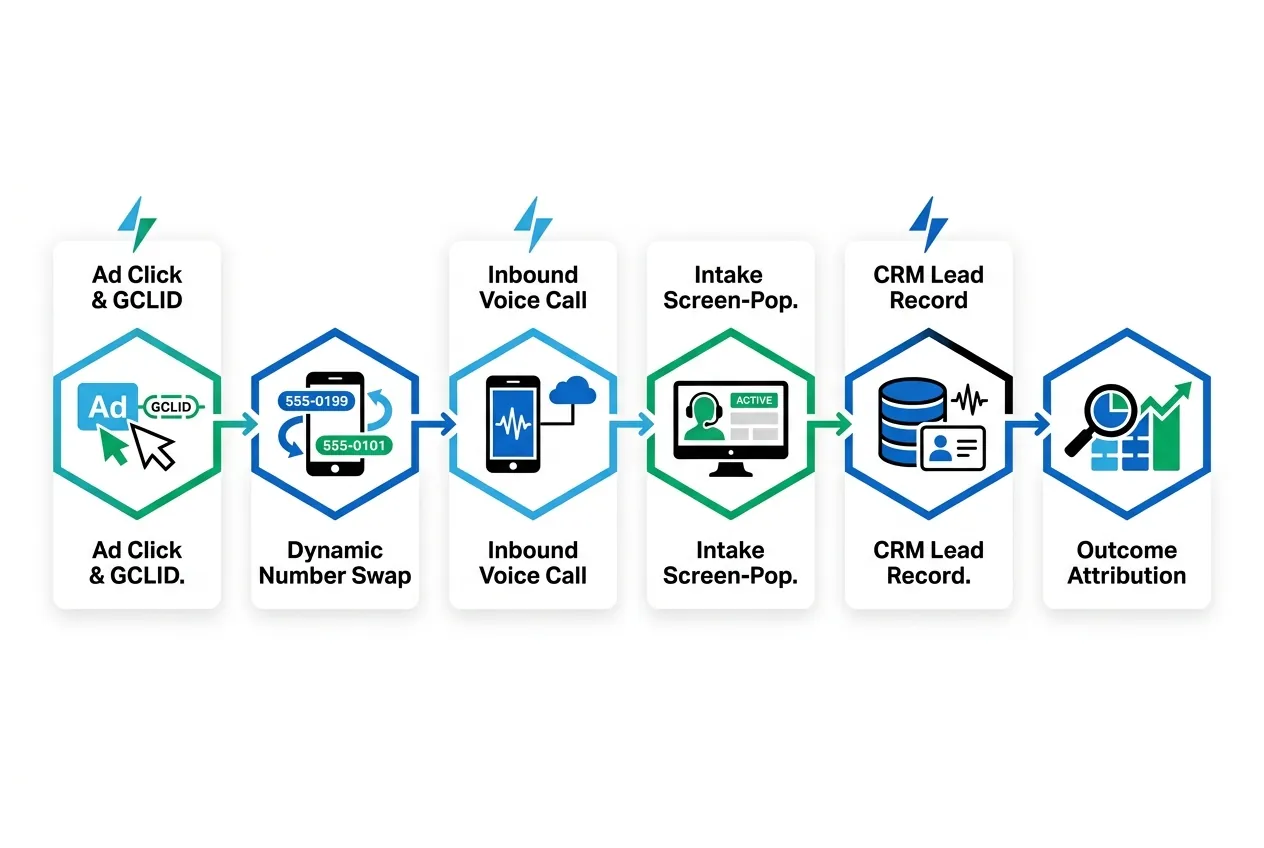
Dynamic call tracking bridges this operational gap using Dynamic Number Insertion (DNI). When a visitor arrives on your website, a client-side JavaScript snippet reads the visitor session parameters and dynamically swaps the visible telephone number for a unique tracking number assigned to that specific session, campaign, or source.
Dynamic call tracking requires careful configuration:
- Pool Sizing: Number pools must be scaled according to concurrent hourly traffic. If a pool is too small, multiple simultaneous visitors see the same phone number, resulting in misattributed calls.
- First-Party Data Passing: The call tracking system must pass the GCLID, landing page URL, and referring source into the CRM screen-pop so intake coordinators see the prospect's intent before answering.
- Milestone Logging: Call duration alone is an inadequate proxy for intent. The intake representative must tag the call disposition directly within the CRM, documenting whether the conversation yielded a clinically qualified inquiry, a scheduled assessment, or an irrelevant solicitation.
Our analysis of call tracking services: what a specialist partner delivers and how to vet one explores how high-performing multi-location organizations implement DNI without fragmenting their local search visibility or NAP (Name, Address, Phone) consistency.
Constructing a lead tracking dashboard that executives and finance trust
Marketing teams often present reports detailing impressions, click-through rates, and overall form volume. Financial leadership dismisses these metrics because raw lead volume does not pay corporate overhead. A production-grade lead tracking dashboard aligns marketing activities directly with the general ledger.
To build trust across leadership, an executive dashboard must separate top-of-funnel activity from downstream pipeline velocity:
Metrics that belong in the executive dashboard
- Cost Per Qualified Opportunity (CPQO): Blended ad spend divided exclusively by prospects who meet verified operational criteria. This prevents agencies from hiding low-quality traffic behind inflated lead counts.
- Speed to First Outreach: An operational health metric showing the elapsed time between initial ingestion and coordinator outreach. Lead conversion rates decay rapidly when initial response times exceed five minutes.
- Pipeline Yield by Ad Variant: Downstream conversion rates organized by specific creative angles, showing which ad copy generates clients who finalize agreements versus those who abandon early.
- Platform Optimization Latency: The elapsed time between when an operational milestone occurs in the CRM and when that signal is ingested by ad network bidding algorithms.
Operational teams need daily granular views to triage queues and resolve uncontacted leads. In contrast, executive dashboards should summarize monthly cohort performance, evaluating customer acquisition cost against total lifetime revenue. For a comprehensive breakdown of attribution models that support this framework, review our pillar guide on marketing attribution: a practical guide for teams that need real answers.
Privacy-first tracking in regulated healthcare and professional services
Constructing an attribution pipeline inside regulated sectors requires navigating complex data privacy boundaries. In healthcare, standard commercial tracking pixels installed haphazardly on patient-facing web properties create significant regulatory exposure.
The Department of Health and Human Services issued explicit warnings regarding these vulnerabilities in their bulletin on the use of online tracking technologies by HIPAA covered entities. Standard client-side trackers frequently transmit user IP addresses, unique device identifiers, and specific URL search parameters alongside page visit details to third-party tech vendors. When a user navigates pages addressing specific medical conditions, substance use disorders, or clinical specialties, transmitting that browsing data alongside identifying IP telemetry can constitute unauthorized disclosures of Protected Health Information (PHI).
Furthermore, advertising platforms enforce strict compliance standards within sensitive verticals. Under Google Ads policies on personalized advertising, advertisers are prohibited from deploying retargeting lists or building custom affinity audiences based on sensitive health categories, mental health conditions, or personal hardship.
A defensible tracking architecture resolves this tension through architectural separation.
Organizations must implement server-side tracking environments where outbound network calls pass through a customer-controlled reverse proxy before reaching external ad platforms. By applying technical safeguards aligned with the HHS guidance on methods for de-identification of PHI, engineering teams strip IP addresses, remove sensitive URL paths, and hash customer attributes. Only de-identified click tokens and standard conversion values reach ad network servers, preserving algorithmic bidding efficiency while keeping sensitive data fully protected.

Email Us
Prefer to send the context directly?
How Marketing Powered delivers attribution and data architecture
Marketing Powered builds modern, privacy-first measurement infrastructures for complex organizations operating in regulated, high-stakes environments. We replace manual spreadsheets and fragile data integrations with automated first-party pipelines that connect marketing expenditure directly to verified bottom-line performance.
Our capabilities are rooted in practical operating experience. Our founder is a former healthcare Chief Marketing Officer who led marketing strategy for a treatment network that expanded from 3 to 24 locations, personally managing $1.5 to $2M per month in Google Ads spend across 11+ behavioral and mental health accounts. As a court-certified expert witness in advertising strategy, our leadership brings verifiable governance and rigor to every campaign deployment.
We approach tracking through our dedicated data and analytics architecture: attribution, call tracking and first-party data service:
- First-Party Schema Engineering: We design and deploy custom intake schemas across web properties, phone tracking engines, and operational CRMs, ensuring acquisition tokens are preserved throughout the intake lifecycle.
- Server-Side Conversion Pipelines: We implement server-side tracking pipelines that sanitize sensitive telemetry, allowing organizations in healthcare, legal, and finance to feed optimization signals back to ad platforms without risking regulatory non-compliance.
- Offline Milestone Feedback: We engineer automated offline conversion import (OCI) routines that send verified operational milestones—such as qualified consultations or completed admissions—back into Google Ads and Meta. Attribution is tracked to verified admission or contract execution, never just raw lead acquisition.
- Owned, Local AI Infrastructure: We deploy owned, local AI infrastructure for HIPAA-aware inference, enabling automated transcription analysis and operational audit workflows without exposing proprietary organizational data to public cloud models.
If you are evaluating external partners to modernize your tracking stack, consult our guide on marketing attribution agency: what a specialist partner delivers and how to vet one.
Questions, Answered.
Lead tracking software is an application that identifies the digital origins of inbound customer inquiries, tracks user interactions across touchpoints, and logs milestone progression through a sales or intake pipeline. High-performing solutions integrate directly with operational CRMs, web analytics engines, and advertising platforms to maintain data continuity from click to close.
In traditional B2B or commercial sales, lead tracking focuses on pipeline velocity, deal stages, and account-based engagement across commercial contacts. In healthcare, lead tracking operates under stringent privacy constraints. Tracking systems must separate marketing attribution tokens from Protected Health Information, comply with sensitive advertising category rules, and track conversions to clinical assessments or patient admissions rather than signed sales contracts.
A lead tracking spreadsheet can support initial validation for low-volume operations handling fewer than ten inquiries a week. Once an organization scales past that point, manual spreadsheets break down. They fail to capture voice calls, drop dynamic campaign parameters, cause operational delays in lead follow-up, and prevent automated conversion data from reaching ad platform bid algorithms.
An offline conversion import is a data process that uploads conversion milestones that take place outside the website—such as an in-person consultation, signed retainer, or facility admission—back into advertising platforms like Google Ads. By passing the original click identifier (such as a GCLID) alongside the milestone status and value, ad algorithms optimize for high-margin customers rather than raw form submissions. Book an attribution audit with Marketing Powered
Ready to see where your marketing can improve?
Request a free audit of your paid media, landing pages, attribution, and measurement setup. You'll get a straight assessment of where the opportunities are.
or email us at info@marketingpowered.ai