Resources
Marketing Attribution: A Practical Guide for Teams That Need Real Answers
Most growth leaders find themselves caught between platform dashboards that claim credit for the same revenue and financial ledgers that tell a different story. Marketing attribution is supposed to eliminate that conflict, yet standard tracking tools frequently obscure the economic reality of complex customer journeys. This practical guide breaks down how to construct an auditable measurement architecture that connects acquisition capital directly to verified pipeline, admissions, and closed revenue.
By Mike Hulick, Founder, Marketing Powered

The core marketing attribution models: mechanics and operational trade-offs

What is marketing attribution, and why does conventional tracking fail?
Marketing attribution is the operational process of evaluating every touchpoint across the customer journey to understand how channels, campaigns, and creative assets influence pipeline and revenue. In simple sales motions, identifying that connection seems straightforward: a user clicks an ad, lands on a URL, and completes an e-commerce transaction in the same browser session. However, in high-consideration environments such as hospitals, healthcare networks, multi-location clinics, B2B software, and regulated professional services, customer journeys do not follow a tidy digital path. Decisions unfold over weeks or months, involve multiple stakeholders, cross different devices, and frequently move from digital screens to offline phone conversations.
Conventional tracking breaks down because growth teams rely on disparate platform-reported metrics rather than unified data architecture. Ad networks evaluate touches inside their own closed gardens. Google Ads measures interactions across its search network, display placements, and video inventory. Meta tracks engagement across Instagram feeds, Reels, and platform clicks. Each ad platform operates using distinct view-through and click-through attribution windows engineered to maximize reported value within its own interface. When a prospective patient or corporate buyer clicks a LinkedIn update, searches on Google two weeks later, clicks a search ad, and then submits a contact form after clicking a retargeting banner, both networks routinely claim 100 percent credit for that conversion.
The structural failure deepens when customer actions move offline. When a patient schedules an appointment by phone or a B2B prospect books an enterprise briefing through an executive referral, standard client-side tracking tags lose the thread entirely. The ad platform records a session that seemingly ended without action, while the intake coordinator or sales representative enters an opportunity into the CRM with no digital attribution parameters attached. Without an operational bridge connecting ad-click identifiers to offline CRM stages, marketing attribution devolves into guesswork. The marketing team ends up defending ad spend using synthetic engagement figures while financial executives focus solely on pipeline deficits.
Every organization evaluating attribution must choose how to allocate credit across customer touchpoints. Attribution modeling attempts to distribute mathematical credit across those interactions, but every model carries distinct assumptions and structural limitations. Selecting the right approach requires understanding how these frameworks function in live marketing environments.
Single-touch attribution models
Single-touch frameworks assign 100 percent of the conversion value to a single customer touchpoint, ignoring all other interactions.
- First-touch attribution: This model assigns full credit to the initial recorded interaction that introduced the prospect to your digital ecosystem. It offers clear visibility into top-of-funnel discovery channels, showing which organic blog posts, non-branded search terms, or social placements originate net-new awareness. Its fundamental limitation is that it completely ignores mid-funnel education, email nurture sequences, and the closing conversion touchpoint. In long sales cycles, relying exclusively on first-touch credit leads teams to starve downstream conversion assets.
- Last-touch attribution (last-click): Historically the default in Google Analytics and standard CRM setups, last-click models assign all value to the final recorded asset or channel before conversion. While simple to deploy, this approach introduces severe bias. It routinely overvalues branded search, direct browser navigation, and aggressive retargeting campaigns while starving the discovery channels that initially captured the buyer. When teams allocate media spend strictly on last-click performance, acquisition pipelines eventually dry up because top-of-funnel investment was stripped away.
Rule-based multi-touch attribution models
To account for multi-channel journeys, rule-based multi-touch frameworks distribute value across several touchpoints using fixed mathematical percentages.
- Linear attribution: This framework distributes credit equally across every tracked interaction in the buyer journey. If an individual encounters an organic search article, clicks a paid search ad, registers for a webinar, and clicks a nurture email before purchasing, each touchpoint receives 25 percent of the credit. While this approach acknowledges full-funnel participation, it obscures which interactions actually altered buyer velocity and which were merely passive impressions.
- Time-decay attribution: This model weights touchpoints based on when they occurred relative to the conversion event. Interactions closer to the conversion receive the highest percentage of credit, with earlier touches receiving exponentially less. This framework reflects momentum, making it useful in sales motions where late-stage competitive comparisons dictate the final choice. However, it severely undervalues the initial high-intent discovery assets that brought the prospect into the funnel.
- Position-based (U-shaped and W-shaped) attribution: Position-based models allocate fixed, higher percentages to milestone events. A standard U-shaped model awards 40 percent of the credit to the first touch, 40 percent to the lead-creation touch, and divides the remaining 20 percent among intervening touches. The W-shaped model builds on this logic by assigning 30 percent each to the first touch, lead creation, and primary opportunity creation, splitting the remaining 10 percent among nurturing touches. These frameworks work well for structured B2B pipelines where distinct lifecycle transitions exist, but they still rely on arbitrary, static percentages rather than observed buyer behavior.
Data-driven and algorithmic attribution
Data-driven attribution models use machine-learning algorithms to compare customer paths that converted against paths that did not convert. By evaluating touchpoint sequences across thousands of journeys, algorithmic modeling determines which touchpoints generated statistically significant incremental lift.
While data-driven attribution removes the arbitrariness of fixed rules, it requires massive conversion volumes to achieve statistical validity. For consumer platforms processing hundreds of thousands of monthly transactions, algorithmic weighting provides useful direction. For high-consideration healthcare networks, specialized clinics, or enterprise B2B organizations closing tens or hundreds of high-value accounts each month, data-driven algorithms often generate volatile, erratic credit distributions because the sample size is far too small.
The privacy and technical shifts breaking client-side tracking
Marketing measurement faces significant headwinds due to browser privacy updates, operating system tracking restrictions, and evolving compliance mandates. Marketing teams relying on legacy tracking tags, third-party cookies, and unencrypted client-side scripts are finding their attribution reports increasingly inaccurate.
The deprecation of third-party tracking across modern browsers has severely limited the ability of ad networks to identify users across independent domains. Apple's App Tracking Transparency framework and Safari's Intelligent Tracking Prevention actively restrict tracking parameters and compress client-side cookie lifespans down to as little as 24 hours. When a prospective buyer clicks a paid campaign on Monday on a mobile device and returns to finalize a consultation on Thursday, client-side scripts frequently treat that returning visit as a new, direct visitor. The multi-touch customer journey is severed, and attribution defaults to direct traffic.
In regulated verticals such as hospitals, healthcare systems, and behavioral health networks, measurement complexity is further heightened by strict federal oversight. The Department of Health and Human Services issued explicit regulatory guidance regarding digital tracking tools under the HHS Tracking Guidance. The guidance warns covered entities and business associates that placing standard advertising pixels on authenticated patient portals, scheduling pages, and specific unauthenticated condition-specific webpages can trigger unauthorized disclosures of protected health information. Transmitting an IP address alongside metadata that connects an identifiable person to health conditions or treatment requests violates federal privacy protections.
Simultaneously, advertising platforms enforce stringent privacy standards. Under the Google Ads Policy: Personalized Advertising, advertisers cannot run personalized advertising, remarketing lists, or custom audience targeting based on sensitive personal categories, including physical health conditions, mental health status, and clinical treatments. Growth teams operating in sensitive healthcare spaces cannot rely on retargeting pixels to mop up unqualified traffic.
These regulatory realities break traditional tracking scripts. When an organization cannot drop persistent third-party tracking pixels on conversion pages, traditional marketing attribution software running on client-side browser cookies fails. Growth operators must pivot away from legacy client-side tag managers toward hardened, first-party data capture and compliant server-side data infrastructure.
Free Audit
Want a straight read on where your budget is leaking?
How to build an accountable first-party marketing attribution architecture
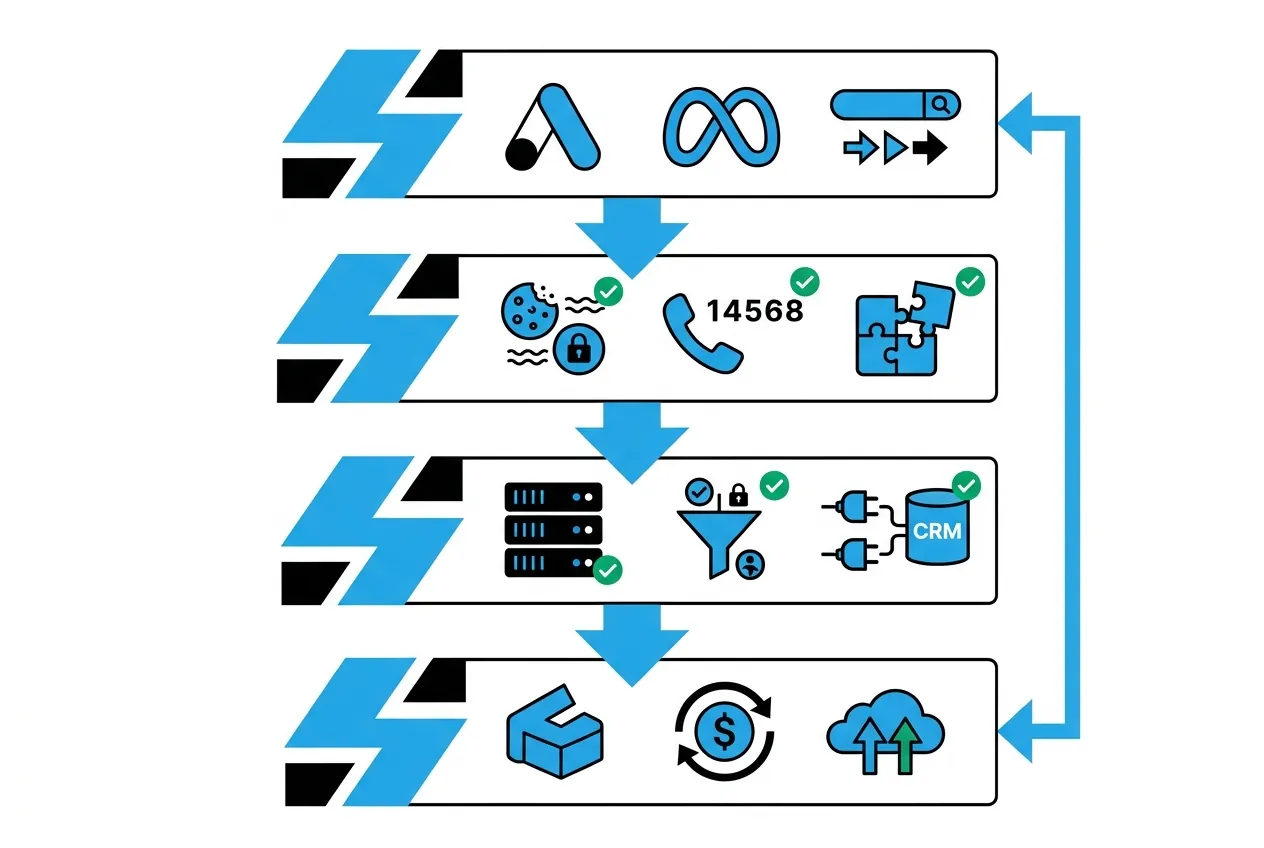
Durable marketing attribution is not a mathematical trick implemented by software. It is an operational discipline rooted in rigorous data governance, robust capture mechanics, and unified pipeline reporting. Teams seeking dependable answers must construct a clean first-party data architecture across four distinct stages.
1. First-party parameter capture and storage
Attribution begins the millisecond an inbound visitor arrives on an owned digital property. Standard URL query strings containing campaign parameters, source definitions, keyword intents, and ad-click identifiers such as Google's GCLID or Meta's FBCLID must be extracted immediately. Rather than storing these identifiers in fragile browser local storage or third-party cookies that expire in days, your infrastructure must write these values into secure, first-party HTTP cookies served directly from your primary root domain.
These first-party identifiers must persist throughout the session and attach seamlessly to dynamic form submissions, scheduling widgets, and chat dialogs. By ensuring that web forms automatically ingest original campaign source parameters into hidden form fields, you guarantee that every digital submission carries its exact acquisition lineage directly into your CRM.
2. Compliant call tracking and dynamic number insertion
In high-consideration sectors, high-intent prospective buyers frequently pick up the phone rather than submit digital contact forms. If phone inquiries are not tied back to the originating campaign, keywords, and session parameters, your attribution architecture loses its most valuable conversion segment.
Deploying dynamic number insertion allows your website to programmatically swap displayed telephone numbers based on visitor traffic source and session data. When an individual dials the dynamically generated number, the call tracking platform matches the incoming phone call to the active digital session, binding the caller's identity to their marketing source parameters.
In regulated healthcare settings, this infrastructure must be deployed with strict compliance guardrails. Call tracking databases and session routing systems must avoid capturing sensitive protected health details unless secure business associate agreements are active and systems are fully isolated. Teams seeking to establish this capability can examine dedicated call tracking services: what a specialist partner delivers and how to vet one to ensure data governance and HIPAA awareness remain intact throughout the routing workflow.
3. Server-side conversion routing and CRM mapping
Client-side ad tags firing inside consumer browsers introduce latency, risk ad-blocker suppression, and expose organizations to data privacy violations. Modern measurement architecture routes data server-side.
When a digital inquiry or telephone interaction occurs, data passes directly from your server to secure event-routing infrastructure. This server-side layer scrubs unauthorized parameters, strips sensitive personal identifiers where prohibited by policy, and verifies data integrity before passing conversion payloads to platform APIs.
Concurrently, the event-routing layer pushes verified leads into your CRM, mapping acquisition parameters to custom deal or contact properties. The record reflects not merely that a lead was created, but records the exact campaign, ad group, keyword match type, landing page version, and session identifier that drove the initial inquiry.
4. Closed-loop offline conversion imports
The most critical breakdown in growth marketing occurs between lead creation and closed revenue. Ad platforms naturally optimize toward the conversion actions they can see. If your ad accounts are configured to optimize for raw form submissions or initial telephone inquiries, their automated bidding engines adjust bidding strategies to maximize low-cost inquiries. This routinely drives up unqualified form submissions, spam calls, and non-viable leads while inflating reported platform returns.
Closed-loop attribution solves this problem by feeding verified offline outcomes back into the advertising networks. Through primary integrations using Google Ads Offline Conversion Tracking and the Meta Conversions API, organizations systematically upload authenticated milestones back to ad platforms.
When an intake department qualifies a patient, a sales team conducts a discovery briefing, or an admissions desk executes an agreement, the CRM triggers a server-side conversion upload containing the original click identifier and conversion value. Smart bidding algorithms then optimize media spend based on actual downstream economic outcomes, such as verified admissions, qualified opportunities, or closed pipeline, rather than top-of-funnel conversion noise.
Evaluating marketing attribution software: why tools cannot fix broken data
When executive teams realize their marketing reporting lacks clarity, the default corporate reaction is frequently to purchase specialized marketing attribution software. Software vendors routinely pitch multi-touch attribution platforms that promise algorithmic clarity, automated cross-device identity resolution, and executive dashboards with minimal technical overhead.
Yet organizations frequently experience buyer remorse within months of implementing multi-touch software platforms. Marketing attribution software is merely a calculation engine; it does not generate clean tracking records. When attribution software sits on top of unmapped intake processes, untracked telephone calls, disconnected CRMs, and broken parameter tracking, it simply redistributes operational noise across intricate visual charts.
Before investing in expensive third-party attribution platforms, growth leaders must audit their foundational tracking architecture:
- Identity resolution limitations: Third-party attribution tools frequently claim advanced probabilistic identity resolution, promising to connect user journeys across multiple personal devices without persistent identifiers. In practice, probabilistic matching relies on modeled assumptions that degrade quickly when browser privacy settings, localized VPNs, and shared enterprise network connections are introduced. Deterministic matching based on first-party CRM identifiers is the only durable methodology.
- Siloed reporting vs. bidding automation: Many third-party attribution platforms operate as isolated reporting dashboards. While they provide retrospective charts detailing customer touchpoints, their insights remain siloed outside your active advertising accounts. If the attribution software cannot inject downstream revenue data directly into Google Ads and Meta bidding algorithms, your media buyers cannot use that data to improve automated bidding performance.
- Data sovereignty and security risks: Regulated enterprises cannot casually route proprietary buyer interactions through external SaaS platforms whose data-handling procedures fall outside compliance standards. For hospitals, specialized healthcare systems, and professional practices, routing sensitive intake details through multi-tenant analytics SaaS platforms introduces significant legal and compliance exposure.
Software cannot compensate for poor operational discipline. Until an organization establishes strict UTM governance, captures first-party session parameters reliably, integrates phone conversions, and aligns CRM lifecycle stages to closed financial outcomes, buying an attribution tool simply adds SaaS overhead to an unsolved data engineering problem.
A decision framework: matching attribution methodology to your sales cycle
Organizations often struggle with marketing attribution because they select a measurement framework misaligned with their sales cycle and organizational data maturity. Measurement frameworks must match commercial realities rather than textbook ideals.
- High-Volume Transactional<br>Cycle: 1 to 7 Days<br>Low Consideration. Recommended Attribution Methodology: Data-Driven or Time-Decay Attribution inside ad platforms. Primary Conversion Milestone Tracked: Completed Checkout or First Transaction Value. Critical Infrastructure Requirement: Client and Server-Side Tags, Basic Form and Cart Event Tracking.
- Multi-Location Local Services<br>Cycle: 1 to 14 Days<br>Immediate Service Need. Recommended Attribution Methodology: First-Party First-Click with Closed-Loop Call Tracking. Primary Conversion Milestone Tracked: Qualified Inbound Call or Scheduled Appointment. Critical Infrastructure Requirement: Dynamic Number Insertion, Call Duration Thresholds, Local CRM Integration.
- Regulated Healthcare & Clinical<br>Cycle: 14 to 60 Days<br>High Consideration & Intake Gate. Recommended Attribution Methodology: Milestone-Based Position Modeling with Offline Imports. Primary Conversion Milestone Tracked: Clinically Qualified Inbound Inquiry and Verified Admission. Critical Infrastructure Requirement: HIPAA-Aware Server-Side Routing, LegitScript-Aware Media, Direct CRM Offline Sync.
- Complex Enterprise B2B<br>Cycle: 60 to 180+ Days<br>Multi-Stakeholder Buying Committees. Recommended Attribution Methodology: W-Shaped Position Model combined with Pipeline Lift Analysis. Primary Conversion Milestone Tracked: Stage 2 Qualified Pipeline and Closed-Won Revenue. Critical Infrastructure Requirement: Full CRM Opportunity Mapping, First-Party Parameter Capture, Closed-Loop OCI.
Transactional organizations with short sales cycles can function effectively using algorithmic, platform-native attribution models because conversion events occur rapidly within standard tracking windows. The feedback loop between ad impression, click, and transaction remains intact.
Conversely, organizations navigating extended consideration cycles, such as healthcare networks, specialized clinical centers, and enterprise service firms, require milestone-based position modeling anchored by deterministic offline conversions. When buying decisions require clinical assessments, insurance verification, multi-stakeholder approvals, or formal enterprise contracting, platform-level tracking cookies will inevitably expire before the sale closes.
For these high-consideration environments, tracking must focus on pipeline velocity and stage progression. The measurement architecture must capture the original click identifier at the moment of initial inquiry, hold that identifier securely in the CRM throughout an extended 60-day or 90-day review cycle, and pass an offline conversion back to the ad network the moment the deal progresses to verified revenue or clinical admission. Evaluating the operational requirements of this infrastructure is why growth leaders frequently partner with specialized firms; learning how to review such providers is detailed in our guide on marketing attribution agency: what a specialist partner delivers and how to vet one.

Email Us
Prefer to send the context directly?
How Marketing Powered delivers data and analytics architecture
Marketing Powered approaches marketing measurement from an operator-led perspective. Founded by a former healthcare CMO who ran marketing for a treatment network that grew from 3 to 24 locations and managed $1.5 to $2M per month in Google Ads across 11+ behavioral and mental health accounts, our firm was built to eliminate measurement ambiguity in regulated, high-stakes environments. Our founder is also a court-certified expert witness in advertising strategy, bringing rigorous evidentiary discipline to marketing measurement.
We design, deploy, and maintain custom data and analytics architecture: attribution, call tracking and first-party data. We do not sell generic SaaS dashboards or push standardized attribution models onto broken operational foundations. Instead, we engineer durable data pipelines that connect advertising platforms, landing page networks, call tracking systems, and enterprise CRMs into unified acquisition systems.
Our operational implementation focuses on four foundational areas:
- First-party tracking deployment: We engineer custom server-side tracking pipelines that capture, store, and route campaign parameters and click identifiers without exposing organizations to data leakage or browser cookie deprecation.
- HIPAA-aware and LegitScript-aware compliance: Built specifically to navigate Google's sensitive healthcare vertical, where personalized advertising and retargeting are strictly prohibited, our systems enforce strict data governance. We operate owned, local AI infrastructure for HIPAA-aware inference, ensuring sensitive data processing remains sovereign and securely isolated.
- Closed-loop CRM and call integration: We integrate dynamic number insertion and CRM pipeline stages directly with platform conversion APIs. Attribution is tracked to verified admission, clinical intake, or closed revenue, not merely raw, unqualified lead submissions.
- Automated offline conversion feedback: We configure continuous offline conversion imports that feed verified revenue events directly into Google Ads and Meta bidding systems, allowing automated smart bidding strategies to optimize spend against high-value commercial outcomes.
By uniting technical data engineering with deep paid media management experience, we ensure that executive leadership teams possess auditable, defensible measurement that satisfies both the growth team and the chief financial officer.
Questions, Answered.
Single-touch attribution assigns 100 percent of conversion credit to one specific touchpoint, typically either the first interaction (first-touch) or the final interaction before conversion (last-touch). Multi-touch attribution distributes credit across multiple interactions throughout the customer journey, either through fixed mathematical rules (such as linear, time-decay, or position-based models) or through algorithmic data modeling. While single-touch models are simple to implement, they ignore multi-channel nurture steps. Multi-touch models better reflect extended customer journeys but require complete, unbroken first-party data capture across every stage to provide meaningful guidance.
Privacy regulations and federal regulatory guidance, including bulletin guidelines from the Department of Health and Human Services, strictly limit how healthcare entities can utilize digital tracking technologies. Standard client-side tracking pixels that transmit IP addresses, page URLs containing medical conditions, or appointment scheduling metadata to third-party ad networks can violate federal privacy standards. Furthermore, platform policies prohibit retargeting users based on physical or mental health conditions. Healthcare marketing attribution requires HIPAA-aware, server-side data routing that strips protected health information before passing event data to advertising networks.
Ad platform dashboards report conversions based on proprietary attribution windows, view-through modeling, and network-specific conversion actions. For instance, Google Ads and Meta routinely claim credit for the same conversion if a user interacted with ads from both platforms prior to converting. Additionally, platform pixels measure client-side form submissions, which often include duplicate submissions, spam leads, and inquiries from outside target service areas. CRM records reflect real business leads that successfully passed through operational intake and qualification filters. The discrepancy can only be resolved by configuring closed-loop offline conversion imports that synchronize CRM-verified milestones back to ad platforms using persistent click identifiers.
For sales cycles exceeding 14 to 30 days, single-touch last-click models fail because they ignore the critical discovery and mid-funnel education channels that initially generated intent. Algorithmic or data-driven models also struggle unless conversion volume reaches thousands of monthly events. For long consideration cycles, a milestone-based position model (such as a W-shaped framework) combined with offline conversion imports provides the most actionable clarity. This approach attributes weighted credit to initial discovery, lead generation, and pipeline qualification milestones, while routing authenticated CRM stages back to ad platforms to anchor automated bidding on closed revenue or verified admissions. Book an attribution audit with Marketing Powered
Ready to see where your marketing can improve?
Request a free audit of your paid media, landing pages, attribution, and measurement setup. You'll get a straight assessment of where the opportunities are.
or email us at info@marketingpowered.ai