Resources
Healthcare Marketing: The Operating Guide for Health Systems and Provider Groups
Healthcare marketing for hospitals, health systems, and multi-specialty provider groups requires a disciplined demand architecture rather than untracked brand awareness. Modern healthcare leadership faces compressed operating margins, clinical staffing shortages, and strict patient privacy regulations that invalidate traditional lead-generation tactics. This operating guide outlines how growth executives connect qualified patient search intent, privacy-compliant conversion tracking, and clinical intake operations to build predictable patient volume across regional facilities.
By Mike Hulick, Founder, Marketing Powered

Developing an Accountable Healthcare Marketing Strategy

What Is Healthcare Marketing in Modern Health Systems?
Modern healthcare marketing is the strategic coordination of patient access, digital communications, clinical service positioning, and intake operations across the care continuum. It differs fundamentally from consumer goods marketing or business-to-business lead generation because it navigates strict clinical ethics, regional referral relationships, and regulatory enforcement. For health-system leaders, the mandate is not simply driving traffic to a web property, but routing individuals to the appropriate level of clinical care while matching demand to available physician capacity.
The discipline divides across three distinct operating environments:
- Acute and Emergency Hospital Services: Immediate, geography-dependent care where patient decision timeframes are compressed, and location accessibility dictates the patient journey.
- Specialized Tertiary Care and Elective Procedures: High-acuity service lines such as orthopedics, cardiology, oncology, and bariatric surgery, where patients and family members conduct thorough, multi-stage evaluations over weeks or months.
- Outpatient and Ambulatory Networks: High-frequency, relationship-based services such as primary care, pediatrics, and behavioral health clinics, where ongoing access, frictionless scheduling, and local proximity determine patient retention.
In commercial discussions, growth leaders frequently ask what constitutes business-to-business (B2B) healthcare marketing versus direct-to-consumer (D2C) patient acquisition. B2B healthcare marketing targets professional referral channels: independent primary care physicians directing complex cases to regional surgical specialists, hospital discharge planners coordinating post-acute recovery beds, and self-insured employers contracting for direct health-system care bundles. Direct-to-consumer patient acquisition addresses individuals researching symptoms, comparing clinical treatment options, or booking outpatient evaluations.
Both categories fail when treated as disconnected advertising campaigns. An effective marketing program unifies institutional physician outreach with consumer search visibility, creating a coherent regional presence that serves patients, referring clinicians, and clinical operations simultaneously.
An accountable healthcare marketing strategy begins with service-line capacity, facility utilization, and reimbursement economics rather than ad channels or promotional messaging. Health systems do not benefit from generating hundreds of patient inquiries for a clinical department operating at 100 percent utilization with a six-week appointment backlog. Doing so frustrates prospective patients, burns out clinical coordinators, and wastes capital.
A defensible strategy requires marketing executives to evaluate four operational inputs before allocating budget:
- Clinical Service-Line Capacity: Real-time visibility into new-patient appointment availability across outpatient practices, operating rooms, and diagnostic facilities. Marketing spend must adjust dynamically based on clinic openings, physician onboarding schedules, and regional service changes.
- Payer Mix Realities: Balancing commercial insurance coverage, Medicare, Medicaid, and self-pay demographics to maintain the financial solvency of specialized programs while fulfilling community health access commitments.
- Patient Search Intent Categorization: Segmenting patient queries between informational research ("what causes meniscus tears"), evaluative comparisons ("orthopedic knee surgeons near me"), and transactional access requests ("same-day joint consultation booking").
- Channel Governance and Compliance: Structuring digital touchpoints to satisfy data privacy restrictions, particularly surrounding online tracking technologies, pixel governance, and regulated advertising categories.
Developing a healthcare marketing strategy also requires service-line prioritization. Growth teams often divide budgets equally across departments, giving equal weight to primary care, cardiovascular care, and physical therapy. This dilutes capital and prevents significant category leadership.
Instead, high-performing healthcare systems organize investments into distinct operating tiers. High-margin surgical specialties receive dedicated paid search budgets and optimized booking flows to maximize theater utilization. High-frequency primary care networks leverage automated local directory optimization and search engine positioning to drive continuous geographic acquisition. Highly specialized tertiary programs invest in clinical education and peer referral networks to draw regional cases requiring advanced interventions.
Building a Privacy-Safe Healthcare Digital Marketing Architecture
Healthcare digital marketing operates under the strictest regulatory scrutiny in the digital economy. Marketing teams that rely on standard commercial tracking methods expose their health systems to severe legal, financial, and reputational risk.
The primary regulatory factor is the federal enforcement regarding online tracking technologies. The HHS Office for Civil Rights Guidance on Online Tracking Technologies specifies that HIPAA-covered entities and business associates cannot use tracking technologies that disclose protected health information (PHI) to third-party ad platforms or analytics vendors without explicit HIPAA-compliant authorizations or a valid Business Associate Agreement (BAA). Standard ad platform pixels, which record IP addresses alongside URLs indicating medical conditions or doctor search queries, create unauthorized PHI transmissions.
Simultaneously, major search platforms maintain strict advertising restrictions. The Google Ads Policy on Personalized Advertising explicitly prohibits remarketing and audience targeting based on sensitive personal health hardships, physical ailments, mental health conditions, and specialized treatments. Advertisers cannot drop a retargeting cookie on a user who visits an oncology or addiction recovery page and serve them follow-up display banners across the web.
To achieve sustainable growth under these constraints, health systems must implement a modern, privacy-first technical architecture:
- Eliminate Unauthenticated Third-Party Ad Trackers: Remove client-side ad network pixels from all patient-facing web properties, appointment request forms, and provider directories.
- Deploy Server-Side Tagging with BAA Coverage: Implement server-side tracking pipelines through compliant middleware where data is sanitized, IP addresses are scrubbed, and identifiers are removed before any campaign conversion metadata reaches external ad systems.
- First-Touch Conversion Focus: Because retargeting is restricted in sensitive medical categories, initial landing pages must provide immediate, high-trust answers, verified clinical credentials, clear pricing or insurance navigation, and direct access to intake scheduling.
- LegitScript Certification for Specialized Lines: Where health networks operate specialized behavioral health, substance use, or specialized pharmaceutical programs, marketing leaders must secure and maintain mandatory third-party verification through LegitScript Certification to run search campaigns.
Free Audit
Want a straight read on where your budget is leaking?
Connecting Demand Capture to Operational Intake and Capacity
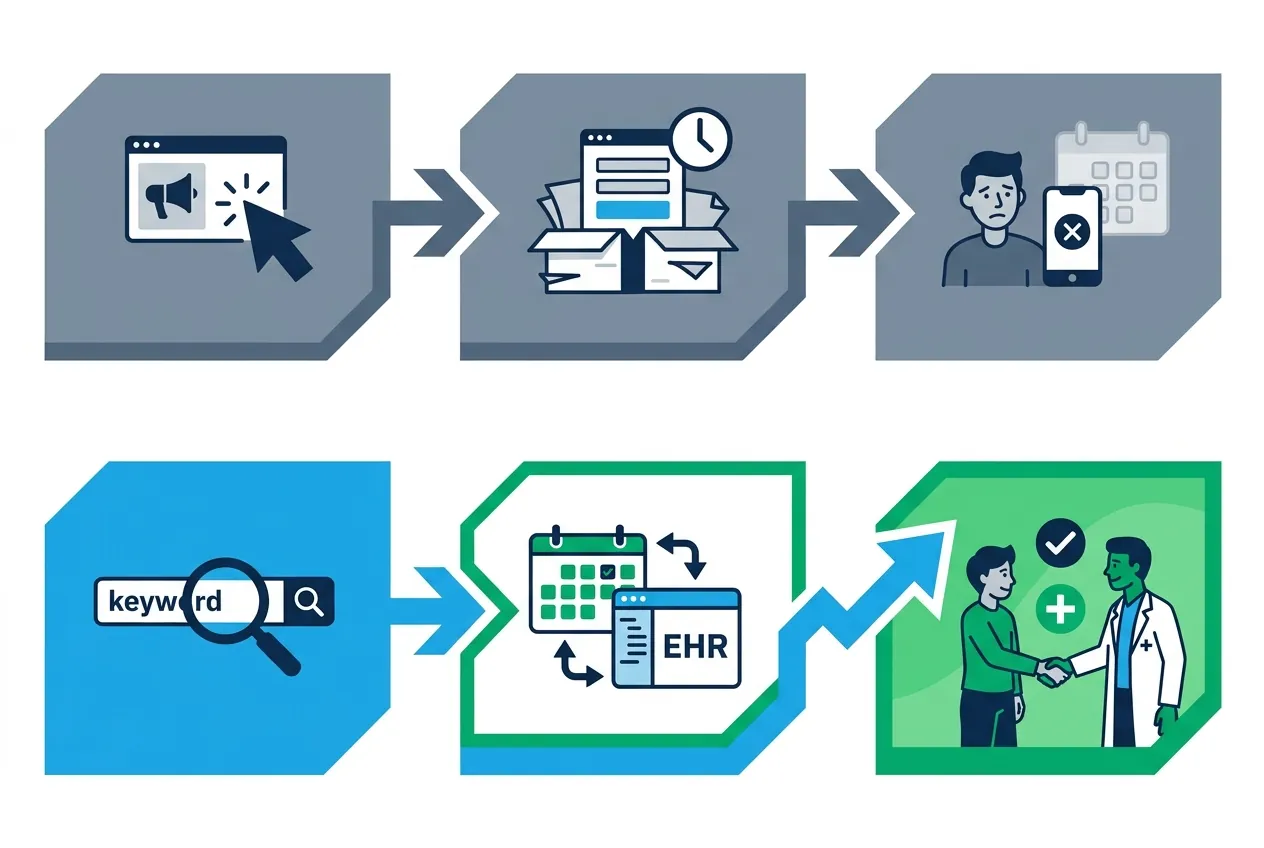
The central vulnerability of healthcare marketing lies between digital demand generation and clinical intake. Marketing departments frequently celebrate declining cost-per-click metrics and high web form submission totals while clinical operations struggle with empty examination rooms and abandoned phone calls. Digital visibility generates zero balance-sheet value if search traffic lands on generic provider directories without direct scheduling, or ad spend routes to access centers that drop calls.
Consider the operational breakdown in a typical multi-facility health network:
A health system launches a regional campaign for outpatient spine surgery. An individual in severe discomfort searches for an evaluation, clicks an ad, and submits a digital form requesting an appointment. That form enters a generic administrative queue. Forty-eight hours later, an intake specialist reviews the ticket and places a return call. The patient does not recognize the unfamiliar hospital exchange, ignores the call, and schedules an evaluation with a competing provider group that offered online self-scheduling. The initial health system spent $140 on the search click, logged a conversion in its analytics dashboard, and realized zero clinical revenue.
Closing this operational chasm requires three structural interventions:
1. Direct Electronic Health Record (EHR) Scheduling Integration
Prospective patients expect the same transactional speed from healthcare providers that they experience across retail and financial services. High-intent service lines must offer direct scheduling integration with the health system's practice management platform or EHR, allowing patients to select specific providers, review verified patient ratings, view real-time calendar availability, and confirm their visit instantly.
2. Dedicated Clinical Access Call Routing
For complex specialties where direct online booking is clinically inadvisable, phone calls remain the dominant conversion channel. Search campaigns must route prospective patients to trained intake coordinators dedicated to that specific clinical service, equipped with real-time provider schedule visibility, insurance verification protocols, and clinical intake scripts. Generic hospital main switchboards should never receive paid acquisition traffic.
3. Closed-Loop Intake Attribution
Marketing attribution must extend beyond the initial phone call or web form. Health systems must establish attribution tracking through to the verified clinical consultation, procedure, or hospital admission. By reconciling campaign click identifiers with anonymized intake status reports, marketing leaders identify which search terms generate actual patient encounters versus administrative overhead.
Structuring a Sustainable Healthcare Marketing Plan Across Service Lines
A comprehensive healthcare marketing plan establishes an operating blueprint that aligns clinical capacity, geographic footprint, and budget allocations over a twelve-month horizon. Rather than a static document produced once a year, an actionable plan operates as an iterative framework updated quarterly based on clinical utilization data.
To implement effective marketing in healthcare, leadership must address four core operational pillars across each service line:
Pillar 1: Geographic Market Sizing and Drive-Time Realities
Patient behavior is inherently local. Healthcare marketing plans must map patient acquisition targets using realistic drive-time polygons rather than simplistic radial zip-code rings. A clinic located eight miles away across a congested urban transit corridor may represent a 45-minute drive, creating high friction for routine visits. Marketing budgets must focus on the primary service area (the geographic footprint accounting for 75 percent of current patients) while deploying targeted surgical acquisition into secondary markets where unique clinical capabilities justify travel.
Pillar 2: Local Search Architecture and Entity Management
For health systems managing dozens of clinics and hundreds of employed physicians, local entity optimization is critical. Each outpatient facility and provider must maintain an accurate, verified Google Business Profile linked to standardized National Provider Identifier (NPI) registry records and local directory citations. Inconsistent suite numbers, outdated office hours, or fractured practice names degrade local search rankings and misdirect emergency patients.
Systematic review acquisition protocols must be deployed at clinical checkout. Patients who experience exceptional clinical care should receive automated, post-encounter prompts requesting feedback on verified profiles, insulating the health system against occasional negative clinical reviews.
Pillar 3: High-Intent Paid Search Strategy
Organic visibility requires time to mature, but hospital beds and surgical blocks require immediate utilization. Paid search captures individuals actively seeking immediate diagnosis or intervention. The healthcare marketing plan allocates media spend to high-intent non-branded searches, for example, "minimally invasive joint replacement" or "pediatric urgent care open now", while systematically defending the health system's institutional brand terms against competitive regional poaching.
Pillar 4: Service-Line Content and Educational Assets
Modern patients read clinical content to understand symptom progression, recovery expectations, and procedural risks before scheduling a specialist consultation. Content programs must move beyond superficial wellness tips. Health systems need clinically sound, physician-reviewed medical explainers that directly address patient questions, outline surgical eligibility criteria, and detail recovery timelines. This content establishes clinical authority, improves search visibility, and qualifies patient expectations prior to intake.
How Marketing Powered Delivers Healthcare Marketing Programs
Executing an accountable healthcare demand system requires specialized capabilities that combine paid search management, local search architecture, intake integration, and strict regulatory governance. Marketing Powered provides dedicated healthcare and hospital marketing programs engineered specifically for health systems, regional hospitals, and multi-location provider groups.
Our operating methodology reflects senior healthcare leadership experience. Marketing Powered is led by a former healthcare CMO who ran marketing for a treatment network that grew from 3 to 24 locations. In that operational capacity, our founder managed $1.5 to $2M per month in Google Ads across 11+ behavioral and mental health accounts, confronting firsthand the operational friction between aggressive media acquisition, strict platform policy enforcement, and clinical bed utilization. Furthermore, our founder serves as a court-certified expert witness in advertising strategy, bringing legal-grade rigor to campaign governance and advertising compliance.
We do not treat healthcare marketing as a generic consumer campaign. Our programs are designed around five specialized operational standards:
- Sensitive Vertical Search Precision: Having operated extensively within Google's sensitive healthcare vertical, where personalized retargeting is strictly prohibited, we engineer search campaigns that capture demand on the first interaction through deep search query segmentation, negative keyword architectures, and high-converting landing environments.
- Full-Funnel Admission and Encounter Attribution: We build measurement architecture that tracks marketing investment through to the verified appointment, clinical encounter, or bed admission, not just the initial form submission or phone call. This gives executive leadership clear visibility into true patient acquisition economics.
- HIPAA-Aware and LegitScript-Aware Operations: Our operating protocols eliminate unauthorized third-party tracking pixels from web properties. We operate within established regulatory standards and maintain deep familiarity with mandatory third-party verification processes, including LegitScript certification requirements.
- Owned, Local AI Infrastructure: Marketing Powered has been AI-native since 2022. To protect organizational privacy and institutional security, we operate owned, local AI infrastructure for HIPAA-aware inference. This ensures that sensitive operational data, clinical documentation, and strategic analysis never pass through uncontrolled public cloud models.
- Multi-Location Operational Scalability: We deploy multi-location directory and paid media structures that balance health-system brand authority with localized clinic volume, preventing internal competition across overlapping service territories.
Health systems and provider networks partner with Marketing Powered to turn fragmented digital marketing budgets into a defensible operating engine that fills clinical schedules and supports long-term institutional growth.
Questions, Answered.
Healthcare marketing is the strategic discipline of communicating a health system's, hospital's, or provider group's clinical capabilities, services, and care access to patients, caregivers, referring physicians, and communities. Its goal is to align patient care demand with clinical capacity, educating individuals on medical options, guiding them through complex care navigation, and facilitating access to verified clinical care while complying with strict health data privacy and advertising regulations.
Healthcare marketing examples include: Paid search campaigns targeting high-intent medical queries such as "pediatric urgent care clinic" or "hip replacement specialist". Local search engine optimization ensuring outpatient clinics and employed physicians appear accurately in regional map listings and search directories. Educational condition guides and treatment videos authored or reviewed by clinical specialists to help patients evaluate complex diagnoses. Post-discharge digital communication workflows that deliver follow-up care instructions and gather patient experience feedback. Targeted business-to-business referral outreach programs connecting regional primary care physicians with tertiary hospital surgical specialists.
Business-to-business (B2B) healthcare marketing targets organizational decision-makers rather than individual patients. Examples include: Health systems marketing specialized tertiary services or clinical trial access to independent regional physician groups to drive clinical referrals. Hospital networks marketing direct-to-employer healthcare plans, onsite wellness clinics, and bundled surgical arrangements to self-insured corporations. Medical device, pharmaceutical, and health technology companies marketing clinical equipment, diagnostic systems, and software platforms to hospital procurement committees and chief medical officers.
A healthcare marketing plan is a comprehensive operational blueprint detailing how a healthcare provider network or hospital system will identify, attract, and retain patients across its clinical service lines over a specified period. It details geographic service areas, clinical capacity, target patient demographics, regulatory compliance protocols, competitive market analysis, digital and offline media budgets, and the attribution systems used to measure return on investment through verified patient admissions and encounters.
A healthcare marketing specialist is a marketing professional or strategist with dedicated domain expertise in the healthcare industry. Unlike general consumer marketers, a healthcare marketing specialist understands clinical terminology, health system operational workflows, patient journey dynamics, healthcare privacy laws such as HIPAA, and platform-specific advertising restrictions enforced by ad networks like Google and Meta.
A healthcare marketing agency is an external firm that specializes in developing and executing marketing strategies for hospitals, health systems, outpatient clinics, and healthcare practices. A specialized agency provides search engine optimization, paid media management, clinical content development, local directory optimization, and privacy-compliant analytics infrastructure designed to navigate the ethical, operational, and regulatory constraints unique to the medical sector. Request a healthcare marketing assessment from Marketing Powered
Ready to see where your marketing can improve?
Request a free audit of your paid media, landing pages, attribution, and measurement setup. You'll get a straight assessment of where the opportunities are.
or email us at info@marketingpowered.ai