Resources
Conversion Rate Optimization for Lead Generation: A System, Not a List of Tests
Conversion rate optimization is often reduced to tactical guessing games about button colors, headline phrasing, and form placement. In high-consideration lead generation, that approach wastes media budget and operational capacity. When a single qualified relationship represents substantial contract value or lifetime revenue, conversion optimization requires an integrated operating system: clear intent mapping, deliberate qualification friction, rapid intake workflows, and closed-loop data attribution.
By Mike Hulick, Founder, Marketing Powered

Why isolated A/B testing fails high-consideration lead generation cro

What is conversion rate optimization in digital marketing?
Conversion rate optimization (CRO) in digital marketing is the discipline of increasing the percentage of visitors who complete a high-value, qualified business action. While the term originates in high-volume e-commerce environments, applying retail tactics to complex B2B, healthcare, or professional services lead generation creates critical operational failures.
In e-commerce, transactional CRO centers on frictionless momentum. The objective is to guide a buyer to an immediate, single-session purchase by removing steps, stripping away fields, and accelerating checkout. Success is measured by transaction volume, cart size, and immediate payment completion.
High-consideration lead generation cro operates under an entirely different economic model:
- Transactional CRO: Focuses on low unit value, immediate decision velocity, anonymous buyers, and zero human intake intervention.
- Pipeline CRO: Focuses on high unit value, multi-stakeholder consideration, identified prospects with specific qualification criteria, and mandatory operational follow-up by an intake coordinator, admissions team, or sales executive.
Measuring micro-conversions, such as white paper downloads, button clicks, or video views, without measuring downstream qualification distorts marketing performance. When marketing teams celebrate a 40% lift in form submissions while intake teams discard 80% of those inquiries as spam, out-of-market consumers, or unqualified shoppers, customer acquisition cost increases.
True conversion optimization establishes an operational bridge between paid media spend and business revenue. In this model, the governing metric is not raw conversion rate at the landing page; it is the qualified conversion rate through to an intake admission, scheduled consultation, or qualified sales pipeline milestone. This qualified yield determines the actual economic ceiling of your marketing scalability.
Treating CRO as a detached sequence of page-level split tests creates systematic blind spots for complex organizations. Most published conversion advice assumes consumer web traffic with tens of thousands of monthly transactions. In that environment, testing minor variations such as hero image placement or button text can reach statistical significance within days.
In high-consideration sectors, conversion volumes are fundamentally lower. A regional hospital system, commercial litigation boutique, or specialized treatment network might handle hundreds of qualified inquiries per month rather than tens of thousands of consumer transactions. Running micro-element A/B tests in lower-volume environments requires months to achieve statistical power, exposing the test data to seasonality, platform algorithm changes, and audience drift.
Furthermore, isolating page experiments from upstream media intent and downstream operational response creates three distinct failure modes:
- The Low-Friction Trap: Web teams strip out qualifying fields such as budget, location, clinical needs, or corporate email requirements to increase page conversion percentage. Lead volume surges, but sales and intake teams spend valuable hours chasing unvetted inquiries, driving up labor costs while total qualified acquisitions remain flat or decline.
- Upstream Disconnect: Testing headline copy in isolation from ad group creative breaks the scent trail. A page variant might convert well overall, but it may attract visitors seeking free resources rather than decision-ready commercial buyers searching high-intent paid queries.
- Downstream Latency: Optimizing a form to generate an immediate inquiry is useless if internal systems take six hours to route the lead to a qualified coordinator. The breakdown occurs in operational execution, not page layout.
High-consideration lead generation cro must be engineered as an end-to-end pipeline. The landing page is simply an exchange node where paid intent is authenticated and routed into an operational workflow.
The diagnostic foundation: what to fix before testing
Before launching split tests or deploying multivariate page tools, organizations must eliminate structural friction. Running traffic experiments on a broken technical baseline or an unverified analytics stack yields noisy, uninterpretable results.
1. Technical Page Infrastructure and Core Web Vitals
Performance latency directly depresses conversion intent. Research published by Google Consumer Insights indicates that as page load time goes from one second to three seconds, the probability of a bounce increases by 32%. Visitors searching for high-stakes services require immediate visual stability. Pages must load core interactive elements in under 1.8 seconds on standard mobile connections, eliminate dynamic layout shifts, and execute responsive CSS rendering cleanly.
2. Event Tracking and Data Hygiene
Data integrity must be verified across three distinct operational layers:
- The Client-Side Layer: Tag management containers must trigger explicit events for form interactions, click-to-call links, and multi-step progression, avoiding duplicate submissions from double clicks.
- The Platform Layer: Google Ads conversion tracking and server-side APIs must record identical event totals without discrepancies caused by aggressive client-side ad blockers.
- The System of Record: Every captured form submission, chat interaction, and phone call must write clean UTM parameters, click identifiers, and source details directly into the CRM or electronic health record (EHR). If CRM lead totals do not reconcile with ad platform conversion metrics, testing cannot be evaluated reliably.
3. Intent Mapping and Message Alignment
Audit the commercial alignment between the search query, the ad creative, and the landing page headline. If an enterprise buyer clicks a paid search ad promising regulatory compliance software, the landing page cannot lead with generic digital transformation concepts. Message match requires direct semantic continuity. The specific problem stated in the ad copy must be addressed directly in the primary headline and above-the-fold value proposition.
4. Explicit Qualification Criteria
Marketing and operations leadership must document objective qualification criteria. A qualified inquiry must be defined by clear markers, such as clinical acuity, enterprise headcount, project scope, or insurance coverage, rather than an arbitrary marketing score. These qualification criteria establish the baseline against which all future conversion experiments are judged.
Free Audit
Want a straight read on where your budget is leaking?
Building a repeatable cro marketing system
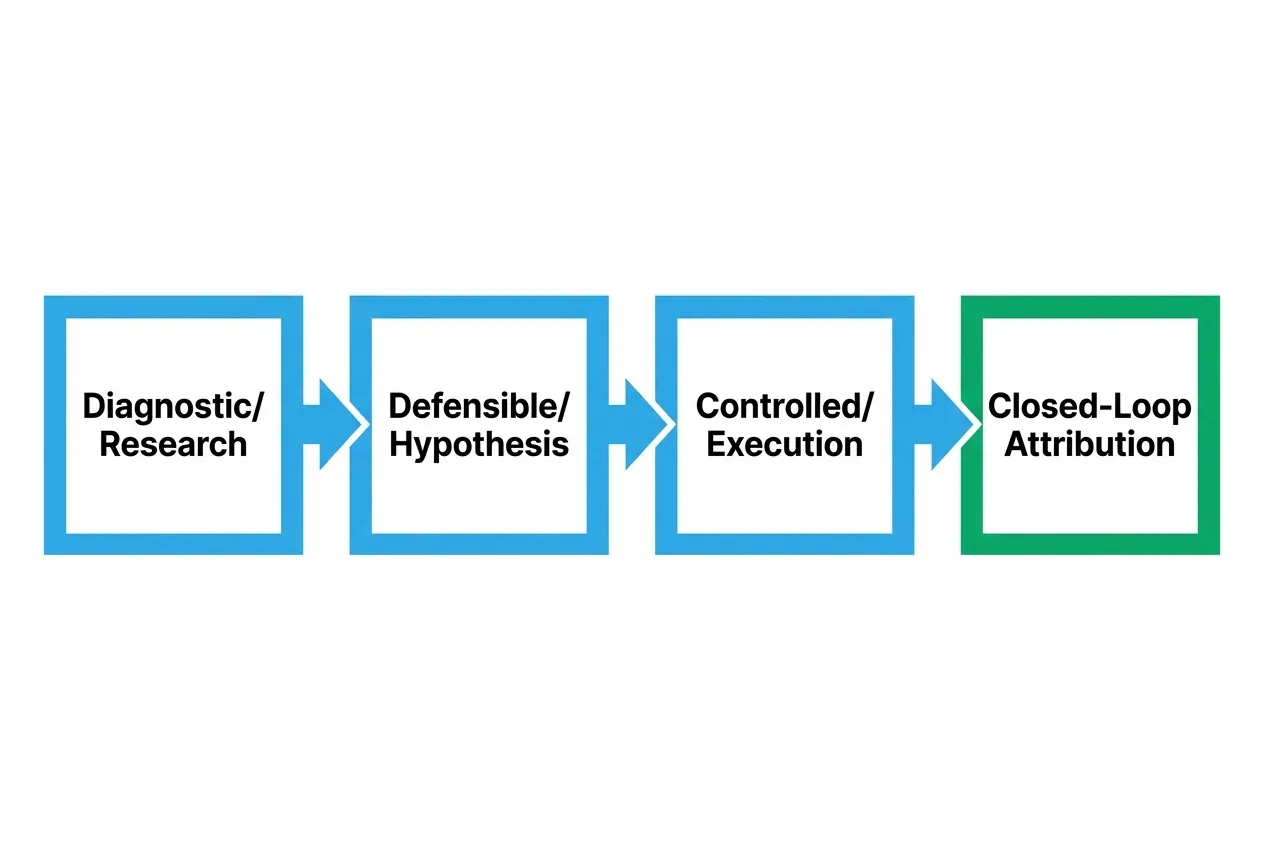
A mature cro marketing program replaces ad-hoc design updates with an iterative operational framework. This system relies on four recurring phases designed to build defensible business value.
Phase 1: Diagnostic Research
The process begins with quantitative and qualitative operational discovery. Form analytics track field-level abandonment rates to reveal where prospects hesitate or exit. Heatmaps and session recordings show whether visitors read critical credentialing information or skip over complex service grids. Crucially, intake interview logs and call center disqualification reasons are reviewed to pinpoint why current inquiries fail to convert down-funnel.
Phase 2: Defensible Hypothesis Development
Hypotheses must not focus on superficial aesthetic alterations. A defensible hypothesis links a specific user friction point to an operational change:
- Weak Hypothesis: "Changing the hero button from blue to green will attract more attention and improve conversion rate."
- Defensible Hypothesis: "Prospective clients abandon the intake form at the insurance field due to confidentiality concerns. Adding explicit data encryption verification and clarifying that verification does not notify employers will reduce drop-off without reducing qualification quality."
Phase 3: Controlled Execution
Rather than testing single-word variations, high-consideration programs test distinct architectural variants against controlled traffic splits. Variants must challenge major structural elements: multi-step qualification forms versus single-step overviews, self-service scheduling versus inbound callback requests, or outcome-focused narratives versus institutional credentialing frameworks.
Phase 4: Closed-Loop Downstream Attribution
The final stage links landing page variants to operational outcomes in the CRM. A variant that yields a 4% form conversion rate resulting in a 50% qualification rate is commercially superior to a variant delivering an 8% form conversion rate with an 18% qualification rate.
Executing this integrated loop requires specialized operational capability. Marketing Powered supports organizations through dedicated conversion optimization, landing pages, and CRM and intake automation services. This model aligns technical page architecture with intake automation, building a cohesive bridge between paid media acquisition and CRM pipeline tracking.
Our operational perspective is informed by large-scale enterprise execution. Our founder previously served as healthcare CMO for a treatment network that expanded from 3 to 24 locations, personally managing $1.5 to $2M per month in Google Ads across 11+ behavioral and mental health accounts. Managing high-stakes budgets in heavily regulated categories reinforces a core principle: conversion systems must be built for rigorous qualification, complete attribution, and disciplined unit economics.
Landing page architecture: message-intent alignment and friction design
In high-consideration sectors, corporate websites fail as paid media destinations. Corporate homepages balance multiple competing agendas: investor relations, general brand awareness, recruitment, and broad thought leadership. High-intent paid traffic requires dedicated, focused landing page architecture.
Visual Hierarchy and Cognitive Load
High-consideration visitors are frequently evaluating complex, stressful, or high-risk decisions. Visual clarity must lower cognitive resistance:
- Above-the-Fold Directness: The user must immediately understand the offering, geographic availability, regulatory licensing, and primary action required within five seconds of arrival.
- De-cluttered Layout: Remove main site navigation bars, external blog links, social media widgets, and secondary distractions that pull users away from the conversion path.
- Defensible Trust Signals: Replace generic testimonial blurbs with verified third-party trust indicators: professional licensing bodies, state accreditations, verified client ratings, and legal certifications.
The Role of Intentional Qualification Friction
Standard marketing doctrine preaches that shorter forms convert better. While shorter forms do increase raw form submissions, they frequently degrade operational efficiency. Strategic conversion optimization uses intentional qualification friction to balance lead volume with intake readiness.
Using dynamic, multi-step forms allows organizations to:
- Capture categorical intent on step one using low-threat selection buttons (such as selecting service needs or project scopes).
- Gather detailed qualification data on step two (such as clinical timeline, budget thresholds, or regulatory environment).
- Request contact details on the final step after the user has invested psychological momentum in the interaction.
This sequence screens out casual, low-intent browsers while providing intake specialists with the operational intelligence needed to conduct a meaningful, high-value conversation.
Designing for Regulated and Sensitive Verticals
Operating in regulated markets introduces platform constraints that dictate landing page design. For example, under Google advertising policies on personalized advertising, advertising platforms prohibit remarketing and audience targeting for sensitive healthcare conditions, addiction treatment, and personal health struggles.
When retargeting is restricted by platform policy or privacy regulations, an organization cannot rely on multi-touch display ads to bring abandoning visitors back over a thirty-day evaluation window. The landing page must answer objections, demonstrate security, and convert high-intent prospects on their initial visit. Clear statements regarding data privacy, confidentiality, and regulatory compliance are essential conversion requirements.
Intake velocity and first-party attribution: improving down-funnel conversion
A conversion rate optimization system does not stop at the landing page form submission. In lead generation, an inquiry is an incomplete transaction. If the user submits a form and waits hours for a reply, conversion velocity stalls, and acquisition costs rise.
The Mathematics of Intake Velocity
Speed to response is one of the most potent conversion variables in digital lead generation. Research published in the Harvard Business Review examining lead response times revealed that organizations contacting prospective customers within one hour of an inquiry were nearly seven times more likely to qualify the lead than those reaching out even an hour later, and more than 60 times more likely than firms waiting 24 hours.
When an inquiry enters the system, automated operational workflows must engage immediately:
- Immediate Call Routing: For high-intent inquiries, systems should trigger an instant dialer connection linking an available coordinator to the user while they are still reading the confirmation page.
- Automated Calendar Scheduling: Direct booking integrations on the confirmation page allow qualified prospects to select a dedicated consultation slot immediately, removing days of back-and-forth email scheduling.
- Two-Way SMS Confirmations: Automated, compliant messaging confirms receipt of the inquiry and sets clear expectations for when an intake specialist will reach out.
First-Party Attribution Architecture
Scaling conversion efficiency requires tracing outcomes back to the originating ad spend. This cannot be achieved using disconnected aggregate analytics. High-performing organizations deploy owned data pipelines and first-party server-side tracking that record:
- Originating platform, campaign identifier, ad creative, and target keyword.
- Form variant, landing page URL, and interaction timestamps.
- System of record identifiers linking the raw inquiry to CRM opportunity stages, consultation attendance, and closed client acquisition.
By feeding qualified milestone data back to paid acquisition engines through offline conversion tracking, algorithms optimize for users who complete the intake cycle rather than users who merely fill out forms. Conversion optimization becomes an operational engine that aligns media procurement, page experience, and intake velocity into a coherent growth system.
Questions, Answered.
Conversion rates vary widely based on channel intent, offering complexity, and form qualification depth. In high-intent paid search campaigns with rigorous qualification forms, landing page conversion rates often range between 3% and 8%. High-friction forms that collect extensive operational, financial, or clinical data may convert between 2% and 4% at the page level, but their downstream qualification and close rates are substantially higher. Focusing on qualified conversion yield through to revenue provides a far more accurate metric than raw form submission rates.
When low inquiry volumes prevent rapid statistical significance in split testing, organizations pivot from micro-element testing to structural optimization and heuristic analysis: Conduct extensive qualitative audits, user journey walkthroughs, and session replay evaluations to eliminate obvious friction. Test major structural shifts, such as changing an entire landing page framework or introducing multi-step qualification, rather than testing minor button colors or copy tweaks. Track progression through intermediate milestone steps, such as completing the first stage of a multi-step form, to gather statistically valid interaction data faster.
Landing page optimization (LPO) is a subset of conversion rate optimization. LPO focuses specifically on the layout, messaging, visual hierarchy, and performance of dedicated campaign pages. Conversion rate optimization is an end-to-end framework that encompasses the entire prospect trajectory: upstream audience intent matching, landing page design, form friction engineering, intake response workflows, CRM handoffs, and closed-loop data attribution. LPO optimizes the page; CRO optimizes the commercial conversion system.
Adding qualification friction, such as mandatory intake questions, budget qualifiers, or specific clinical selections, filters out visitors who do not meet operational criteria. While this deliberate friction may reduce the overall percentage of visitors who complete the form, it protects the sales and intake staff from spending time on unqualified inquiries. This increases sales capacity, shortens response times for high-value prospects, and improves the organization's overall acquisition economics. Schedule a strategy call with Marketing Powered
Ready to see where your marketing can improve?
Request a free audit of your paid media, landing pages, attribution, and measurement setup. You'll get a straight assessment of where the opportunities are.
or email us at info@marketingpowered.ai