Resources
Local SEO Best Practices: What Works and Why
Applying disciplined local seo best practices separates organizations that dominate regional search from those that disappear outside a tight two-mile radius. For multi-location healthcare systems, clinical networks, and regional service brands, organic map visibility functions as an operational discipline rather than an isolated set of technical adjustments. High-intent local searches translate directly into phone inquiries, facility visits, and booked appointments when physical operations and digital infrastructure reinforce each other.
By Mike Hulick, Founder, Marketing Powered

Core Ranking Fundamentals: Relevance, Distance, and Prominence
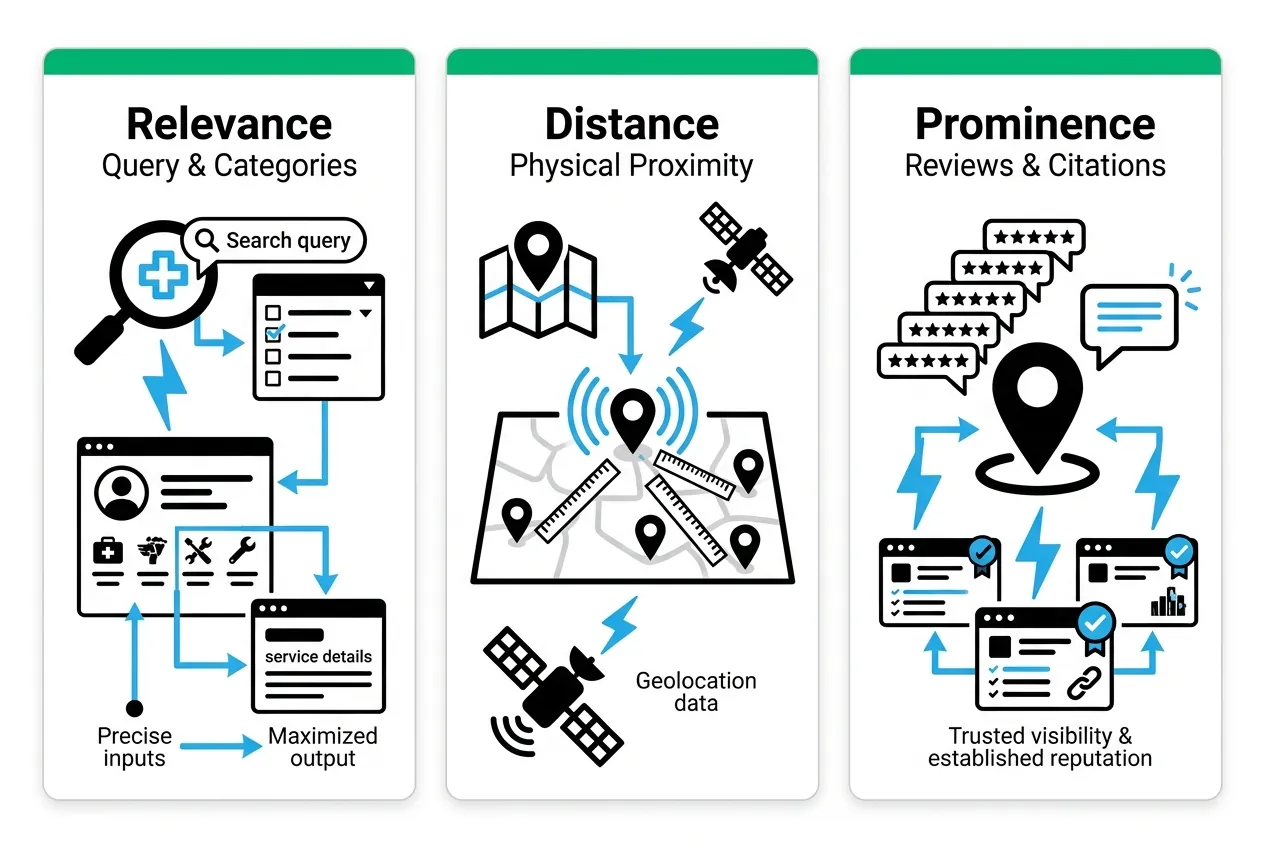
Search engines evaluate local intent through an algorithm designed to reflect real-world commercial activity. According to Google Business Profile Help, local rankings depend on three foundational factors: relevance, distance, and prominence. Understanding the operational mechanics behind each factor allows multi-unit organizations to allocate resources where they create measurable gains.
Relevance measures how closely a business profile matches the explicit intent of a search query. When a user searches for an outpatient pediatric clinic or urgent care open extended hours, the algorithm assesses primary categories, secondary categories, service listings, and the depth of on-page copy on the linked website. Imprecise category selection dilutes relevance immediately. For example, selecting a broad healthcare classification when a specialized medical category exists signals that the facility is only a secondary match. Relevance requires matching clinical services to standardized taxonomy while ensuring that the landing page linked to the profile details those exact capabilities.
Distance reflects the physical proximity between the searching user and the registered address of the facility. Proximity represents a physical constraint. While a marketing team cannot change the geographic coordinates of an established clinic or branch office, distance dynamics dictate how content and entity signals must be deployed. Search engines calculate distance based on device geolocation, explicit geographic terms in the query, and network IP addresses. If an organization operates in a competitive metropolitan area, relying solely on a main corporate profile leaves outer service zones vulnerable to competitors located closer to the searcher. Expanding geographic reach requires establishing authentic prominence rather than attempting to manipulate location parameters.
Prominence measures how well known, credible, and established an organization is across the web and within its local community. Search algorithms determine prominence through inbound directory citations, articles, local media coverage, website domain authority, and customer feedback signals. Review volume, review recency, and average star ratings factor directly into local prominence scores. An organization with hundreds of authentic patient reviews, structured location schema, and citations across authoritative medical directories consistently demonstrates higher prominence than a competitor with thirty stagnant reviews and missing business details.
Local SEO Strategies for Multi-Location Architecture
Multi-unit operators face technical hurdles that single-location businesses never encounter. Scaling from 3 to 24 locations requires coordinated local seo strategies that prevent internal competition, eliminate duplicate content filtering, and establish clear entity disambiguation.
The most frequent structural error in multi-location marketing is the deployment of identical, city-swapped landing pages. Organizations often publish dozens of location pages featuring duplicate corporate descriptions, altering only the city name and phone number. Search engines detect this programmatic duplication, filtering those URLs out of organic indexation and suppressing their associated map listings. Sustainable architecture demands unique, operationally relevant content for every address.
Every local landing page must incorporate distinctive operational attributes:
- Direct facility details: Precise driving directions, specific public transit lines, parking lot access instructions, and building floor numbers.
- Local operational staff: On-site clinical directors, lead physicians, or branch managers with professional credentials and specialized service summaries.
- Specific service availability: Granular listings of programs or treatments physically delivered at that individual facility rather than broad corporate capabilities.
- High-resolution facility photography: Exterior photos displaying street signage, interior reception areas, treatment rooms, and intake offices that confirm physical authenticity.
- Direct local contact data: A unique local phone number routed to dedicated intake staff rather than a generic national call center hub.
On-page technical implementation requires specific LocalBusiness structured data markup. Multi-location health systems should implement specialized schema types such as MedicalClinic, Hospital, or Physician depending on the facility scope. This structured data must define properties including legal name, physical address, exact geographic coordinates (latitude and longitude), opening hours, accepted insurance networks where applicable, and parentOrganization attributes linking back to the corporate entity. Clean schema links the local landing page directly to its corresponding Google Business Profile CID, unifying the organic URL with the Map Pack listing.
To explore how enterprise networks maintain organic visibility across sprawling footprints without risking algorithmic penalties, read our deep dive on Multi-location SEO: how to rank every location without duplicate content.
Local SEO Examples Across Regulated Healthcare and Service Networks
Examining functional local seo examples clarifies the divide between tactical theory and field execution, particularly within complex, regulated environments.
Consider an urgent care or behavioral health network expanding across a metropolitan region. A network with twelve clinical sites across three adjacent counties faces the challenge of practitioner listings competing against facility listings. A common point of failure occurs when individual doctors, nurse practitioners, or therapists create independent profiles using the clinic address. Without governance, patient reviews scatter across a dozen unmanaged practitioner profiles while the primary facility profile languishes with minimal review volume.
High-performing healthcare systems resolve this by implementing a structured entity hierarchy. The main clinic profile serves as the primary entity, housing the bulk of general urgent care and facility-level reviews. Individual practitioner profiles are claimed and maintained as subordinate entities, explicitly categorized under their exact medical specialization, such as Pediatrics or Internal Medicine. The clinic profile links to the primary location page, while the practitioner profile links directly to that clinician's professional bio page. This prevents internal ranking cannibalization, directs user intent cleanly, and aggregates authority without fragmenting patient feedback.
Another instructive example involves geographic radius containment. When a physical facility sits near a municipal border, marketing teams often attempt to rank in neighboring towns by inserting target city names into the Google Business Profile title. A clinic physically located in Bethesda, Maryland that names its profile "Bethesda Health Clinic - Rockville Urgent Care" commits a direct violation of platform guidelines. Search engines penalize artificial name stuffing by suspending profiles or resetting listing trust.
Leading networks capture neighboring demand legitimately by producing geo-specific service area content on their primary domain. They publish targeted informational resources addressing specific regional health concerns, maintain accurate service area listings within profile backends, and earn localized backlinks from regional civic and health organizations. Physical prominence expands through authority rather than naming gimmicks.
Free Audit
Want a straight read on where your budget is leaking?
Point-of-Service Review Generation with Powered Cards
Customer sentiment and review velocity represent vital prominence signals. However, relying on delayed post-visit email sequences or generic automated text messages yields consistently diminishing returns. Response rates drop precipitously once a customer or patient leaves the facility, and delayed follow-ups frequently reach customers only when an administrative issue, such as a delayed billing statement, prompts negative sentiment.
Sustainable review acquisition requires integrating feedback capture into daily operational workflows while the customer or client remains on site. Point-of-service review invitations convert at significantly higher rates because the positive human interaction between provider and client is immediate.
This operational requirement led to the development of Powered Cards. Designed for multi-location clinics, hospitals, and professional service environments, Powered Cards provides physical, branded access points utilizing near-field communication (NFC) and direct QR routing. Front-desk personnel, intake coordinators, or service specialists hand the card to the client at checkout or discharge, inviting them to share their perspective.
A simple tap of a modern smartphone on an NFC card or a camera scan of a precision QR code immediately opens the profile review portal. This eliminates multiple points of digital friction: the customer does not need to search for the business name, navigate through directory filters, or search out the correct suburban branch. The access point routes directly to the verified listing.
Distributing physical review cards transforms review collection from a sporadic marketing department initiative into an ongoing front-line standard operating procedure. Front-desk staff receive clear, standard physical tools, eliminating the ambiguity of manual solicitation. Because the process captures real-world interactions at the moment of completed service, review velocity grows steadily across every branch in the network.
To understand how physical-to-digital touchpoints integrate with your broader reputation architecture, review our analysis on Google review cards: using NFC and QR cards to collect reviews at the point of service.

Diagnostic Local SEO Tools for Territory Tracking
Managing search presence across a distributed branch network requires an operational technology stack capable of monitoring localized performance fluctuations. National organic rank trackers report average keyword positions across an entire country or city center, obscuring the geographic realities of the Local 3-Pack. Multi-unit enterprises rely on specialized local seo tools to visualize and diagnose visibility street by street.
Geo-grid ranking scanners provide the foundation for local rank tracking. Rather than checking ranking from a single server location, a geo-grid scanner evaluates local search results from a matrix of coordinates arranged across a defined radius, such as a five-mile grid around a clinic. The output visualizes Map Pack ranking positions through color-coded pins superimposed over a street map. A marketing director can immediately see that a facility ranks in position one within an eight-block radius to the north and east, but drops to position eight two miles to the south where a competitor operates. This spatial diagnostic pinpoints exactly where off-page authority and localized citation efforts must be concentrated.
Listing governance platforms represent the second essential tool category. When managing dozens of locations, manual profile maintenance invites discrepancies. Corporate mergers, phone system updates, and holiday scheduling changes create data fragmentation. Centralized listing management systems synchronize Name, Address, and Phone (NAP) data across primary aggregators, mapping engines, and local directories. Automated monitoring alerts operations teams whenever unauthorized user edits, such as suggested hour modifications or incorrect phone numbers, appear on public profiles.
Call tracking and attribution software designed for multi-unit enterprises complete the diagnostic stack. Assigning dynamic tracking numbers to organic local landing pages while preserving raw profile numbers through proper directory configuration allows intake teams to track organic calls through to booked appointments. Attribution systems must confirm whether organic search inquiries result in completed customer intake, ensuring that marketing spend correlates with business revenue.
Evaluating Local SEO Services for Small Business and Growing Networks
Evaluating outside local seo services for small business and expanding enterprise networks requires a clear understanding of what drives durable organic performance. Many generalist agencies offer passive citation building and superficial monthly profile posts, treating local optimization as an entry-level add-on to broad national campaigns.
Specialized multi-location marketing demands an operator-led discipline. Marketing Powered structures local search operations around end-to-end commercial outcomes:
- Centralized profile architecture: Establishing verified ownership, standardizing categorization, pruning unauthorized duplicate listings, and configuring structured practitioner-to-facility hierarchies.
- High-performance landing page development: Architecting unique, conversion-engineered local landing pages featuring localized clinical copy, direct scheduling integrations, and schema validation.
- Physical-to-digital reputation systems: Deploying hardware touchpoints through Powered Cards, paired with frontline staff training to accelerate compliant review velocity.
- Closed-loop intake attribution: Integrating call tracking, web appointment submissions, and intake software to trace local search exposure directly to qualified revenue.
Marketing Powered's founder brings the perspective of a former healthcare Chief Marketing Officer who ran marketing for a treatment network that grew from 3 to 24 locations, directing advertising strategy across 11+ behavioral and mental health accounts. As a court-certified expert witness in advertising strategy, our leadership designs local search systems that withstand rigorous regulatory and technical scrutiny.
Being AI-native since 2022, we maintain owned, local AI infrastructure for HIPAA-aware inference, enabling multi-location organizations to deploy advanced automated workflows without exposing sensitive patient health information to public cloud models. In sensitive healthcare verticals where ad retargeting is strictly prohibited by platform policies, building an authoritative, organic local search presence provides a primary engine for sustainable patient acquisition.
Organizations seeking specialized operational support can evaluate service frameworks through our guide on Multi location seo services: what a specialist partner delivers and how to vet one.

Email Us
Prefer to send the context directly?
Regulatory Governance and Platform Compliance
Aggressive local optimization strategies often fail because marketing teams disregard the stringent regulatory boundaries governing public reviews, health privacy, and fair trade advertising. Violating these standards exposes organizations to listing suspensions, severe regulatory penalties, and lasting reputational damage.
Review collection must adhere to strict platform policies and federal law. According to the Google Maps User Contributed Content Policy, businesses are explicitly prohibited from engaging in review gating, paying for feedback, offering incentives such as discounts or gifts, or mandating specific ratings. Review gating involves filtering customers through a private pre-survey, directing satisfied clients to Google while routing unhappy clients to an internal complaint form. Platform algorithms actively detect these patterns, and Google routinely strips reviews or revokes business profile access for non-compliant organizations.
Federal oversight adds a critical layer of operational governance. The Federal Trade Commission enforces strict rules against deceptive consumer reviews and testimonials, as detailed in the FTC Consumer Review Fairness Act and Rule Guidance. The FTC prohibits businesses from buying fake reviews, suppressing negative reviews, or requiring employees and affiliated parties to post undisclosed endorsements. Penalties for systematic review deception can result in substantial monetary fines and public enforcement actions.
Healthcare organizations face additional privacy restrictions under federal health privacy laws. When responding to public reviews on Google Business Profiles, facility staff must never confirm, deny, or imply that a reviewer was a patient at their facility. Even if a reviewer explicitly discusses their clinical diagnosis or treatment details online, the organization cannot disclose protected health information in its public response. Compliant review management requires standardized response protocols that thank the reviewer for their feedback and provide an offline, direct administrative contact number to resolve concerns confidentially.
Questions, Answered.
Search engines update basic profile data within hours, but tangible movement in competitive local Map Packs typically requires eight to twelve weeks of consistent optimization. Algorithmic recalibration depends on multiple concurrent signals: resolving business profile inconsistencies across external directories, expanding unique content on corresponding landing pages, and establishing a regular cadence of customer reviews. Accelerating real-world review capture at the point of service provides immediate assistance in establishing the prominence signals search engines require.
Practitioner profiles should be deployed selectively based on your operating model. For large medical centers, multi-specialty clinics, or legal partnerships, claiming individual practitioner profiles allows the organization to capture specialized queries, such as searches for specific pediatricians or orthopedic surgeons. However, practitioner listings must be linked directly to individual clinician bio pages rather than the main facility page, and the primary facility profile must remain the central focus for general branded inquiries. If an organization lacks the operational capacity to manage multiple listings, focusing exclusively on the facility profile prevents fragmenting patient reviews.
This drop-off illustrates the algorithmic impact of distance and physical proximity. Search engines prioritize locations closest to the user's geographic coordinates to deliver immediate utility. If a business lacks strong prominence signals, its search radius remains tightly restricted around its physical address. To expand ranking reach across a wider service area, an organization must build organic domain authority, earn localized backlinks from regional organizations, and maintain higher review velocity and sentiment than closer competitors.
No. Directing customers with negative feedback to an internal resolution form while steering satisfied customers to a public review profile violates both Google platform policies and FTC consumer protection regulations. All customers must receive an equal, unhindered opportunity to leave public feedback. The compliant method for handling negative customer experiences is to invite universal public feedback, monitor alerts closely, and deploy trained staff to resolve patient complaints offline via direct telephone contact. Get a multi-location visibility audit from Marketing Powered
Ready to see where your marketing can improve?
Request a free audit of your paid media, landing pages, attribution, and measurement setup. You'll get a straight assessment of where the opportunities are.
or email us at info@marketingpowered.ai