Resources
Reputation Management for Doctors: The Multi-Location Healthcare Guide
Reputation management for doctors is an operational intake discipline that directly governs local patient discovery, Google Map Pack rankings, and regulatory risk. For multi-location medical practices, hospitals, and specialty clinics, public patient feedback dictates whether regional facilities win local search visibility when prospective patients search for care. Managing clinical reputation across distributed sites requires capturing authentic patient sentiment at the point of care while strictly safeguarding protected health information under federal privacy laws.
By Mike Hulick, Founder, Marketing Powered

Why Local Healthcare SEO Depends on Review Velocity and Recency

What Is Reputation Management for Doctors and Healthcare Organizations?
Healthcare reputation management is the systematic operational process of monitoring, cultivating, and responding to patient feedback across search engines, healthcare directories, and practice listings. In multi-location clinical networks, this discipline operates across two distinct digital entities: physical facility profiles and individual practitioner profiles. A regional health system might operate twelve urgent care centers, each possessing its own location listing with physical addresses and departmental hours. Working inside those facilities are dozens of credentialed physicians, each with an individual National Provider Identifier (NPI) and independent public search presence.
When prospective patients evaluate clinical care options within their immediate geographic radius, search engines analyze both profiles to determine local relevance. If a clinic maintains strong overall ratings but its practicing specialists carry neglected, low-volume profiles, search engines struggle to connect specific clinical specialties to local search intent. Conversely, if clinical locations rely entirely on passive, unguided feedback collection, the public sentiment record becomes dominated by dissatisfied outliers.
Online reputation management for doctors requires uniting clinical leadership, front-desk receptionists, and marketing teams behind a coordinated standard of care. At clinical check-out desks, staff must provide frictionless, neutral channels for every patient to share their experience. At the executive level, marketing leadership must centralize ownership of all practitioner and clinic listings. Unifying these listings prevents duplicate profiles, corrects inconsistent operating details, and ensures no location goes unmonitored.
Securing new patient volume through organic discovery requires placement in Google's Local 3-Pack, the high-intent map block displayed at the top of local search queries. According to official Google Business Profile Help documentation, local search rankings are determined by three core factors: relevance, distance, and prominence. Prominence reflects how well known a business is, and Google explicitly confirms that review count and positive review score directly influence local search prominence.
Modern search algorithms evaluate review signals dynamically rather than relying on a static overall average. A healthcare practice showing a 5.0-star rating based on eight reviews collected four years ago consistently loses visibility to a regional competitor maintaining a 4.6-star rating supported by hundreds of authentic patient reviews with steady weekly additions. Search engines analyze three critical feedback dimensions:
- Review Velocity: The consistent pace at which a clinic accumulates public reviews over time. Sudden influxes of reviews within forty-eight hours followed by prolonged inactivity trigger automated spam filters and algorithm flags.
- Review Volume: The overall depth of verified patient feedback compared to other healthcare providers operating within the same medical discipline and geography.
- Review Recency: The freshness of public sentiment confirming that the medical office is currently operational, responsive, and maintaining consistent standards of clinical care.
For healthcare networks operating multiple facilities, coordinating these review signals across every site is foundational. Practices that structure their web assets and directory listings as outlined in our strategic guide to multi-location SEO: how to rank every location without duplicate content gain enduring competitive advantages in local search. Review collection cannot function as an intermittent marketing campaign. It must run continuously as an integrated clinical workflow.
Managing Physician Reviews Without Violating Patient Privacy Under HIPAA
The primary operational hurdle in physician reputation management is maintaining compliance with federal privacy mandates. Healthcare providers, hospital networks, and covered business entities are strictly prohibited from disclosing protected health information (PHI) across public digital forums. The HHS HIPAA Privacy Rule Guidance makes clear that protected health information extends beyond clinical diagnostic codes, surgical records, or laboratory results. Publicly confirming or acknowledging that an identifiable person is or ever was a patient of the medical practice constitutes an unauthorized disclosure of protected health information unless that individual has executed a valid, signed HIPAA marketing authorization.
This legal boundary often surprises practice managers and clinical department heads. When an agitated individual leaves a critical 1-star review complaining about a clinical delay, an instinctive public rebuttal such as "We reviewed your chart and our team spent thirty minutes addressing your symptoms" constitutes a severe HIPAA violation. That statement publicly confirms patient status, acknowledges clinical chart review, and reveals that medical evaluation occurred.
Even well-intentioned, positive replies routinely violate privacy regulations when handled carelessly:
- Non-Compliant Reply: "Thank you for choosing our cardiology team, David. We are pleased our specialists helped manage your arrhythmia." This response confirms patient identity, identifies clinical care, and reveals a medical diagnosis.
- Non-Compliant Reply: "Thank you for visiting our downtown location on Tuesday morning, Jennifer." This response confirms patient identity along with the exact date, time, and physical treatment location.
- Compliant Reply: "Thank you for sharing your feedback. Our medical group is committed to providing thorough, patient-centered care. If you have questions or details you would like to discuss with our staff, please contact our practice management office directly." This reply acknowledges no individual identity, reveals no clinical history, and redirects the conversation to a confidential administrative channel.
Managing physician reputation management across dozens of providers requires standard operating procedures. Individual practitioners, clinical assistants, and front-desk employees must not have unmonitored authorization to publish public responses to online reviews. Public replies must use pre-approved privacy-safe templates or route through a centralized review governance process.
Free Audit
Want a straight read on where your budget is leaking?
Avoiding the Regulatory Trap of Review Gating and Policy Breaches
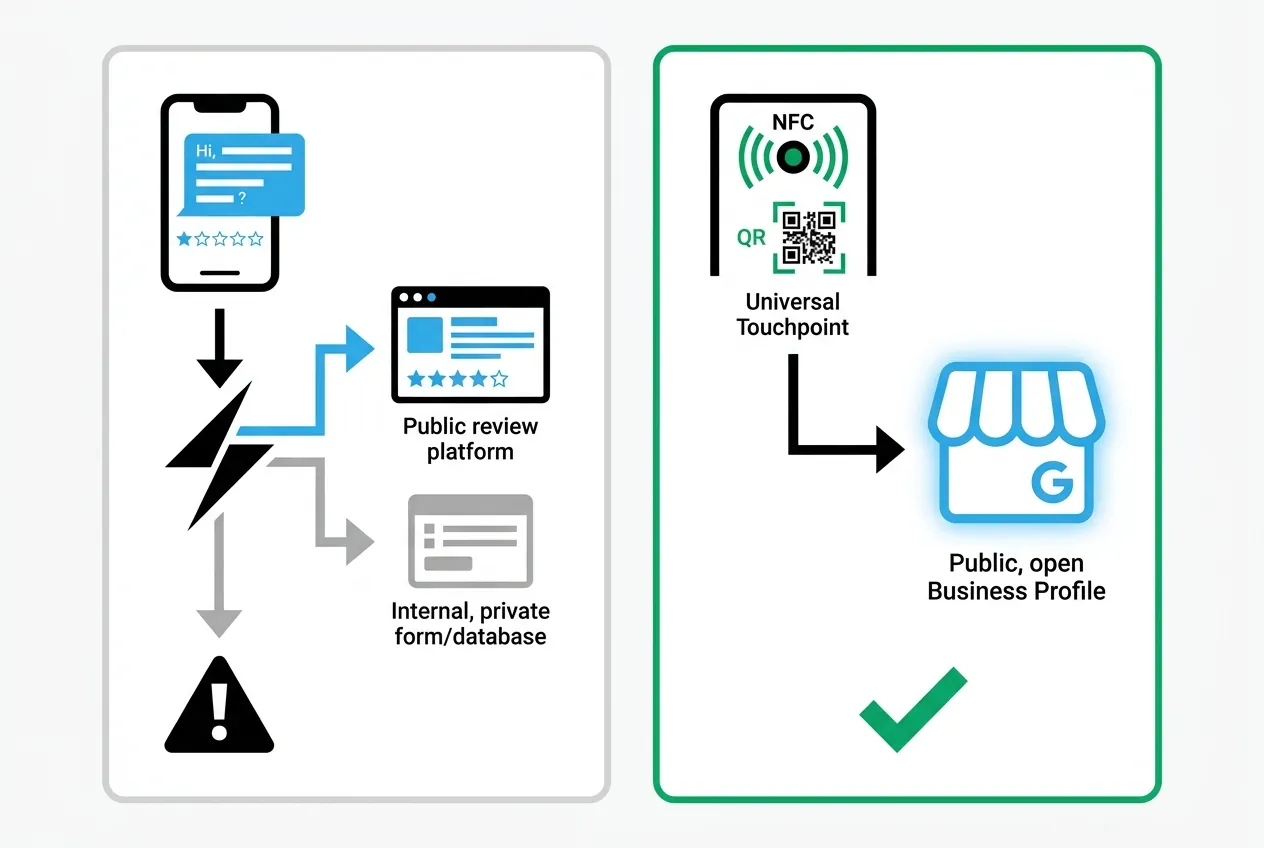
Anxious about the impact of negative reviews, healthcare organizations often deploy third-party software platforms that use sentiment filtering. In these setups, automated text messages or email surveys ask patients an initial screening question: "How was your appointment today from 1 to 5 stars?" If the patient selects 4 or 5 stars, the system forwards them directly to a public Google review link. If the patient selects 1, 2, or 3 stars, the software routes them to an internal feedback form or customer service ticket.
This practice is called review gating, and it violates platform terms across major search engines. The Google Maps User Contributed Content Policy strictly forbids business practices that selectively solicit positive reviews or discourage negative feedback from consumers.
Beyond search engine guidelines, sentiment gating exposes medical organizations to regulatory action by federal agencies. The Federal Trade Commission enforces commercial review integrity under 16 CFR Part 465. As outlined in official FTC Consumer Reviews Rule Guidance, practices that suppress, conceal, or selectively gate consumer feedback to present an artificially inflated brand image are considered deceptive commercial practices.
Violations can lead to formal regulatory scrutiny, civil penalties, and mandatory public disclosures. Medical practices must abandon automated sentiment gating. Defensible online reputation management relies on presenting an open, universal invitation to review the practice to every patient who completes an appointment. When medical teams deliver high-quality clinical care, natural review volume highlights satisfied patient experiences without resorting to non-compliant filtering software.
Compliant Protocols and Scripts for Responding to Patient Reviews
A compliant workflow for responding to patient reviews must preserve patient privacy, demonstrate professional composure, and protect the organization's reputation. Healthcare groups managing multiple clinic locations should establish an objective review triage hierarchy:
- 5-Star Rating (No Text). Public Response Protocol: Post a standard privacy-safe statement thanking the reviewer for providing feedback. Internal Clinical Action: Record submission in location sentiment log. Escalation Path: Administrative queue.
- 5-Star Narrative (Positive). Public Response Protocol: Post a privacy-safe reply highlighting the organization's dedication to quality patient care. Internal Clinical Action: Share commendation with the clinic medical director and staff. Escalation Path: Administrative queue.
- 3-Star Neutral (Operational); Public Response Protocol: Reiterate clinic operating standards; invite the reviewer to discuss details offline.; Internal Clinical Action: Review facility wait times and front-office scheduling workflows.; Escalation Path: Practice manager review
- 1-Star Critical (Clinical Care); Public Response Protocol: Post a strict privacy-safe neutral script; direct the reviewer to patient relations.; Internal Clinical Action: Conduct internal record review; notify clinical risk leadership.; Escalation Path: Risk management and clinical director
Standard Privacy-Safe Response Templates
Template 1: Positive Feedback.
"Thank you for taking the time to share your perspective. Our medical group remains dedicated to providing compassionate, accessible, and high-quality care to our community. We appreciate your feedback and strive to maintain these care standards for everyone we serve."
Template 2: Operational Dissatisfaction (Wait Times or Facility Logistics)
"Our clinical team is committed to delivering organized, respectful, and attentive service across every appointment. We take concerns regarding scheduling delays and facility operations seriously. Because public platforms do not allow us to discuss individual visits confidentially, please contact our administrative practice management team directly through our main office so we can look into this matter."
Template 3: Critical Feedback or Allegations Regarding Clinical Quality.
"Patient safety and high clinical standards are the primary priorities of our medical organization. Due to federal privacy regulations, our team cannot discuss or verify specific patient visits, appointments, or clinical experiences on a public forum. We welcome the opportunity to examine your concerns through our confidential channels. Please reach out directly to our Patient Relations Department through our central administrative line."
These standard scripts achieve three operational objectives. First, they address the public review without confirming whether the individual was ever a patient. Second, they show prospective patients reading the listing that the organization handles feedback with professionalism and poise. Third, they establish a direct, confidential path for resolving genuine patient grievances offline.
Email Us
Prefer to send the context directly?
Point-of-Service Review Capture with Powered Cards and Multi-Location Systems
Traditional post-appointment review collection methods face significant drop-off. Standard clinic workflows rely on sending automated email messages or SMS links twenty-four to forty-eight hours after an appointment. By that point, the patient has returned to daily personal and professional responsibilities, leading to steep declines in completion rates. When digital outreach fails to engage the broad base of satisfied patients, public profiles become vulnerable to vocal, frustrated outliers.
The most reliable moment to gather authentic patient feedback is at the point of service, during clinical check-out when positive interactions with clinical and administrative staff are top of mind.
To eliminate check-out friction, healthcare organizations deploy Google review cards: using NFC and QR cards to collect reviews at the point of service. Powered Cards provide medical check-out desks with dedicated physical hardware containing near-field communication chips and high-contrast dynamic QR codes.
When implementing physical review hardware across multi-facility healthcare groups, reception teams must present the invitation neutrally. Front-office personnel must never offer gifts, discounts, copay credits, or contest entries in exchange for reviews. Under search engine terms, incentivizing reviews is strictly prohibited. Frontline staff should simply offer the card: "If you would like to share feedback on your visit today, you can tap your phone right here to open our public review profile."
For multi-location medical organizations, monitoring review acquisition across clinical sites is critical. As detailed in our analysis of multi location seo services: what a specialist partner delivers and how to vet one, review performance must connect directly to regional search visibility tracking. Monitoring review velocity across regional facilities enables healthcare marketing directors to identify operational bottlenecks at underperforming clinics before search rankings decline.

How Marketing Powered Scales Multi-Location Healthcare Reputation
Marketing Powered engineers local search visibility, technical SEO, and point-of-care review infrastructure for regional healthcare networks, hospitals, and specialty clinical practices. Our team treats reputation management not as superficial public relations, but as a core technical driver of patient acquisition and intake performance.
Our executive leadership includes a former healthcare CMO who ran marketing for a treatment network that grew from 3 to 24 locations, managing large-scale media spend across 11+ behavioral and mental health accounts. Our operational systems are LegitScript-aware and HIPAA-aware, engineered specifically for Google's sensitive healthcare verticals where consumer retargeting is not permitted.
We implement comprehensive healthcare reputation programs across multi-location operations:
- Entity-Level Directory Architecture: We structure, claim, and synchronize facility profiles and licensed physician listings across search engines, maintaining proper categorization and preventing profile cannibalization.
- Turnkey Point-of-Service Deployment: We outfit clinical facilities with custom Powered Cards, managing dynamic URL routing, front-desk staff protocols, and location-by-location interaction tracking.
- Privacy-Safe Governance Protocols: We implement HIPAA-aware review monitoring and escalation workflows, training local clinic administrators and providing standard response procedures that protect patient privacy while building patient trust.
- Full-Funnel Admission Attribution: We measure reputation performance beyond basic review totals. Our attribution infrastructure connects local map rankings, profile calls, and online appointment requests directly to verified patient admissions.
- Owned, Local Computing Infrastructure: Marketing Powered has been AI-native since 2022, operating owned, local AI infrastructure for HIPAA-aware inference. This architecture ensures operational analytics and marketing data remain protected within secure computing environments.
Healthcare marketing leaders managing distributed clinical networks require operational systems rather than superficial marketing tactics. We build the review capture infrastructure, legal safeguards, and local search architecture needed to expand regional healthcare presence while protecting regulatory compliance.
Questions, Answered.
Reputation management for doctors is the process of monitoring, acquiring, and managing public reviews and directory listings for physicians and clinical facilities. It unites local search engine optimization, point-of-service review collection, and privacy-compliant response workflows to elevate Google Map Pack visibility and attract prospective patients.
Physician reputation management must adhere to federal healthcare privacy laws, including the HIPAA Privacy Rule. Unlike standard commercial businesses, healthcare practices cannot confirm that an individual is a patient, mention clinical conditions, or discuss appointment history in a public forum. Every response requires strict privacy-safe protocols that prevent protected health information disclosures.
Google removes reviews only if they breach its User Contributed Content Policy, such as entries containing hate speech, harassment, severe profanity, conflicts of interest, or spam. Google will not remove a review simply because a healthcare provider disputes a patient's interpretation of events. When a negative review complies with platform guidelines, the practice must manage it with a compliant, privacy-safe public reply.
No. Review gating violates Google Maps content policies and violates Federal Trade Commission rules under 16 CFR Part 465. Review gating involves filtering patients through internal rating forms to direct only positive reviews to public profiles while diverting negative feedback away from public view. Practices using review gating risk profile suspension and regulatory penalties.
Front-desk staff should make review submission effortless and neutral. Clinical teams can display physical Powered Cards equipped with NFC tap technology and dynamic QR codes at the check-out desk. Receptionists should invite feedback simply: "If you would like to share feedback regarding your visit today, you can tap your smartphone right here." Staff must never offer financial incentives, discounts, gifts, or pressure patients for positive ratings. Request a multi-location healthcare visibility audit
Ready to see where your marketing can improve?
Request a free audit of your paid media, landing pages, attribution, and measurement setup. You'll get a straight assessment of where the opportunities are.
or email us at info@marketingpowered.ai