Resources
A Call Is Not a Conversion: What I Look at Instead for Real Marketing Measurement
Evaluating media performance strictly by the volume of inbound phone calls creates an illusion of commercial growth. Robust marketing measurement looks past the ringing handset to examine operational intake qualification, milestone velocity, and net revenue. When you optimize campaigns for raw call volume, automated bidding engines find people who dial readily rather than patients or clients who convert.
By Mike Hulick, Founder, Marketing Powered

What marketing measurement means when calls replace digital checkouts
In high-consideration purchases and healthcare admissions, transactions do not happen in an e-commerce cart. A prospective patient, client, or commercial buyer picks up the phone to discuss insurance coverage, clinical capabilities, or contract terms. Because the purchase loop moves offline immediately, many marketing teams configure their analytics to fire a primary conversion tag the moment a call connects.
That single configuration error distorts your acquisition economics. A phone call is merely an open communications channel, not an economic conversion. When an intake department logs 500 incoming calls in a week, that total includes wrong numbers, job seekers asking about open positions, vendors selling software, current clients checking appointment times, and prospects whose insurance is out of network.
If your analytics platform counts all 500 events as equal acquisition victories, your commercial reporting is broken. You end up reporting an artificially low cost per acquisition to leadership while the intake floor struggles under operational fatigue. Real measurement begins by distinguishing between network traffic and qualified opportunity.

The risk of optimizing ad platforms on raw conversion quality
Modern ad networks rely on automated bidding algorithms to find users likely to trigger your selected conversion event. When you instruct an automated bidding model to maximize conversions based on phone call triggers, the platform obeys that directive literally. It studies the shared digital signals of users who dial the number and finds more people with matching behavioral profiles.
This dynamic directly degrades downstream conversion quality. Automated bidding models cannot inherently tell the difference between a high-intent commercial buyer and an individual dialing a business line by mistake. In fact, individuals seeking customer support or urgent assistance often click ads and call faster than measured buyers who research clinical credentials or evaluate contract terms.
When the bidding algorithm receives positive feedback for generating low-intent inquiries, it doubles down on that audience segment. Cost per call drops on your dashboard, yet qualified intake opportunities decline. Your intake coordinators spend their working hours triaging calls that should never have reached them, which increases administrative overhead and delays response times for legitimate, qualified inquiries.
Beyond duration: what marketing metrics to track across intake
Many agencies attempt to fix this issue by introducing a duration filter, such as counting a call as a conversion only if it lasts longer than 60 or 90 seconds. In practice, duration is an unreliable proxy for intent. An interactive voice response menu, a long hold time, or an intake coordinator explaining why a facility does not accept a specific insurance plan can easily keep an unqualified caller on the line for three minutes.
To understand commercial reality, operators must move beyond duration and track structural milestones across the intake lifecycle:
- First-time caller ratio: The proportion of total calls originating from unique, first-time prospects versus administrative or operational repeat callers.
- Intake qualification rate: The percentage of callers who satisfy your minimum operational, geographic, clinical, and payer criteria.
- Assessment or consultation scheduled rate: The volume of qualified inquiries that commit to a formal evaluation or discovery meeting.
- Completed assessment rate: The attendance rate verifying that the prospective client or patient actually showed up for the scheduled session.
- Final admission or contract rate: The actual commercial outcome where revenue is realized.
Evaluating these intermediate stages reveals where pipeline velocity stalls. If an advertising campaign produces high qualification rates but low completed assessments, the friction point often lies in your internal intake scheduling cadence rather than your audience targeting.
Free Audit
Want a straight read on where your budget is leaking?
Designing a modern marketing measurement strategy for offline pipeline
Connecting digital advertising spend to offline revenue requires a closed-loop data architecture. A durable marketing measurement strategy tracks a prospective customer from their initial search query through your CRM intake stages and passes value signals back to the advertising platform.
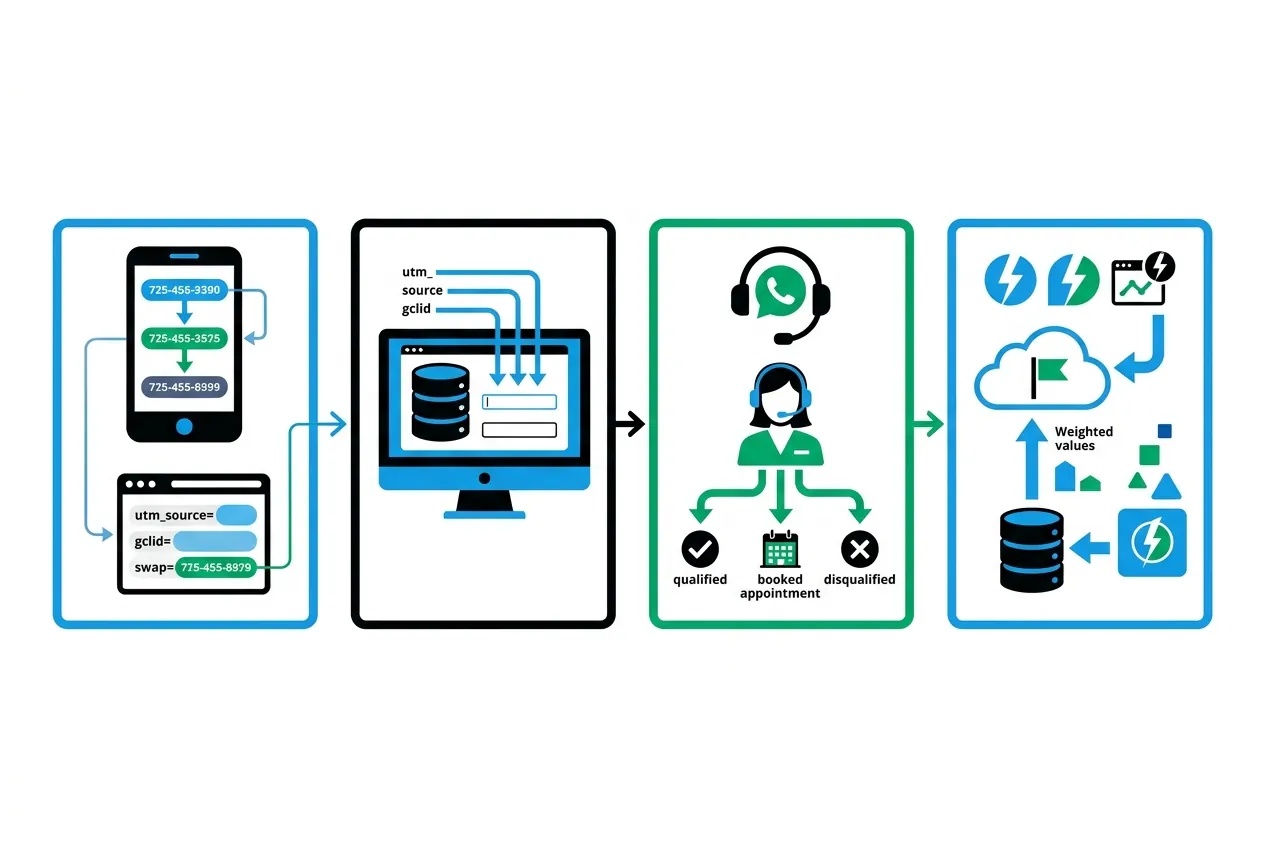
The technical workflow relies on four operational steps:
First, deploy dynamic number insertion across your digital properties. Dynamic number insertion swaps phone numbers on your site based on the visitor's session, binding incoming calls to digital identifiers such as campaign parameters and Google click identifiers.
Second, capture and store these session parameters alongside the caller's record in your CRM. When an intake coordinator answers the phone, your call-tracking system passes the session identifier directly into the contact record.
Third, standardize your intake dispositions. Coordinators must tag incoming inquiries using consistent criteria, such as recording whether the caller met clinical criteria, verified acceptable commercial insurance, or booked an intake assessment.
Fourth, transmit validated pipeline milestones back to ad networks via Google Ads Offline Conversions. Rather than letting Google optimize toward raw phone dials, you upload offline conversion events when a caller passes intake qualification or completes an admission. By assigning weighted conversion values to these advanced stages, you train bidding algorithms to hunt for revenue rather than call volume.
Measuring marketing effectiveness in privacy-restricted healthcare verticals
Operating an offline conversion feedback loop in regulated environments requires strict adherence to privacy frameworks. In behavioral healthcare and specialized medical services, measuring marketing effectiveness involves technical constraints that do not exist in conventional B2B or consumer retail sectors.
Under the Google Ads Personalized Advertising Policy, advertising platforms strictly prohibit remarketing, retargeting lists, and personalized audience targeting for sensitive healthcare categories, including mental health, addiction treatment, and specific medical conditions. You cannot simply build lookalike lists from past patient rosters or run retargeting ads to users who visited a specific clinical service page.
Furthermore, healthcare organizations cannot transmit Protected Health Information or unauthorized clinical identifiers to public ad network pixels. Passing an offline conversion event must never reveal an individual's diagnosis, medical history, or clinical notes.
Compliant measurement relies on decoupled, privacy-safe transaction identifiers. The ad network receives a confirmation that a specific click identifier reached an operational business milestone, along with an assigned conversion value, without receiving any clinical documentation or personal health identifiers. This distinction allows operators to steer bidding algorithms effectively while preserving regulatory boundaries.
How Marketing Powered builds attribution and data analytics architecture
Building an offline conversion engine requires both media proficiency and systems engineering. At Marketing Powered, our data and analytics architecture aligns advertising systems with actual commercial admissions and sales outcomes.
Our methodology is grounded in direct operating history. As a former healthcare CMO who ran marketing for a treatment network that grew from 3 to 24 locations, I managed $1.5 to $2M per month in Google Ads across 11+ behavioral and mental health accounts. As a court-certified expert witness in advertising strategy, I have evaluated ad mechanics and tracking architectures under rigorous evidentiary scrutiny.
Marketing Powered has been AI-native since 2022. Because we are LegitScript-aware and HIPAA-aware, our attribution models are built specifically for Google's sensitive healthcare vertical, where retargeting is not permitted. Rather than stopping at the raw lead, we track attribution directly to the final admission.
To evaluate intake interactions securely, we deploy owned, local AI infrastructure for HIPAA-aware inference. This architecture allows us to run natural language processing, call categorization, and operational intake auditing locally on private hardware. Sensitive caller transcripts are never routed to multi-tenant public cloud APIs, giving operators deep visibility into intake quality while maintaining absolute data sovereignty.
Teams looking to modernize their intake tracking can explore our dedicated call tracking services or partner with a specialized marketing attribution agency to implement these workflows across their tech stack.

Email Us
Prefer to send the context directly?
Unified marketing measurement: aligning media spend with commercial intake
Fixing your marketing metrics changes organizational behavior across departments. When marketing agencies and internal media teams are judged solely on raw call volume, their tactical decisions become predictable: they bid on broad, cheap keywords, write ad copy that promises broad solutions, and celebrate high conversion counts on vendor reports.
The intake team bears the cost of those incentives. Staff spend their shifts sorting through misdialed numbers, administrative requests, and out-of-network inquiries, leading to operational burnout and missed opportunities. Meanwhile, finance leaders observe rising marketing expenditures without corresponding revenue growth.
Unified measurement eliminates this operational friction. When media platforms bid on verified intake qualifications, cost per call may rise, but cost per qualified admission falls. Marketing, admissions, and executive leadership evaluate performance against a shared commercial reality: pipeline stage progression and verified revenue. For a deeper breakdown of multi-touch systems and data design, read our comprehensive guide on marketing attribution.
Questions, Answered.
A lead is an initial signal of interest, such as a submitted web form or an inbound phone call. A conversion is the completion of a commercially meaningful action. In phone-driven businesses, a raw call is merely an inquiry; true conversion happens when the caller is qualified by your intake team, completes an assessment, or becomes an admitted customer.
Call duration measures elapsed time, not commercial intent. Long hold times, navigation through interactive voice menus, wrong numbers, and extended conversations explaining that a provider does not accept a caller's insurance can easily exceed two or three minutes. Relying on duration tags inflates conversion counts with unqualified inquiries.
Offline conversion imports feed validated CRM milestone data back into Google Ads using unique click identifiers. Instead of optimizing bids to find users who simply place a call, automated bidding algorithms use these offline signals to prioritize search queries and user profiles that historically result in qualified intake assessments and completed admissions.
Yes, provided the tracking architecture is explicitly designed for compliance. By using dynamic number insertion to capture click identifiers and passing back only hashed transaction IDs and stage values via offline conversion uploads, healthcare providers optimize media performance without transmitting Protected Health Information or violating platform restrictions on sensitive categories. Book an attribution audit with Marketing Powered
Ready to see where your marketing can improve?
Request a free audit of your paid media, landing pages, attribution, and measurement setup. You'll get a straight assessment of where the opportunities are.
or email us at info@marketingpowered.ai