Resources
AI for Healthcare Marketing: Practical Uses and the Guardrails They Need
Deploying artificial intelligence within healthcare marketing requires a balance between acquisition speed and regulatory compliance. Health system commercial leaders can use automated language models and predictive analytics to improve discoverability and intake workflows, but ungoverned implementations expose organizations to severe regulatory liability and privacy breaches. Understanding the boundaries of ai for healthcare marketing allows clinical networks, hospitals, and specialty providers to scale patient acquisition while protecting institutional trust.
By Mike Hulick, Founder, Marketing Powered

What AI for Healthcare Marketing Means in Regulated Environments
Healthcare marketing operates under constraints that standard commercial marketing never encounters. While direct-to-consumer retail brands can freely deploy automated retargeting, dynamic personalized copy, and broad tracking scripts, healthcare organizations face strict federal, state, and platform boundaries. In a multi-location health system or clinical practice, marketing teams handle sensitive touchpoints where a prospective patient's search query, web activity, or intake submission can constitute protected health information.
Deploying artificial intelligence in this environment means moving beyond basic chatbot plugins and superficial generative copy. It requires a disciplined operational framework that connects machine learning, natural language processing, and local computing infrastructure directly to patient acquisition channels. Modern marketing systems use algorithmic models to analyze organic search intent, manage multi-location local listings, monitor search engine result pages, and optimize paid media bids across complex directory structures.
At the clinical and operational level, marketing leadership must differentiate between two distinct technological categories: public commercial models and ring-fenced operational systems. Public predictive tools, such as the algorithmic bidding models integrated into ad networks, operate on aggregated signals to locate high-intent searchers. In contrast, generative language models deployed inside prospective patient intake funnels or website conversion paths handle sensitive user inputs. Treating both categories with the same standard creates regulatory exposure.
A responsible deployment recognizes that marketing workflows must align with clinical integrity. When prospective patients look for specialized care, the content they read must be clinically accurate, verified by qualified professionals, and stripped of deceptive performance promises. Automated systems cannot replace medical oversight; their primary role is to eliminate manual coordination overhead, structure complex data, and maintain operational consistency across dozens of physical care locations.

Why Do We Need AI in Healthcare Marketing Operations?
Healthcare marketing executives face an increasingly difficult commercial landscape. Patient acquisition costs continue to rise across competitive service lines such as orthopedics, cardiology, behavioral health, and oncology. At the same time, prospective patients exhibit fragmented search behaviors, moving across generative search engines, localized map results, specialized directories, and community health forums. Marketing departments tasked with managing multi-location systems often struggle to keep physician profiles, service offerings, and educational content updated across multiple digital platforms.
Manual content production and fragmented data analysis cannot match the speed of modern search discovery. For a regional health system with twenty outpatient facilities, manually maintaining localized physician biographies, unique facility pages, and symptom guides creates immense administrative friction. Marketing teams spend disproportionate hours coordinating draft approvals rather than evaluating campaign economics. Automating these back-office operational layers allows teams to scale localized directory presence, monitor competitive search visibility, and standardize consumer educational materials across regional markets.
Adopting specialized ai tools for healthcare marketing also addresses the acute need for structured attribution. Traditional healthcare marketing often relies on loose lead metrics, such as phone calls initiated or form submissions completed, without connecting those early signals to confirmed appointments or actual clinical admissions. By using automated data ingestion pipelines that clean and normalize intake touchpoints, marketing leaders can evaluate true channel productivity without manual spreadsheet manipulation.
This operational efficiency directly protects patient care standards. When routine administrative tasks such as search trend analysis, directory syndication, and ad variation drafting are handled by supervised automated systems, internal teams can dedicate their attention to clinical review, messaging accuracy, and patient experience improvements. The objective is not to remove human judgment from healthcare communications, but to eliminate operational bottlenecks that slow organizational response.
Practical Applications: Using AI for Healthcare Across Three Risk Tiers
To safely implement automated systems, healthcare organizations must abandon binary views of technology adoption. Generative models should neither be banned outright nor deployed indiscriminately across all patient touchpoints. Instead, health systems require a risk-tiered operational model that categorizes marketing workflows by potential regulatory, clinical, and privacy exposure.
Tier 1: Low-Risk Operational Intelligence
Low-risk applications involve back-office research, structured data manipulation, and administrative campaign management where protected health information is never present and clinical claims are not being made. Marketing teams can deploy specialized tools in this tier with standard operational oversight.
Primary Tier 1 applications include:
- Analyzing organic search engine result pages (SERPs) to identify search intent gaps across specific medical service lines.
- Formatting structured schema markup, operational hours, and address metadata for multi-location healthcare directories.
- Evaluating anonymized, public consumer reviews to detect systemic operational friction, such as long clinic wait times or billing confusion.
- Generating creative variations of ad copy headlines and sitelink extensions based on pre-approved messaging frameworks.
- Processing aggregated platform metrics to detect sudden anomalies in media spending efficiency.
Because these tasks rely entirely on public datasets and administrative parameters, they pose minimal regulatory risk while yielding immediate operational efficiency.
Tier 2: Managed-Risk Educational Content
Managed-risk workflows involve public-facing educational assets, condition overviews, procedure descriptions, and physician profiles. These materials directly inform prospective patients who are evaluating care options. The central hazard in this tier is clinical inaccuracy: commercial language models are prone to confabulation, often generating plausible-sounding medical assertions that lack clinical validity or cite non-existent clinical trials.
When using AI for healthcare educational content, organizations must enforce a non-negotiable human-in-the-loop review system. Automated tools can draft initial page structures, synthesize primary source medical literature, and adapt clinical terminology into readable consumer language. However, no educational page may be published without formal verification and written sign-off by a licensed physician, clinical specialist, or accredited medical editor. Every clinical statement must link back to authoritative guidelines from governing medical bodies or primary clinical literature.
Tier 3: High-Risk Conversion and Intake Workflows
High-risk applications touch prospective patient interactions directly. These include digital triage assistants, pre-intake conversational tools, dynamic form routing, and patient communication automation. In this tier, consumer inputs frequently contain sensitive details regarding symptoms, past diagnoses, insurance coverage, and personal identifying data.
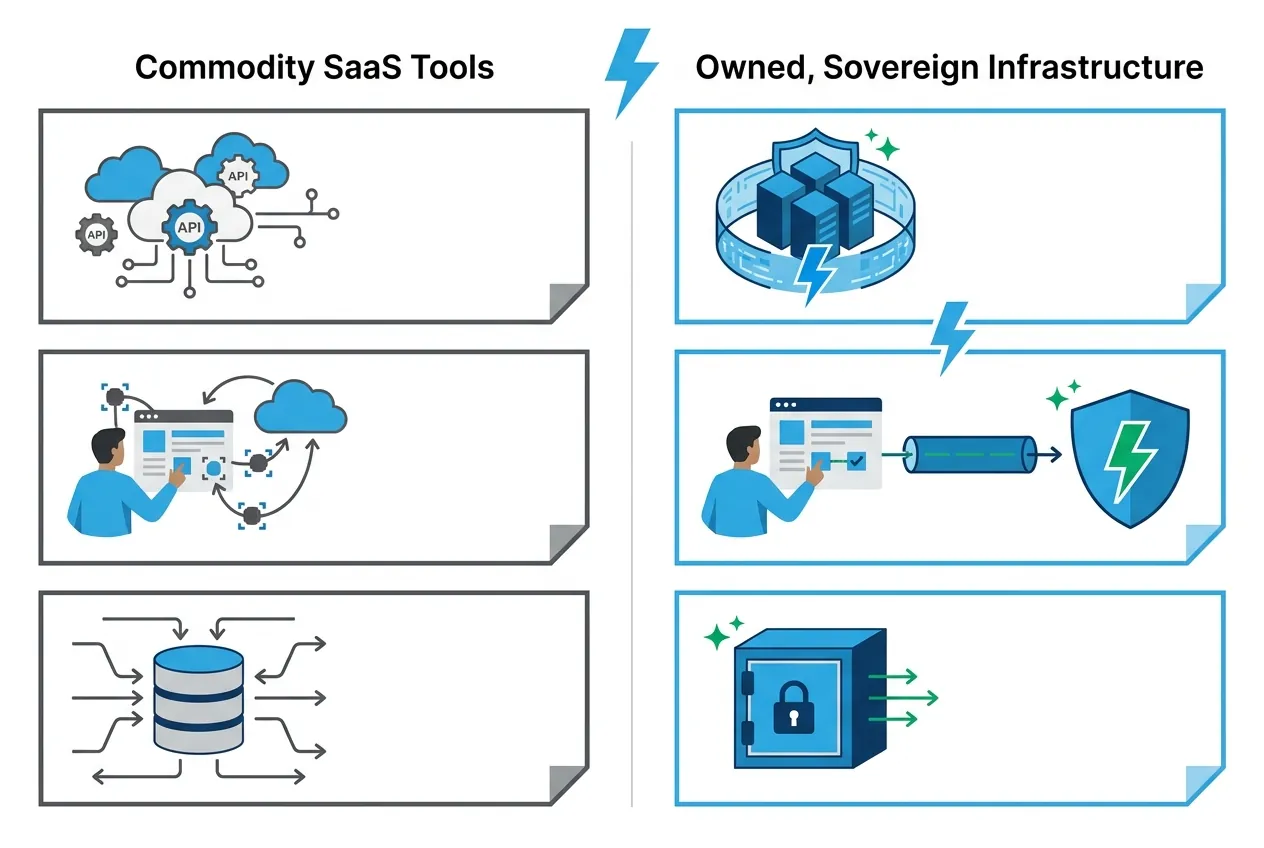
Deploying commodity cloud-based consumer models in Tier 3 workflows is an acute institutional liability. Standard third-party application programming interfaces (APIs) and commercial software-as-a-service (SaaS) wrappers often route user prompts through external cloud environments that use interaction data for model retraining. Healthcare providers deploying high-risk intake tools must use sovereign, ring-fenced infrastructure where models run locally or in private environments with explicit data isolation boundaries.
Free Audit
Want a straight read on where your budget is leaking?
Privacy, HIPAA, and Platform Guardrails: Where Commodity AI Breaks Down
The commercial software market is saturated with generative wrappers that claim to revolutionize medical marketing. For institutional healthcare operators, using these off-the-shelf tools without strict technical boundaries introduces severe compliance risks across federal regulations and ad network policies.
Federal oversight regarding digital healthcare privacy has expanded significantly. The Office for Civil Rights has made clear that tracking tools and automated scripts cannot intercept identifiable patient interactions on healthcare web properties. According to the official HHS OCR Tracking Guidance, deploying unvetted third-party tracking technologies that capture an individual's IP address, medical search terms, or appointment scheduling behaviors can constitute an impermissible disclosure of protected health information under HIPAA rules. When marketing teams embed third-party automated chatbots or tracking scripts that transmit session data back to public cloud servers, they risk triggering regulatory investigations.
Advertising platform restrictions create another operational hurdle. Major ad platforms enforce stringent limitations on healthcare advertisers. As outlined in the Google Ads Healthcare and Medicines Policy, advertisers are strictly prohibited from using personalized advertising, remarketing lists, or custom audience targeting based on sensitive personal health categories. Commodity marketing software built for standard e-commerce relies heavily on behavioral retargeting pixels and dynamic visitor tracking. Deploying those same tactics in regulated healthcare categories can lead to immediate ad account suspension.
Advertising claims face heightened scrutiny from consumer protection regulators. The Federal Trade Commission actively investigates false and unsubstantiated claims regarding automated decision-making and performance results. In its published FTC Guidance on AI Claims, the commission warns businesses that exaggerating algorithmic capabilities, making deceptive efficacy statements, or publishing automated marketing copy that cannot be substantiated with scientific evidence violates federal law. Automated copy generators programmed to write persuasive marketing copy will naturally invent superlative claims regarding treatment outcomes or recovery timelines unless strictly constrained by deterministic guardrails.
Marketing Powered was built specifically for Google's sensitive healthcare vertical, where retargeting is not permitted. Navigating these constraints requires operational experience in regulated media management rather than theoretical software experimentation. The founder of Marketing Powered is a former healthcare CMO who ran marketing for a treatment network that grew from 3 to 24 locations, managing $1.5 to $2M per month in Google Ads across 11+ behavioral and mental health accounts. As a court-certified expert witness in advertising strategy, the founder designed the firm's acquisition frameworks to remain fully LegitScript-aware and HIPAA-aware.
Marketing systems in regulated verticals cannot rely on surface-level conversions. Attribution must be tracked directly to actual clinical intake or admission, not just an unvetted top-of-funnel web lead, ensuring that advertising spend optimizes toward legitimate patient acquisition while honoring federal privacy boundaries.
Evaluating an AI Healthcare Marketing Agency Beyond Vendor Labels
As interest in marketing technology accelerates, traditional digital marketing agencies increasingly rebrand themselves as artificial intelligence specialists. For healthcare executives, distinguishing substantive technical infrastructure from superficial rebranding is critical to protecting organizational capital and brand equity. Evaluating an ai healthcare marketing agency requires examining operational architecture, compliance standards, and technical governance rather than accepting marketing slogans.
To evaluate prospective partners, marketing leaders should explore how the agency handles computing infrastructure, model deployment, and clinical validation:
First, examine data transmission pathways. Ask prospective partners where model inference actually occurs. If an agency routes prospective patient inquiries, intake transcripts, or form data through standard consumer-tier cloud APIs, your organization has no control over how that data is stored, cached, or processed. A technically proficient partner understands how to run open-weight models on dedicated, ring-fenced hardware, ensuring that zero sensitive prompt data is retained by third-party commercial entities.
Second, review the agency's editorial governance protocols. Inquire whether their content production workflows include mandatory human clinical verification. A competent agency maintains a clear boundary between automated drafting and clinical review, requiring qualified medical professionals to inspect factual assertions, drug references, and treatment claims before publication.
Third, evaluate how the firm approaches organic search discovery. The transition toward generative search engines requires healthcare organizations to optimize for direct citation within large language model responses. Collaborating with an experienced generative engine optimization agency ensures your health system builds authoritative, entity-based knowledge graphs that search engines reference when answering complex medical questions.
Finally, assess how the agency links marketing activity to executive financial metrics. Organizations adopting modern systems should consult broader strategic frameworks, such as our guide to AI marketing: what it changes for strategy, teams and budgets, to align software capabilities with operational goals. True operational expertise reflects accountable business growth, disciplined capital allocation, and strict data protection.
Specialized Systems on Owned Infrastructure: The Marketing Powered Model
Sustainable competitive advantage in healthcare marketing stems from institutional data sovereignty, not from renting public commercial software. Organizations that build their core acquisition processes entirely on third-party SaaS wrappers remain vulnerable to sudden API pricing increases, unexpected terms-of-service alterations, and data leakage risks. Marketing Powered operates on a different foundation, deploying specialized AI systems built on owned, local infrastructure.
Being AI-native since 2022, Marketing Powered uses dedicated private compute environments to run local model inference. By hosting and running open-weight language models on owned hardware, the firm processes marketing research, search intent clustering, multi-location content structuring, and intake conversation analysis without routing sensitive operational datasets through public cloud vendors. This architecture provides complete administrative control over data residency, inference parameters, and information security.
In an executive war room or clinic operations center, healthcare leaders need marketing systems that tie directly to facility occupancy and clinic schedules. The firm's operational workflows combine owned compute with deep healthcare media discipline. Instead of optimizing paid campaigns for top-of-funnel form fills that place heavy burdens on admissions teams, acquisition funnels are engineered to track attribution to confirmed admission. Offline conversion data is reconciled using secure, privacy-preserving hashing methods, allowing ad platform bidding algorithms to locate qualified patients while remaining fully compliant with platform healthcare policies.
This combination of owned infrastructure and healthcare operational experience allows multi-location health systems, hospitals, and specialized clinics to deploy advanced automation safely. Marketing leaders gain the speed and scale of modern natural language processing while maintaining an uncompromised risk posture that protects their patients and their institution.
Questions, Answered.
Healthcare marketing teams can deploy automated systems safely by separating workflows according to data exposure risk. Back-office research, technical SEO optimization, directory formatting, and initial ad copy variations carry low privacy risk because they do not involve protected health information. For direct patient-facing touchpoints or digital intake workflows, organizations must avoid public cloud APIs and instead use owned, local infrastructure with explicit data isolation boundaries, combined with privacy-compliant, server-side conversion tracking.
Automated systems accelerate patient acquisition by structuring complex multi-location directory networks, optimizing search engine entity authority, and identifying gaps in prospective patient search journeys. Natural language models can analyze high-intent search queries across specific medical service lines, allowing marketing departments to draft detailed educational materials that answer common patient questions. When paired with human clinical verification, these systems improve organic search rankings and reduce manual editorial overhead.
Public commercial tools operate in shared cloud environments where user prompts and interaction data may be cached, logged, or used to train future public foundation models. For healthcare organizations handling sensitive intake discussions or proprietary operational metrics, routing data through third-party APIs creates regulatory exposure under federal tracking and privacy standards. Owned infrastructure ensures that models run locally on private hardware, keeping sensitive institutional data entirely within organizational control.
Generative search engines summarize medical information directly within the search interface, often citing only a small group of authoritative medical sources. Healthcare providers can no longer rely solely on legacy keyword placement. Marketing operations must focus on generative engine optimization, building verified entity profiles, publishing clinically validated content with clear author credentials, and establishing structured schema markup so algorithmic engines recognize the provider as a credible authority. Talk with Marketing Powered about owning your marketing AI stack
Ready to see where your marketing can improve?
Request a free audit of your paid media, landing pages, attribution, and measurement setup. You'll get a straight assessment of where the opportunities are.
or email us at info@marketingpowered.ai