Resources
Google Ads for Healthcare: Campaign Types, Policies, and Measurement
Deploying google ads for healthcare requires a fundamentally different commercial architecture than standard digital advertising. Rising cost-per-click rates across clinical categories mean medical providers cannot afford broad matching, unvetted landing page flows, or unverified lead counts. Success depends on capturing clinical intent at the precise moment of need, respecting strict regulatory guardrails, and measuring pipeline down to verified patient appointments.
By Mike Hulick, Founder, Marketing Powered

Why Google Ads for Healthcare Demands an Operator-Led Strategy
Healthcare paid search sits at the intersection of immediate human vulnerability, strict platform rules, and complex clinical operations. When prospective patients turn to a search engine, they search with high urgency. A parent searching for an urgent care clinic for a pediatric laceration, an executive seeking discreet residential depression treatment, or an individual researching a specialized orthopedic surgeon each presents a distinct clinical urgency. Treating these distinct search profiles as uniform e-commerce leads wastes capital and damages clinic operations.
Generic agency playbooks frequently fail medical practices because they optimize for raw conversion volume. In standard lead generation, form fills and brochure downloads count as success. In healthcare, an unqualified form fill creates operational drag. Clinical intake coordinators, call center teams, and front-desk personnel spend limited administrative hours triaging inquiries that never turn into scheduled encounters. If an ad account generates calls from patients using out-of-network insurance plans for a specialty clinic that accepts only commercial coverage or direct pay, the marketing appears successful on paper while actively eroding clinical margins.
The commercial challenge intensifies because Google classifies health-related searches under sensitive vertical rules. Medical accounts operate without standard remarketing safety nets, face sudden ad disapprovals based on policy changes, and navigate stringent patient privacy standards. Managing medical media spend requires operating experience where campaign configuration reflects actual clinic intake capacity, payer mix economics, and regulatory compliance.
Operating at scale reinforces this reality. Marketing Powered brings an executive background led by a former healthcare CMO who ran marketing for a treatment network that grew from 3 to 24 locations, managing $1.5 to $2M per month in Google Ads across 11+ behavioral and mental health accounts. Scaling multi-location healthcare systems requires recognizing that paid search is not merely a traffic acquisition exercise. It is a demand-filtering engine that must coordinate directly with front-desk capacity, clinical credentialing, and intake protocols. Navigating this ecosystem requires structural discipline across healthcare PPC: structuring paid search for qualified patient demand to align clinical capacity with media investments.

Campaign Types: Matching Paid Search Structures to Clinical Service Lines
Selecting the right campaign format determines whether an ad budget produces scheduled patients or empty clicks. Google provides several campaign types, but their utility varies sharply across medical specialties and operational models.
Search Network: Intent Capture for Google Ads for Medical Practices
The traditional Search Network remains the primary foundation for healthcare acquisition. When structuring google ads for medical practices, exact-match and phrase-match keywords capture explicit intent without exposing the account to irrelevant queries.
Medical search queries generally divide into three clinical categories:
- Symptom and Condition Searches: Queries such as "persistent knee pain after running" or "signs of acute depression." These indicate an early diagnostic phase. Bidding on these requires cautious landing page copy that informs without offering unverified diagnostic claims.
- Treatment and Procedure Searches: Keywords such as "minimally invasive spine surgery," "TMS therapy," or "knee replacement options." These indicate clinical readiness and command higher bids.
- Provider and Facility Searches: Terms such as "orthopedic surgeon near me" or "in-network physical therapy clinic." These prospects possess the highest commercial intent and convert at the highest rates.
For surgical centers, specialty clinics, and direct-care practices, standard Search campaigns allow manual negative keyword filtering, strict location perimeter controls, and complete bidding oversight. Using exact match on high-intent procedure keywords prevents advertising dollars from matching irrelevant research searches.
Call-Only and Call-Asset Campaigns: Urgent Triage and Rapid Intake
For urgent care centers, crisis stabilization units, pediatric after-hours clinics, and acute addiction intake, traditional web forms introduce friction. Prospective patients or distressed family members rarely fill out detailed intake questionnaires during an emergency. They dial immediately.
Call-only campaigns (and search ads featuring prominent call assets) direct high-intent mobile searchers straight to phone queues. These campaigns bypass landing pages entirely, connecting the searcher with an intake specialist. However, running call ads requires strict operational alignment:
- The intake team must answer calls within three rings. Dropped calls directly inflate patient acquisition costs.
- Ad schedules must mirror clinical staffing hours. Routing paid calls to an unattended voicemail after hours destroys budget.
- Call tracking numbers must utilize dynamic number insertion or dedicated forwarding pools that respect privacy regulations without storing protected patient health details on non-compliant servers.
Performance Max and Demand Generation: High Risk in Regulated Care
Performance Max (PMax) uses automated bidding and multi-channel asset allocation across Search, Display, YouTube, Discover, and Maps. While PMax delivers volume in direct-to-consumer retail, it introduces operational and regulatory risks in healthcare.
First, Performance Max limits ad-group negative keyword management. Without account-level placement controls and extensive brand exclusion lists, automated systems can display medical ads alongside irrelevant content, sensational health news, or inappropriate YouTube videos. Second, PMax relies heavily on automated asset generation, which can generate ad copy variations that violate medical board guidelines or trigger policy rejections.
For specialized healthcare organizations, running broad PMax campaigns often creates spikes in unqualified calls and disjointed attribution. If deployed at all, PMax should remain restricted to well-defined service lines where expansive negative brand lists exist, patient intake criteria are broad, and offline conversion tracking actively steers Google's bid algorithms away from low-value clicks.
Local Search and Google Maps for Healthcare Providers
Local search intent drives a substantial volume of clinical appointments. Searches containing "near me" or specific neighborhood modifiers trigger Google's local three-pack results.
Connecting a verified Google Business Profile to a Google Ads account enables location assets. This allows a clinic or multi-location health system to appear at the top of local map searches when nearby prospective patients seek care. For physical clinics, combining local search ads with structured practice landing pages captures demand from consumers seeking physical proximity, parking convenience, and confirmed operating hours.
Google Ads Healthcare and Medicines Policy: Navigating Critical Restrictions
Google maintains strict advertising policies to protect consumer health and safety. Violating these rules triggers immediate ad disapprovals, merchant center suspensions, or permanent account bans. Navigating the Google Ads Healthcare and Medicines Policy requires continuous oversight of terminology, landing page copy, and clinical claims.
Restricted Substances, Pharmaceuticals, and Clinical Terminology
Google restricts the use of prescription drug names, regulated medical terms, and clinical procedures in ad copy and landing page text. Mentioning brand-name medications (for example, specific weight-loss injectables, psychiatric medications, or opioid pain relievers) can trigger automated disapprovals even if the advertiser is a licensed prescriber.
To reference controlled substances or select medical products, healthcare organizations must obtain proper verification through Google's healthcare application process. Even with approval, advertising prescription drugs directly to consumers remains heavily restricted outside specific jurisdictions such as the United States and Canada.
Medical practices must review ad copy for clinical claims. Claims implying guaranteed clinical cures, unsubstantiated recovery timeframes, or unverified success percentages violate Google's misleading content guidelines and draw regulatory scrutiny from consumer protection bodies.
LegitScript Certification for Behavioral Health Providers
To combat deceptive marketing practices in substance use treatment, Google requires third-party credentialing for addiction treatment advertisers. In the United States, facilities providing addiction treatment services, detox programs, or recovery support must obtain verification through LegitScript Certification before submitting an application to advertise on Google.
The LegitScript certification process audits:
- Valid clinical and facility licensure in every jurisdiction of operation.
- Criminal background clearances for leadership and key personnel.
- Physical property inspection and clinical operational policies.
- Adherence to accepted medical guidelines and insurance billing transparency.
Operating an account in this space requires strict compliance hygiene. Marketing Powered brings direct operational depth to this environment, running accounts that are LegitScript-aware and HIPAA-aware, built for Google's sensitive healthcare vertical where retargeting is not permitted. Without active certification and ongoing compliance monitoring, campaigns targeting recovery or addiction services are suspended immediately.
The Prohibition on Retargeting in Healthcare Google Ads
Under the Google Ads Policy on Personalized Advertising, advertisers cannot target audiences based on sensitive personal categories, including physical or mental health conditions, clinical treatments, or personal hardships.
In standard consumer marketing, retargeting website visitors who abandoned a shopping cart is routine. In healthcare, building an audience list of individuals who visited an oncology page, a depression intake form, or an orthopedic surgical overview and serving them display or search remarketing ads is prohibited. Google's automated scanners actively review audience targeting configurations and landing page classifications. Using Customer Match lists (such as uploading patient email addresses) to target health-related campaigns also violates policy and risks immediate suspension.
Because healthcare advertisers cannot rely on retargeting funnels to bring unconverted prospects back over several weeks, healthcare paid search must function as a disciplined first-touch capture system. Every ad impression, keyword match, and landing page asset must convert high-intent prospective patients on their initial visit.
Free Audit
Want a straight read on where your budget is leaking?
Compliance and Patient Privacy: HIPAA-Aware Tracking Architecture
Measuring advertising efficiency in healthcare requires rigorous privacy controls. Marketing teams cannot simply deploy client-side advertising pixels across appointment scheduling flows without assessing legal and regulatory boundaries.
The Department of Health and Human Services (HHS) Office for Civil Rights (OCR) issued definitive guidance in its HHS OCR Bulletin on Tracking Technologies. The guidance clarified that regulated healthcare entities subject to HIPAA cannot share protected health information (PHI) with third-party tracking technology vendors without a valid Business Associate Agreement (BAA) or explicit HIPAA authorization from the patient.
The Risks of Client-Side Tracking Pixels
Deploying third-party tracking snippets (such as the standard Google tag or Meta pixel) directly in the code of patient portals, telehealth scheduling pages, or intake questionnaires presents operational and legal liability.
When a browser loads a client-side tracking script on a clinical URL, that script automatically captures metadata:
- The user's public IP address.
- The specific webpage URL (which often contains condition details, such as /treatment/major-depression or /services/pediatric-cardiology).
- Form field interactions and device identifiers.
When an IP address is paired with a specific medical procedure URL, regulatory frameworks may classify that aggregate data as protected health information. Transmitting this data to ad platforms that do not sign BAAs can expose the healthcare organization to regulatory penalties, audits, and civil litigation.
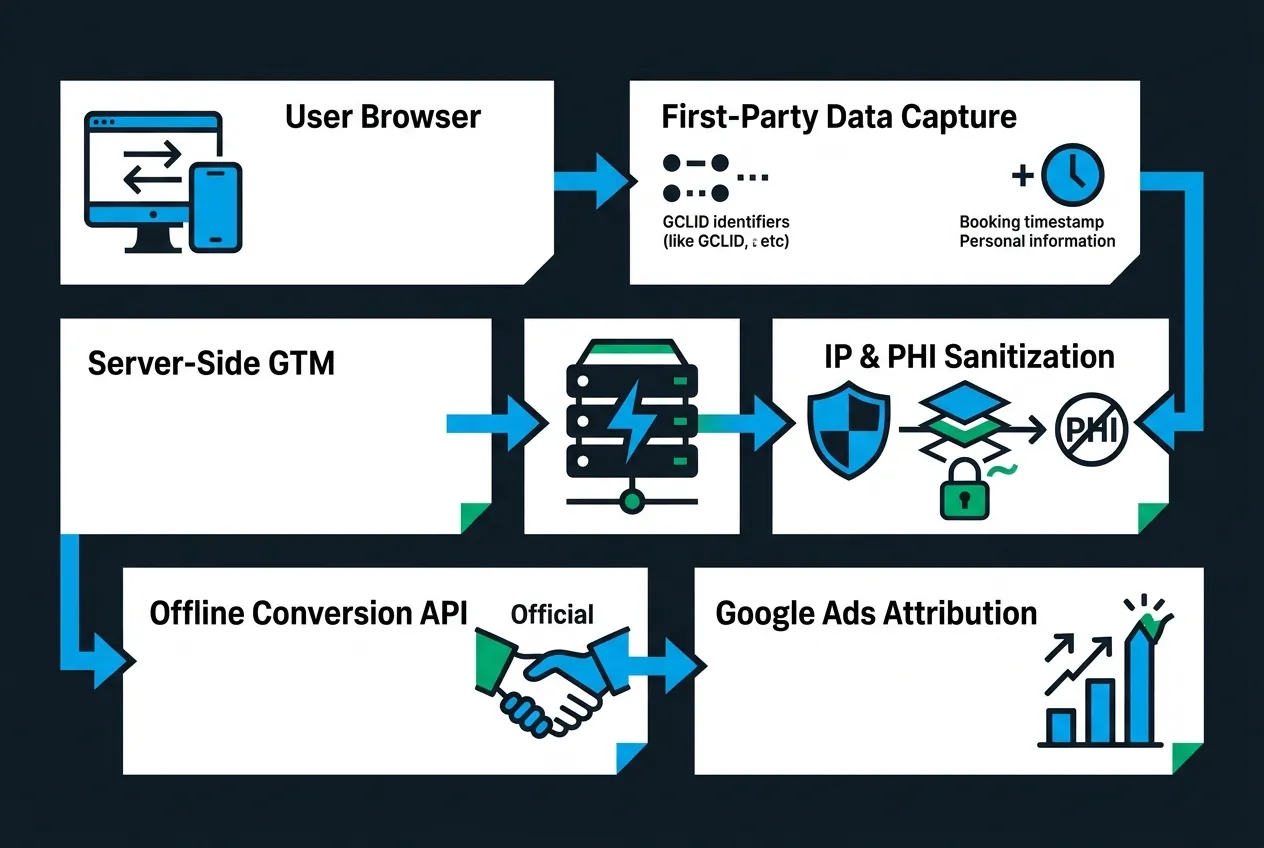
Implementing Server-Side GTM and Offline Conversion APIs
To measure campaign performance accurately without transmitting protected identifiers, healthcare organizations must implement privacy-first data pipelines.
The defensible architectural standard combines server-side Google Tag Manager (sGTM) with Google's Offline Conversion Tracking (OCT) API:
- Client-Side Data Sanitization: The patient's browser interacts only with a first-party domain proxy. No unvetted third-party vendor scripts run on sensitive intake pages.
- Server-Side Data Governance: Hits pass directly to an isolated, owned server instance. The server strips visitor IP addresses, removes clinical URL parameters, and extracts unique advertising identifiers (such as the Google Click ID, or GCLID).
- Data Redaction and Hashing: Identifiers are decoupled from any clinical intake data. No medical records, diagnostic answers, or clinical notes enter the marketing data layer.
- Offline Conversion Ingestion: When an intake coordinator verifies insurance eligibility and books an appointment in the Electronic Health Record (EHR) or Practice Management System (PMS), the scheduling event triggers a server-side API call. The system passes the GCLID, an anonymous conversion event name ("Appointment_Booked"), and a non-clinical conversion value back to Google Ads.
This offline loop gives Google's smart bidding engines the exact signal needed to optimize for qualified appointments, completely insulating the system from transmitting protected health information.
Structuring High-Converting Landing Pages for Google Ads for Doctors
A search campaign can achieve high click-through rates, but if the destination landing page fails to establish trust or introduces administrative friction, prospective patients leave. Running successful google ads for doctors requires dedicated landing pages built around clinical clarity, practitioner credentials, and transparent intake steps.
Medical practices often direct paid media to their website homepage. This degrades conversion rates. A standard practice homepage contains broad navigation menus, news announcements, research links, and multiple unrelated physician bios. A prospective patient searching for immediate relief from herniated disc pain should not have to navigate general hospital announcements to locate a specialist.
High-converting medical landing pages feature five core structural components:
- Clear Clinical Specialization: The page hero section must confirm that the clinic treats the exact condition searched within three seconds of landing. Headline copy must match the intent of the ad creative.
- Verified Provider Credentials: Patients choose doctors based on clinical authority. Prominently display board certifications, hospital affiliations, fellowship training, and institutional memberships near the top of the page.
- Clear Insurance and Payment Information: Financial uncertainty halts patient conversion. Explicitly list accepted insurance carriers, Medicare acceptance, or straightforward self-pay fee schedules to eliminate drop-off.
- Low-Friction Intake Mechanisms: Provide dual contact options. Pair a straightforward, HIPAA-compliant digital appointment request form (requiring only basic contact details and preferred times) with a click-to-call phone number staffed by trained intake personnel.
- Accessibility and Mobile Optimization: Over 60% of local healthcare searches occur on mobile devices. Pages must load under two seconds on cellular connections, feature tap-to-call functionality, and maintain legible typography.
Optimizing for Closed-Loop Conversions: Bidding on Qualified Encounters
The central economic failure in healthcare digital marketing is bidding on proxy metrics. When marketing teams instruct Google Ads algorithms to maximize form fills, the platform delivers the cheapest possible form fills. In healthcare, cheap inquiries often correlate with unqualified inquiries: out-of-area searchers, individuals seeking free advice, or patients seeking services the clinic does not provide.
To run a commercially viable healthcare ad account, conversion tracking must follow the patient journey from search impression to completed clinic visit.
Moving Beyond Raw Form Submissions
A clinic marketing department that relies on thank-you page pageviews as its primary conversion action creates blind spots. An ad campaign might generate 50 leads at $50 per lead. If only two of those leads convert into scheduled appointments, the effective Cost Per Scheduled Appointment is $1,250. Another campaign might generate 20 leads at $150 per lead, but convert 12 into scheduled appointments, yielding a Cost Per Scheduled Appointment of $250.
If Google's bidding algorithm (such as Maximize Conversions or Target CPA) optimizes purely for raw inquiries, it will allocate media spend toward the first campaign, scaling unqualified volume while starving the profitable campaign of budget.
Tracking Down to Scheduled and Completed Encounters
Marketing Powered enforces closed-loop measurement where attribution is tracked to admission or completed appointment, not just raw lead capture.
By integrating the practice management intake workflow with Google Ads using offline conversion imports:
- Intake Triage: Each incoming phone call and form fill captures a unique campaign identifier (GCLID) and passes it securely into the clinical CRM or practice management intake pipeline.
- Milestone Attribution: As the intake team validates insurance, schedules the consultation, and marks the appointment as completed in the EHR, the milestone triggers a conversion upload back to Google Ads.
- Value-Based Bidding: Higher conversion values are assigned to scheduled consultations and completed patient encounters, while unqualified inquiries receive zero value.
- Smart Bidding Calibration: Google's Target ROAS (Return on Ad Spend) or Target CPA algorithms adjust bids based on the real-world operational probability of a search query driving a completed clinical visit.
This structure eliminates marketing waste, optimizes budgets toward high-margin service lines, and stabilizes patient acquisition costs. Healthcare groups vetting agency capabilities can evaluate structural standards across healthcare PPC services: what a specialist partner delivers and how to vet one and examine general account management models through Google ads agency: what a specialist partner delivers and how to vet one.

Email Us
Prefer to send the context directly?
How Marketing Powered Manages Paid Search in Regulated Healthcare
Managing medical paid search requires technical infrastructure, regulatory knowledge, and media management experience. Marketing Powered delivers comprehensive Google and Meta paid media management designed around the commercial realities of healthcare organizations, medical practices, and multi-location clinical networks.
Our execution model reflects real operating experience:
- Executive Healthcare Leadership: Our approach is built on executive operating background, led by a former healthcare CMO who scaled a treatment network from 3 to 24 locations, managing $1.5 to $2M per month in Google Ads across 11+ behavioral and mental health accounts. Strategy is informed by a court-certified expert witness in advertising strategy.
- Regulatory and Policy Governance: We configure accounts to comply with the Google Ads Healthcare and Medicines Policy, manage LegitScript application workflows, and enforce Google's non-personalized advertising rules.
- Privacy-First Attribution Systems: We deploy server-side Google Tag Manager and offline conversion ingestion pipelines aligned with HHS OCR tracking guidance. This architecture connects ad spend directly to scheduled appointments and patient admissions without exposing protected health information to third-party ad networks.
- Owned, Local AI Infrastructure: We have been AI-native since 2022, operating owned, local AI infrastructure for HIPAA-aware inference. This allows us to process campaign intelligence, analyze search term data, and model intake workflows locally without passing sensitive healthcare information through public cloud-hosted AI APIs.
- Multi-Location Demand Distribution: For regional health networks, ambulatory surgical groups, and medical groups, we build scalable account structures that direct budget based on clinic-level appointment availability, physician scheduling capacity, and regional payer acceptance.
We focus our work on commercial discipline: capturing qualified patient demand, preserving regulatory integrity, and optimizing every media dollar toward verifiable patient encounters.
Questions, Answered.
A specialized healthcare Google Ads specialist oversees the technical setup, policy adherence, campaign architecture, and conversion attribution of paid search accounts. Unlike generalist media buyers, a healthcare specialist manages sensitive vertical compliance (including Google's Healthcare and Medicines Policy and LegitScript verification), configures privacy-compliant server-side tracking pipelines that respect HHS OCR guidance, implements strict negative keyword structures to filter unqualified inquiries, and aligns bidding strategies directly with clinic intake workflows and EHR scheduling data.
Yes, provided the specialist operates with deep healthcare domain knowledge and focuses on booked patient encounters rather than superficial vanity clicks. Healthcare keywords carry high cost-per-click rates. Without rigorous keyword match-type control, continuous negative keyword expansion, and compliance-aware landing page design, medical practices frequently exhaust their ad spend on unqualified inquiries, out-of-network patients, or research clicks. A qualified specialist eliminates untargeted media waste and configures closed-loop conversion attribution, making paid search a measurable, positive-ROI acquisition channel.
No. Under Google's Personalized Advertising Policy, advertisers are strictly prohibited from using remarketing lists, retargeting pixels, or Customer Match audience targeting for any health-related conditions, medical treatments, or clinical procedures. Because practices cannot retarget visitors who leave the site without scheduling, healthcare paid search must be engineered as a high-performance, first-touch conversion system using intent-focused keywords and dedicated, low-friction landing pages.
Healthcare organizations maintain compliance by eliminating direct client-side tracking pixels on appointment booking pages and patient portals. Instead, they implement server-side Google Tag Manager (sGTM) on isolated infrastructure and utilize Google Ads Offline Conversion Tracking (OCT). When a patient books an appointment, the clinical intake system passes an anonymous identifier (such as a Google Click ID) and conversion milestone back to Google Ads via secure API, completely omitting protected health information, patient identifiers, or clinical details from the platform.
LegitScript certification is mandatory for any advertiser running campaigns in the United States related to addiction treatment, substance use recovery, or related behavioral health services. Without an active LegitScript certification and subsequent verification through Google's healthcare advertising application, Google Ads automatically suspends any campaigns bidding on recovery-related search queries. Obtaining and maintaining certification ensures an account can advertise continuously without sudden policy suspensions. Request a paid media audit
Ready to see where your marketing can improve?
Request a free audit of your paid media, landing pages, attribution, and measurement setup. You'll get a straight assessment of where the opportunities are.
or email us at info@marketingpowered.ai