Resources
AI Agents for Marketing: Where Specialized Agents Help and Where Humans Stay in Control
Enterprise marketing leaders are discovering that autonomous prompt boxes cannot replace end-to-end commercial execution. Deploying specialized ai agents for marketing solves the operational bottleneck of repetitive campaign workflows without sacrificing brand safety or regulatory compliance. Sustainable scale requires modular software agents operating under deterministic human review on owned infrastructure.
By Mike Hulick, Founder, Marketing Powered

How specialized marketing AI agents outperform monolithic models

What are AI agents for marketing?
An AI agent is a software system configured to pursue a specific operational goal by perceiving its context, reasoning through multi-step tasks, selecting tools, and evaluating its own output against established criteria. Unlike a standard conversational prompt that generates a single response to a user query, an agent functions within a defined workflow loop. It takes structured inputs, executes intermediate checks, references verified background data, and produces formatted deliverables without requiring human intervention at every intermediate keystroke.
In an operational setting, this distinction is visible on the production floor. A digital marketing team transitioning away from manual drafting does not hand its brand keys over to an all-purpose chatbot. Instead, operators build a modular sequence across their campaign management boards. One screen shows an inbound research agent extracting customer intent clusters from raw search queries; an adjacent terminal displays a brief-structuring agent mapping those queries into defined content outlines; and a central staging environment shows an editorial agent verifying technical terminology against approved product documentation.
The fundamental shift is the transition from broad generative tools to bounded, agentic marketing systems. A generic large language model tries to guess what a user desires across infinite domains. A marketing AI agent operates within strict guardrails. It receives an explicit system instruction detailing its role, access to specific internal APIs or source files, defined constraints on tone and vocabulary, and unambiguous output schemas such as structured JSON, markdown tables, or formatted advertising copy.
When organized effectively, these systems form collaborative networks that mirror a seasoned marketing team. Rather than expecting one software program to write strategy, optimize technical schema, draft ad creative, and audit regulatory compliance simultaneously, enterprise architectures assign each task to an isolated specialist agent. This division of labor keeps error rates low and makes every stage of campaign production auditable by human supervisors.
Monolithic artificial intelligence models degrade quickly when tasked with complex, multi-stage commercial projects. When an operator feeds an open-ended prompt asking an LLM to analyze a market, devise an acquisition strategy, write ten landing pages, and produce ad variations, the context window fills with competing instructions. The model begins to suffer from attention dilution, which leads directly to superficial reasoning, generic platitudes, hallucinated statistics, and drifted brand voice.
Specialized marketing ai agents solve this problem through functional decomposition. By breaking a large commercial objective into discrete, sequential stages, each agent operates with maximum cognitive fidelity on a single task.
Consider the technical contrast between a monolithic prompt and a modular agent pipeline:
- Bounded Context Windows: A specialized research agent processes only clean search intent data, competitor positioning matrices, and primary customer interviews. It does not carry the cognitive overhead of creative styling or conversion optimization rules.
- Enforced Output Schemas: Rather than producing unstructured prose, a specialized content strategist agent outputs a rigorous brief containing verified headings, explicit keyword targets, and source record citations. Downstream agents ingest this structured output as their absolute parameters.
- Targeted System Instructions: A copywriting agent configured solely for regulated healthcare or professional services operates under explicit negative constraints. It is programmed to exclude specific prohibited claims, reject unsupported guarantees, and maintain formal sentence architecture.
- Deterministic Evaluation Checks: A specialized QA agent inspects the copywriter agent output against source records. If a claim lacks an explicit citation from the verified knowledge library, the QA agent rejects the draft back to the copywriter before any human wastes time reviewing it.
This specialization prevents the brand decay common to generic AI content engines. When marketing teams restrict software agents to bounded domains, the outputs shift from generic filler to defensible marketing assets that reflect actual domain authority.
The division of labor: Where ai marketing automation excels
Software agents excel at high-volume, structured, and repeatable analytical tasks that overwhelm human staff. Deploying ai marketing automation across operational bottlenecks accelerates execution speed while freeing strategic thinkers to focus on positioning, narrative architecture, and capital allocation.
In production environments, specialized agents deliver the highest leverage across four distinct workflows:
- Search Intent and Semantic Query Clustering: Processing thousands of Search Console queries manually is inefficient. Specialized agents can categorize massive keyword libraries by commercial intent, identify content cannibalization across multi-location websites, and extract semantic entities that competitors fail to address.
- Structural Content Brief Formulation: Before a single sentence is written, an agent can ingest top-ranking search pages, catalog their structural headings, identify unanswered user questions, and map relevant internal links across an existing website taxonomy. This produces an actionable, fact-grounded outline in minutes.
- Controlled Ad Creative Variation: Creating localized ad variants across multi-location businesses requires strict adherence to character limits, location modifiers, and value propositions. Specialized creative agents can generate hundreds of unique headline combinations matched to specific ad groups while respecting platform constraints.
- Attribution Anomaly Detection: Connecting top-of-funnel ad spend to bottom-of-funnel customer revenue generates vast datasets. Analytical agents can monitor campaign performance around the clock, alerting media buyers to sudden shifts in cost per acquisition, broken tracking parameters, or conversion discrepancies across disparate CRM databases.
In each scenario, the agent functions as an operational force multiplier rather than an unguided decision-maker. The software does not determine company strategy; it removes the manual friction required to execute that strategy at enterprise scale.
Free Audit
Want a straight read on where your budget is leaking?
Where humans must stay in control: Governance and risk gates
While specialized agents provide remarkable operational acceleration, autonomous AI loops operating without deterministic human gates introduce catastrophic enterprise risks. Language models remain probabilistic pattern matchers. Left unchecked, they will confidently hallucinate facts, violate strict regulatory standards, dilute brand equity, and allocate advertising capital into wasteful placements.
Human oversight must be built into the system as an architectural requirement, not an optional review step. This governance occurs across three non-negotiable operational checkpoints:
Strategic Commissioning
No agent should ever be permitted to self-select a marketing objective. Human operators define the commercial problem, establish target customer economics, select target accounts or patient demographics, and set the boundary constraints. The operator defines what must be achieved, what sources are authorized for reference, and what topics or positioning angles are strictly forbidden.
Citation and Factual Review
Factual accuracy cannot be delegated to an algorithm. In regulated sectors like healthcare, law, and financial services, an inaccurate claim can trigger severe regulatory penalties or permanent reputational harm. Human editors must verify every statistic, regulatory reference, and platform policy against primary documentation.
For instance, healthcare advertisers operate under strict platform-specific limitations. According to the Google Advertising Policies, personalized advertising and retargeting based on sensitive health categories are strictly restricted. Similarly, the Office for Civil Rights provides direct regulatory oversight regarding tracking mechanisms through the HHS OCR Guidance. An unmonitored AI agent might generate paid media retargeting strategies or recommend pixel configurations that directly violate these federal and platform standards. Human compliance review prevents such systemic violations.
Commercial Capital and Deployment Authority
Software agents must never hold live administrative access to ad account budgets or unmoderated CMS publishing endpoints. An automated script cannot understand broader macroeconomic volatility, internal inventory shortages, or sudden clinical capacity constraints. A human media buyer must authorize bid changes and budget reallocations; a human editor must approve the final layout, creative nuance, and public publication of content assets.
At Marketing Powered, this operating discipline stems from real-world leadership. The firm's founder is a former healthcare CMO who ran marketing for a treatment network that grew from 3 to 24 locations, managing $1.5 to $2M per month in Google Ads across 11+ behavioral and mental health accounts, and serves as a court-certified expert witness in advertising strategy. Operating at that scale in sensitive, high-stakes environments proves that software automation without experienced human governance is an unacceptable business risk.

How to build ai agents for marketing on owned infrastructure
Most organizations experimenting with marketing AI agents rely on public software-as-a-service platforms. They connect proprietary internal data to external third-party tools via cloud APIs, exposing sensitive corporate intelligence, customer data, and strategic playbooks to third-party model providers. Furthermore, cloud-dependent agent chains expose businesses to fluctuating token pricing, sudden vendor API deprecations, and high network latency.
The strategic alternative for enterprise organizations is deploying specialized ai agents for marketing on owned, local infrastructure.
Operating private inference environments on dedicated hardware inside the corporate perimeter provides three structural advantages:
- Complete Data Sovereignty: Proprietary intake logs, conversion data, pricing models, and strategic documentation remain inside the organization. Local inference ensures that sensitive customer records or protected health information are never passed through external cloud servers or used to train third-party models.
- Deterministic Operational Reliability: When an agency or internal marketing department relies on cloud SaaS wrappers, an unexpected API change or service outage can halt campaign generation. Owned hardware provides guaranteed uptime and consistent execution speeds without rate-limiting constraints.
- Custom Open-Weight Model Adaptation: Cloud tools force companies into standardized model parameters. Owned infrastructure allows teams to run fine-tuned, open-weight models optimized specifically for their industry terminology, regulatory boundaries, and internal conversion tracking frameworks.
Building an owned agent stack does not mean disconnecting entirely from the web. It means decoupling business intelligence from public cloud dependencies. Strategic marketing workflows run locally on dedicated computing resources, while external connections are restricted to controlled data connectors that pull verified public research through deterministic, audited conduits.
Specialized AI systems in practice: The Marketing Powered operational approach
Marketing Powered operationalizes this architecture through its proprietary marketing AI operating system (MAIOS). Rather than treating artificial intelligence as a magic chat box, MAIOS functions as an end-to-end production assembly line with segregated agent duties and mandatory human gates.
The system reflects an AI-native operational methodology built and refined since 2022, designed specifically for complex, regulated markets where retargeting is prohibited and marketing accountability must link directly to downstream commercial outcomes. In behavioral healthcare environments, for example, attribution must be tracked directly to admission rather than stopping at the initial lead submission.
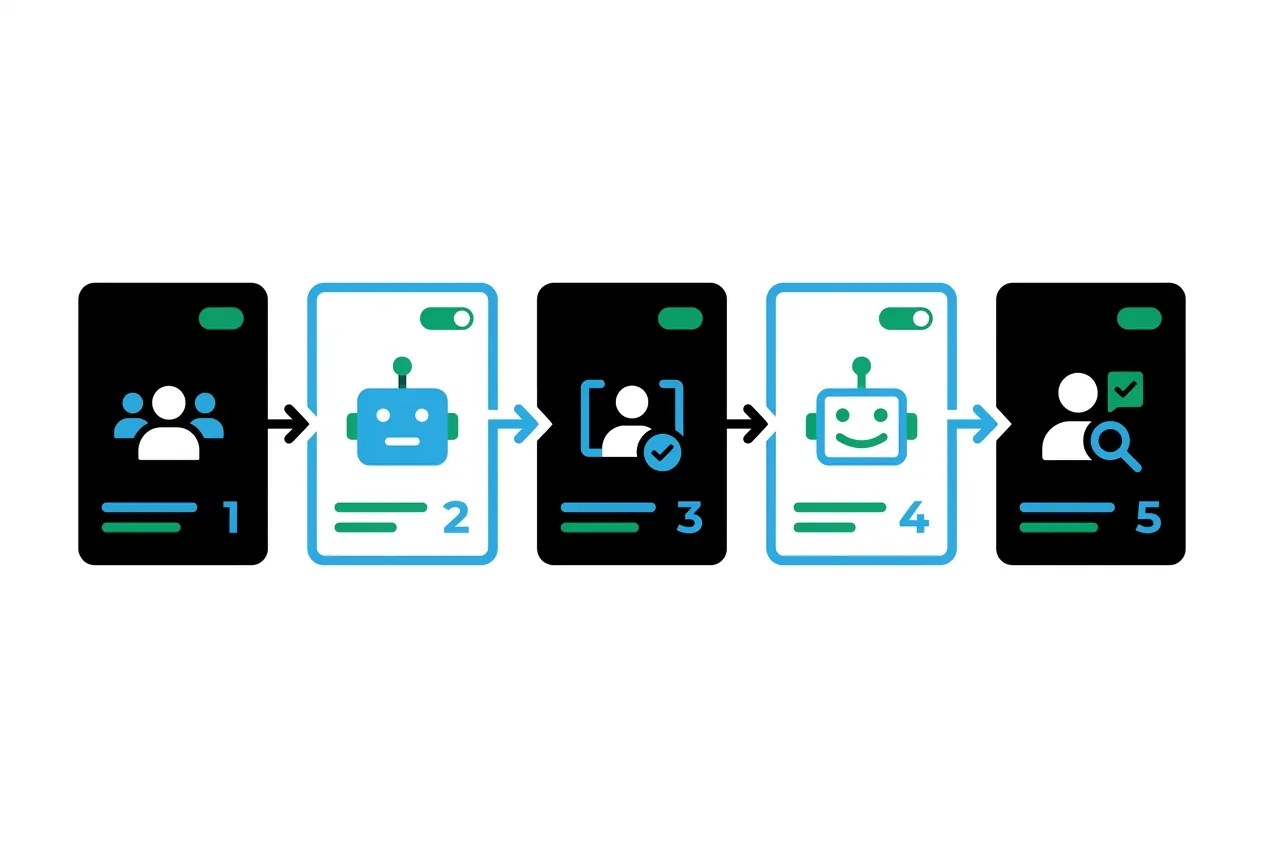
The MAIOS production pipeline follows a structured, five-stage operational framework:
- Stage 1: Operator Commissioning: A human strategist defines the campaign brief, identifies the business objective, inputs approved brand records, and establishes the factual boundary context. The system is locked to those authorized sources; agents are instructed to ignore outside training assumptions when contradictory.
- Stage 2: Specialist Briefing Agents: Downstream research and SEO manager agents ingest the commission. They analyze search intent hierarchies, evaluate competitive coverage gaps, and construct a detailed editorial blueprint containing mandatory headings, keyword integrations, and primary source requirements.
- Stage 3: Editorial Gate 1: A human editorial lead reviews the brief. If the structural argument lacks commercial nuance, or if an intent cluster is misaligned, the brief is returned for targeted agent revision. No generative writing can begin without an explicit human sign-off on the strategic architecture.
- Stage 4: Modular Drafting Agents: Once approved, an authority copywriting agent drafts the content asset section by section. The agent operates under rigid voice rules, avoiding unsupported claims, fabricated statistics, or generic filler. A parallel compliance agent parses the draft to flag any claim lacking an explicit primary source citation.
- Stage 5: Final Human Executive Review: The completed asset moves to human leadership for final evaluation. The editor inspects prose rhythm, audits regulatory references against primary sources, checks formatting standards, and authorizes publication.
This governed pipeline combines the rapid throughput of automated processing with the rigorous quality control of senior marketing directors. Organizations interested in establishing this infrastructure can explore our specialized AI systems services to deploy customized, locally hosted agent workflows within their own marketing divisions.
Email Us
Prefer to send the context directly?
Evaluating your stack: Renting SaaS versus owning agentic marketing
Marketing executives face an infrastructure decision: continue paying recurring subscription fees for third-party SaaS wrappers, or invest in owned agentic marketing pipelines that create lasting organizational intellectual property.
To evaluate which model fits your operational model, compare the core technical and strategic trade-offs across each approach:
- Data Privacy & Compliance; Rented SaaS Platforms: Data processed on shared cloud infrastructure; potential exposure of proprietary workflows.; Owned Agent Infrastructure: Local inference inside private perimeters; HIPAA-aware data isolation.
- Cost Dynamics; Rented SaaS Platforms: Recurring monthly seat licenses and variable usage fees that scale with team size.; Owned Agent Infrastructure: Predictable hardware investment; zero marginal software cost per generated asset.
- Workflow Control; Rented SaaS Platforms: Locked into rigid vendor interfaces, canned prompts, and third-party platform roadmaps.; Owned Agent Infrastructure: Modular architecture; customizable system instructions, routing, and tool integration.
- Brand Differentiation. Rented SaaS Platforms: Homogeneous outputs derived from identical public models and shared prompt templates. Owned Agent Infrastructure: Custom-tuned models reflecting proprietary data, voice standards, and conversion patterns.
- Enterprise Defensibility; Rented SaaS Platforms: Zero enterprise equity; if the vendor raises prices or shuts down, the capability vanishes.; Owned Agent Infrastructure: Reusable software assets, proprietary pipelines, and owned institutional knowledge.
Renting third-party tools is suitable for early-stage experimentation or low-stakes drafting where brand voice and data privacy carry minimal commercial risk. However, for mid-market healthcare systems, hospital networks, professional service firms, and regulated multi-location enterprises, renting creates operational fragility.
Building on owned, localized infrastructure transforms marketing operations from a recurring expense into a defensible corporate asset. By deploying modular software agents governed by strict human oversight, organizations achieve unprecedented operational scale while maintaining complete command over their brand, their compliance, and their capital.
For broader strategic perspectives on this transition, explore our foundational guides on AI marketing: what it changes for strategy, teams and budgets, as well as our analytical frameworks on evaluating an AI marketing agency beyond the label and vetting a generative engine optimization agency.
Questions, Answered.
Traditional marketing automation relies on deterministic, rule-based logic: if a user clicks a link, then send an email. The software cannot adapt if an unexpected input occurs. In contrast, an AI agent uses large language models to reason through multi-step objectives, analyze unstructured context, select appropriate tools dynamically, and evaluate the quality of its own outputs before passing work to a human reviewer.
Specialized agents prevent hallucinations through bounded context retrieval and segregated validation steps. Instead of relying on open web memory, an agent is restricted to an approved library of company documentation, policy records, and primary regulatory sources. A secondary validation agent then checks every drafted claim against those specific records, rejecting any statement that lacks a verified source.
While specialized agents can analyze auction data, detect conversion anomalies, and generate ad copy variants, they should never be given autonomous authority to adjust budgets or allocate media spend. Platform volatility, tracking discrepancies, and clinical or inventory constraints require seasoned human media buyers to evaluate business context and approve capital allocation.
Healthcare and regulated businesses must handle patient inquiries and proprietary conversion data in strict compliance with data privacy mandates. Sending intake data, conversion logs, or confidential operational protocols through public third-party AI APIs can create regulatory liability. Running agents on local, owned infrastructure ensures that data handling remains completely inside the organization's secure boundary.
Begin by mapping your existing operational workflows to identify repetitive, high-friction bottlenecks such as search intent categorization, competitor brief research, or cross-platform ad formatting. Build bounded, single-purpose agents to automate those specific tasks, and implement mandatory human approval gates before expanding into downstream creative and analytical workflows. Talk with Marketing Powered about owning your marketing AI stack
Ready to see where your marketing can improve?
Request a free audit of your paid media, landing pages, attribution, and measurement setup. You'll get a straight assessment of where the opportunities are.
or email us at info@marketingpowered.ai