Resources
Service Line Marketing: Prioritizing the Programs That Drive Margin
Hospital and health-system marketing budgets are routinely diluted when patient acquisition capital is distributed based on department politics rather than commercial return. Effective service line marketing aligns paid acquisition, organic visibility, and clinical intake directly with procedural contribution margin, active provider capacity, and localized commercial search intent. By treating marketing as an integrated operational workflow, health systems direct investment toward high-yield specialties while preventing costly demand generation for saturated clinical departments.
By Mike Hulick, Founder, Marketing Powered

Why equal budget distribution across clinical departments fails

What is service line marketing in modern healthcare?
Service line marketing is the specialized discipline of organizing hospital and health-system growth strategies around distinct clinical departments rather than general institutional brand awareness. Instead of running broad awareness campaigns that promote a hospital network as a generic community asset, service line marketing focuses on specific patient pathways, including orthopedics, cardiology, oncology, neurosciences, and behavioral health. This approach treats each clinical specialty as an independent commercial unit with its own operating economics, clinical capacity constraints, provider schedules, and patient search behaviors.
In practice, a modern service line marketing strategy links patient intent to a specific clinical intake pathway. When a prospective patient searches for hip replacement specialists or structural heart diagnostics, the marketing system must deliver localized messaging, immediate insurance verification pathways, and frictionless scheduling. General brand marketing rarely solves these acute patient needs. For health systems operating multi-facility networks, service line marketing provides the granular governance required to direct patient volume into the specific facilities and sub-specialists that have immediate clinical availability.
Connecting patient acquisition to measurable operations requires coordinating internal stakeholders who historically operate in silos. Clinical department chairs, marketing directors, intake center operators, and finance teams must share a common objective. When marketing operates independently from clinical scheduling, campaigns generate telephone inquiries and form submissions that never translate into verified appointments or surgical block utilization. True service line marketing bridges this gap, establishing operational continuity between media deployment and downstream clinical encounters.
To understand how this operates at the organizational level, explore our guide on healthcare marketing: the operating guide for health systems and provider groups.
The primary obstacle to effective hospital service line strategy is institutional politics. Within regional health systems, marketing budget allocation often mirrors clinical hierarchy or internal lobbying rather than financial performance. Specialty chairs frequently demand equal shares of the digital advertising budget, insisting that their clinics receive identical promotional backing regardless of clinical throughput, payer mix, or operating room utilization.
Distributing marketing capital evenly across every specialty produces severe operational mismatches:
- Promoting bottlenecked clinics: Campaigns send high-intent inquiries to outpatient clinics facing four-to-six-week scheduling delays, leading to high cancellation rates and frustrated prospective patients who book with regional competitors instead.
- Wasting budget on negative-margin encounters: Subsidizing high-volume, low-reimbursement primary visits without downstream specialty pull-through consumes acquisition capital that should fund high-acuity surgical programs.
- Starving underutilized surgical facilities: Advanced operating suites, catheterization laboratories, and newly recruited specialists sit under-capacity because marketing budgets were divided among ten different general initiatives.
- Distorting reporting through vanity metrics: Digital agencies celebrate low cost-per-click numbers and impression volumes while health-system executives see no measurable lift in procedural volume or net patient revenue.
When marketing capital is allocated without operational vetting, patient acquisition initiatives become an unmonitored expense rather than a controlled commercial engine. Sustainable service line growth requires health-system leaders to abandon equal departmental distribution and adopt an evidence-led prioritization framework.
The capacity, margin, and demand framework for hospital service line strategy
To maximize return on invested capital, health systems must evaluate every potential clinical initiative across three objective criteria: clinical capacity, contribution margin, and commercial search demand. Prioritizing service lines through this lens ensures that marketing capital flows exclusively toward clinical programs that generate positive net revenue and possess immediate operational availability.
First, evaluate clinical capacity. A service line cannot absorb paid patient acquisition if new patient appointment lead times exceed seven to ten business days. When lead times stretch past two weeks, inquiry-to-appointment conversion rates fall steeply. Marketing teams must audit provider scheduling templates, clinic staffing levels, and operating room block time before deploying campaigns. If a specialty clinic cannot handle immediate volume, marketing dollars must be paused or redirected.
Second, analyze procedural contribution margin. Healthcare finance teams must identify which inpatient and outpatient procedures generate the highest contribution margin per clinical hour. Elective joint replacements, transcatheter structural heart interventions, spine surgeries, and complex diagnostic imaging provide the operating margins necessary to subsidize vital community health services. Marketing budgets must be weighted heavily toward these high-margin clinical programs.
Third, quantify localized capture demand. Evaluate verified patient search volume across designated market areas. By assessing geographic search patterns, health systems identify unmet commercial intent for specific interventions. Prioritizing service lines against these three pillars allows leadership to categorize programs into three operational tiers:
- Tier 1: Core Growth Drivers: High contribution margin, active provider capacity, and strong commercial search volume (e.g., total joint replacement, outpatient surgical sports medicine, structural heart). These programs receive the majority of paid media investment.
- Tier 2: Targeted Specialists: High contribution margin with constrained capacity or moderate demand (e.g., specialized surgical oncology, electrophysiology). These programs receive targeted search coverage that matches specific surgeon schedules.
- Tier 3: Maintenance and Community Care: Low commercial margin or severe scheduling saturation (e.g., general routine primary care, emergency department walk-ins). These areas rely on organic discovery, community presence, and automated intake rather than active paid media investment.
Free Audit
Want a straight read on where your budget is leaking?
Orthopedic marketing: high-margin intent capture and scheduling alignment
Orthopedic marketing serves as the foundational proving ground for elective procedural growth. Musculoskeletal conditions represent high-margin opportunities for surgical centers and inpatient facilities, but acquiring these patients efficiently requires segmenting general pain searches from actionable procedural intent.
Prospective orthopedic patients search along distinct stages of clinical intent. A search query for "knee pain exercises" reflects early conservative management with zero immediate procedural yield. Deploying paid search budgets against these informational keywords burns media capital without driving clinical encounters. Conversely, queries such as "knee replacement surgeon near me" or "arthroscopic shoulder specialist" signal immediate commercial intent.
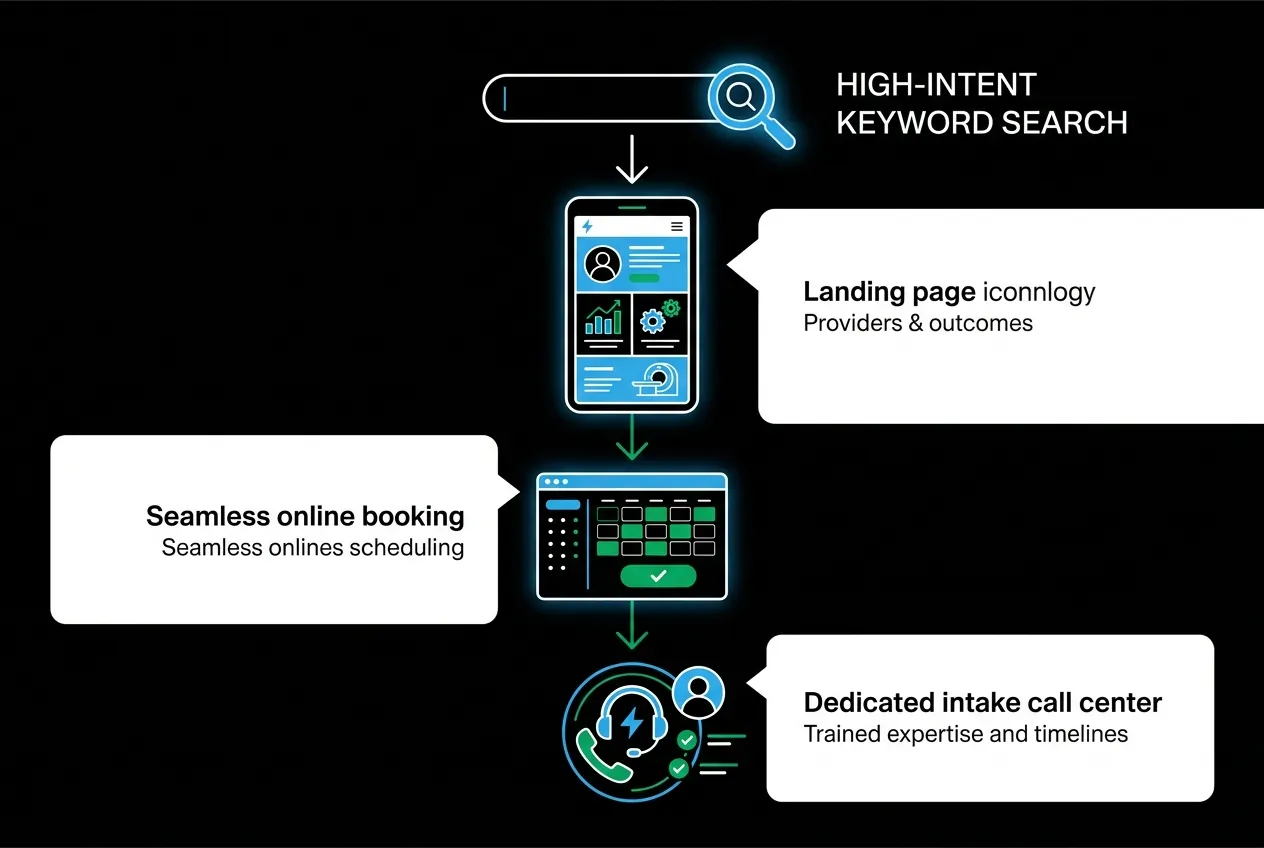
Effective campaign architecture routes this commercial demand directly to conversion environments built around sub-specialists:
A common failure point in orthopedic campaigns is the intake interface. Directing paid traffic to a general hospital directory or a centralized call center where staff treat orthopedic inquiries as routine clerical calls destroys campaign efficiency. Orthopedic prospective patients require immediate insurance confirmation, rapid access to imaging reviews, and fast appointment booking. Health systems must implement direct scheduling workflows or dedicated intake lines staffed by personnel trained in orthopedic triage.
Local visibility also dictates conversion rates. Orthopedic patients rarely travel past accessible regional options unless seeking complex revision surgery. Health systems must optimize provider-level Google Business Profiles across every clinic location, ensuring that individual surgeons display verified patient feedback, precise sub-specialty categories, and direct appointment links. Combining localized organic visibility with exact-match search advertising creates comprehensive coverage across regional catchment areas.
Cardiology marketing: navigating clinical complexity and preventive demand
Cardiology marketing operates across two distinct operational models: urgent tertiary interventions and elective diagnostic or structural cardiac procedures. Balancing these two pathways requires health systems to tailor their messaging, digital intake paths, and compliance protocols to different patient populations.
Elective cardiovascular services, such as electrophysiology for atrial fibrillation, transcatheter aortic valve replacements (TAVR), and advanced lipid management clinics, offer significant downstream contribution margin. Capturing these patients requires structured educational content that guides individuals through complex diagnostic choices. Digital self-assessments, including structured heart-health risk profilers, allow patients to evaluate symptom severity while providing health systems with qualified patient inquiries that can be routed to preventive cardiology clinics.
However, advertising in cardiovascular health demands strict compliance with healthcare advertising regulations. Under the Google Ads Policy on Personalized Advertising, advertising campaigns for sensitive health conditions cannot use retargeting, remarketing lists, or personalized demographic targeting. Because prospective patients who leave a cardiology landing page cannot be retargeted with display ads, the initial landing page encounter must capture patient intent immediately through clear navigation, transparent clinical credentials, and friction-free contact options.
Furthermore, digital marketing teams must protect patient privacy across all web properties. As detailed in the HHS Guidance on Online Tracking Technologies, public-facing hospital pages and patient portals cannot use third-party tracking pixels that impermissibly transmit protected health information or user IP addresses associated with specific medical conditions to advertising networks. Cardiovascular marketing campaigns must rely on privacy-safe measurement frameworks, server-side data tracking, and HIPAA-aware intake systems that maintain strict regulatory compliance while measuring acquisition performance.
When evaluating external support for these complex regulatory environments, review our breakdown on healthcare marketing agency: what to expect and how to choose one.
Managing the clinical intake workflow to prevent patient leakage
Generating qualified patient inquiries through paid search and local SEO represents only half of the acquisition equation. The most sophisticated service line marketing campaigns fail if the health system's intake infrastructure leaks prospective patients between the initial click and the completed clinical encounter.
Patient leakage occurs primarily at three operational junctures:
- Call center latency: Prospective patients seeking procedural care call during business hours but face extended hold times or automated phone trees. If an inbound call is not answered by a trained scheduler within four rings, patient abandonment rises significantly, driving the individual to the next provider on the search results page.
- Delayed digital follow-up: When prospective patients complete an appointment request form on an orthopedic or cardiology landing page, response latency matters. Inquiries contacted within 15 minutes convert at substantially higher rates than those contacted hours or days later.
- Rigid provider scheduling templates: Many health-system clinics restrict new patient appointments to narrow time windows, creating artificial waitlists. Marketing leaders must work closely with clinical operations to unlock open-access scheduling slots for high-priority service lines.
Eliminating intake friction requires continuous operational visibility. Marketing teams must track inbound call recordings, monitor call disposition codes, and integrate digital marketing channels with the health system's customer relationship management (CRM) and electronic health record (EHR) environments. When leadership evaluates marketing by cost per completed visit rather than cost per lead, intake friction transforms from an overlooked administrative issue into a core operational focus.
If your organization is evaluating outside expertise to solve these operational challenges, see our strategic guide on hospital marketing company: what a specialist partner delivers and how to vet one.

Email Us
Prefer to send the context directly?
How Marketing Powered builds accountable service line acquisition engines
Marketing Powered delivers accountable, full-funnel healthcare marketing programs designed for hospitals, regional health systems, and multi-location specialty groups. We eliminate the disconnect between advertising spend and realized clinical volume by combining commercial search acquisition with end-to-end operational attribution.
Our operating model is informed by extensive large-scale healthcare experience. Marketing Powered's founder is a former healthcare CMO who ran marketing for a treatment network that grew from 3 to 24 locations, personally managing $1.5 to $2M per month in Google Ads across 11+ behavioral and mental health accounts. As a court-certified expert witness in advertising strategy, our leadership constructs acquisition architectures that withstand rigorous regulatory, clinical, and financial scrutiny.
We execute healthcare acquisition through specialized operational standards:
- Attribution tracked to admission, not just lead: We do not evaluate campaign success based on raw form submissions or clicks. We configure measurement systems that track patient attribution through to the completed appointment, procedural encounter, and clinical admission where authorized data environments permit.
- Engineered for Google's sensitive verticals: We operate with deep, practical fluency in Google Ads sensitive category restrictions, LegitScript validation frameworks, and healthcare privacy policies. Because retargeting is prohibited in sensitive health environments, our landing page and search strategies are engineered to capture intent and convert prospective patients on the primary encounter.
- Owned, local AI infrastructure for HIPAA-aware inference: AI-native since 2022, Marketing Powered utilizes owned, local AI infrastructure for HIPAA-aware inference. This allows our team to deploy advanced data workflows and conversational intake automation without exposing sensitive operational data to public cloud platforms.
- Multi-location search alignment: We structure digital marketing around shared enterprise governance while tailoring execution to the specific capacity, competitive landscape, and clinician roster of each facility.
By treating patient acquisition as a joined-up operational discipline, we help health systems deploy capital where it generates defensible procedural volume and sustainable operating margins.
Questions, Answered.
In business and healthcare, a service line is a specialized operational unit organized around a specific category of clinical care, product offering, or customer need. In a hospital or health system, service lines typically include specialties such as orthopedics, cardiology, oncology, women's health, and neurosciences. Each service line encompasses the specialized clinicians, diagnostic infrastructure, outpatient facilities, surgical suites, and dedicated intake workflows required to deliver comprehensive care within that medical discipline.
Service line marketing is the strategic deployment of marketing, search visibility, intake optimization, and clinical communications to drive patient volume for specific healthcare specialties. Unlike general hospital branding, which builds broad community awareness, service line marketing focuses on capturing high-intent patients actively seeking specialized medical care, diagnostics, or elective procedures, matching patient demand directly with available clinical capacity and high-margin services.
Through the line (TTL) marketing is an integrated commercial strategy that combines broad, mass-reach awareness campaigns (above the line) with direct, targeted, conversion-focused acquisition tactics (below the line). In a hospital environment, a through the line campaign might combine regional health-system educational initiatives about heart health with localized, high-intent Google search advertising that drives symptomatic patients directly into online scheduling workflows for cardiac screenings.
A health system should balance service line marketing and brand marketing by anchoring spend in commercial economics. While brand marketing protects general institutional reputation and employer value, service line marketing generates the procedural revenue that sustains health-system operations. Leading healthcare organizations typically allocate the majority of their growth capital toward high-margin service line acquisition while ensuring those individual campaigns reinforce overall brand credibility through consistent standards and messaging. Request a healthcare marketing assessment from Marketing Powered
Ready to see where your marketing can improve?
Request a free audit of your paid media, landing pages, attribution, and measurement setup. You'll get a straight assessment of where the opportunities are.
or email us at info@marketingpowered.ai