Resources
Addiction Treatment SEO: Local Visibility and Admissions Intent
Executing an effective addiction treatment seo strategy requires aligning local search visibility and facility architecture directly with clinical admissions intent. When behavioral health operators focus solely on aggregate search volume, marketing budgets get consumed by national informational queries that fail to generate verified verifications of benefits. A disciplined organic program builds sustainable census by capturing searchers in crisis within your geographic catchment area at the exact moment they need care.
By Mike Hulick, Founder, Marketing Powered

The Economics of Addiction Treatment SEO: Traffic Versus Admissions
Many behavioral health facilities fall into the trap of measuring search performance by total blog impressions and organic pageviews. An agency publishes dozens of high-level articles on the stages of addiction, substance withdrawal timelines, or historical drug trends. While these informational pieces can generate significant website traffic, the intake coordinators answering your phones encounter high bounce rates, out-of-region callers, and uninsured individuals seeking free community resources your facility does not provide. In an operational environment where residential beds cost thousands of dollars per week to staff, organic marketing must justify itself on admissions, not vanity metrics.
Top-of-funnel informational traffic frequently pulls searchers who are conducting academic research or exploring broad questions without clinical urgency. In contrast, admissions-focused search engine optimization isolates commercial and navigational queries originating within target geographic territories. Search queries like "inpatient medical detox accepting Blue Cross" or "residential addiction program near me" display immediate admissions intent.
When your digital marketing strategy prioritizes admissions intent over aggregate volume, your intake department stops wasting hours screening unqualified inquiries. Admissions personnel can focus their time on verifying coverage, coordinating transportation, and reviewing clinical assessments with families ready to place a loved one into care. The economic return of organic search does not stem from millions of national impressions. It stems from owning the high-intent, localized queries that reliably produce admitted patients at a predictable acquisition cost.
Dominating the Google Local 3-Pack with Rehab SEO
For most addiction treatment networks, the primary point of conversion occurs within the Google Maps Local 3-Pack. When families or individuals experience a substance use crisis, their initial search behavior centers on proximity. Effective rehab seo requires optimizing your physical facility profiles to dominate these local search placements across your primary service area.
Google determines local ranking prominence based on three core factors: relevance, distance, and prominence, as detailed in Google Business Profile Help. Many treatment centers fail in local search because their profile categories are configured incorrectly or their addresses lack physical verification.
To establish technical relevance in the local pack, operators must enforce specific configurations:
- Category Prioritization: Select "Addiction Treatment Center" as your primary Google Business Profile category. Add secondary categories such as "Mental Health Clinic", "Rehabilitation Center", and "Alcoholism Treatment Program" only where your state licensing and clinical programming explicitly match those designations.
- Strict Name, Address, and Phone (NAP) Consistency: Any variance between your profile name, physical address, and telephone number across your website and external directories degrades local authority. Avoid keyword-stuffing your business title, which violates platform guidelines and invites listing suspensions.
- Dedicated Facility Landing Pages: Every Google Business Profile must link to a unique, indexable facility page on your root domain rather than the home page. That landing page must feature the identical physical address, local direct-dial phone number, facility photographs, and embedded Google Map.
- HIPAA-Compliant Review Management: Online reviews significantly impact Google's prominence score. Behavioral health providers must handle reputation management with extreme care. Requesting reviews from active patients or responding to public reviews in a manner that confirms a patient received medical treatment violates privacy regulations. Establish protocols for collecting post-discharge alumni feedback through neutral, voluntary channels that maintain patient confidentiality.
Facility and Program Page Architecture That Drives Admissions Intent
Treatment center websites often suffer from confusing information architectures. When clinical programs, levels of care, and physical campus details are lumped together on a single generic services page, search engines cannot determine the specific clinical relevance of the facility. To capture searchers evaluating treatment options, your website architecture must mirror the standard American Society of Addiction Medicine (ASAM) continuum of care.
Structuring dedicated landing pages for each specific level of care allows search engines to index your programs against discrete clinical searches:
- Medical Detoxification Pages: Target acute-need queries from individuals requiring immediate withdrawal management. Content must detail medical oversight protocols, 24/7 nursing availability, and medication-assisted treatment (MAT) capabilities.
- Inpatient and Residential Treatment Pages: Detail living arrangements, clinical therapy modalities (such as Cognitive Behavioral Therapy and Dialectical Behavior Therapy), daily schedules, family therapy integration, and estimated lengths of stay.
- Partial Hospitalization (PHP) and Intensive Outpatient (IOP) Pages: Capture local professionals and regional patients seeking daytime or evening programming while residing at home or in sober living environments.
- Substance-Specific Clinical Hubs: Build dedicated sub-pages addressing alcohol use disorder, opioid dependency, prescription drug misuse, and polysubstance challenges. These pages should explain medical detoxification timelines, common co-occurring disorders, and individualized treatment planning without relying on generic medical definitions copied from government repositories.
Every facility page must feature transparent conversion paths. Prominently display your intake phone number, an immediate verification of benefits submission form, and clear information regarding facility accreditations, such as The Joint Commission or CARF.
Free Audit
Want a straight read on where your budget is leaking?
Commercial Insurance Architecture: Converting Coverage Queries
The single greatest point of friction between an organic website visit and an admission is financial qualification. Families in crisis rarely commit to an intake interview without knowing whether their health insurance policy offsets the cost of care. Treatment centers that hide payer relationships behind vague statements like "we accept most major insurance" suffer high drop-off rates on their primary landing pages.
To capture searchers with immediate admissions intent, build out an intentional insurance architecture:
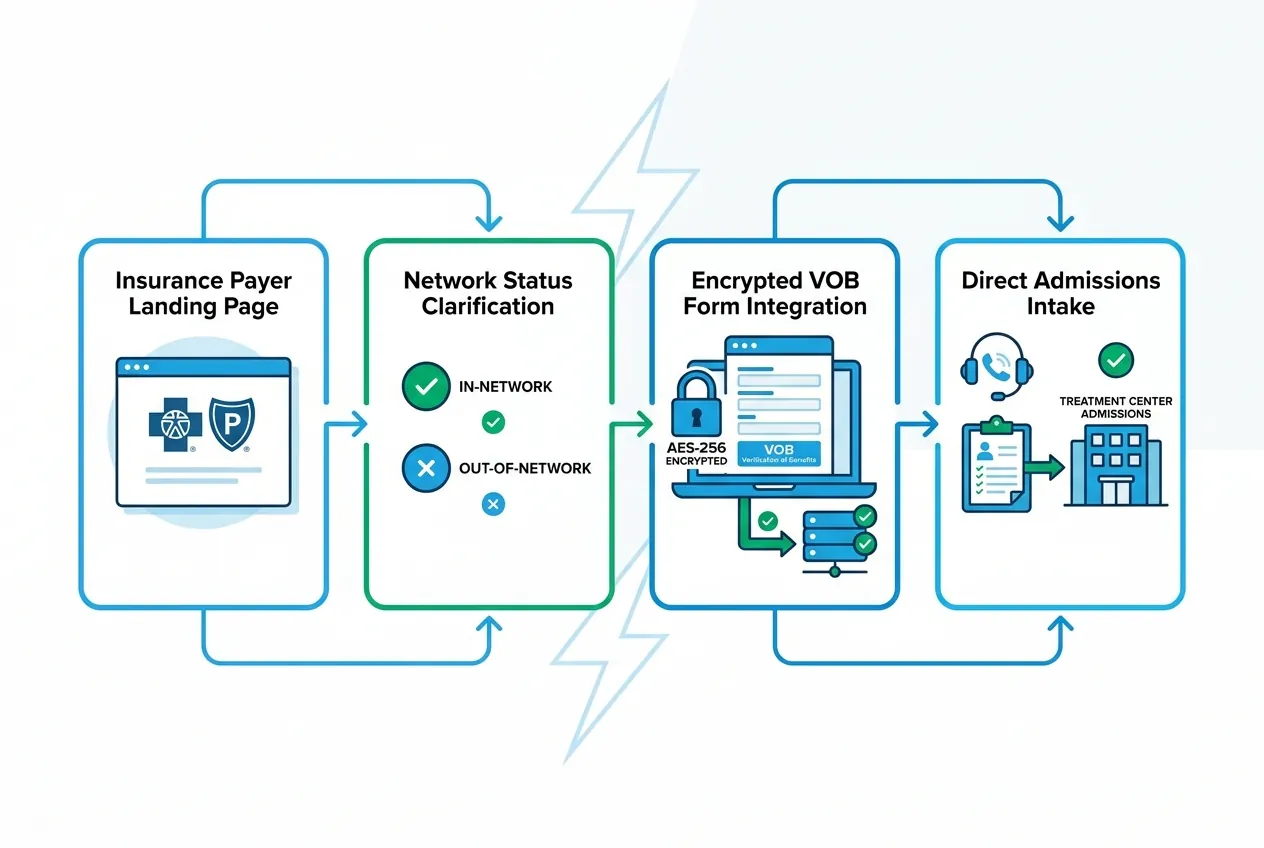
- Payer-Specific Landing Pages: Construct dedicated pages for each primary commercial insurance carrier your facility contracts with, whether in-network or out-of-network. Structure URLs logically (such as /insurance/cigna or /insurance/blue-cross-blue-shield). Detail the typical verification process, authorization protocols, and levels of care commonly covered under those behavioral health policies.
- Verification of Benefits (VOB) Integration: Place secure, encrypted intake forms directly on these insurance hubs. Ensure that your form technology complies with patient data security rules and does not transfer sensitive healthcare details across unencrypted endpoints.
- Clarification of Network Status: Clearly state whether your facility is an in-network provider or works with out-of-network benefits. Transparency at this step reduces administrative drag on admissions staff and eliminates unqualified inquiries from searchers whose plans cannot be utilized at your centers.
- Employer-Sponsored and Union Coverage Content: If your treatment center holds direct relationships with regional labor unions, municipal employers, or corporate employee assistance programs (EAPs), build dedicated resource pages addressing those cohorts. These hyper-specific pages capture low-volume, exceptionally high-converting search intent.
Technical SEO and Schema Markup for Behavioral Health SEO
Technical search engine optimization forms the structural foundation that allows search engine crawlers to parse and categorize your clinical offerings. For behavioral health seo, standard technical practices such as core web vital optimization, mobile responsiveness, and clean URL hierarchies must be augmented with specialized healthcare schema markup.
According to technical documentation on Schema.org MedicalClinic, structured data provides explicit clues about the meaning of a page to search engine algorithms. Implementing JSON-LD structured data on your treatment center website directly informs search crawlers about your clinical credentials, medical staff, and care capabilities.
Key technical schema entities that behavioral health websites should deploy include:
- MedicalClinic or MedicalBusiness: Deploy this on the home page and individual facility pages. Include accurate geographic coordinates, accepted insurance networks, physical operating hours, and medical specialties.
- MedicalCondition and SubstanceUseDisorder: Apply this structured data to clinical education pages and substance-specific program pages to explicitly link your content to recognized medical taxonomies.
- Physician or Person: Utilize this schema on clinical leadership profiles to mark up medical directors, psychiatrists, and licensed clinical social workers, establishing direct professional credibility for your clinical governance.
Ensure your website maintains clean canonical structures and robust crawl efficiency. Treatment websites that rapidly add duplicate location pages or thin substance-specific blogs often create indexation bloat, diluting domain authority across lower-value assets.
Clinical Governance and Search Quality for Drug Rehab SEO
Search engines classify behavioral health content under the highest threshold of quality evaluation: Your Money or Your Life (YMYL). Content impacting an individual's physical safety, mental health, or financial wellbeing faces strict quality standards. Winning sustainable rankings in drug rehab seo requires authentic clinical governance that demonstrates experience, expertise, authoritativeness, and trust (E-E-A-T).
Generic blog content generated without medical oversight degrades your site's authority and misinforms searchers facing life-threatening substance use challenges. To satisfy both search engine algorithms and prospective patients evaluating your care, institutionalize a formal clinical review process:
- Named Clinical Authors and Reviewers: Every page discussing substance withdrawal symptoms, psychiatric conditions, pharmacotherapy, or clinical modalities must carry a visible byline from a credentialed healthcare professional (such as an MD, DO, PMHNP, LCSW, or LMFT).
- Verifiable Professional Biographies: Link author and reviewer bylines to comprehensive internal biography pages. These pages should document the clinician's educational background, state medical board license numbers, clinical board certifications, and professional background.
- Authoritative Clinical Citations: When referencing addiction statistics, clinical trial results, or treatment efficacy, cite established primary sources directly. Reference agencies such as the Substance Abuse and Mental Health Services Administration (SAMHSA), the National Institute on Drug Abuse (NIDA), and peer-reviewed medical publications.
- LegitScript Certification Display: LegitScript provides rigorous third-party verification for behavioral health operators. Displaying your active status from LegitScript Certification for Addiction Treatment across site footers and admissions pages confirms to search engines and families that your facility operates in compliance with state licensing laws and strict ethical operating standards.
Email Us
Prefer to send the context directly?
How Marketing Powered Engineers SEO for Treatment Centers
At Marketing Powered, we approach search engine optimization for behavioral health through the lens of operational facility economics. Our founder is a former healthcare CMO who ran marketing for a treatment network that grew from 3 to 24 locations, managing $1.5 to $2M per month in Google Ads across 11+ behavioral and mental health accounts. We also serve as a court-certified expert witness in advertising strategy. We know firsthand that high organic traffic numbers mean nothing if intake lines remain quiet or admissions teams receive unqualified callers.
Paid media in this vertical operates under strict constraints. As detailed in the Google Advertising Policies for Personalized Ads and Google Ads policy on Healthcare and medicines, search platforms strictly prohibit retargeting and personalized audience creation for sensitive medical conditions like substance abuse. Because you cannot re-engage a lost prospect through remarketing lists, capturing high-intent organic demand and converting that traffic on the first touch is vital to protecting your cost per acquisition.
Our methodology treats search engine optimization as an integrated component of admissions performance:
- Attribution Down to Admission: We configure data architectures that track organic conversions beyond raw phone calls and web forms. By integrating search touchpoints with HIPAA-aware intake systems, we measure which pages and search queries generate verified insurance benefits, completed clinical assessments, and actual bed placements.
- Data Sovereignty and Owned Compute: AI-native since 2022, we utilize owned, local AI infrastructure for HIPAA-aware inference. This allows our team to analyze operational call patterns, transcribe anonymized intake conversations, and identify content gaps without exposing sensitive patient health information to public cloud repositories.
- Complete Demand Alignment: We align your organic search engine optimization with your paid media and reputation management strategies. Explore our comprehensive framework in Behavioral health marketing: an operator's guide to ethical growth to understand how multi-location providers scale without compromising compliance.
If you are evaluating outside agency support, review our operational guides on Mental health marketing agency: what a specialist partner should deliver and Addiction treatment marketing agency: how to vet one before you sign to establish clear accountability standards for your digital marketing investments.
Questions, Answered.
Organic search engine optimization in the behavioral health sector typically requires three to six months to demonstrate measurable improvements in search visibility and qualified intake inquiries. Highly competitive local markets with dozens of established treatment centers may take longer to penetrate in the Google 3-Pack. However, optimizing your primary Google Business Profile, correcting technical site errors, and publishing high-intent commercial insurance pages often produces measurable improvements in qualified call volume within the first 90 days.
Traffic that fails to convert into admissions usually stems from a misalignment of search intent. If your organic strategy relies primarily on broad, national blog articles covering drug definitions or general symptoms, you attract casual informational searchers rather than individuals in crisis within your geographic catchment area. Low conversion rates also occur when websites lack transparent commercial insurance information, feature difficult navigation, or omit direct, frictionless intake contact options.
LegitScript certification is not an absolute algorithmic prerequisite for standard organic search indexation, whereas it is mandatory for running paid Google Ads in the addiction treatment category. However, displaying active LegitScript certification significantly enhances your website's trust signals for search engines evaluating YMYL content. It also acts as an essential conversion driver for families seeking third-party validation that your facility is a licensed, ethical, and fully vetted healthcare provider.
Multi-location treatment networks should host all facilities under a unified root domain rather than creating separate, independent websites for each physical campus. Consolidating your digital assets onto one primary domain concentrates authority, simplifies backlink acquisition, and strengthens overall technical trust. Under this architecture, build distinct facility landing pages for each physical location, optimized with dedicated Google Business Profile links, localized schema markup, campus-specific photographs, and distinct clinical program offerings. Talk with Marketing Powered about your admissions and marketing economics.
Ready to see where your marketing can improve?
Request a free audit of your paid media, landing pages, attribution, and measurement setup. You'll get a straight assessment of where the opportunities are.
or email us at info@marketingpowered.ai