Resources
Lead Quality: How to Measure It and Feed It Back into Campaigns
Low cost per lead often conceals failing customer acquisition. When paid media campaigns optimize entirely for raw form fills and incoming calls, ad networks systematically deliver low-intent inquiries that waste sales and intake labor. Sustainable media efficiency requires operational definitions of lead quality, dynamic scoring protocols, and closed-loop data pipelines that feed verified downstream revenue milestones back to ad platform bidding models.
By Mike Hulick, Founder, Marketing Powered

Establishing the Baseline: How to Measure Lead Quality Across Channels

What Is Lead Quality and Why Does Cost-Per-Lead Lie?
Lead quality represents the statistical probability that an inbound prospect converts into a qualified commercial opportunity, consultation, or admission. Standard reporting frameworks often conceal operational reality by treating all inbound conversions as equal assets. A marketing dashboard might celebrate a drop in cost per lead from $120 to $45, while an intake department drowns in disconnected numbers, out-of-territory inquiries, and individuals seeking free services.
Ad platform bidding algorithms are mathematical optimization engines designed to achieve the lowest cost per specified conversion action. When campaigns instruct an algorithm to maximize form submissions, it routes media spend toward users who habitually submit forms across web properties. These users rarely possess commercial intent, budget, or clinical eligibility. Media buyers celebrate rising click-to-lead rates, while commercial operations bear the labor expense of filtering invalid inquiries.
The hidden cost of low-quality lead volume appears directly on the operational balance sheet. Every minute an intake coordinator or enterprise sales representative spends dialing unqualified inquiries is a minute withheld from high-intent buyers. Conversion velocity drops, operational morale deteriorates, and customer acquisition costs rise at the contract level. Evaluating advertising programs by top-of-funnel conversion counts decouples marketing expenditure from actual revenue generation.
Measuring performance through a unified framework requires looking past front-end conversion volume. For broader context on structuring verified measurement pipelines, explore our comprehensive guide, Marketing attribution: a practical guide for teams that need real answers.
Measuring lead quality across multiple channels requires moving beyond platform pixels and implementing standardized qualification criteria inside the CRM. A defensible lead quality score divides prospective buyer inquiries into three measurable operational layers:
- Contactability: Does the inquiry represent a live human who responds through the submitted channel? Key metrics include valid phone numbers, deliverable corporate or personal email addresses, and completed two-way contact within an established response window.
- Eligibility: Does the prospect satisfy the strict operational criteria of the business? In specialty healthcare, this means acceptable clinical acuity and verified commercial insurance. In professional services or enterprise technology, this involves target annual revenue, employee headcount, geography, and decision-making authority.
- Commercial Intent: Does the prospect exhibit immediate readiness to purchase, schedule an evaluation, or enter a binding agreement? This separates exploratory researchers from prospects requiring urgent solutions.
Organizations should formalize these dimensions into clear ratios that bridge advertising clicks and closed revenue:
- Contact Rate: Contacted Leads divided by Total Raw Leads. A rate falling below 60 percent indicates form fraud, low intent, or slow intake response times.
- Qualification Rate: Marketing Qualified Leads (MQLs) converted to Sales Qualified Leads (SQLs) divided by Contacted Leads. This measures channel demographic precision.
- Opportunity Conversion Rate: Opportunities or Consultations divided by SQLs. This indicates prospect intent and competitive positioning.
- Final Acquisition Rate: Closed Deals or Admissions divided by Total Opportunities. This calculates true downstream commercial value.
Tracking these metrics by ad platform, campaign, and keyword exposes discrepancies in raw volume. A search campaign delivering 40 leads at a $100 acquisition cost might generate zero commercial opportunities, while a campaign delivering 10 leads at $400 might produce three closed contracts. The higher front-end lead cost produces a substantially lower acquisition cost per revenue event.
To learn how specialized agencies design these multi-touch tracking ecosystems, read Marketing attribution agency: what a specialist partner delivers and how to vet one.
The Role of Dynamic Lead Scoring in High-Value and Regulated Sectors
In complex sales cycles and sensitive healthcare verticals, static qualification criteria fail to capture changing buyer intent. Implementing dynamic lead scoring allows organizations to rank inquiries automatically so intake teams prioritize high-value prospects while routing lower-intent inquiries into automated nurture sequences.
Dynamic scoring models synthesize two categories of first-party data:
Explicit Qualification Attributes
Explicit scoring evaluates deterministic criteria submitted directly by the user or identified through verified database enrichment:
- Commercial insurance carrier verification or commercial budget tier
- Geographic proximity to physical facilities or licensed service territories
- Stated urgency, such as an immediate service request versus general pricing exploration
- Enterprise parameters, including job seniority, verified corporate email domain, and active business operational footprint
Implicit Behavioral Signals
Implicit scoring tracks user interactions across digital properties prior to and immediately following lead capture:
- Specific search query intent, separating educational keyword strings from high-intent commercial keywords
- Viewing specialized clinical service pages, fee structures, or accreditation sections
- Total digital dwell time and multi-session brand engagement
- Inbound call duration tracked through dynamic telephony infrastructure, where conversations exceeding three minutes typically correlate with high qualification rates
For organizations managing incoming phone calls, pairing behavioral scoring with dynamic call routing is essential. To evaluate telephone conversion tracking solutions, consult Call tracking services: what a specialist partner delivers and how to vet one.
Dynamic lead scoring allows sales and intake teams to assign a numerical grade to every prospect before outreach begins. More importantly, it creates a structured data threshold that defines exactly when an inquiry transitions into qualified leads that warrant algorithmic conversion feedback.
Free Audit
Want a straight read on where your budget is leaking?
How to Improve Lead Quality on Google Ads with Value-Based Bidding
Most Google Ads accounts operate on Target Cost-Per-Acquisition (tCPA) or Maximize Conversions bidding strategies tied to a generic thank-you page visit. Under this configuration, the bidding algorithm treats a spam bot, an unqualified job seeker, and a high-value commercial client as identical successes. To improve lead quality, marketing teams must transition Google Ads to value-based bidding models supported by offline conversion tracking.
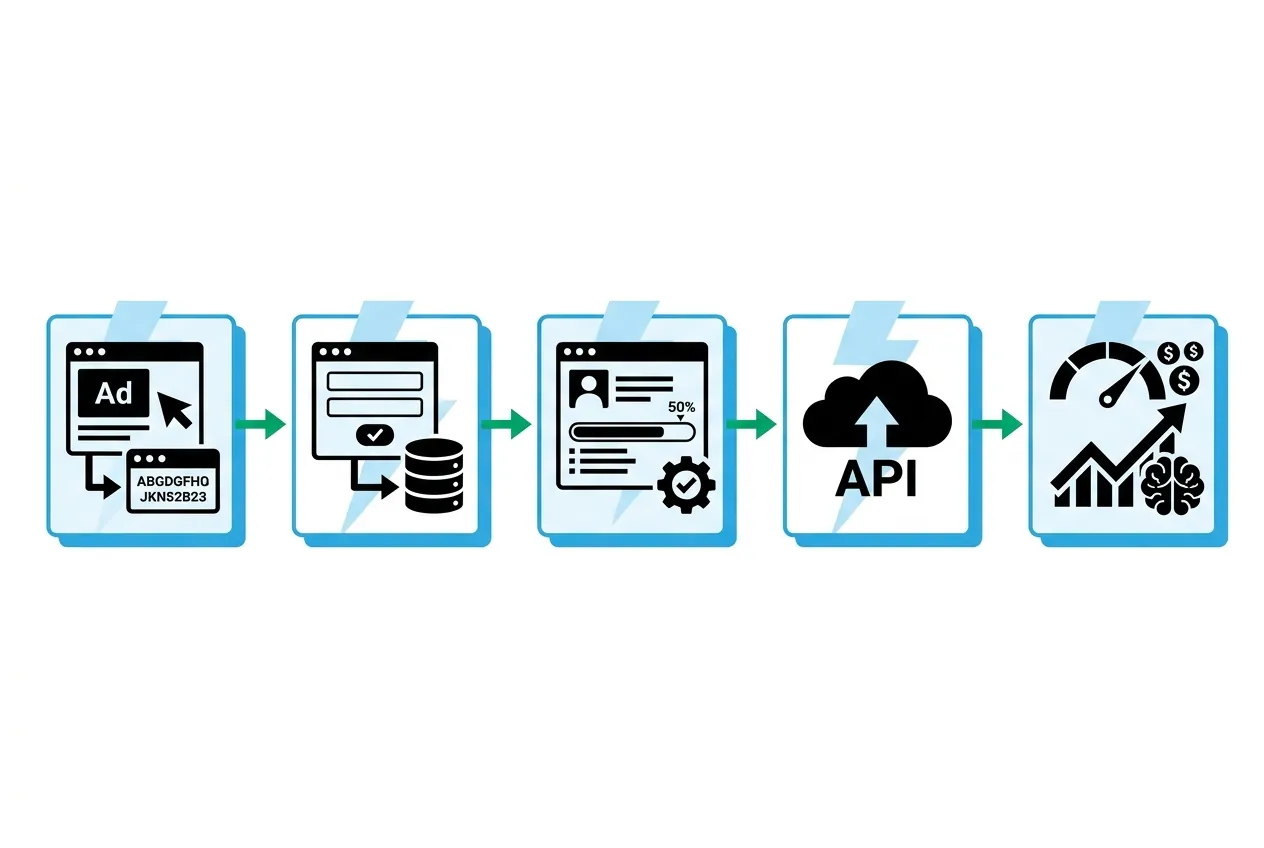
Google Ads allows advertisers to import CRM milestones back into the bidding environment using unique identifiers captured at the moment of click. Under standard desktop and mobile web tracking, the system captures the Google Click Identifier (GCLID). In privacy-restricted app or mobile web environments, Google relies on GBRAID or WBRAID parameters, as detailed in Google Ads Help on Offline Conversion Imports.
Once the technical pipeline captures these click identifiers and attaches them to the prospect record in your CRM, the operational team tracks the lead down-funnel. When the lead achieves a verified milestone, such as Clinical Intake Completed, Consultation Scheduled, or Signed Retainer, an automated script or API upload sends that conversion back to Google Ads with its exact timestamp and a assigned financial value.
Once offline conversions flow steadily, the account can migrate from Target CPA to Target ROAS (Return on Ad Spend) or Maximize Conversion Value. According to Google Ads Help on Value-Based Bidding, value-based bidding enables algorithms to predict which auction queries are most likely to drive high-value downstream milestones rather than hollow form completions. Media spend automatically shifts away from cheap, unproductive queries and concentrates on high-intent search terms that produce paying customers or verified admissions.
Regulated healthcare organizations must execute this data exchange without violating user privacy. Google maintains strict prohibitions regarding audience segmentation and personal identifiers for health-related queries under the Google Ads Policy on Personalized Advertising. Offline conversion imports satisfy regulatory standards because they pass transactional milestone values and click identifiers directly via server-to-server protocols, completely bypassing third-party tracking cookies and avoiding user retargeting lists.
How to Improve Lead Quality on Meta Ads Using the Conversions API
Meta Ads operates through expansive algorithmic audience expansion. When campaigns target broad demographic segments using the standard Meta Pixel, the system optimizes for individuals who interact with advertisements and complete on-page forms within Facebook and Instagram. This often generates an abundance of low-intent leads containing autofilled, obsolete contact information.
To upgrade lead quality across Meta campaigns, growth teams must implement server-side conversion tracking through the Meta Conversions API (CAPI). As outlined in the Meta Business Help Center, the Conversions API creates a direct connection between an organization's CRM infrastructure and Meta's optimization servers. This setup allows businesses to transmit downstream offline events, such as Lead Qualified, Evaluation Booked, or Closed Sale, using securely hashed first-party customer parameters.
When structuring Meta campaigns for high-ticket or regulated services, marketing teams should deploy a two-tiered optimization framework:
- Optimize for Qualified Lead Events: Instead of setting the campaign objective to default Form Submissions or standard Lead pixel fires, configure the ad set to optimize for a Custom Conversion mapped directly to your CRM's verified qualification status. Meta delivery algorithms will deprioritize users who submit false contact numbers and refocus on users who mirror the profile of responsive prospects.
- Utilize Higher Intent Lead Forms: If leveraging on-platform Instant Forms, configure the form settings to Higher Intent. This adds a confirmation step where prospects must review their information before submission, sharply reducing accidental submissions and invalid contact details. Combine this with custom screening questions that force manual text entry rather than accepting platform autofill data.
Feeding verified qualification events back to Meta closes the gap between front-end ad engagement and back-end revenue, training the ad algorithm to bypass casual scrollers in favor of motivated buyers.
Data and Analytics Architecture: Building the Closed-Loop Feedback Engine
Bridging the divide between paid acquisition channels and operational CRM systems requires sophisticated engineering. Marketing Powered builds custom data and analytics architectures that eliminate platform blind spots and establish complete closed-loop attribution for healthcare systems, enterprise service providers, and multi-location operators.
Our technical methodology incorporates verified operational depth:
- Operator-Led Infrastructure: Founded by a former healthcare CMO who ran marketing for a treatment network that grew from 3 to 24 locations, our operational protocols are built for complex, high-stakes customer journeys where front-end metrics fail to reflect unit economics.
- Large-Scale Media Experience: Our founder, a former healthcare CMO, managed $1.5 to $2M per month in Google Ads across 11+ behavioral and mental health accounts, and we design tracking systems that handle deep conversion volume and remain resilient under changing algorithm parameters.
- Regulatory and Legal Rigor: Guided by experience as a court-certified expert witness in advertising strategy, our attribution frameworks adhere to strict regulatory compliance standards. Systems are LegitScript-aware and HIPAA-aware, engineered specifically for Google's sensitive healthcare verticals where traditional retargeting is strictly prohibited.
- First-Party Data Governance: We utilize owned, local AI infrastructure for HIPAA-aware inference, ensuring sensitive customer and patient identifiers are protected while allowing organizations to extract actionable conversion insights from raw intake transcripts and CRM logs.
- Attribution Tracked to Admission: Rather than stopping at digital lead generation, our architecture measures performance down to the signed contract, scheduled procedure, or verified patient admission.
By linking Google Ads, Meta Ads, telephony providers, and internal CRMs into a synchronized data warehouse, we turn disconnected conversion data into an automated optimization engine. Front-line intake coordinators spend their time processing legitimate demand, media buyers optimize against actual revenue, and executive leadership gains complete visibility into channel profitability.
Questions, Answered.
The simplest starting point is adding hidden tracking fields to your website forms to capture UTM parameters and platform click identifiers like GCLID. Pair these hidden fields with custom drop-down questions that require prospects to specify their timeline, budget, or service need. In your CRM, establish three mandatory status tags for your sales or intake team: Uncontacted, Unqualified (with a required reason code), and Qualified. Reviewing conversion rates across these three tags by campaign reveals lead quality patterns immediately.
Google Ads Smart Bidding requires steady conversion volume to train its machine learning models effectively. While Google can technically run value-based bidding on lower volumes, accounts typically achieve stable algorithmic optimization when feeding at least 30 to 50 verified conversion events per month into a specific campaign. If your downstream closing volume falls below this threshold, optimize the algorithm toward an earlier qualified milestone, such as Completed Discovery Call or Qualified Prospect, while continuing to track closed revenue internally.
Adding form fields will reduce the total volume of raw form submissions, but it consistently increases the percentage of qualified submissions. Reducing friction maximizes lead quantity; introducing calculated friction maximizes lead quality. High-intent buyers are willing to provide relevant details about their needs, whereas casual browsers abandon the process. Testing friction through qualifying questions or multi-step form sequences filters out low-intent volume and preserves internal sales and intake labor.
Healthcare organizations cannot pass protected health information (PHI), clinical treatment details, or medical conditions to ad platforms. To improve lead quality safely, healthcare marketers must use server-side tracking pipelines that strip out personal identifiers before transmitting conversion signals. Uploading transaction values tied solely to click identifiers (GCLID) and abstract milestone names (such as Assessment Scheduled or Intake Completed) allows Google Ads to optimize for high-value patients without accessing sensitive medical records or violating privacy regulations. Book an attribution audit with Marketing Powered
Ready to see where your marketing can improve?
Request a free audit of your paid media, landing pages, attribution, and measurement setup. You'll get a straight assessment of where the opportunities are.
or email us at info@marketingpowered.ai