Resources
Admissions Marketing: Connecting Campaigns to Verified Admissions
Admissions marketing is the disciplined alignment of patient acquisition spend, clinical criteria, intake operations, and closed-loop measurement to verified patient admissions. In behavioral healthcare and addiction treatment, generating anonymous form submissions is not the same as filling beds with clinically appropriate patients. Sustainable facility growth requires evaluating campaigns by verified admissions, aligning search intent directly with intake capacity, and maintaining strict compliance across regulated platforms.
By Mike Hulick, Founder, Marketing Powered

Why Cost Per Lead Misleads Treatment Facility Operators

What Is Admissions Marketing in Behavioral Health?
In standard commercial marketing, a conversion occurs when a user buys a product or submits a contact form. In behavioral health, an initial phone call or form submission is merely the starting point of an intensive operational process. Between an initial digital touchpoint and an actual admission sits a rigorous clinical and financial evaluation: clinical acuity assessment, level-of-care determination, insurance verification of benefits (VOB), single-case agreement negotiation, bed availability, and travel logistics.
Admissions marketing treats the entire patient acquisition process as an integrated system. Instead of viewing advertising as a detached activity that terminates when a phone rings, this discipline evaluates campaign health by what happens inside the facility. Marketing teams coordinate closely with intake coordinators at their desks, intake nurses reviewing medical charts, and financial clearance specialists confirming coverage with commercial payers.
When marketing programs optimize purely for volume, intake teams spend hours triaging inquiries that cannot convert. A caller may need medically managed inpatient detox when the facility only operates outpatient programming. Another caller may hold insurance coverage that the provider does not accept. Effective admissions marketing focuses media spend on qualified clinical demand, ensuring that inbound inquiries match the specific licenses, clinical competencies, and payer contracts of the facility. To understand how this fits into a broader organizational growth model, review our comprehensive guide on behavioral health marketing: an operator's guide to ethical growth.
Evaluating behavioral health campaigns solely on cost per lead (CPL) is one of the most common ways facilities misallocate capital. Digital ad platforms excel at generating low-cost inquiries if their algorithms are told that any lead form or 30-second phone call represents success. However, driving cheap leads without clinical qualification creates significant hidden costs throughout the organization.
The primary pitfall of unvetted CPL optimization is network and clinical mismatch. Inquiries generated by broad search terms often yield individuals covered by Medicaid or Medicare reaching out to out-of-network private facilities, or prospective patients requiring psychiatric stabilization beyond the scope of a standard residential program. While the agency reports a $55 cost per lead, the intake team spends twenty minutes on the phone gathering information only to discover that the individual cannot be admitted.
This dynamic causes severe operational friction:
- Admissions teams suffer call fatigue and burnout from vetting dozens of unqualified calls each shift.
- Speed-to-lead degrades for highly qualified individuals who need urgent placement because coordinators are tied up on unproductive calls.
- Automated bidding strategies on ad platforms misinterpret low-quality leads as positive signals, steering ad spend toward audiences even less likely to admit.
- Executive leadership receives optimistic marketing scorecards while facility census continues to decline.
Relying on CPL creates an illusion of marketing productivity. Real commercial health requires replacing superficial lead metrics with downstream metrics that track clinical verification and confirmed arrivals.
Aligning Paid Media with the Admissions Call Center
The admissions call center is the operational engine where marketing spend either converts into census or dissipates into overhead. In high-acuity healthcare, prospective patients and their families rarely fill out long forms and wait days for an email reply. They reach out in moments of vulnerability, often during evenings or early mornings, demanding immediate, empathetic, and knowledgeable support.
When paid media teams operate in isolation from call center operations, efficiency collapses. If marketing launches aggressive search campaigns during peak hours without coordinating with admissions leadership, call volumes can easily exceed coordinator capacity. Calls roll to voicemail or encounter hold times, which dramatically reduces contact rates. In addiction treatment and crisis mental health, an unanswered call is often a lost admission, as callers quickly move down the search results to find another facility.
Bridging this gap requires bidirectional operational integration. Paid campaigns must be throttled based on live call queue volume and scheduled around coordinator shift capacity. More importantly, the admissions call center must feed structured disposition data back to the growth team. When intake coordinators log specific disqualification reasons, such as out-of-network insurance, clinical out-of-scope conditions, or lack of detox beds, paid media managers can adjust negative keyword lists, refine dayparting, and narrow geographic targets. For facilities seeking an external partner to execute this level of operational coordination, read our guide on choosing an addiction treatment marketing agency: how to vet one before you sign.
Free Audit
Want a straight read on where your budget is leaking?
Calculating Real Cost Per Admission Across Marketing Channels
To establish true financial clarity, behavioral health leadership must track marketing performance down to the cost per admission. Cost per admission measures the exact media and operational marketing dollars required to place a fully vetted patient into a bed or outpatient cohort.
The fundamental formula is straightforward:
Cost Per Admission = (Total Channel Spend + Direct Marketing Overhead) ÷ (Verified Physical Admissions)
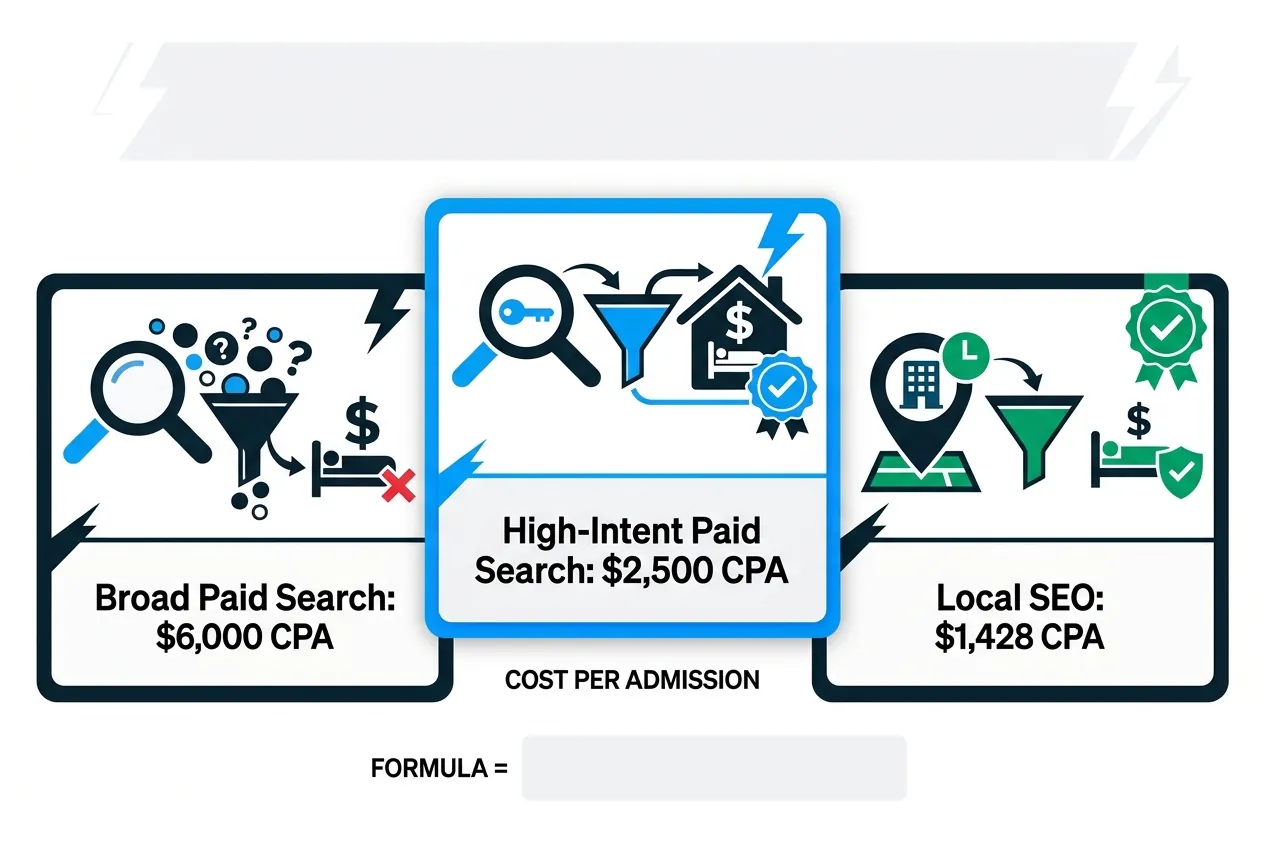
Applying this metric reveals stark differences between marketing channels that look equally productive under standard lead reporting. Consider the following comparison across three common acquisition sources:
- Broad Paid Search. Monthly Spend: $30,000. Total Inbound Leads: 400. Cost Per Lead (CPL): $75. Verified Admissions: 5. Cost Per Admission: $6,000.
- High-Intent Paid Search. Monthly Spend: $30,000. Total Inbound Leads: 150. Cost Per Lead (CPL): $200. Verified Admissions: 12. Cost Per Admission: $2,500.
- Local Organic Search & SEO. Monthly Spend: $10,000. Total Inbound Leads: 80. Cost Per Lead (CPL): $125. Verified Admissions: 7. Cost Per Admission: $1,428.
In this scenario, broad paid search delivers an attractive $75 CPL, yet results in a costly $6,000 cost per admission because the vast majority of inquiries fail clinical or insurance verification. Conversely, targeted high-intent campaigns carry a higher front-end lead cost ($200) but convert into admissions at a significantly higher rate, cutting the net cost per admission by more than half.
Calculating this metric accurately requires joined-up attribution that tracks an anonymous digital visitor from their initial search query to a masked CRM identifier, through insurance verification, and finally to physical check-in. Facilities that calculate true acquisition costs by channel can reallocate budget away from wasteful lead traps and invest aggressively in search terms that consistently produce admitted patients.
Increasing Admissions Conversion Rate Through Verification Alignment
Improving your admissions conversion rate is primarily an exercise in operational alignment rather than promotional copywriting. The admissions conversion rate represents the percentage of qualified inbound inquiries that progress through clinical assessment and financial clearance to complete an admission.
A major point of friction in this progression is the verification of benefits (VOB) turnaround time. When an admissions coordinator collects policy information, every minute spent waiting for payer verification introduces drop-off risk. Delays allow anxiety, ambivalence, family interventions, or competitor outreach to derail the placement. Establishing real-time electronic benefit verification protocols and integrating clear payer criteria into your landing pages minimizes drop-offs. If a facility only accepts private commercial insurance, designing front-end messaging that clearly guides commercial policyholders while offering curated external resources for state-funded plans protects both the patient and the admissions team.
Clinical pre-screening must also align with front-end ad positioning. When landing pages clearly articulate the specific conditions treated, such as dual diagnosis, primary substance use, or specialized trauma programming, prospective families self-select before calling. This pre-qualification elevates lead quality, shortens intake assessment interviews, and allows coordinators to spend more time guiding qualified families through travel logistics, medical intake forms, and day-of-admission preparations. For a detailed breakdown of the capabilities required to balance clinical positioning with marketing execution, see our overview of what a mental health marketing agency: what a specialist partner should deliver.
Navigating LegitScript, HIPAA, and Google Healthcare Ad Policies
Executing admissions marketing requires navigating some of the strictest regulatory and advertising environments in digital media. Treatment providers cannot rely on standard e-commerce growth tactics, as major ad networks enforce rigorous rules designed to protect vulnerable individuals.
On Google Ads, any advertiser promoting drug and alcohol addiction treatment services in the United States must be certified by LegitScript and verified by Google before their campaigns can run, as outlined in the Google Ads Help: Addiction Services policy. The certification process managed by LegitScript Addiction Treatment Certification involves comprehensive evaluations of facility licensing, physical site legitimacy, clinical leadership credentials, background checks, and compliance with ethical insurance billing standards. Operating without this certification leads to immediate ad suspension.
Equally critical are the platform restrictions surrounding user privacy and retargeting. Under the Google Advertising Policies for Personalized Ads, advertisers are strictly prohibited from using remarketing, retargeting lists, or interest-based audience targeting for sensitive health conditions, including addiction, mental health disorders, and prescription drug use. Facilities cannot place retargeting pixels on their websites to follow previous visitors around the web with display ads.
Furthermore, behavioral health providers must comply with statutory healthcare privacy frameworks. The Department of Health and Human Services provides explicit guidance on how digital tracking technologies intersect with protected health information in the HHS Guidance on Online Tracking Technologies. Transmitting unmasked IP addresses, medical query details, or identifiable patient data to third-party ad platforms violates federal privacy standards. Compliant admissions marketing relies on high-intent inbound search capture, privacy-first analytics, and secure first-party attribution rather than aggressive third-party data tracking.

Email Us
Prefer to send the context directly?
Engineering Predictable Treatment Center Admissions with Marketing Powered
Marketing Powered approaches behavioral healthcare marketing from an operator-first perspective, resolving the attribution blind spots and intake inefficiencies that stall facility census. The foundation of our methodology comes from practical leadership: our founder is a former healthcare CMO who ran marketing for a treatment network that grew from 3 to 24 locations, managing $1.5 to $2M per month in Google Ads across 11+ behavioral and mental health accounts. Additionally, our founder serves as a court-certified expert witness in advertising strategy.
We recognize that behavioral health providers cannot treat patient acquisition like an unregulated retail funnel. Marketing Powered is LegitScript-aware and HIPAA-aware, purpose-built for Google's sensitive healthcare vertical where retargeting is not permitted. Our campaigns do not rely on generic broad-match volume or unvetted lead generation. Instead, we structure paid media and organic search to capture verified commercial intent, aligning search queries directly with your clinical licensing, bed availability, and in-network payer contracts.
To solve the tracking dilemma without compromising patient privacy, we track attribution to admission, not just lead. By pairing privacy-compliant data workflows with our owned, local AI infrastructure for HIPAA-aware inference, we analyze campaign performance, call dispositions, and intake throughput securely. Our system connects front-end ad spend directly to verified treatment center admissions, providing executive leadership with complete visibility into true acquisition economics. Explore our specialized behavioral health marketing services to see how our operational framework transforms acquisition performance.
Questions, Answered.
Admissions marketing is a specialized healthcare growth strategy that focuses on driving verified clinical patient admissions rather than unvetted digital leads. It integrates paid search, organic search, intake call center workflows, and closed-loop data tracking to ensure that marketing expenditures directly support facility bed utilization and clinical capacity while adhering strictly to healthcare compliance rules.
General healthcare marketing often aims at broad brand awareness, physician referral networking, or general outpatient appointment scheduling. Admissions marketing operates primarily in high-acuity, sensitive verticals such as addiction treatment, eating disorder recovery, and residential psychiatric care. It requires navigating strict ad certification rules, dealing with complex insurance verification processes, handling urgent crisis-driven inquiries, and complying with stringent prohibitions against health-related retargeting.
Cost per lead measures only the initial contact point, such as a phone call or form submission, regardless of whether the person has appropriate insurance, clinical eligibility, or intent to enroll. Cost per admission measures the exact dollar amount required to place a fully qualified patient into clinical care. Tracking cost per admission prevents providers from overspending on low-quality campaigns that overwhelm intake staff with unadmittable inquiries.
Compliant attribution tracking requires separating digital ad data from protected health information. Facilities use secure server-side tracking, unique click identifiers, and CRM disposition codes to connect marketing sources with downstream admissions. By stripping personal identifiers before evaluating channel performance, operators can measure cost per admission without sending sensitive patient health information to external ad networks. Talk with Marketing Powered about your admissions and marketing economics.
Ready to see where your marketing can improve?
Request a free audit of your paid media, landing pages, attribution, and measurement setup. You'll get a straight assessment of where the opportunities are.
or email us at info@marketingpowered.ai