Resources
HIPAA Compliant AI: Deploying Large Language Models in Healthcare Marketing
Deploying hipaa compliant ai requires healthcare marketing teams to move beyond generic software disclaimers and address the technical realities of data transmission. Between federal regulatory bulletins and strict advertising platform restrictions, modern organizations must isolate patient identities from algorithmic processing. When configured properly, generative models accelerate content and intake workflows without creating legal exposure under federal privacy statutes.
By Mike Hulick, Founder, Marketing Powered

Is ChatGPT HIPAA compliant? Enterprise BAAs versus consumer accounts

What is HIPAA compliant AI in healthcare marketing?
Commercial artificial intelligence systems cannot achieve compliance in a vacuum. Under the Health Insurance Portability and Accountability Act, statutory obligations apply to Covered Entities and Business Associates rather than software products. The law does not issue product certifications. Instead, hipaa compliant ai describes an operating environment where technical safeguards, legal agreements, access controls, and data sanitization protocols prevent the impermissible disclosure of Protected Health Information (PHI).
In a medical or behavioral health marketing department, artificial intelligence tools perform several distinct functions:
- Drafting search ad copy, patient educational content, and clinical service descriptions.
- Categorizing incoming prospective patient inquiries from web forms and live chats.
- Parsing intake call transcripts to evaluate contact center performance.
- Classifying campaign performance patterns across multi-location clinic networks.
Each of these functions introduces different levels of operational exposure. If a marketing coordinator pastes a patient intake message containing a name, phone number, and medical diagnosis into a standard consumer language model, an immediate regulatory violation occurs.
To visualize this operational boundary, picture two distinct terminal screens in an intake department. On the left is an unmonitored consumer web browser sending unencrypted patient inquiries across public consumer networks. On the right is a restricted administrative console routing scrubbed, de-identified demographic tokens through an encrypted, zero-data-retention pipeline. The intelligence of the underlying mathematical model is identical in both cases. The technical environment and contractual custody of the data determine whether the workflow satisfies federal privacy rules. For an overarching framework on compliant campaign development, see HIPAA compliant marketing: what the rules mean for campaigns and tracking.
Marketing leaders frequently ask: is chatgpt hipaa compliant? The short answer depends entirely on the tier of service and the contract executed with OpenAI. Standard consumer versions of ChatGPT, including the Free and Plus tiers, are not compliant with healthcare privacy regulations.
When users interact with consumer versions of ChatGPT, default terms allow input data to be retained and utilized to train future models. Furthermore, OpenAI does not execute a Business Associate Agreement (BAA) for consumer accounts. Entering identifiable patient inquiries, scheduling requests, or clinical testimonials into these consumer interfaces creates unauthorized disclosures of PHI.
To use hipaa compliant chatgpt workflows, healthcare organizations must procure enterprise-grade services. OpenAI provides Business Associate Agreements for qualifying business customers on ChatGPT Enterprise, ChatGPT Team, and commercial API deployments, as documented in the OpenAI Enterprise Privacy terms.
Under an executed BAA with zero-retention configurations:
- Customer prompts and generated completions are excluded from foundation model training.
- Data transmitted via commercial API endpoints is encrypted in transit and at rest.
- Retention windows for operational logging are strictly limited or disabled based on configuration.
- Dedicated administrative access controls allow security personnel to audit workspace usage.
Healthcare growth leaders must enforce strict internal software governance. A marketing specialist attempting to summarize intake emails using a personal consumer account poses an acute institutional liability. The execution of a BAA is a legal baseline, but internal workflows must still enforce sanitization rules to ensure sensitive identifiers never populate external cloud prompts unnecessarily.
Where PHI leaks: prompts, web trackers, and marketing workflows
Evaluating ai in healthcare marketing compliance requires auditing the full journey of a user interaction, from ad click to CRM entry. In modern marketing architectures, data leakage rarely happens because of malicious intent. It happens because digital tracking technologies and automated intake tools share data by default.
The Department of Health and Human Services (HHS) Office for Civil Rights outlined this risk in the HHS Bulletin on Online Tracking Technologies. The guidance explains that when a digital tracker connects a user's IP address, device identifier, or browsing behavior with an appointment booking page or a specific health condition search, that data bundle constitutes PHI under HIPAA.
Marketing teams often create data leaks at three specific touchpoints:
- Interactive web chat widgets. Front-end chat tools powered by third-party language models often capture visitor IP addresses while prompting users to describe their medical symptoms. Without a signed BAA and technical isolation, this configuration passes unencrypted patient intent directly to third-party endpoints.
- CRM and intake automation. Forwarding raw call transcripts or web form submissions directly into language models to generate lead summaries can expose medical details, location coordinates, and payment records. Marketers managing web instrumentation should review Google Analytics and HIPAA: what healthcare marketers can and cannot do to understand how client-side tracking codes compound this vulnerability.
- Downstream ad attribution. In sensitive medical verticals, ad platforms enforce strict programmatic boundaries. For example, Google restricts personalized advertising and retargeting lists for sensitive health conditions under the Google Ads Personalized Advertising Policy. Marketers cannot feed patient conversion lists back into open algorithmic models to build retargeting pools. Campaigns must convert on high intent, clear messaging, and clean first-party capture.
Free Audit
Want a straight read on where your budget is leaking?
What are HIPAA compliant AI tools? Vendor evaluation criteria
When evaluating the market for hipaa compliant ai tools, healthcare executives must look past vendor marketing claims. Software vendors routinely advertise their systems as secure, yet security alone does not satisfy statutory privacy mandates.
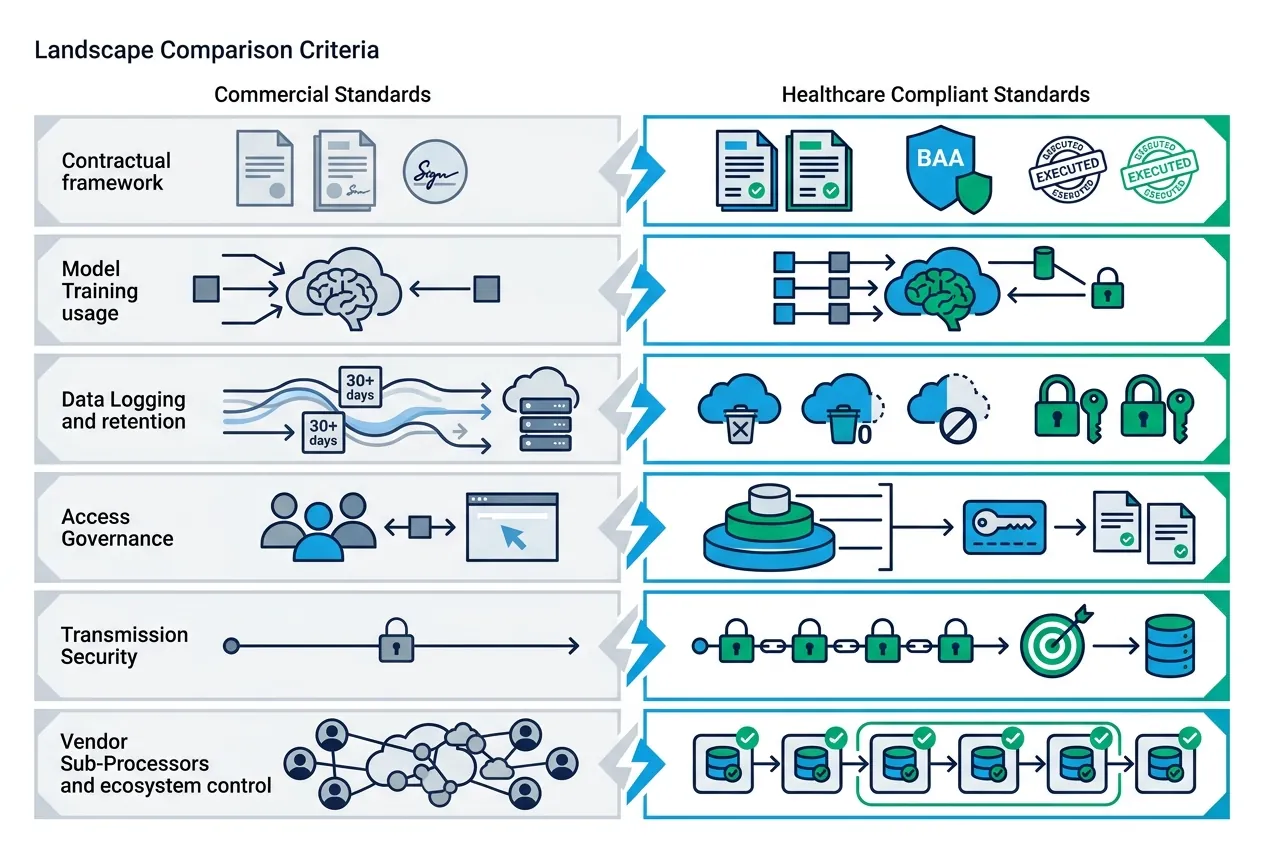
To establish defensibility, a cross-functional procurement team comprising marketing directors, compliance officers, and IT security personnel should audit prospective vendors using a structured technical matrix:
- Contractual BAA. Commercial Standard: Standard Terms of Service (click-through). Healthcare Compliant Standard: Executed Business Associate Agreement with defined indemnification.
- Model Training. Commercial Standard: Customer prompts utilized for platform optimization. Healthcare Compliant Standard: Explicit contractual exemption from model training datasets.
- Data Logging. Commercial Standard: Extended cloud logging (30+ days) for service review. Healthcare Compliant Standard: Zero-retention data logging or customer-controlled cryptographic keys.
- Access Governance. Commercial Standard: Shared team logins or single-tier permissions. Healthcare Compliant Standard: Role-Based Access Control (RBAC) with Single Sign-On and audit logs.
- Transmission Security. Commercial Standard: Standard TLS web connections. Healthcare Compliant Standard: End-to-end encryption with strict API endpoint scoping.
Marketing technology stacks frequently use productivity tools like Airtable or Paubox. Paubox specializes in encrypted healthcare communication and executes BAAs across its secure email ecosystem. Airtable offers enterprise contracts that support compliance obligations when configured specifically for covered data.
Applying this same rigor to artificial intelligence platforms requires verifying the exact endpoint architecture. If an AI platform uses external third-party models in the background, its BAA must extend downward to cover its sub-processors. When vetting prospective agency partners to help manage these tools, consult our resource on Hipaa compliant marketing companies: what a specialist partner delivers and how to vet one.
The case for local inference and owned AI infrastructure
While commercial cloud APIs covered by BAAs provide one path to compliance, an alternative model eliminates third-party transmission entirely: self-hosted, local model inference.
Instead of sending prospective patient inquiries, intake logs, or proprietary conversion datasets to a remote cloud provider, healthcare organizations can deploy open-weight language models directly on owned, local infrastructure. Running models within an owned hardware boundary provides significant operational advantages:
- Zero external data transmission. Patient tokens, CRM notes, and campaign data never leave the private local area network. No third-party vendor sees the prompts.
- Immunity to vendor policy shifts. Commercial cloud vendors frequently adjust data retention rules, pricing tiers, and terms of service. Owned compute infrastructure keeps operating protocols stable.
- Custom data pipelines. Healthcare systems can build specialized sanitization layers, terminology classifiers, and intake evaluation routines tailored directly to multi-location operations.
Marketing Powered has been AI-native since 2022, operating owned, local AI infrastructure for HIPAA-aware inference. This engineering approach eliminates reliance on third-party cloud agreements for sensitive processing tasks. Rather than wondering whether a commercial cloud provider's logging retention matches internal compliance protocols, running open-weight models on owned compute ensures that sensitive conversion records remain entirely within controlled operational boundaries.
Privacy-safe marketing architecture from ad click to intake
Achieving clean conversion attribution without compromising patient privacy is the central challenge in healthcare customer acquisition. High-performing healthcare organizations do not choose between strict regulatory compliance and precise marketing measurement. They design systems that achieve both.
Marketing Powered delivers this balance through dedicated privacy-safe tracking and marketing technology. The firm's leadership brings direct industry experience: our founder is a former healthcare CMO who ran marketing for a treatment network that grew from 3 to 24 locations, personally managed $1.5 to $2M per month in Google Ads across 11+ behavioral and mental health accounts, and serves as a court-certified expert witness in advertising strategy.
Because Google prohibits retargeting across sensitive healthcare categories, marketing success depends on intent capture, message alignment, and clean conversion infrastructure. Our methodology tracks attribution to admission, not just lead, while maintaining complete data isolation.
The operational architecture works through four distinct stages:
- First-touch capture. Search campaigns capture high-intent users on dedicated landing pages that strip third-party client-side trackers from sensitive intake steps.
- Edge processing and tokenization. When an inquiry occurs, server-side containers receive the event, strip away user IP addresses and specific medical diagnostic strings, and assign a pseudo-anonymous identifier.
- Local AI classification. Owned inference models classify inquiry quality, routing velocity, and operational contact center handling without sending identifying patient data across third-party networks.
- Offline conversion return. Once an admitted patient journey is established inside the secure clinical record, anonymized conversion value tokens are returned upstream via server-side APIs to inform ad platform bidding algorithms.
This closed-loop system protects prospective patient identities under federal statutes while providing growth teams with the optimization data needed to run efficient customer acquisition campaigns.
Questions, Answered.
HIPAA compliant AI refers to artificial intelligence systems deployed within an administrative, physical, and technical architecture that satisfies the privacy and security rules of the Health Insurance Portability and Accountability Act. Because HIPAA does not certify software, compliance depends on executed Business Associate Agreements, zero-retention data logging, encryption protocols, and procedures that prevent the unauthorized disclosure of Protected Health Information.
Enterprise tiers of major technology platforms can be configured to support compliance, including ChatGPT Enterprise, ChatGPT Team, Microsoft Azure OpenAI Service, and specialized communications tools such as Paubox. However, these tools are only compliant when a formal Business Associate Agreement is executed and the platform settings are configured to prevent model training and extended logging.
Airtable supports HIPAA compliance exclusively on its Enterprise scale plans with an executed Business Associate Agreement. Standard free, plus, or pro plans do not support compliance and must not be used to store, manage, or summarize patient intake details, appointment requests, or medical service inquiries.
Healthcare marketers can safely use free AI tools to generate general ad copy concepts, headline variations, and educational articles, provided that no Protected Health Information, patient names, real email inquiries, or identifiable medical scenarios are entered into the prompts. Free tools should never be linked to web forms, CRM databases, or intake communication streams. Request a privacy and tracking review of your marketing stack.
Ready to see where your marketing can improve?
Request a free audit of your paid media, landing pages, attribution, and measurement setup. You'll get a straight assessment of where the opportunities are.
or email us at info@marketingpowered.ai