Resources
Multi Touch Attribution: When It Helps and When It Misleads
Modern growth operators face an enduring commercial dilemma: marketing capital is deployed across complex digital channels, but verifying which touchpoints actually generate downstream revenue remains broken. The emergence of multi touch attribution promised to eliminate this ambiguity by replacing crude single-touch rules with fractional, journey-spanning credit. While multi touch modeling offers valuable diagnostic visibility into buyer behavior, treating algorithmic credit distributions as an infallible financial balance sheet misallocates capital, inflates intermediary channel claims, and obscures true economic yield.
By Mike Hulick, Founder, Marketing Powered

First Touch vs Last Touch: Why Legacy Models Distort Budgets

What Is Multi Touch Attribution and How Does It Work?
Multi touch attribution is an analytical evaluation framework that assigns fractional economic value to multiple marketing touchpoints across a prospective buyer's conversion path. Instead of crediting an entire opportunity to a single click, it attempts to quantify how display impressions, organic searches, paid search clicks, webinar attendances, and direct visits interact over time to produce a closed transaction.
In an active analytics room, this process begins at the data-ingestion layer. When a prospect interacts with an ad campaign, an analytics script or server-side endpoint records critical metadata: the referer URL, the device user agent, session timestamps, and URL parameters such as Google Click Identifiers (gclid) or standard campaign UTMs. As that same individual navigates across multiple sessions, identity resolution protocols attempt to stitch these isolated event logs into a continuous timeline using first-party cookies, persistent visitor IDs, or hashed email addresses captured via form fills.
Once the user completes a predefined macro-conversion, such as submitting an enterprise demo request or placing a call to an intake center, the attribution engine processes the assembled path. The system evaluates the chronological sequence of interactions, calculates weighting factors based on either predetermined rules or statistical modeling, and divides the value of that conversion across the participating channels. Marketing operators look to this diagnostic view to identify which media channels work as introductory discovery mechanisms, which serve as mid-funnel validators, and which function strictly as closing instruments.
To understand why fractional measurement gained widespread adoption, growth teams must evaluate the systemic distortions created by single-touch heuristics. In the debate between first touch vs last touch attribution, both frameworks suffer from structural blindness that penalizes specific stages of the commercial acquisition funnel.
Last-touch attribution assigns one hundred percent of conversion credit to the final recorded asset or click prior to an intake event. This framework systematically overvalues direct traffic, branded search campaigns, and bottom-of-funnel retargeting. When capital allocation is dictated entirely by last-click performance, media teams starve top-of-funnel discovery channels of necessary budget. Branded search and automated retargeting appear exceptionally efficient precisely because they harvest demand that was stimulated by earlier, uncredited marketing interactions. Over time, reducing top-of-funnel media spend erodes the total pool of net-new prospects entering the pipeline, even as last-click metrics report healthy returns.
First-touch attribution introduces the opposite distortion. By granting total commercial credit to the initial recorded discovery click, this model overvalues broad social media awareness campaigns and high-level educational content while completely discounting the operational mechanisms required to convert interest into revenue. It ignores downstream email nurturing, personalized sales outreach, inbound phone support, and targeted mid-funnel search campaigns that address pricing, compliance, and institutional credibility. Organizations relying on first-touch measurement risk over-investing in top-of-funnel volume that generates unqualified traffic, failing to support prospects through multi-week evaluation cycles.
Multi-touch models were engineered specifically to dismantle this binary choice. By establishing a framework that acknowledges both discovery and conversion mechanics, marketing executives sought a more equitable representation of the total buyer journey.
Deconstructing the Multi Touch Attribution Model in Practice
Deploying an effective multi touch attribution model requires understanding the mathematical rules used to split credit across channels. Most legacy analytics platforms rely on heuristic models that apply arbitrary, fixed percentages to observed digital touchpoints:
- Linear Attribution: This model divides credit equally across every observed interaction. If a buyer interacts with a paid search ad, an organic blog post, an automated nurture email, and a direct site visit, each touchpoint receives twenty-five percent of the conversion value. While linear modeling prevents any single channel from dominating the report, it dilutes the strategic impact of critical inflection points, treating routine transactional emails with the same economic weight as high-intent discovery queries.
- Time-Decay Attribution: Under this ruleset, touchpoints that occur closer in time to the final conversion receive an exponentially larger share of credit. An interaction that occurs two days before an application is weighted far more heavily than a discovery click that occurred six weeks prior. While logical for short-cycle consumer purchases, time-decay modeling effectively replicates last-click bias in complex enterprise, healthcare, or professional services environments where evaluation cycles deliberately span months.
- Position-Based (U-Shaped and W-Shaped) Attribution: Position-based models attempt to blend discovery and conversion priorities. A standard U-shaped framework assigns forty percent of credit to the first touch, forty percent to the lead-creation touch, and divides the remaining twenty percent evenly among the middle interactions. W-shaped configurations add a third anchor point, typically assigning thirty percent each to discovery, lead creation, and sales opportunity generation, with ten percent distributed across intermediary touches.
While these heuristic models provide consistency across reporting periods, they remain subjective assumptions codified into software dashboards. They describe touchpoint sequence, but they cannot prove causality.
Free Audit
Want a straight read on where your budget is leaking?
Data Driven Attribution and Algorithmic Weighting
To overcome the arbitrary nature of fixed-percentage rules, modern enterprise measurement platforms moved toward data driven attribution. Rather than relying on human assumptions regarding channel importance, algorithmic systems evaluate thousands of converting and non-converting paths across an account to calculate the incremental statistical contribution of each touchpoint.
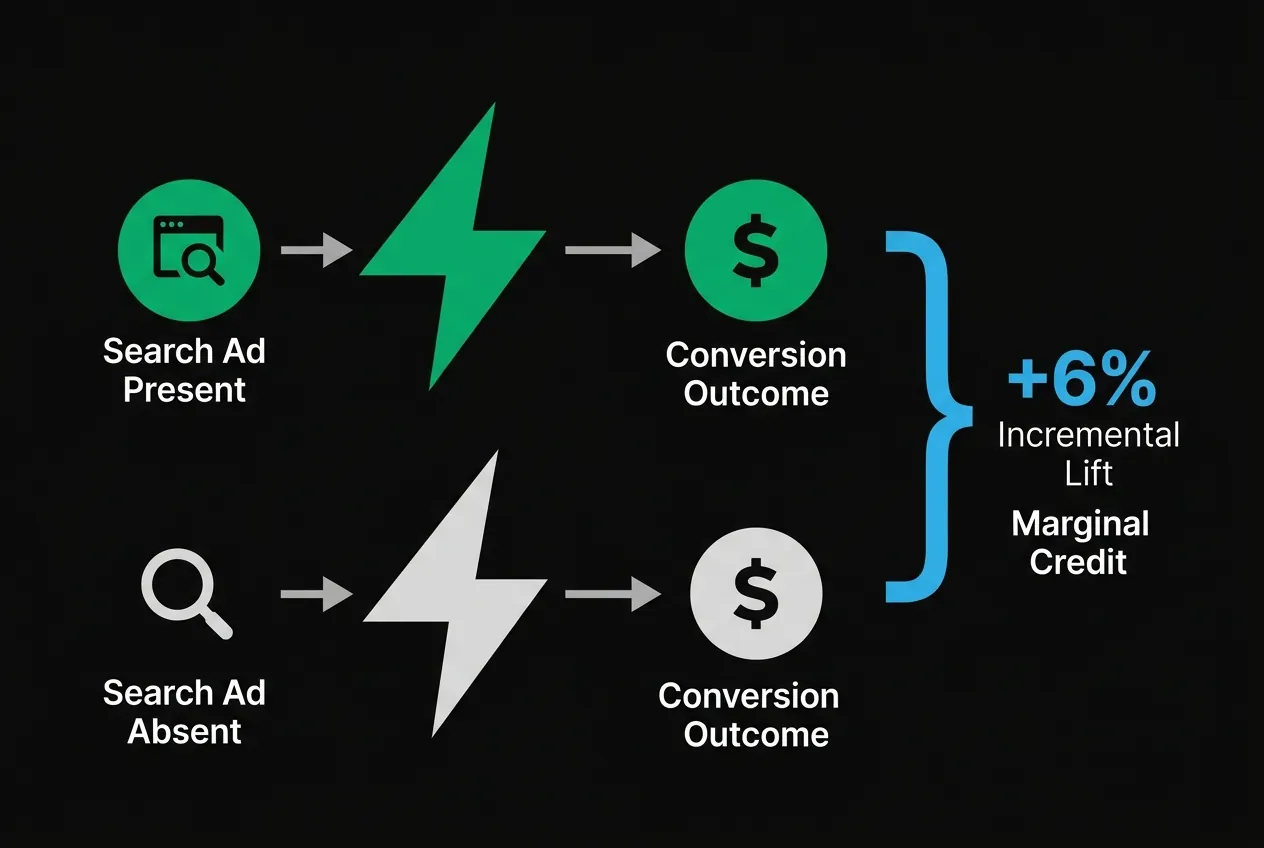
Native measurement systems, including Google Analytics 4, have established algorithmic credit distribution as their baseline standard, as detailed in the official documentation for Google Analytics Help. These algorithmic engines frequently leverage cooperative game theory concepts, such as Shapley values, or Markov chain modeling. Under a Shapley value framework, the algorithm evaluates how conversion probability shifts when a specific marketing channel is present in a journey compared to when it is absent. If prospective buyers who encounter a specific non-branded search ad convert at an eight percent rate, but drop to a two percent conversion rate when that ad is removed from the path, the algorithm elevates the marginal credit assigned to that paid search campaign.
However, growth operators must maintain healthy skepticism regarding platform-hosted data-driven models. A proprietary algorithm hosted within a major ad ecosystem inevitably relies on closed-source statistical assumptions. Because ad networks capture richer behavioral signals within their own properties than across external touchpoints, platform-native attribution engines tend to assign favorable fractional credit to their own ad inventory. Algorithmic attribution offers superior statistical sophistication compared to linear rules, but it does not remove the commercial necessity for external verification.
The Blind Spots: Where MTA Marketing Breaks Down
Despite technological refinement, modern mta marketing strategies face fundamental structural constraints. Fractional attribution platforms rely on tracking individual prospective buyers across time, devices, and platforms. Over the past five years, browser policy shifts, mobile operating system restrictions, and regulatory privacy mandates have systematically dismantled the technical infrastructure required for client-side deterministic tracking.
First, browser privacy mechanisms severely degrade cross-session observation windows. As documented by the WebKit engineering team, Apple WebKit ITP caps the storage duration of client-side script-writable cookies to between one and seven days. In high-consideration sectors, such as healthcare systems, commercial insurance, or enterprise technology, buying journeys frequently extend from thirty to ninety days. When an executive or patient research phase spans multiple weeks, browser tracking protections wipe the initial cookie identifiers. When the prospect eventually returns via an organic search or direct URL to complete an intake form, the analytics script cannot link that session back to the paid discovery click that occurred three weeks earlier. The multi-touch system records the visit as a brand-new, single-touch interaction, rendering multi-touch path analysis incomplete.
Second, mobile tracking permissions introduce massive data fragmentation. Under Apple's operating system framework, detailed in the Apple Developer Documentation, applications must obtain explicit user authorization through the App Tracking Transparency framework to track activity across third-party websites and apps. With millions of users withholding consent, deterministic cross-app tracking has collapsed. A buyer reading an industry analysis on LinkedIn or interacting with an ad in Instagram who later conducts an independent desktop search can rarely be stitched into a unified multi-touch record.
Third, regulatory and platform category rules prevent persistent tracking in sensitive industries. Under the official Google Ads Healthcare and Medicines Policy, advertisers operating in sensitive healthcare verticals are strictly prohibited from deploying personalized advertising, building audience remarketing lists, or utilizing retargeting pixels. Operating without retargeting requires fundamentally different media architecture, as attribution systems cannot rely on tracking individual users across clinical topics.
Finally, fractional digital attribution suffers from offline channel blindness. In high-value services and healthcare environments, high-intent prospects do not simply fill out web forms; they pick up the phone and call. If an analytics architecture does not bind dynamic telephony call tracking into the data ingestion layer, the entire phone-based conversion volume is severed from the digital touchpoint history. The multi-touch dashboard reports an incomplete picture, crediting only web-form leads while remaining blind to the marketing touchpoints that generated inbound qualified phone calls.
Building an Attribution Architecture Grounded in Verified Revenue
Overcoming the structural failure points of fractional tracking requires abandoning the pursuit of pure deterministic path tracking in favor of an accountable first-party measurement architecture. Effective growth measurement does not attempt to track every click across the open internet; it rigorously validates the relationship between acquisition media spend and verified downstream operational events.
At Marketing Powered, this discipline is built into our practice for Data and analytics architecture: attribution, call tracking and first-party data. Rather than relying on third-party SaaS tracking scripts that collapse under browser cookie caps, the operational architecture centers on owned, first-party infrastructure. Dynamic number insertion ties inbound phone calls directly to campaign click parameters, capturing session-level source data before passing the caller into intake workflows. First-party server-side collection endpoints capture click parameters directly into an owned data warehouse, bypassing client-side cookie limitations while respecting strict privacy boundaries.
This measurement philosophy is drawn directly from executive-level operational history. The founder of Marketing Powered is a former healthcare CMO who ran marketing for a treatment network that grew from 3 to 24 locations, managing $1.5 to $2M per month in Google Ads across 11+ behavioral and mental health accounts. Operating within Google's sensitive healthcare vertical, where retargeting is strictly prohibited and regulatory scrutiny is paramount, required engineering attribution that tracked marketing investment past superficial front-end form leads to verified clinical admissions. As a court-certified expert witness in advertising strategy, our leadership approaches measurement as a matter of defensible proof, not platform vanity metrics.
Being AI-native since 2022, Marketing Powered deploys owned, local AI infrastructure for HIPAA-aware inference. This allows healthcare systems, hospitals, and enterprise organizations to process sensitive intake transcripts, call logs, and customer communications locally, extracting actionable conversion intelligence without transmitting protected health information to public cloud endpoints. By anchoring attribution to verified operational milestones, whether a confirmed patient admission, a qualified case intake, or a booked enterprise contract, organizations move away from unverified fractional models and establish true financial accountability.
For a broader evaluation of how attribution frameworks integrate with commercial strategy, consult our foundational pillar guide, Marketing attribution: a practical guide for teams that need real answers. When evaluating external operational partners to implement these pipelines, review Marketing attribution agency: what a specialist partner delivers and how to vet one, as well as our technical guide on Call tracking services: what a specialist partner delivers and how to vet one.
Questions, Answered.
Multi touch attribution operates by capturing unique tracking parameters, such as UTM codes, click IDs, and session cookies, whenever a prospect interacts with a digital touchpoint. These individual interaction events are ingested into an analytics database and joined together into a single user timeline through session stitching. When a conversion event occurs, such as a submitted application or phone inquiry, the attribution model applies specific mathematical rules or statistical algorithms to divide the financial credit for that conversion across all recorded touchpoints along the journey.
Rule-based attribution relies on static, subjective assumptions configured by the marketer, such as assigning equal credit across all interactions in a linear model or weighting the first and last touches at forty percent each in a position-based model. Data driven attribution uses machine learning algorithms to evaluate converting and non-converting user paths across an entire account. It calculates the statistical probability of conversion when a touchpoint is present versus absent, assigning fractional credit dynamically based on observed incremental contribution rather than fixed assumptions.
Modern browser privacy technologies, such as Apple WebKit ITP, place hard time restrictions on client-side cookies, frequently deleting script-writable cookies within one to seven days. In industries with extended evaluation windows, such as healthcare, higher education, or enterprise B2B, a buyer's research phase often extends well past these expiration windows. When the prospect returns to complete an intake or purchase, their previous touchpoint history has been purged, causing the attribution system to misclassify the return visit as an isolated, single-touch interaction.
Multi touch attribution and marketing mix modeling serve fundamentally different analytical purposes and cannot replace one another. Multi-touch attribution provides granular, bottom-up diagnostic tracking of observed digital touchpoints, helping media buyers optimize campaign tactics, ad creative, and keyword selection. Marketing mix modeling is an aggregated, top-down statistical methodology that evaluates total revenue against macro-level marketing spend, economic shifts, seasonality, and offline channels. Mature growth organizations utilize marketing mix modeling for strategic capital allocation across channels while employing first-party attribution pipelines for tactical execution.
When operating in regulated or sensitive categories where platform policies prohibit remarketing lists and audience targeting, organizations cannot rely on passive, cookie-based audience nurture. Measurement must shift toward capturing first-party intent at the immediate point of interaction. This requires deploying dynamic telephony call tracking, server-side data ingestion, and direct CRM webhooks that bind incoming lead parameters directly to backend operational milestones, such as qualified consultations or completed admissions. Book an attribution audit with Marketing Powered
Ready to see where your marketing can improve?
Request a free audit of your paid media, landing pages, attribution, and measurement setup. You'll get a straight assessment of where the opportunities are.
or email us at info@marketingpowered.ai