Resources
AI Marketing: What It Changes for Strategy, Teams and Budgets
The widespread adoption of ai marketing forces executive leadership to confront a decisive operational choice: continue renting commodity features through scattered cloud subscriptions, or build an owned marketing intelligence infrastructure. Marketing teams do not suffer from a lack of generative text; they struggle with workflow integration, data security, and attribution that connects media spend to business outcomes. Transitioning an enterprise marketing department into an AI-native operation requires restructuring strategic priorities, reallocating capital budgets, and establishing strict data governance across every channel.
By Mike Hulick, Founder, Marketing Powered

The Strategic Shift: How AI Marketing Moves from Prompts to Architecture
The initial wave of commercial artificial intelligence entered marketing departments as disconnected point solutions. Content writers experimented with browser interfaces for ad copy, graphic designers tested image prompts, and media buyers ran automated bidding experiments within walled gardens. While these point solutions delivered isolated speed improvements, they rarely altered company unit economics.
A prompt-based approach to marketing produces a shallow operational layer. When every competitor has identical access to public foundation models through commercial web browsers, generative content becomes an undifferentiated commodity. The volume of published material increases across the market, but the economic return on that material compresses.
True strategic leverage begins when an enterprise moves beyond ad-hoc prompting and begins engineering marketing architecture. System architecture treats machine intelligence not as an external novelty, but as an embedded calculation layer across the entire customer acquisition lifecycle. This transition requires connecting customer relationship management (CRM) records, call tracking feeds, offline sales data, and ad network application programming interfaces (APIs) into a cohesive pipeline.
Consider a physical marketing operations center inside a high-growth multi-location services network. Three years ago, analysts spent hours manually cleaning campaign performance exports, matching phone call records to form fills, and building static attribution spreadsheets for regional managers. In an architected environment, local inference engines run continuously within the private network. Incoming intake phone calls are transcribed locally, stripped of sensitive identifiers, cross-referenced with active ad parameters, and evaluated against clinical or operational qualification criteria in minutes.
This architectural shift alters the fundamental questions leadership asks about campaigns. Instead of asking how to produce fifty blog articles in an afternoon, executive teams evaluate how automated intake data loops can inform bidding algorithms on ad platforms. The objective is not generative volume. The objective is the continuous, automated extraction of actionable market signals from first-party data.

Redefining AI Marketing Strategy: Moving Beyond Rented Software Wrappers
Developing a durable ai marketing strategy requires distinguishing between foundational technical assets and disposable commercial software. A significant portion of the modern marketing technology ecosystem consists of software wrappers: lightweight user interfaces layered directly over commercial foundation model APIs. Subscribing to dozens of wrapper tools creates operational fragility, vendor dependency, and escalating recurring costs.
Evaluating the Hidden Costs of Commodity AI Wrappers
When marketing teams license generic third-party artificial intelligence tools, they introduce three hidden balance-sheet liabilities:
- Compounding Unit Economics: Most commercial software vendors charge per-seat or per-generation fees. As creative production, localization, and customer segmentation expand across multiple business lines, recurring operational expenditures scale linearly. The efficiency gains delivered by the technology are captured by the software vendor rather than retained as enterprise margin.
- Platform Dependency and Interruption Risk: Cloud software wrappers rely entirely on the terms of service, uptime, and pricing models of external platforms. When a third-party vendor alters its content policies, updates its base model parameters, or increases API consumption rates, dependent marketing pipelines suffer immediate operational disruption.
- Data Leakage and Competitive Contamination: Transmitting proprietary campaign conversion data, audience lists, or operational performance metrics into hosted commercial tools exposes valuable commercial intellectual property. Public models utilize customer inputs for systemic continuous learning unless enterprise agreements explicitly state otherwise.
Establishing Sustainable Competitive Moats
A defensible competitive moat is never built on shared public software. It is built on proprietary context, historical operating data, and custom business logic. An organization that owns its marketing workflows creates intellectual property that compounds in value over time.
To build an authentic moat, an ai marketing strategy must prioritize first-party knowledge ingestion. Proprietary customer interaction transcripts, localized conversion histories, actual customer lifetime value metrics, and regulatory review logs must be organized into private vector repositories and structured data tables. When private intelligence pipelines query local models, the resulting creative assets, tactical optimizations, and strategic forecasts reflect the accumulated experience of the company rather than the generic average of the public internet.
Organizations should also examine how they partner with external service providers. Engaging a specialized partner requires rigorous evaluation criteria; marketing leaders can reference AI marketing agency: how to evaluate one beyond the label to separate authentic technical operators from intermediaries repackaging basic public software.
Rebuilding the Marketing Org: How AI Reshapes Roles and Workflows
Deploying ai for marketing reshapes the organizational chart. The traditional marketing department structure, segmented into rigid silos of junior copywriters, manual data entry specialists, graphic asset formatters, and channel coordinators, was designed around manual assembly lines. Machine intelligence automates baseline execution steps, making legacy departmental structures inefficient.
Modern organizational design elevates employees from manual creators to editors, system architects, and governance directors. The human element does not disappear; rather, human responsibility shifts toward verification, creative direction, and commercial judgment.
The transformation of roles within the marketing team follows a distinct progression across core functional areas:
- Creative Production: Writers and visual artists no longer spend hours drafting basic variations of headlines or resizing display banners. Instead, they define brand tonality, establish conceptual positioning, curate specialized reference datasets, and evaluate automated system outputs against strict brand standards.
- Paid Media Management: Campaign managers step away from manual bid adjustments and daily keyword negative matching. They focus on conversion signal integrity, offline conversion data pipeline engineering, and landing page architecture.
- Content and SEO Operations: Content teams abandon superficial keyword stuffing. As generative search engines transform organic search discovery, teams focus on authoritative primary research, executive interviews, and technical visibility. Operators preparing for this shift can consult Generative engine optimization agency: what a specialist partner delivers and how to vet one to align their multi-channel strategy with modern discovery engines.
- Marketing Operations and Analytics: Data specialists transition from generating backward-looking descriptive dashboards to maintaining active data synchronization pipelines between the CRM, intake centers, and media platforms.
This organizational shift carries real execution risk: deskilling. When junior professionals rely entirely on automated systems to generate campaign angles, audience structures, and analytical conclusions, they risk losing the foundational judgment required to spot algorithmic errors. Resilient marketing teams enforce mandatory human-in-the-loop review protocols. Subject-matter experts must inspect, verify, and approve automated deliverables before they reach ad networks, prospects, or search indexes.
Free Audit
Want a straight read on where your budget is leaking?
Capital Allocation: Budgeting for AI Across Compute, Talent, and Data
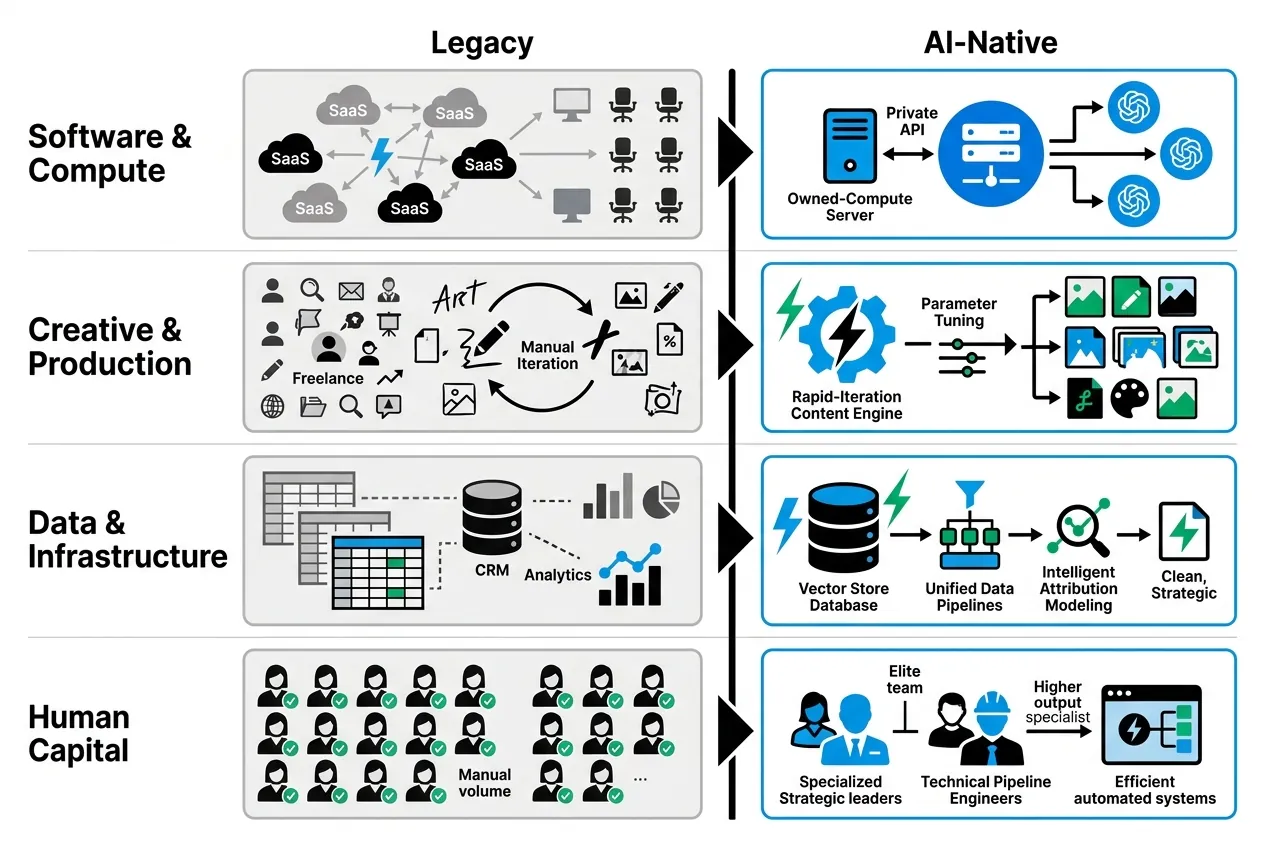
Deploying artificial intelligence marketing requires a fundamental restructuring of marketing capital allocation. Historically, marketing budgets were cleanly divided between working capital (direct advertising spend on media networks) and non-working capital (agency retainers, creative production vendors, and SaaS subscriptions).
Machine intelligence dissolves these clean divisions. A static budget allocation model fails to capture the economic advantages of computational infrastructure, proprietary data engineering, and automation talent.
- Software & Compute. Legacy Marketing Operation: Disparate SaaS subscriptions, per-seat licenses, point tools. AI-Native Marketing Operation: Owned computing hardware, local model instances, private APIs. Primary Economic Benefit: Fixed operating expenses, zero per-seat penalty, high asset utilization.
- Creative & Production. Legacy Marketing Operation: High freelance costs, manual creative iterations, agency markups. AI-Native Marketing Operation: In-house system operators, model parameter tuning, rapid variant engines. Primary Economic Benefit: Lower cost per creative asset, immediate iteration cycles.
- Data & Infrastructure. Legacy Marketing Operation: Basic web analytics, disconnected CRMs, manual spreadsheets. AI-Native Marketing Operation: Unified vector stores, local database pipelines, custom attribution. Primary Economic Benefit: Proprietary data moat, precise attribution modeling.
- Human Capital. Legacy Marketing Operation: Large teams of entry-level production coordinators. AI-Native Marketing Operation: Specialized strategic leaders, technical editors, pipeline engineers. Primary Economic Benefit: Higher operational output per full-time employee.
Evaluating the financial decision to invest in owned computing hardware versus renting cloud-based software requires careful balance-sheet analysis. Subscribing to commercial cloud APIs appears cost-effective initially because it requires zero upfront capital expense. However, as transactional volume scales across multiple locations, service lines, and content pipelines, monthly API bills and software seat costs escalate continuously.
Investing in owned, local computing hardware introduces an upfront capital expense for servers and local inference workstations, alongside operational costs for power and technical maintenance. In return, the organization gains predictable long-term costs, zero per-generation inference expenses, absolute data privacy, and full deployment control.
For high-volume, multi-location enterprises managing continuous data processing, running open-weights models on dedicated local hardware often delivers a substantially lower total cost of ownership over a multi-year horizon than paying recurring cloud API tokens.
Data Sovereignty and Compliance in Regulated Artificial Intelligence Marketing
In highly regulated sectors such as healthcare, hospital systems, addiction treatment, financial services, and legal advisory, marketing strategy is governed by strict compliance mandates. The casual use of public artificial intelligence tools within these verticals presents grave regulatory and commercial risks.
Data sovereignty means maintaining complete, verifiable ownership and operational control over where your data resides, who can access it, and how it is processed. When an employee pastes customer interaction records, patient inquiry details, or confidential litigation transcripts into a hosted cloud tool, data sovereignty is broken.
Healthcare Regulations and Protected Health Information
Operating digital acquisition systems within healthcare requires precise regulatory adherence:
- Protected Health Information (PHI) under HIPAA: Marketing operations must comply with federal privacy protections. The Department of Health and Human Services provides clear guidelines on how digital acquisition technologies interact with protected information in the HHS Office for Civil Rights Guidance on Tracking Technologies. Standard tracking pixels, form endpoints, and cloud analytics platforms that transmit identifiable health conditions, appointments, or treatment inquiries to unauthorized third parties violate federal privacy rules.
- Advertising Platform Restrictions: Major advertising networks enforce stringent protections regarding sensitive categories. Under the Google Ads Policy on Personalized Advertising, advertisers are strictly prohibited from utilizing retargeting, remarketing lists, or personalized audience profiling based on sensitive personal health conditions.
- Verification Mandates: In categories such as behavioral health, addiction medicine, and pharmaceuticals, advertising platforms demand rigorous certification. For example, Google outlines mandatory third-party verification standards in the Google Ads Healthcare and Medicines Policy.
Navigating these regulatory realities requires an advertising framework built specifically for Google's sensitive healthcare vertical, where retargeting is not permitted. Organizations operating in these sectors must maintain LegitScript awareness and HIPAA awareness across every ad campaign, intake workflow, and measurement system.
When deploying artificial intelligence marketing in sensitive industries, data pipelines must separate consumer tracking identifiers from operational conversion intelligence. By routing intake analytics and call evaluations through owned, local AI infrastructure for HIPAA-aware inference, organizations extract critical conversion signals without exposing protected health information to public cloud networks.

Specialized AI Systems: How Marketing Powered Deploys Owned Infrastructure
Marketing Powered approaches artificial intelligence from the perspective of experienced operators, not software resellers. The firm was built by a former healthcare CMO who ran marketing for a treatment network that grew from 3 to 24 locations, managing $1.5 to $2M per month in Google Ads across 11+ behavioral and mental health accounts. As a court-certified expert witness in advertising strategy, our leadership understands the legal, operational, and financial realities of high-stakes customer acquisition.
Marketing Powered has been AI-native since 2022. We do not sell superficial prompt libraries or wrap third-party software in marked-up monthly subscriptions. Instead, we design and deploy specialized AI systems and AI-native marketing operations that integrate directly into client workflows while preserving strict data sovereignty.
Our operational model is built around three concrete execution pillars:
- Owned, Local Computing Infrastructure: We operate dedicated, local computational hardware to handle sensitive data processing, automated intake analysis, and content engineering. By running configurable, open-weights foundation models on local infrastructure, we eliminate per-token SaaS markups, maintain total control over execution pipelines, and ensure sensitive operational data never touches public training pools.
- Attribution Tracked to Admission, Not Just Lead: In multi-location healthcare, professional services, and high-ticket customer acquisition, generating an unverified lead form is an incomplete achievement. Marketing Powered tracks acquisition through the entire funnel to the point of qualified admission or signed contract. By integrating privacy-safe intake tracking with campaign bidding algorithms, media budgets optimize for closed commercial outcomes rather than hollow front-end form fills.
- Rigorous Human Governance Protocols: Automation handles repetitive analysis, initial drafts, keyword grouping, and data normalization. Experienced human strategists and subject-matter editors govern every strategic decision, creative asset, and media adjustment.
This combination of executive marketing experience and owned technology gives organizations an operational framework that compounds in value over time.
Questions, Answered.
An AI tool wrapper is an external software-as-a-service application that adds a light interface over a public foundation model's API, charging recurring monthly fees per user. Owned marketing infrastructure consists of private data pipelines, locally operated or dedicated open-weights models, and proprietary workflow logic completely controlled by the enterprise, ensuring fixed operational costs and data sovereignty.
Traditional attribution models rely on static click tracking and basic conversion rules that struggle with long sales cycles, offline phone calls, and cross-device journeys. Artificial intelligence systems process multi-touch consumer interactions, analyze unstructured call center transcripts, clean data across disconnected databases, and map marketing touches directly to downstream business outcomes like closed deals or patient admissions.
Yes, provided the technical architecture isolates protected health information from public networks. Healthcare organizations must avoid transmitting identifiable health data, unhashed contact details, or sensitive URLs into public commercial software. By deploying owned, local AI infrastructure for HIPAA-aware inference, organizations process operational and clinical qualification data entirely within their secured private networks.
No. While technical comprehension is vital, marketing organizations do not need to build foundation models from scratch. Enterprise success relies on workflow architects, experienced editors, and integration specialists who understand how to connect existing open-weights models to proprietary databases, conversion systems, and ad platforms.
Machine intelligence shifts paid media optimization from manual campaign management to data-signal engineering. By feeding ad platforms high-integrity, qualification-verified conversion data in near-real time, bidding algorithms allocate budget toward high-value audiences more efficiently, reducing media waste and lowering customer acquisition costs. Talk with Marketing Powered about owning your marketing AI stack.
Ready to see where your marketing can improve?
Request a free audit of your paid media, landing pages, attribution, and measurement setup. You'll get a straight assessment of where the opportunities are.
or email us at info@marketingpowered.ai