Resources
Healthcare PPC: Structuring Paid Search for Qualified Patient Demand
Managing healthcare PPC requires an entirely different operational discipline than running standard commercial lead generation. High-intent paid search remains the most reliable digital channel for reaching patients actively seeking medical care, but regulatory boundaries, platform advertising restrictions, and privacy rules eliminate conventional marketing tactics. Success is not measured by the volume of form submissions delivered to a reporting dashboard, but by whether your campaign structure isolates qualified clinical intent and routes spend directly toward completed appointments and verified admissions.
By Mike Hulick, Founder, Marketing Powered

Medical PPC Compliance: Navigating Sensitive Categories and Platform Policies
What Is Healthcare PPC and Why Does It Require a Distinct Architecture?
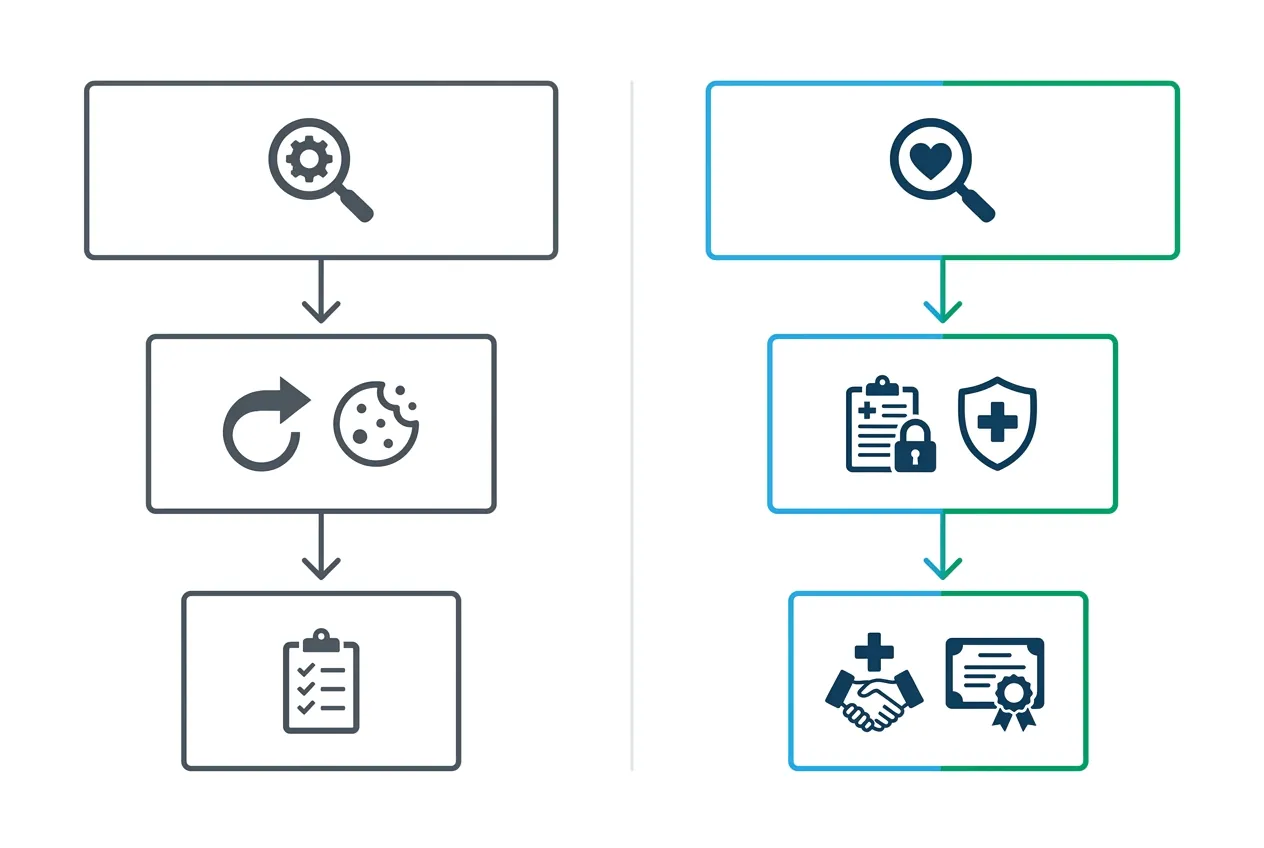
Pay-per-click advertising in healthcare refers to auction-based digital search marketing where hospitals, medical practices, behavioral health networks, and specialty clinics bid on keyword queries entered by prospective patients. While general e-commerce marketing relies on broad acquisition funnels, behavioral retargeting sequences, and lookalike audiences to generate consumer purchases, medical marketing operates under severe operational and legal constraints.
What Does PPC Stand for in Healthcare?
In clinical and medical environments, pay-per-click (PPC) represents an immediate conduit between a patient experiencing an acute or elective health need and a provider equipped to treat it. Instead of passive brand impressions, paid search captures active intent at the exact moment a patient, caregiver, or referring professional searches for clinical solutions.
The operational economics of healthcare paid search hinge on downstream qualification rather than upfront click volume. In consumer goods, a low-cost lead can be nurtured through automated email sequences and aggressive display remarketing over months. In healthcare, an unqualified inquiry burns administrative resources. Intake coordinators, triage nurses, and admissions teams spend valuable hours reviewing inquiries only to discover clinical misalignments, out-of-network commercial insurance, or geographic mismatches. A successful campaign architecture prioritizes clinical suitability and geographic fit over raw volume.
The Cost of Applying Generic E-Commerce Playbooks to Healthcare
Standard digital agencies often deploy broad-match keywords coupled with soft conversion actions like button clicks, PDF downloads, or general contact form fills. In retail, this approach trains platform bidding algorithms to find users likely to browse. In healthcare, this strategy trains algorithms to find users seeking free clinical advice, academic research, or emergency services your facility may not provide.
Medical organizations cannot absorb the operational friction of unvetted volume. When an intake team handles hundreds of mismatched leads, speed-to-lead degrades for clinically urgent, fully qualified prospective patients. The resulting inflation in customer acquisition cost (CAC) drains marketing budgets while leaving clinical capacity unfilled. Healthcare PPC must be engineered as an integrated operational pipeline connecting search query isolation directly to intake capability.
Healthcare organizations face an intricate regulatory environment where digital advertising rules intersect with federal patient privacy mandates. Managing campaigns in this sector demands strict adherence to platform terms and federal statutory standards.
The Impact of Google's Personalized Advertising Restrictions
Digital marketers accustomed to other commercial sectors frequently rely on remarketing lists, customer match audiences, and interest-based profiling. In medical marketing, these mechanisms are unavailable. Under the Google Ads Personalized Advertising Policy, advertisers are strictly prohibited from using personalized advertising to target users based on sensitive health categories. This restriction spans physical conditions, mental health status, addiction treatments, and specific clinical procedures.
Because you cannot serve retargeting ads to an individual who visited your orthopedic or depression treatment landing page, your initial touchpoint must do the heavy lifting. The paid search architecture must capture precise search intent, present clear clinical differentiation on compliant landing pages, and provide a friction-free conversion pathway on the very first visit.
LegitScript Certification and Healthcare Verification
Advertising platforms enforce mandatory third-party verification to protect searchers from deceptive practices. Google requires strict certification protocols across medical devices, pharmaceuticals, and sensitive clinical offerings as detailed in the Google Ads Healthcare and Medicines Policy.
For behavioral health, mental health treatment networks, and addiction recovery facilities, third-party vetting is mandatory. In the United States, providers must achieve accreditation through LegitScript Addiction Treatment Certification before Google allows paid search ads to serve. Obtaining and maintaining this certification requires scrutiny of operational licenses, clinical protocols, background checks, and physical facility verification. Failing to maintain platform-specific healthcare certifications leads to immediate ad disapprovals and account suspensions.
Privacy-Safe Tracking Under HHS Guidance
The regulatory pressure on healthcare marketing extends into tracking architecture. The Office for Civil Rights (OCR) at the U.S. Department of Health and Human Services issued strict warnings regarding digital measurement in its HHS OCR Guidance on Tracking Technologies. The guidance details how unvetted tracking technologies, such as third-party client-side advertising pixels, can improperly disclose protected health information (PHI) to technology vendors without valid HIPAA Business Associate Agreements (BAAs).
Transmitting user IP addresses alongside visited URLs that reveal clinical conditions or appointment scheduling details violates privacy frameworks. Modern medical PPC demands a privacy-first infrastructure that eliminates unvetted client-side tags, processes conversion events through secure environments, and safeguards patient data while still feeding necessary optimization signals back to ad platforms.
Structuring Campaigns for Intent: Service Lines, Locations, and Match Types
To drive qualified patient volume while controlling acquisition expenses, healthcare paid search requires a granular account architecture built around distinct clinical service lines, precise geographic radii, and strict query control.
Segmenting by Clinical Service Line and Acuity
A common structural mistake is grouping distinct medical treatments into shared campaigns. A multi-specialty health system or behavioral health network must never combine outpatient therapy, intensive outpatient programs (IOP), and residential inpatient care under a single budget pool.
Each clinical offering carries distinct patient economics, admission criteria, and urgency:
- Service Line Isolation: Build dedicated campaigns for individual service lines. An orthopedic group must segregate joint replacement, sports medicine, and spinal surgery. A behavioral health network must isolate adolescent care from adult addiction programs.
- Clinical Acuity Alignment: High-urgency treatments require continuous ad scheduling, dedicated intake staff routing, and tailored copy reflecting crisis intervention. Elective or scheduled consultations require messaging focused on provider credentials, clinical outcomes, and insurance compatibility.
- Budget Autonomy: Grouping distinct clinical offerings together allows high-volume, lower-margin keywords to monopolize daily ad budgets, starving high-priority clinical programs of qualified search visibility.
Multi-Location Geographic Targeting and Local Intent
Healthcare delivery is fundamentally local. Even regional specialty hospitals draw the majority of their procedural and inpatient volume from defined geographic corridors. Bidding on statewide or nationwide parameters without geographic bid adjustments wastes budget on patients who will not travel for care.
Set up location targeting based on validated patient origin data rather than arbitrary geographic radius circles. Map patient origin ZIP codes from your electronic health record (EHR) or intake database to identify true catchment areas. Use location exclusions aggressively: exclude neighboring counties or states where your clinical team lacks licensure, facility credentialing, or in-network insurance arrangements. For multi-location clinic networks, configure distinct ad groups featuring location extensions, localized landing pages, and clinic-specific phone tracking numbers.
Keyword Match Types and Negative Keyword Hygiene
The misuse of broad match in medical search results in high ad spend on symptom queries, home remedies, and non-commercial searches. While broad match can uncover emerging query themes, it must be governed by rigorous automated negative filtering.
Structure ad groups primarily around phrase match and exact match variations for core commercial terms, such as "inpatient rehab center," "pediatric cardiologist near me," or "joint replacement surgeon." Reserve broad match only for scaled accounts that utilize automated smart bidding fed by verified offline conversion data.
Maintain exhaustive negative keyword lists across every campaign. Crucial negative categories include:
- Academic and Informational Queries: Words like "journal," "pathophysiology," "case study," "statistics," "definition," and "causes."
- Employment and Licensing: Terms like "jobs," "salary," "careers," "shadowing," "internships," and "nursing requirements."
- Low-Intent and Unaligned Payment: Words like "free clinic," "charity care," "state funded," "cheap," or Medicaid indicators if your facility only accepts commercial insurance.
- Alternative Conditions: Irrelevant medical terms or symptoms your clinical staff does not treat.
Free Audit
Want a straight read on where your budget is leaking?
Offline Conversion Tracking: Connecting Paid Search to Patient Intake
The fundamental failure mode of healthcare paid search is optimizing campaigns toward superficial conversion actions. When ad bidding algorithms are instructed to optimize for web form submissions or call clicks, they optimize for users most prone to submitting forms, not individuals who complete intake assessments, meet clinical criteria, and attend appointments.
The Failure of the Client-Side Pixel in Regulated Environments
Standard web advertising uses client-side pixels to report conversion events immediately upon a landing page submission. In healthcare, this model introduces two severe liabilities:
First, client-side scripts running on pages with medical content pose regulatory risks under the HHS OCR Guidance on Tracking Technologies by potentially exposing sensitive user actions to third parties.
Second, a raw lead submission provides zero signal regarding clinical qualification. A form filled out by an uninsured individual seeking services your facility does not provide looks identical to a fully insured, clinically appropriate admission in standard analytics dashboards. Bidding algorithms rewarded for raw form volume double down on acquiring low-quality, unqualified inquiries.
Implementing Offline Conversion Imports
To train ad bidding engines effectively, healthcare organizations must implement Offline Conversion Imports (OCI). When a user clicks a paid search ad, Google Ads generates a unique, pseudonymous click identifier (GCLID) or passes a compliant session parameter. This parameter is captured securely by your HIPAA-aware web form or call tracking platform and passed directly into your intake management system or Customer Relationship Management (CRM) database.
As the prospective patient progresses through the clinical intake workflow, milestone events are recorded:
- Initial Inquiry Validated
- Clinical Assessment Scheduled
- Clinical Assessment Completed
- Insurance Benefits Verified (VOB Complete)
- Admission or Procedure Completed
Through an encrypted, HIPAA-aware server-side integration, these validated conversion milestones are uploaded back into Google Ads, paired only with the original pseudonymous identifier and conversion timestamp. No Protected Health Information (PHI), medical notes, or patient names are ever transmitted to the ad platform.
Tracking Outcomes from Call to Clinical Admission
For multi-location practices and behavioral health providers, phone calls often represent the highest-intent conversion channel. Prospective patients seeking immediate clinical support prefer direct communication.
Deploy dynamic number insertion (DNI) through specialized call-tracking infrastructure that operates under a signed Business Associate Agreement. This captures the campaign, ad group, and keyword responsible for inbound calls without recording sensitive medical disclosures into public ad platforms.
Intake teams then score call outcomes within their CRM. When attribution is tracked to admission rather than merely tracking initial leads, marketing leadership gains definitive clarity on true operational return on ad spend. Ad platforms can then apply value-based smart bidding models, automatically allocating budget toward the search queries and campaign structures that yield attended appointments and completed admissions.
High-Converting, Compliant Landing Pages for Medical PPC
Driving qualified search traffic to your digital properties delivers commercial value only if your landing pages effectively convert that demand into verified intake inquiries. In sensitive healthcare verticals, user trust, technical speed, and clinical transparency dictate conversion rates.
Designing for Trust and Immediate Intent Resolution
A prospective patient or family member researching healthcare services is often experiencing acute stress. Landing page experiences must provide absolute clarity, safety, and operational credibility within the first five seconds of interaction:
- Clear Clinical Capabilities: State precisely what conditions your facility treats, the levels of care provided, and any clinical limitations.
- Accreditation and Licensing: Prominently display verified accreditations, state licensing credentials, and third-party certifications such as LegitScript or The Joint Commission.
- Provider Credentials: Feature real photography, medical directorship bios, and board certifications rather than generic stock imagery.
- Frictionless Intake Options: Provide direct, compliant pathways for intake: a click-to-call direct line answered 24/7 by trained admissions staff, and a simple, secure inquiry form requesting minimal necessary contact information.
Privacy-Preserving Intake Funnels
Landing page intake forms must be engineered with privacy at the forefront. Forms should collect only the information essential to initiate clinical intake: name, contact phone number, email, and preferred method of contact. Detailed medical histories, medication lists, and clinical narratives should never be gathered on open marketing landing pages via unvetted third-party web forms.
Ensure that all form processing runs through encrypted endpoints covered by appropriate data-handling agreements. Avoid deploying third-party heatmaps, session recording scripts, or unvetted social media tracking pixels on landing pages that contain health-related copy or form inputs. Doing so protects your organization from statutory exposure while maintaining prospective patient confidentiality.

Strategic Budget Pacing and Bidding Optimization in Healthcare Search
Search auctions within healthcare represent some of the highest cost-per-click environments in digital advertising. Bids for competitive medical terms, specialized surgical procedures, and behavioral health programs can exceed $50 to $100 per click in dense metropolitan markets. Managing these budgets requires active pacing and disciplined bid strategies.
Smart Bidding vs. Manual Control in Healthcare Paid Search
While modern ad platforms promote fully automated bidding strategies like Maximize Conversions or Target CPA, deploying these strategies prematurely in healthcare PPC can lead to rapid budget depletion.
- Initial Phase (Manual CPC with Enhanced Bidding): When launching new service lines or opening fresh clinic locations, begin with manual bidding or enhanced cost-per-click. This prevents the bidding algorithm from bidding aggressively on peripheral search queries before you have accumulated conversion data and established negative keyword baselines.
- Scaling Phase (Target CPA and Target ROAS): Once an account consistently generates at least 30 to 50 verified conversions per month, transition to Target CPA (Cost Per Acquisition) or Target ROAS (Return on Ad Spend). This transition should only occur if conversion tracking is hooked directly into qualified intake milestones or offline conversion imports. Smart bidding fed by unqualified lead volume will rapidly escalate costs.
Managing Budget Pacing Across Operating Capacities
Healthcare facilities do not have infinite operating capacity. Clinical operations are constrained by bed counts, physician scheduling slots, and staffing availability. Healthcare PPC campaigns must be calibrated to match operational realities:
- Intake Staffing Alignment: Align daily budget pacing with your clinical intake team's live operating hours. If your intake coordinators only handle inquiries between 8:00 AM and 6:00 PM, running heavy search spend at midnight can result in abandoned calls and delayed lead response times, dramatically lowering conversion rates.
- Dynamic Facility Pacing: In multi-location systems, clinical capacity shifts weekly. If a specific residential facility or regional outpatient clinic reaches 95% capacity, ad spend should immediately shift toward clinics with open bed capacity. Account structures must allow marketing leadership to pause, throttle, or expand individual facility budgets without resetting account-wide algorithmic learning.
Email Us
Prefer to send the context directly?
How Marketing Powered Manages Paid Media for Regulated Healthcare
Executing paid search across complex, highly regulated verticals requires both technical advertising proficiency and deep operational healthcare experience. Marketing Powered manages high-stakes paid media by combining strategic advertising architecture with advanced data systems.
The firm is led by a former healthcare CMO who ran marketing for a treatment network that grew from 3 to 24 locations, providing direct insight into the operational realities of patient scheduling, intake workflows, and clinical capacity. Our leadership has managed $1.5 to $2M per month in Google Ads across 11+ behavioral and mental health accounts, operating at the highest levels of search auction complexity.
Marketing Powered brings unmatched credibility to advertising strategy, led by a founder who is a court-certified expert witness in advertising strategy. Our systems are built explicitly for Google's sensitive healthcare vertical, where retargeting is not permitted and compliance requires rigorous attention. We are fully LegitScript-aware and HIPAA-aware, engineering intake systems where attribution is tracked to admission, not just lead.
Furthermore, our operational model leverages owned, local AI infrastructure for HIPAA-aware inference, allowing us to build deep marketing intelligence, analyze search query patterns, and automate reporting pipelines without compromising client data sovereignty or passing sensitive marketing data to public cloud models. Learn more about our specialized approach to Google and Meta paid media management for healthcare and regulated organizations.

Common Healthcare PPC Pitfalls and How to Audit Your Account
Healthcare organizations frequently waste substantial portions of their digital marketing budgets due to structural inefficiencies, poor data tracking, and compliance oversights. Performing a structured account audit uncovers operational leakage and refocuses spend on qualified demand.
Over-Reliance on Broad Match Without Downstream Verification
The most prevalent source of budget waste is running broad-match keywords without offline conversion feedback loops. When accounts utilize broad match, the ad platform automatically matches ads to adjacent search terms. Without negative keyword lists containing thousands of vetted exclusions, campaigns routinely bid on diagnostic queries, symptom lookups, and irrelevant clinical terms.
An account audit must examine search term reports over the trailing 90 days. If more than 20% of your total search queries consist of informational, non-commercial, or symptom-based searches, your campaign hierarchy is diluting your budget.
Fragmented Geographic and Location Extension Setups
Many multi-location practices configure single national or regional campaigns and rely on location assets (extensions) to route users locally. This setup fails to control where budget is spent. Inevitably, one or two densely populated markets consume 80% of the daily budget, leaving secondary clinic locations starved for visibility. A proper account audit examines geographic spend distribution to ensure that budgets are allocated intentionally based on clinic capacity, local market opportunity, and provider availability.
Disconnected Intake and Marketing Data
When marketing agencies report exclusively on cost per lead (CPL) and form-fill volume, clinic executives remain blind to true commercial efficiency. If your marketing reporting does not correlate ad spend directly to scheduled appointments, verified insurance benefits, and completed patient admissions, your PPC strategy is incomplete. Auditing your paid media ecosystem requires auditing the data bridge between your landing pages, call tracking infrastructure, and internal clinical intake systems.
Questions, Answered.
PPC in healthcare stands for pay-per-click advertising, a digital marketing model where healthcare providers bid on specific search queries on platforms like Google Ads. Advertisers pay only when an individual clicks on their ad to visit their website or call their clinical intake team.
PPC stands for Pay-Per-Click. In healthcare, it represents a direct method for hospitals, medical practices, and behavioral health providers to capture active, high-intent patient demand at the exact moment individuals search for specialized care, clinical procedures, or treatment facilities.
No. Under the Google Ads Personalized Advertising Policy, retargeting and personalized messaging are strictly prohibited for sensitive healthcare categories, including mental health conditions, physical health issues, addiction recovery, and specific medical treatments. Advertisers must convert prospective patients on the initial touchpoint.
Depending on your clinical specialty and geographic location, specific third-party credentials may be required. In the United States, addiction treatment providers must secure LegitScript certification before advertising on Google Ads. Other healthcare entities, including online pharmacies and medical device suppliers, must complete specialized verification processes under Google Ads healthcare policies.
Offline conversion tracking connects ad platform click identifiers to validated milestones inside your clinical CRM or intake software, such as completed appointments or admissions. By importing these verified events back into Google Ads without transmitting protected health information, you train automated bidding algorithms to optimize for actual patient admissions rather than low-quality form submissions. Request a paid media audit from Marketing Powered
Ready to see where your marketing can improve?
Request a free audit of your paid media, landing pages, attribution, and measurement setup. You'll get a straight assessment of where the opportunities are.
or email us at info@marketingpowered.ai