Resources
Medical Practice Marketing: A Practical Plan for Multi-Provider Groups
Scale across a multi-provider group introduces immediate friction: clinical schedules vary, service lines compete for budget, and marketing spend frequently yields unverified leads instead of completed patient visits. Successful medical practice marketing requires a coordinated operating system connecting local search discovery, privacy-compliant paid media, and verified appointment scheduling. This guide details a phased marketing framework built for healthcare organizations managing 5 to 50 clinicians.
By Mike Hulick, Founder, Marketing Powered

1. Foundations: Aligning Medical Practice Marketing With Clinical Capacity
Marketing multi-provider clinics fails when campaigns operate in isolation from clinical capacity. In a 10-physician orthopedic or multi-specialty group, aggregate appointment availability does not indicate where marketing spend should go. One surgeon may have a six-week backlog for elective joint procedures, while a newly credentialed sports medicine physician sits with 40 percent open utilization. Driving generic demand into that practice creates clinical bottlenecks for one provider and leaves commercial opportunity uncaptured for another.
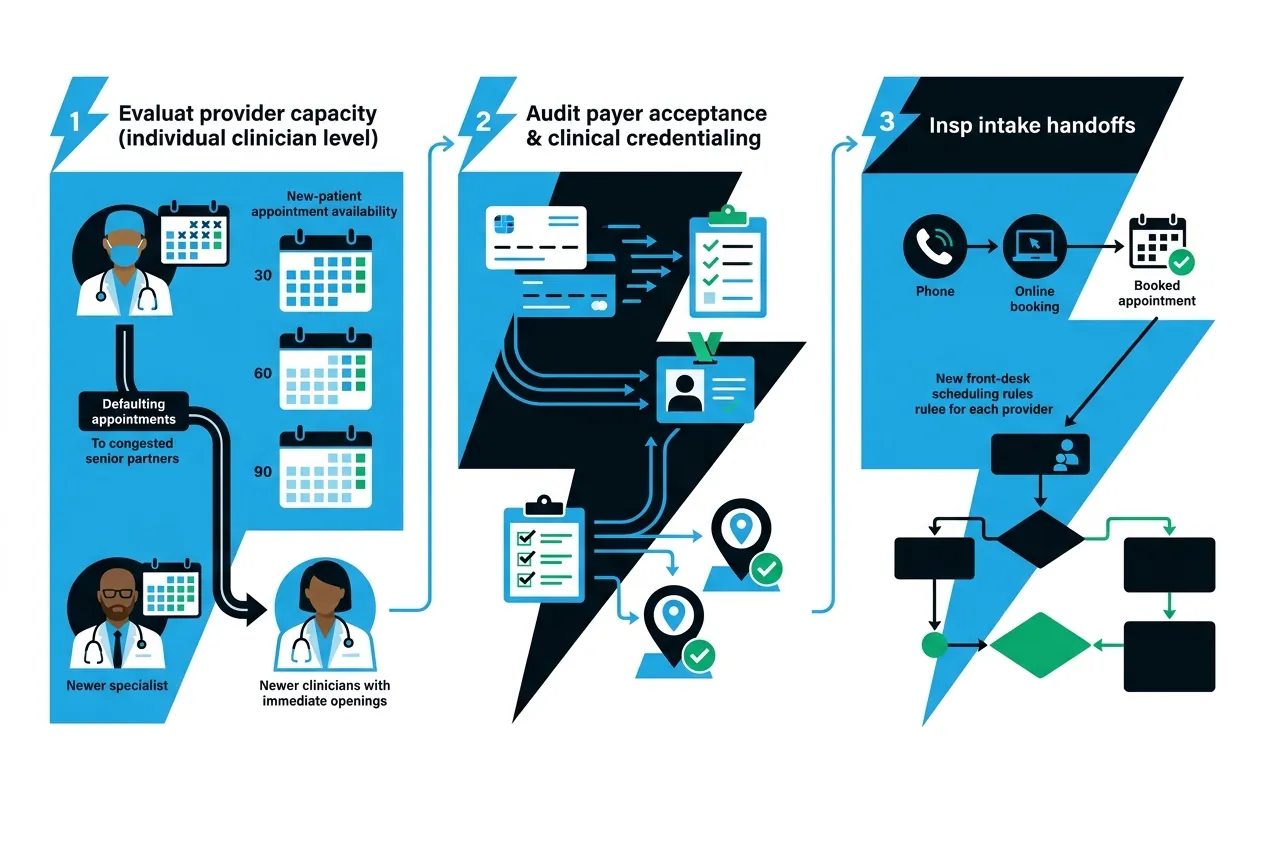
Before deploying advertising budgets, growth leaders must establish an operational baseline. This process begins by auditing provider capacity, payer mix requirements, and scheduling friction across every location.
First, evaluate provider scheduling utilization at the individual clinician level. Document the specific new-patient appointment slots open over the next 30, 60, and 90 days. Group practices often discover that front-desk staff default to scheduling inbound inquiries with senior, established partners whose schedules are already congested, rather than routing patients to newer clinicians with immediate availability. Marketing teams must work with practice managers to define explicit scheduling rules for each provider, establishing which procedures or visit types are currently open to new patient booking.
Second, audit payer acceptance and clinical credentialing. In multi-location medical groups, newly added providers frequently experience delays in commercial payer credentialing. Directing patient acquisition campaigns toward a provider who cannot yet accept standard regional insurance networks results in immediate patient drop-off at intake. Map each provider's credentialing status by carrier before launching targeted service-line campaigns.
Third, inspect the handoff between digital acquisition assets and clinic intake desks. In a physical clinic setting, front-office personnel handle patient check-in, co-pay collection, phone triage, and incoming digital requests simultaneously. When digital campaigns drive inquiries without structured routing, intake coordinators become overwhelmed. Call abandonment rates rise, web inquiries sit unaddressed in email queues for 48 hours, and conversion rates drop precipitously. A functional intake system establishes dedicated scheduling lines, clear call-handling scripts, and direct electronic health record (EHR) scheduling integration so that prospective patients can confirm appointments without administrative friction.
2. Local Search Architecture and Multi-Location Physician Practice Marketing
Local search represents the primary battleground for medical groups. When prospective patients experience acute symptoms or seek a specialist, their journey almost invariably begins with a localized search query. Developing a defensible local footprint requires a structured approach to physician practice marketing that balances the visibility of the overarching practice brand with the individual reputations of its clinicians.
Google Business Profile (GBP) management becomes complex at multi-provider scale. Healthcare organizations must properly implement Google's practitioner listing guidelines. The clinic facility itself requires a distinct primary profile, categorized accurately under its core discipline (such as "Medical Clinic," "Surgical Center," or "Pediatric Clinic"). Individual clinicians operating within that facility may maintain practitioner profiles, categorized by their specific medical specialty (such as "Cardiologist" or "Dermatologist").
The common mistake in multi-provider groups is allowing individual practitioner listings to compete against the main office profile. If a doctor departs the practice, an improperly structured personal listing can siphon local search authority, display outdated contact numbers, or direct patients to an unaffiliated competing facility. To protect local equity:
- Maintain central administrative ownership of all facility and practitioner profiles through a single corporate Google Business Profile account.
- Ensure practitioner listings use the clinic's physical address, the clinic's dedicated scheduling URL, and a direct departmental phone number that routes into the central intake system.
- Standardize Name, Address, and Phone (NAP) data across major medical directories, state licensing boards, and local citations.
- Implement structured data on the website using Schema.org vocabulary. Pair MedicalClinic schema for facility pages with nested Physician schema on clinician bio pages. Explicitly link individual physicians to their corresponding clinic locations using the memberOf and worksFor properties.
Managing patient reviews across these profiles demands rigorous adherence to regulatory and platform guidelines. Under the Google Maps User Contributed Content Policy, practices are strictly prohibited from review gating (filtering unhappy patients to private feedback forms while sending satisfied patients to public review sites), offering incentives for reviews, or asking staff to post reviews. Simultaneously, the FTC Consumer Reviews and Testimonials Rule prohibits deceptive consumer reviews, fake testimonials, and employee endorsements that lack clear disclosures.
Establish a post-visit review generation process that is systematic and neutral. Automated SMS or email follow-ups sent after completed appointments should invite all patients to share objective feedback on Google. Training clinical and administrative staff to encourage honest reviews without condition creates a steady, defensible volume of authentic patient sentiment that boosts local search pack rankings across every clinic location.
3. High-Intent Medical Practice Advertising and Search Demand Capture
Paid search is an essential channel for scaling patient acquisition across multi-location practices, but healthcare advertising operates under unique structural constraints. Unlike retail or business-to-business sectors, healthcare marketers cannot deploy behavioral remarketing funnels to nurture hesitant prospects over time.
Under the Google Ads Personalized Advertising Policy, Google strictly prohibits retargeting users based on sensitive health conditions, medical treatments, or personal hardships. If a user clicks an ad for orthopedic joint surgery or depression treatment and departs without booking, you cannot serve display or social retargeting ads to pull them back. Every campaign must be designed to win on first-touch intent capture and immediate conversion.
Effective medical practice advertising focuses on active, intent-driven search queries rather than broad informational exploration. Structure campaigns into tightly themed ad groups aligned with specific clinical procedures and high-intent symptoms:
- Symptom and Treatment Intent: Focus keywords on immediate clinical needs (e.g., "rotator cuff tear specialist," "pediatric urgent care open now," "Mohs micrographic surgery near me") rather than general research topics (e.g., "what causes shoulder pain").
- Provider and Credential Intent: Capture searches looking for vetted medical authority (e.g., "board certified endocrinologist," "female OB-GYN accepting new patients").
- Facility and Geographic Modifiers: Incorporate hyper-local targeting around specific clinic catchment areas, limiting radius targeting to drive times realistic for outpatient care.
To prevent budget waste across multi-provider accounts, active negative keyword management is mandatory. Exclude terms related to clinical trial protocols, professional medical training, employment searches, billing inquiries, and generic condition encyclopedias.
Ad copy must balance regulatory restraint with commercial clarity. State board-certified specialties, immediate appointment availability, verified accepted insurance carriers, and specific geographic locations. Provide clear calls to action that lead to dedicated, mobile-optimized landing pages. These pages must feature clean provider credentials, accepted insurance lists, clinic address verification, and an uncluttered appointment request mechanism that converts intent into scheduled visits on the first interaction.
Free Audit
Want a straight read on where your budget is leaking?
4. Content Strategy and Marketing for Doctors Across Digital Touchpoints
Effective content marketing for doctors requires moving beyond shallow wellness tips and generic lifestyle blog posts. In clinical healthcare, search engines evaluate content under stringent quality standards: Experience, Expertise, Authoritativeness, and Trustworthiness (E-E-A-T). Patients seeking medical intervention require rigorous, understandable, and medically vetted answers to specific clinical concerns.
Building authoritative clinical content involves a structured collaboration between the marketing team and medical providers. Physicians, nurse practitioners, and clinical directors rarely have hours to write search-optimized articles from scratch. Establish a streamlined clinical review workflow:
- Editorial Topic Identification: Marketing teams identify high-volume, high-value clinical search topics focused on treatment options, procedural risks, recovery timelines, and diagnostic criteria.
- Recorded Clinical Interviews: Marketing leads conduct structured 15-minute interviews with the relevant provider, capturing clinical nuances, patient case trends, and expert perspectives in the provider's authentic voice.
- Drafting and Medically Reviewed Bylines: Copywriters produce detailed, comprehensive guides from the interview transcripts, structuring content with clear clinical terminology, referenced medical standards, and scannable sections.
- Physician Review and Sign-Off: The clinician reviews the draft for medical accuracy. Once approved, publish the guide under the doctor’s direct byline, complete with a verified biography, board certifications, medical school training, and a link to their active state licensing profile.
This process transforms provider biographies into high-converting assets. Most practice websites treat doctor profiles as static digital resumes. A functional provider page should include:
- A high-resolution professional portrait showing approachable, clinical attire.
- An introductory video (60 to 90 seconds) where the clinician explains their care philosophy, procedural specialties, and what new patients can expect during an initial consultation.
- Explicit lists of treated conditions, performed procedures, and accepted insurance plans.
- Direct scheduling integration or a clear request form tied exclusively to that provider's calendar.
- Embedded peer-reviewed publications, clinical memberships, and hospital affiliations.
When prospective patients can view a physician discussing their specific ailment, clinical anxiety drops and appointment completion rates increase. This systematic approach ensures that every provider in a 20- or 40-clinician practice builds individualized search equity that supports the broader organization.

5. Modern Medical Marketing Across the Patient Intake Journey
Digital traffic is irrelevant if the patient intake journey fails to convert inquiries into verified appointments. Modern medical marketing requires tracking and optimizing every touchpoint from initial search query to completed clinic visit.
Patient acquisition breaks down most frequently at the intake interface. When practices rely on standard, open-ended contact forms ("leave your message and we will call you back"), patient abandonment climbs. Prospective patients searching for medical care are seeking certainty: they want to know if their insurance is accepted, when they can be seen, and where the clinic is located.
To optimize this journey, deploy a multi-channel conversion architecture tailored to diverse patient preferences:
- Direct Online Scheduling: Integrate direct digital booking into the practice management system. Allow patients to select an available time slot, input insurance information, and receive instant confirmation. For specialty practices with complex intake protocols, implement a structured pre-screening intake form that collects necessary clinical history before displaying available appointment slots.
- Intake Call Routing and Triage: Many patients, particularly older demographics or those with complex symptoms, prefer to call. Phone numbers on local landing pages must route directly to trained intake coordinators, bypassing generic clinic switchboards. Use interactive voice response (IVR) options to separate new patient scheduling calls from existing patient prescription refills or billing inquiries, ensuring new patient acquisition calls are answered within three rings.
- Automated Intake Reminders and Preparation: No-show rates directly erode practice profitability. Deploy automated SMS and email sequences that deliver calendar invitations, clinic arrival instructions, digital intake paperwork, and parking directions immediately upon booking. Completing administrative paperwork digitally prior to the appointment reduces waiting room delays and cuts day-of cancellations.
Measuring this entire funnel is critical. Many healthcare organizations track only "leads" (raw form fills or total phone calls), failing to reconcile marketing investments against actual clinical appointments. Connecting marketing analytics to practice management software reveals which channels and ad groups deliver patients who actually show up, verify coverage, and complete consultations.
6. Delivering Accountable Healthcare Growth at Marketing Powered
Executing a compliant, multi-provider patient acquisition program requires specialized operational infrastructure. Marketing Powered is an operator-led marketing and marketing-technology firm designed to solve the commercial and regulatory challenges faced by expanding health systems and provider networks.
Our foundation is built on practical operating experience. Our founder is a former healthcare CMO who ran marketing for a treatment network that grew from 3 to 24 locations, managing $1.5 to $2M per month in Google Ads across 11+ behavioral and mental health accounts. As a court-certified expert witness in advertising strategy, our leadership brings deep regulatory insight to healthcare marketing operations.
Healthcare groups face severe platform restrictions and scrutiny that generic agencies frequently misunderstand. Marketing Powered operates with LegitScript-aware and HIPAA-aware principles built specifically for Google's sensitive healthcare vertical, where standard consumer retargeting is not permitted. Rather than relying on third-party remarketing pools, our campaigns capture precise first-touch intent and route demand into compliant conversion funnels.
To preserve clinical data sovereignty, Marketing Powered has been AI-native since 2022, utilizing owned, local AI infrastructure for HIPAA-aware inference. This allows our team to analyze operational data, draft specialized provider content, and audit campaign performance without routing protected patient information through public cloud artificial intelligence systems.
Most importantly, our attribution models are built around business reality. We track performance through to verified patient admissions and completed clinical visits, rather than stopping at vanity lead metrics. For health systems seeking an accountable partner to scale provider utilization across regional clinics, our specialized healthcare and hospital marketing programs deliver strategic clarity, technical rigor, and defensible growth.
To learn more about our strategic approach, explore our operating framework in our comprehensive guide to healthcare marketing for provider networks and hospitals, or evaluate specialist criteria in our guide to selecting a healthcare marketing agency.

Email Us
Prefer to send the context directly?
7. Patient Privacy, Tracking Governance, and Closed-Loop Attribution
Healthcare marketing leaders face unprecedented regulatory scrutiny regarding web tracking technologies. For years, consumer marketing agencies routinely placed standard social media and search tracking pixels across patient-facing websites, capturing appointment requests and form fills without technical governance. In modern healthcare marketing, this practice introduces massive regulatory liability.
Under the HHS Office for Civil Rights tracking guidance, regulated entities are prohibited from utilizing tracking technologies that disclose protected health information (PHI) to third-party tracking vendors without compliant authorizations or Business Associate Agreements (BAAs). Tracking pixels that capture IP addresses alongside URLs indicating medical conditions (such as a page confirming an appointment for oncology or cardiology) violate privacy regulations if transmitted to unauthorized advertising platforms.
To build an accountable, privacy-compliant attribution framework, multi-provider groups must overhaul their tracking architecture:
- Remove Unvetted Third-Party Pixels: Audit all web properties and immediately remove unauthorized tracking pixels from patient portals, appointment scheduling workflows, and condition-specific intake forms.
- Deploy Server-Side Tracking and Data Cleansing: Implement secure server-side tracking pipelines. Conversion events transmitted to ad platforms must be stripped of any identifying personal health data, user parameters, or sensitive URL paths, passing only aggregated, anonymized transaction data.
- Execute Business Associate Agreements: Ensure all data vendors, call tracking providers, and intake software vendors sign formal BAAs confirming adherence to healthcare privacy mandates.
- Implement Closed-Loop Offline Conversion Tracking: Instead of relying on client-side pixels to report leads, connect practice management or EHR scheduling data back to advertising platforms via secure offline conversion imports. When an intake desk confirms an appointment or logs a completed new patient visit, an anonymized conversion identifier matches that visit back to the originating ad click.
This closed-loop methodology solves two critical problems. It provides marketing leaders with exact, undeniable performance data showing which campaigns drive real clinic volume, and it protects the health system from data privacy violations.
Questions, Answered.
A multi-provider practice must maintain an integrated approach: market the overarching brand for institutional trust, location access, and facility-level local search rankings, while optimizing individual clinician profiles for specialty-specific and credential-based queries. The group brand builds long-term regional authority, while provider-specific assets (such as individual practitioner Google Business Profiles and detailed bio landing pages) convert prospective patients seeking a personal connection with a specific specialist.
For immediate appointment bookings, high-intent Google Search advertising combined with localized Google Business Profile visibility consistently drives the highest return on investment. Patients experiencing specific symptoms or needing immediate specialist consultations turn to search engines with active intent. Social media and organic content are valuable for brand education and community reputation, but paid search and local map packs generate immediate, qualified patient intake.
Under Google Ads policies and healthcare data privacy guidelines, direct retargeting based on personal medical conditions or health-related page visits is strictly restricted. Advertising platforms prohibit serving personalized ads to users who previously visited clinical condition or treatment pages. Multi-provider groups must focus on capturing high-intent search demand on the first interaction and deploying secure, direct conversion pathways rather than relying on remarketing funnels.
Healthcare marketing success should be evaluated by scheduled appointment volume, patient show rates, cost per acquired patient, and downstream clinical utilization. Tracking raw form submissions or click-through rates obscures marketing efficiency. Integrating your advertising analytics with practice management intake data through privacy-safe offline conversion tracking allows you to optimize ad spend based on verified, completed clinical consultations. Request a healthcare marketing assessment
Ready to see where your marketing can improve?
Request a free audit of your paid media, landing pages, attribution, and measurement setup. You'll get a straight assessment of where the opportunities are.
or email us at info@marketingpowered.ai