Resources
Building a HIPAA Compliant Website: Forms, Tracking, and Hosting Architecture
Healthcare marketing leaders face an urgent operational tension between strict regulatory privacy audits and organizational patient acquisition goals. Building a modern hipaa compliant website requires moving far beyond superficial security plugins or static legal disclaimers. True digital compliance demands engineered data governance across hosting infrastructure, patient intake forms, and privacy-safe marketing measurement.
By Mike Hulick, Founder, Marketing Powered

What Makes a Website HIPAA Compliant Across Infrastructure and Code
A website is not an isolated brochure; it is an active software application that exchanges data between patient browsers, third-party services, and internal healthcare record systems. Understanding what makes a website hipaa compliant starts with recognizing the legal definition of Protected Health Information (PHI) under the Health Insurance Portability and Accountability Act. When a visitor's web activity reveals their identity alongside details regarding their medical condition, treatment history, or healthcare scheduling, that interaction creates individually identifiable health information (IIHI). Under the HHS Office for Civil Rights Guidance on Tracking Technologies, transmitting these combined data points to third parties without authorization constitutes an impermissible disclosure.
Achieving compliance requires establishing strict technical safeguards across three distinct website layers: hosting, form intake, and analytics. A failure in any single layer compromises the entire environment. For example, deploying bank-grade database encryption for patient intake forms provides little defense if an unvetted third-party marketing pixel silently scrapes form fields and transmits user IP addresses directly to commercial social networks.
Compliance demands that every vendor handling or transmitting PHI execute a formal Business Associate Agreement (BAA) pursuant to 45 CFR 164.502(e) and 164.504(e). Standard commercial vendors, including commodity web hosts and public SaaS analytics tools, routinely refuse to sign BAAs covering marketing endpoints. Without an executed BAA and verified data pipelines, transmitting sensitive web data to downstream vendors triggers severe financial and reputational liabilities under federal privacy statutes.

Core Technical HIPAA Website Requirements for Modern Healthcare Providers
The baseline framework for safeguarding healthcare web traffic is established by the HIPAA Security Rule. Translating federal statutory requirements into production engineering yields five specific hipaa website requirements that apply across all public healthcare portals, clinical landing pages, and multi-location directories:
- Encryption in transit and at rest: Web traffic must enforce modern transport layer security protocols, specifically TLS 1.3 or minimum TLS 1.2, rendering browser communications unreadable to interception. Any form data, temporary logs, or database backups stored on the web server must use AES-256 encryption.
- Mandatory Business Associate Agreements: Covered entities must hold an executed BAA with every infrastructure provider, hosting facility, form processor, and data transport vendor that can touch, process, or store server payloads.
- Access controls and role-based permissions: Server management consoles, CMS administrative backends, and database environments must require multi-factor authentication (MFA) and enforce principle-of-least-privilege access. Generic administrative logins shared across teams invalidate audit integrity.
- Comprehensive audit logging and event monitoring: Systems must generate immutable logs that record server access, file modifications, administrative logins, and data transmission events. Logs must be archived securely and reviewed regularly to detect unauthorized intrusions.
- Ephemeral data handling and disaster recovery: Websites should avoid retaining patient data within standard content management databases like WordPress or Drupal. Web forms should process inquiries ephemerally, transmitting validated payloads directly to secure electronic health records (EHR) or HIPAA-aligned CRM systems before purging the payload from web storage.
Meeting these baseline requirements prevents data breaches while maintaining operational uptime for patient acquisition funnels.
Secure Architecture for HIPAA Compliant Website Forms and Intake
Web intake forms represent the most sensitive point of patient contact on any healthcare website. Whether a visitor books an initial clinical assessment, requests a specialized appointment, or asks a clinical question, they actively input direct identifiers paired with sensitive health intent. Deploying hipaa compliant website forms requires specialized architectural controls to eliminate data leakage.
Standard CMS form plugins (such as default installations of Gravity Forms, WPForms, or Contact Form 7) save form submissions directly into the local CMS MySQL database in unencrypted plain text. If the website administrative panel is breached, or if an automated SQL injection vulnerability is exploited, the entire history of patient inquiries is compromised. Furthermore, standard form plugins often transmit notification emails containing unencrypted patient names, phone numbers, and clinical details over standard email protocols (SMTP), violating the HIPAA Security Rule.
To secure form capture, engineering teams must implement four defensive protocols:
- Transport encryption and client-side validation: Form inputs must validate data formats before submission to prevent code injection, dispatching form payloads exclusively across secure TLS endpoints.
- Field-level data sanitization: Web intake fields should capture only minimum necessary details. Avoid open-ended text fields where prospective patients might disclose complex medical histories before entering an authenticated clinical portal.
- Stateless, ephemeral server processing: The form processing script must accept the payload, encrypt the data in transit, immediately route the record into an encrypted, BAA-covered CRM or EHR endpoint, and purge the submission from server memory. No patient records should reside in the web CMS database.
- Signed vendor agreements: The form platform itself, whether a dedicated HIPAA-aligned SaaS intake tool or a custom serverless API routing service, must execute a formal BAA with the covered entity.
Securing form intake ensures that marketing funnels capture qualified patient demand without accumulating unencrypted, highly liable patient records on public web infrastructure.
Free Audit
Want a straight read on where your budget is leaking?
Managing HIPAA Website Tracking and Analytics Without Compromising Attribution
Marketing teams cannot manage patient acquisition costs without conversion attribution. However, traditional analytics configurations routinely expose organizations to federal regulatory penalties. Resolving the operational challenges of hipaa website tracking requires understanding the mechanics of client-side tracking pixels and the strict regulatory frameworks governing online marketing tags.
The FTC Enforcement Action against GoodRx highlighted how consumer health platforms violated federal law by sharing personal health details, prescription searches, and IP addresses with third-party advertising platforms via tracking pixels without user consent. When standard JavaScript snippets from Meta, Google, or TikTok run directly in a visitor's browser, they automatically collect the user's IP address, device hardware fingerprints, referrer URLs, and interactive button clicks. If a user visits a specialized addiction treatment, oncology, or mental health web page, the combination of their static IP address and the specific URL parameter establishes identifiable health data.
Federal jurisprudence has shaped the regulatory boundary for public websites. In June 2024, the U.S. District Court for the Northern District of Texas issued a ruling in American Hospital Association v. Becerra, vacating the OCR's rule that an IP address combined with a visit to an unauthenticated public health webpage automatically constitutes PHI. While this judicial ruling provides relief for public informational browsing, it does not exempt scheduling pages, intake forms, patient portal login screens, or interactive condition assessments. Furthermore, state-level privacy statutes and wiretapping class actions continue to target unauthenticated health tracking aggressively.
Additionally, healthcare providers advertising through major ad networks must navigate strict advertising limitations. Under the Google Ads Healthcare and Medicines Policy, advertisers are strictly prohibited from deploying personalized advertising, remarketing lists, or retargeting pixels based on sensitive health conditions or medical treatments. Retargeting past site visitors with display ads or search adjustments based on their clinical browsing history violates both platform policies and patient privacy expectations.
Implementing HIPAA Compliant Website Analytics Through Server-Side Pipelines
Healthcare organizations cannot use standard, client-side Google Analytics setups to track user conversions because Google explicitly refuses to execute a BAA covering marketing analytics products. Setting up hipaa compliant website analytics requires decoupling data collection from client-side browser execution entirely.
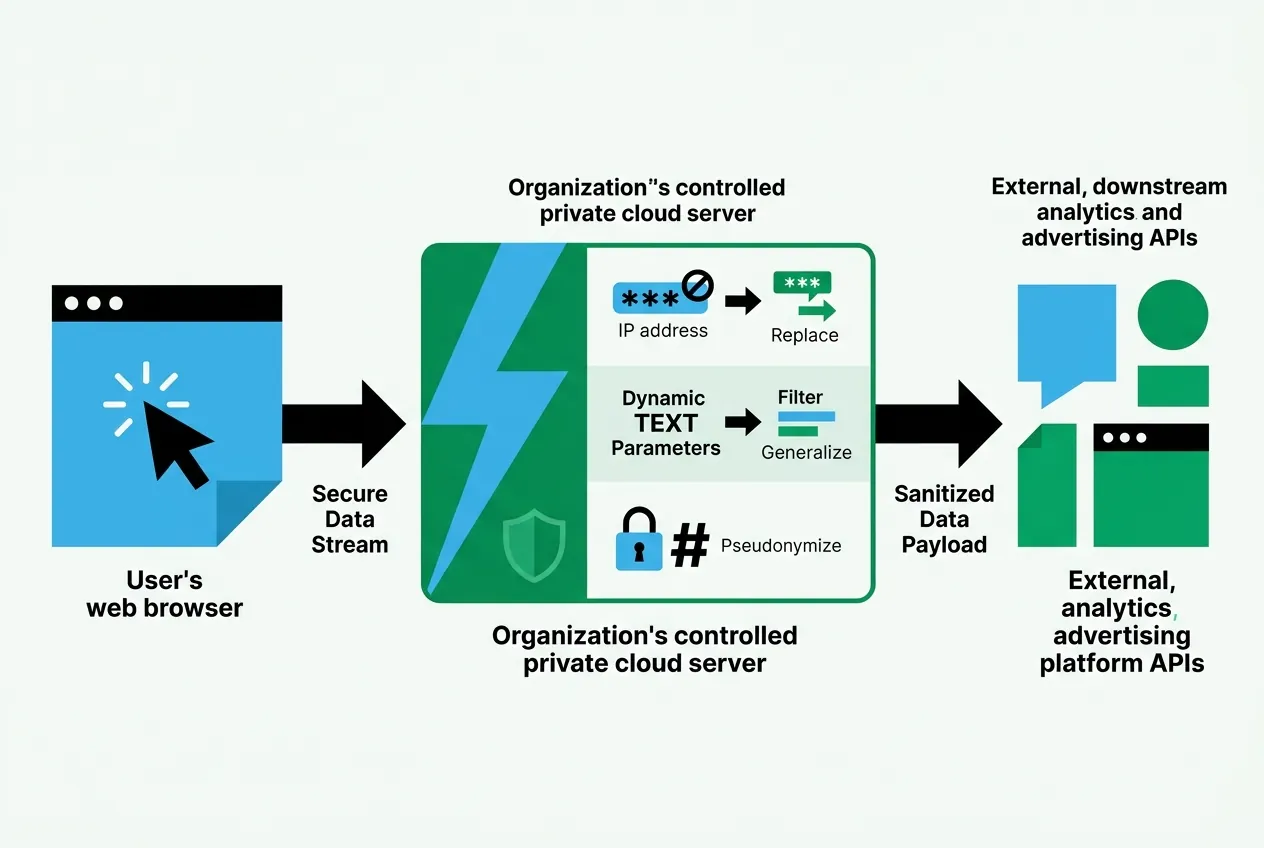
The industry-standard solution is a dedicated, server-side data routing proxy. In a server-side analytics architecture, browser events do not communicate with third-party marketing platforms directly. Instead, user interactions trigger an internal event dispatched to a private cloud server controlled by the healthcare organization:
This privacy proxy intercepts the outgoing event payload and executes strict data scrubbing:
- IP address obfuscation: The user's real IP address is completely removed or truncated at the server level, preventing downstream analytics platforms from receiving geolocation identifiers.
- Parameter scrubbing: Query parameters, form strings, and sensitive URL paths indicating clinical conditions are filtered out or mapped to generic category labels.
- Identity pseudonymization: Client identifiers are replaced with ephemeral, rotated server tokens that preserve session counts without exposing persistent consumer identities.
By running this server-side infrastructure under an executed BAA with an enterprise cloud provider (such as Amazon Web Services or Google Cloud Platform), the healthcare organization maintains complete data sovereignty. Conversion events can be securely transmitted to advertising platforms via server-to-server APIs to optimize campaign performance while guaranteeing that no PHI crosses the boundary into unauthorized commercial databases.
For a comprehensive analysis of multi-channel privacy regulations, review our complete guide to HIPAA compliant marketing: what the rules mean for campaigns and tracking. If your growth team relies specifically on Google services, consult our specialized analysis on Google Analytics and HIPAA: what healthcare marketers can and cannot do.
Choosing Infrastructure and HIPAA Compliant Website Hosting Providers
A secure web codebase cannot compensate for a vulnerable hosting environment. Deploying a healthcare digital presence requires enterprise hipaa compliant website hosting backed by infrastructure-level security guarantees and fully executed legal agreements.
Standard shared web hosts, low-cost virtual private servers (VPS), and popular managed WordPress hosts frequently state in their terms of service that their platforms are not certified to process, store, or transmit PHI. If an organization hosts a website on an unapproved shared server, a vulnerability in a neighboring tenant's website can expose the host filesystem, resulting in an immediate regulatory breach.
Compliant hosting infrastructure requires:
- Isolated cloud architecture: Dedicated virtual instances or containerized environments that prevent resource sharing and memory snooping across isolated organizations.
- Signed enterprise BAAs: The hosting vendor must sign a formal BAA covering all computational hardware, block storage volumes, automated snapshot backups, and internal network transfers. Major cloud providers (including AWS, Microsoft Azure, and GCP) provide compliant architectures under their standard healthcare compliance agreements.
- Automated patch management and system hardening: Operating system kernels, web servers (NGINX, Apache), and runtime engines (PHP, Node.js, Python) must receive automated, zero-downtime security patches. Firewalls must restrict administrative ports (such as SSH) to authorized, VPN-connected IP addresses.
- Physical data center compliance: Infrastructure facilities must maintain independent certifications verifying physical access controls, environmental failovers, and redundant power infrastructure.
Organizations managing complex clinical operations across multi-location networks should avoid hosting patient intake systems on the same application server that hosts the public blog. Separating the public marketing content management system from authenticated intake portals isolates operational risk and simplifies security audits.
To evaluate external implementation vendors capable of architecting this infrastructure, read our guide on Hipaa compliant marketing companies: what a specialist partner delivers and how to vet one.
Email Us
Prefer to send the context directly?
How Marketing Powered Architects Privacy-Safe Healthcare Marketing Technology
Marketing Powered designs and implements high-performing, privacy-safe marketing systems for hospitals, healthcare systems, and multi-location behavioral health networks. We solve the attribution dilemma by engineering compliant tracking infrastructure that connects marketing investment directly to operational admissions while strictly protecting patient privacy.
Our technical approach is guided by deep operational expertise. Marketing Powered's founder is a former healthcare CMO who ran marketing for a treatment network that grew from 3 to 24 locations, personally managed $1.5 to $2M per month in Google Ads across 11+ behavioral and mental health accounts, and serves as a court-certified expert witness in advertising strategy. We operate as an AI-native firm since 2022, maintaining owned, local AI infrastructure for HIPAA-aware inference to analyze market trends and build campaign systems without exposing sensitive data to public consumer AI clouds.
Our technical implementations for healthcare growth teams focus on four core operational pillars:
- Server-side tracking deployment: We build custom server-side data routing containers running in dedicated cloud infrastructure backed by signed BAAs. These containers sanitize web events, strip personal identifiers, and feed privacy-safe conversion data directly into platform APIs.
- Full-funnel admission attribution: We do not stop at vanity form fills. Our systems track marketing efficiency to legitimate qualified intake and operational admission, not just lead volume, while maintaining strict data boundaries that prevent clinical intake data from flowing back to commercial ad networks.
- Policy-aligned media management: We specialize in Google's sensitive healthcare vertical, where retargeting is not permitted and LegitScript certification is mandatory for applicable treatment providers. We structure intent-driven search architectures that capture high-converting patient demand on the first touch.
- Intake security hardening: We audit, rebuild, and secure patient intake workflows, ensuring that web forms route through ephemeral, encrypted pipelines that keep public CMS databases clean of PHI.
Discover how our specialized privacy-safe tracking and marketing technology for healthcare and regulated organizations allows your team to scale qualified patient volume while maintaining airtight compliance defensibility.

Step-by-Step Technical Checklist for Verifying Website Compliance
Evaluating your organization's digital footprint requires a methodical technical audit across external scripts, hosting infrastructure, and intake workflows. Use this checklist to establish compliance defensibility:
- Hosting & Network. Verification Item: BAA Execution. Compliance Requirement: Signed BAA with cloud host covering storage and servers. Defensibility Test: Inspect contract archive for valid countersignatures.
- Hosting & Network; Verification Item: Transport Security; Compliance Requirement: TLS 1.3/1.2 enforced across all public endpoints; Defensibility Test: Run automated SSL Labs server test; verify HSTS status
- Hosting & Network. Verification Item: Database Storage. Compliance Requirement: Encrypted volumes at rest using AES-256. Defensibility Test: Verify cloud disk configuration and encryption keys.
- Web Forms. Verification Item: Data Retention. Compliance Requirement: Ephemeral data handling with no CMS database storage. Defensibility Test: Query CMS database tables for plain-text patient records.
- Web Forms. Verification Item: Payload Routing. Compliance Requirement: Direct encrypted API dispatch to BAA-backed CRM/EHR. Defensibility Test: Trace webhook transmission endpoints and verify payload logs.
- Web Forms; Verification Item: Notification Alerts; Compliance Requirement: Administrative notifications scrubbed of health data; Defensibility Test: Check administrative inbox; verify zero PHI in notification emails
- Tracking Scripts. Verification Item: Client-Side Pixels. Compliance Requirement: Zero third-party ad pixels on clinical or intake pages. Defensibility Test: Inspect browser network tab on forms and condition pages.
- Tracking Scripts. Verification Item: Server Proxy. Compliance Requirement: Server-side proxy deployed to truncate IP addresses. Defensibility Test: Verify server container code sanitizes client network data.
- Tracking Scripts. Verification Item: Ad Platform Sync. Compliance Requirement: Conversions routed via server APIs without clinical URLs. Defensibility Test: Audit API payloads dispatched to Google and Meta endpoints.
Completing these operational verifications ensures your organization eliminates invisible technical liabilities before they surface during regulatory audits or civil litigation.
Questions, Answered.
A website is HIPAA compliant when it implements the administrative, physical, and technical safeguards mandated by the HIPAA Security and Privacy Rules. This requires executing signed Business Associate Agreements with all hosting, infrastructure, and software vendors that handle website traffic; enforcing TLS 1.3 or 1.2 data encryption in transit; encrypting stored databases at rest; isolating or purging patient intake data from public web databases; and eliminating client-side tracking pixels that leak user IP addresses and clinical page views to unauthorized third-party ad networks.
Standard, client-side Google Analytics 4 installations violate HIPAA because Google explicitly states it will not sign a Business Associate Agreement for Google Analytics and prohibits the ingestion of Protected Health Information. Because GA4 collects user IP addresses and tracking cookies by default, running standard GA4 tags on pages related to specific health conditions or intake forms creates severe compliance exposure. To use GA4 safely, healthcare organizations must deploy a server-side tagging architecture that strips all IP addresses, device identifiers, and clinical query parameters before relaying sanitized, anonymous session data to Google's servers.
No. Standard WordPress form plugins (such as default setups of Gravity Forms, WPForms, or Ninja Forms) store form submissions in plain text within the website's MySQL database and transmit unencrypted email notifications over standard SMTP. Furthermore, these plugin vendors do not sign Business Associate Agreements for standard licenses. To make WordPress forms compliant, healthcare providers must use specialized HIPAA-aligned form services that execute a BAA, utilize encrypted API gateways, bypass local database storage entirely, and route submissions directly into a secure, encrypted CRM or EHR system.
No. The June 2024 ruling in American Hospital Association v. Becerra vacated only the Department of Health and Human Services' enforcement position regarding unauthenticated, public-facing informational web pages. The court ruled that an IP address combined with a visit to a general, public healthcare article does not automatically constitute PHI under federal law. However, the ruling does not protect tracking technologies deployed on patient portal login pages, scheduling widgets, interactive symptom checkers, or digital intake forms. Furthermore, the Federal Trade Commission actively penalizes digital health tracking under Section 5 of the FTC Act, and state-level wiretapping lawsuits continue to target organizations deploying client-side tracking tags. Client-side ad pixels should never be loaded on pages where users schedule care or input personal health information.
Client-side tracking runs third-party JavaScript code directly in the patient's browser, giving third-party advertising platforms unrestricted access to the user's IP address, device fingerprints, and browsing history. Server-side tracking intercepts user events on a private, intermediate server controlled by the healthcare organization under a signed BAA. The server sanitizes the data payload by purging personal identifiers, hashing user tokens, and scrubbing clinical URL strings before transmitting a compliant, privacy-safe conversion signal to downstream analytics or advertising platforms. Request a privacy and tracking review of your marketing stack
Ready to see where your marketing can improve?
Request a free audit of your paid media, landing pages, attribution, and measurement setup. You'll get a straight assessment of where the opportunities are.
or email us at info@marketingpowered.ai