Resources
Answer Engine Optimization: Structuring Content for AI Overviews and Assistants
Answer engine optimization represents a structural evolution in digital discovery, shifting marketing focus from ranking isolated links to securing authoritative extraction inside conversational models. When enterprise buyers, clinical professionals, or consumers ask complex questions, search platforms synthesize direct answers from corroborated data sources rather than simply listing ten blue links. Mastering answer engine optimization requires engineering your digital footprint so large language models and search engines cite your organization as a verified authority.
By Mike Hulick, Founder, Marketing Powered

How AI Overviews and Search Engines Extract Answers

What Is Answer Engine Optimization (AEO)?
Answer engine optimization is the operational practice of structuring web content, data hierarchies, and brand knowledge so machine synthesis engines can parse, validate, and cite that information directly. While legacy search engine optimization focused on indexing individual URLs to maximize page-level click-through rates, answer engine optimization optimizes for informational extraction. The goal is to become the trusted factual node that conversational interfaces, large language models, and search engines select when generating synthesized answers.
This distinction matters because the delivery mechanism of information has fundamentally changed. When a prospective buyer queries an assistant like ChatGPT, Perplexity, or Claude, or searches through modern search engines, the system executes a retrieval process known as retrieval-augmented generation. Instead of serving an index of candidate websites, the engine retrieves relevant text fragments across multiple domains, evaluates the semantic consistency of those fragments, and compiles a single, synthesized response.
In a modern enterprise marketing department, this operational shift changes the daily workflow of content teams, technical developers, and digital strategists. Rather than reviewing long-form articles purely for visual formatting and generic keyword frequency, an editorial team inspects content through the lens of extraction clarity. They look at structured comparison tables, direct answer declarations, and underlying schema definitions to confirm that an automated crawler can extract key facts without misinterpreting the operational context.
For high-consideration and regulated industries such as healthcare systems, legal practices, enterprise technology, and specialized professional services, the stakes of this shift are high. If an answer engine cannot extract unambiguous data points regarding your service areas, clinical capabilities, regulatory standing, or commercial models, your organization becomes invisible at the initial research stage. Winning visibility requires treating content as an interconnected data layer built for both human comprehension and automated machine extraction.
To optimize content for automated extraction, marketing leaders must understand the technical pipeline that drives conversational search engines. When a user submits an informational query, the search platform executes four distinct phases: retrieval, parsing, factual corroboration, and generation.
During the retrieval phase, the engine searches its primary web index to surface candidate documents containing high semantic relevance to the query. Google systems evaluate these documents against core quality thresholds, rewarding original operational insight and technical utility as outlined in the Google Search Central documentation on creating helpful content. Content that relies on generic summary text, circular phrasing, or unverified claims is filtered out before extraction begins.
Once candidate documents pass the initial retrieval filter, the engine parses the content for concise answer blocks. To optimize for AI Overviews, digital assets must provide direct semantic anchors. If a document buries an answer within five paragraphs of introductory fluff, the parsing engine registers a low confidence score for immediate extraction. Conversely, if an H2 or H3 heading presents a specific, high-intent question followed immediately by a self-contained, fact-dense answer block, the model assigns a high probability score to that excerpt.
The third phase is factual corroboration. Advanced retrieval engines cross-reference extracted claims against external knowledge graphs, structured databases, and corroborated third-party sources. If your page asserts a unique industry metric or technical definition that conflicts with recognized baseline data, the system may discard the excerpt to prevent hallucinations.
Finally, the generation layer synthesizes the corroborated fragments into a cohesive summary. In Google AI Overviews, this synthesis appears at the top of the search results page, complete with interactive link cards pointing back to the primary source documents. Earning a citation within that summary requires that your site satisfy every technical hurdle in the retrieval and parsing sequence.
The Strategic Shift: AEO SEO vs Traditional Organic Search
The emergence of modern search environments does not eliminate traditional search mechanics, but it changes the relationship between user intent, technical markup, and content architecture. Comparing classic optimization with modern answer engine discovery clarifies how marketing operations must adapt their priorities.
- Primary Target. Traditional SEO: Web crawlers matching keyword strings to rank pages. Modern AEO SEO: Large language models extracting factual entities.
- Success Metric. Traditional SEO: Search rankings, page impressions, and link clicks. Modern AEO SEO: Citations in AI Overviews, brand recall, pipeline impact.
- Content Structure. Traditional SEO: Long-form editorial designed for dwell time. Modern AEO SEO: Modular answer units, entity definitions, and clear data tables.
- Technical Layer. Traditional SEO: Basic meta tags, XML sitemaps, and link graphs. Modern AEO SEO: Nested JSON-LD schemas, entity relations, and structured facts.
- Conversion Path; Traditional SEO: User lands on page, reviews navigation, and fills out form; Modern AEO SEO: User receives direct answer; visits site to validate high-value intent
In traditional campaigns, marketing teams spent enormous resources optimizing for broad, top-of-funnel keywords. The goal was to capture maximum traffic volume, pull visitors to a blog post, and nurture them through remarketing lists and lead magnets.
In a search landscape shaped by conversational assistants, that top-of-funnel traffic is increasingly absorbed by zero-click syntheses. If a user seeks a simple definition or regulatory explanation, the answer engine provides it directly inside the interface.
As a result, aeo seo focuses heavily on middle-of-funnel and bottom-of-funnel queries where human decision-makers require deep verification, specialized competence, and institutional trust. The objective shifts from generating casual browsing sessions to securing definitive brand citations that establish authority when enterprise buyers evaluate solutions. Organizations navigating this transition often review how an AI marketing agency: how to evaluate one beyond the label separates real technical data architecture from superficial search tactics.
Free Audit
Want a straight read on where your budget is leaking?
How to Implement Answer Engine Optimization on Your Website
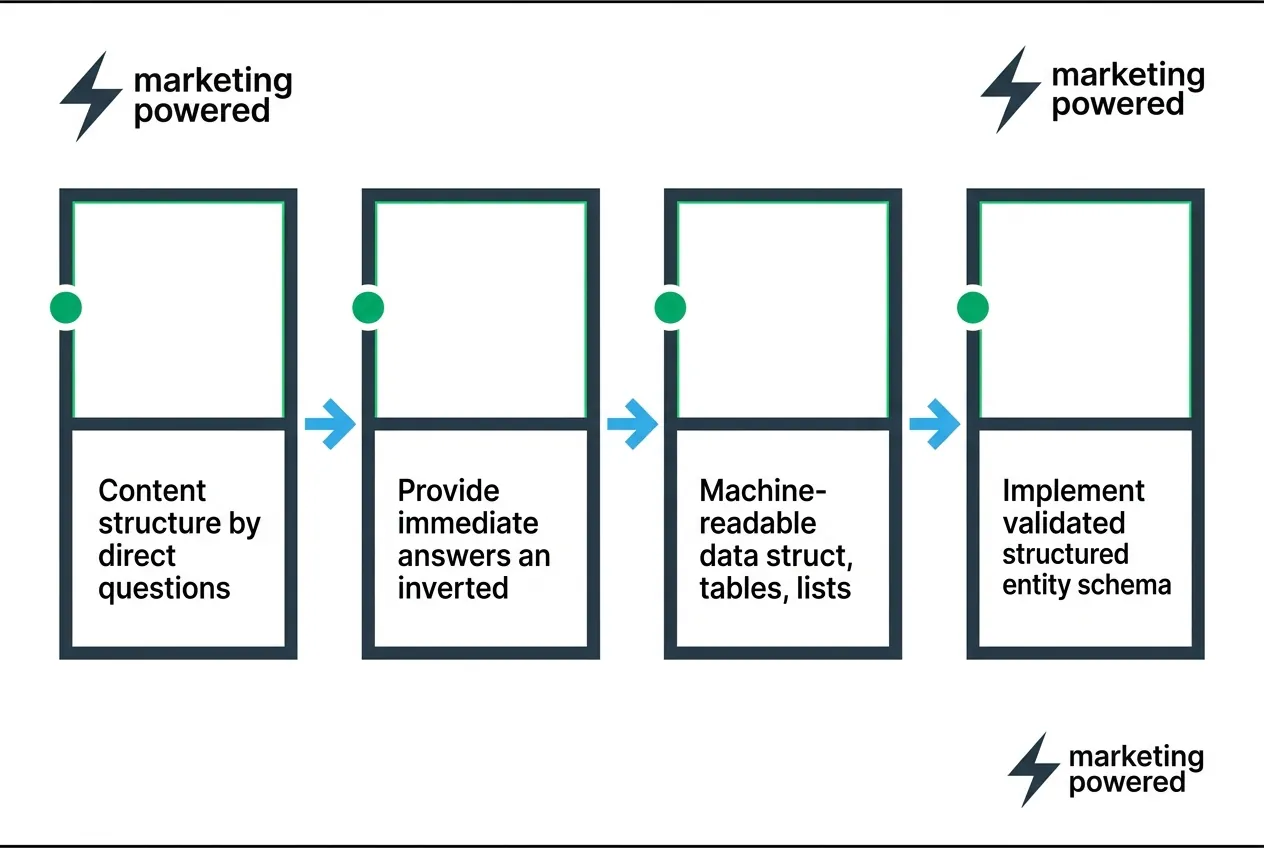
Transitioning a website into an authoritative knowledge base requires systematic technical execution across several key layers:
1. Structure Pages Around Question-Led Hierarchies
Every core service page and informational resource should use clear, unambiguous heading tags formatted as direct questions. Rather than using clever or abstract editorial headings, use headings that mirror the exact phrasing real buyers use when interrogating conversational assistants.
For example, instead of a heading like "A Modern Approach to Multi-Location Care Coordination," use an explicit question: "How does centralized scheduling improve patient intake across multi-location clinics?" This gives parsing algorithms an unambiguous semantic target for content indexing.
2. Apply Inverted-Pyramid Answer Blocks
Immediately beneath each question heading, provide a direct, factual answer spanning between 40 and 60 words. State the core conclusion, the operational mechanism, and the measurable outcome directly in the first two sentences.
Avoid introductory throat-clearing such as "In today's fast-paced digital world, many organizations wonder..." Answer engines parse for noun-verb-object clarity. Once the definitive summary block is established, use the remainder of the section to elaborate on implementation details, edge cases, and strategic trade-offs.
3. Deploy Machine-Readable Tables and Ordered Lists
Large language models and retrieval systems parse structured HTML tables and numbered lists with higher confidence than dense narrative prose. When detailing process workflows, pricing criteria, feature comparisons, or regulatory guidelines, convert the information into clean HTML tables or ordered lists.
This structural clarity simplifies the extraction job for AI Overviews SEO, allowing automated parsers to lift comparison matrices directly into synthesized answer snapshots without semantic degradation.
4. Implement Nested Entity Schema Markup
Technical structured data provides an explicit semantic bridge between your written content and the knowledge graphs maintained by search engines. Basic schema markup that only declares a page as an "Article" or "WebPage" is insufficient for competitive conversational discovery.
Marketing teams should deploy detailed JSON-LD markup that maps organizations, medical entities, specific service offerings, and validated author credentials, adhering closely to the Google Search Central guide on structured data.
By explicitly linking entities on your website to recognized Wikidata entries and authoritative external registries, you remove ambiguity regarding your organization's identity, clinical standing, or professional accreditations.
The Attribution Reality: Measuring AI Search Without Vanity Metrics
One of the most persistent challenges for executive leadership is measuring the commercial return of answer engine optimization. Marketing technology vendors frequently promise proprietary dashboards claiming to track real-time citation frequency across closed conversational assistants. In practice, these claims often obscure the technical limitations of current search reporting.
Major search platforms aggregate performance data without providing dedicated, isolated tracking filters for conversational extracts. As documented in the Google Search Console Performance report documentation, clicks and impressions originating from AI-generated answers are combined within overall search performance categories rather than broken out into distinct, separate metrics. Closed commercial platforms like ChatGPT and Claude do not provide public access to complete programmatic click-attribution logs for organic mentions.
Because platform-native reporting remains blended, sophisticated marketing organizations avoid relying on unverified third-party citation metrics. Instead, they ground their measurement in first-party data and full-funnel attribution:
- Branded Query Velocity: Measuring growth in high-intent branded search volume across target geographic and commercial segments over time. When an organization is consistently cited inside AI Overviews as a category authority, prospective buyers follow up by searching for the brand directly.
- Direct and Referral Path Analysis: Monitoring conversion velocity from specialized referrers and direct visits to key structural assets, such as technical documentation, methodology pages, and proprietary research tools.
- Closed-Loop Pipeline Attribution: Connecting initial touchpoints to definitive commercial milestones rather than surface leads. For instance, Marketing Powered's founder, an advertising strategy expert witness and former healthcare CMO who grew a treatment network from 3 to 24 locations, managed $1.5 to $2M per month in Google Ads across 11+ behavioral and mental health accounts where attribution was tracked directly to patient admission rather than simple form submissions.
Applying this rigorous standard prevents marketing executives from chasing vanity citation counts that fail to produce revenue. To understand how conversational search fits into a broader commercial program, explore our comprehensive guide on AI marketing: what it changes for strategy, teams and budgets.
Specialized AI Systems: How Marketing Powered Builds Owned Infrastructure
Structuring content for answer engines requires more than updating website copy; it demands an operational infrastructure capable of analyzing, testing, and deploying knowledge assets securely. Many agencies approach generative discovery by purchasing standard subscriptions to third-party language models, processing client assets through public cloud endpoints, and generating generic copy that sounds identical to every competitor.
Marketing Powered takes an operator-led approach founded on owned, local AI infrastructure. AI-native since 2022, the firm maintains an internal production system known as MAIOS (Marketing Powered AI Operating System). This platform operates on dedicated local hardware to run open-source models, custom extraction analyzers, and proprietary schema validators within a secure perimeter.
This owned infrastructure model solves three critical challenges for organizations operating in regulated environments:
- Data Sovereignty and Compliance: In healthcare systems, behavioral health networks, and regulated professional services, processing proprietary data through public cloud wrappers creates severe compliance vulnerabilities. Operating dedicated local infrastructure allows for HIPAA-aware inference, ensuring patient information and confidential business logic are never exposed to public model training sets.
- Deterministic Extraction Auditing: Rather than guessing how conversational assistants parse web assets, Marketing Powered uses local model suites to simulate retrieval-augmented generation pipelines. We test client content against open-source embedding models, identifying missing entity links, structural ambiguities, and extraction failures before pages are deployed to production.
- End-to-End Operational Control: Owning the computing and intelligence infrastructure eliminates dependence on fluctuating software-as-a-service subscriptions. Organizations can systematically deploy custom workflow automations, proprietary knowledge bases, and multi-location schema updates with complete operational reliability.
For enterprises evaluating advanced partners in this space, our guide on generative engine optimization agency: what a specialist partner delivers and how to vet one outlines the technical infrastructure required for enterprise-scale execution. You can explore our operational framework on our specialized AI systems and marketing operations page.
Questions, Answered.
Answer engine optimization (AEO) focuses primarily on structuring content to provide direct, factual answers to specific questions across search engines, conversational assistants, and voice interfaces. Generative engine optimization (GEO) is a broader term encompassing strategies to increase brand representation, topical authority, and narrative inclusion across all generative language model interactions, including exploratory research, competitive comparisons, and complex automated reasoning workflows.
No. Answer engine optimization does not replace technical SEO; it builds upon it. Conversational engines still require clean website architecture, rapid server response times, mobile optimization, crawlable internal linking structures, and verified indexation. Without sound technical SEO fundamentals, automated search bots cannot access the underlying code to retrieve answers for synthesis.
Update cycles vary widely depending on crawl frequency, domain authority, and query volatility. While search engine crawlers may index updated page content within hours or days, incorporating those changes into synthesized AI Overviews requires the engine to recalculate its semantic entity graphs and confidence scores. This synthesis cycle typically takes several weeks to reflect structural updates.
No. Structured schema markup informs search engines what your content represents, but it does not validate the authority, factual accuracy, or helpfulness of that information. High-quality schema is a technical prerequisite for reliable machine parsing, but conversational search engines prioritize content that displays deep operational experience, original domain research, and external third-party corroboration. Talk with Marketing Powered about owning your marketing AI stack
Ready to see where your marketing can improve?
Request a free audit of your paid media, landing pages, attribution, and measurement setup. You'll get a straight assessment of where the opportunities are.
or email us at info@marketingpowered.ai