Capabilities
Ideal Customer Profile Research Grounded in Evidence
Most ICP work ends as a slide with a logo wall and a few adjectives, which is not a targeting decision. Ideal customer profile research should produce account-level fit criteria built from what your customers actually bought, why they bought it and where the work succeeded after the contract was signed. Everything else is a segment someone found attractive.

Start with the customer outcomes you can actually document
Before profiling anyone, define what a successful customer looks like in your own records. That means the value delivered, the gross margin on the account, how long implementation or onboarding took, and whether the relationship renewed or expanded. A health system that bought and never activated the service is not a good-fit account, no matter how well it matches the firmographics.
This first pass is a working session with the people who hold the evidence: finance for margin and retention, delivery or operations for implementation friction, sales for what the buyer said they were trying to fix. The output is a short, written definition of a successful customer, with the accounts that meet it listed and the accounts that do not meet it listed beside them. Fit criteria written before that definition exists is demographic guessing with better formatting.

Separate account fit from contact traits
Organizations and the people inside them are different units of analysis, and conflating them is the most common flaw in B2B customer profiling. Account fit asks whether the organization has the use case, the trigger, the budget authority and the operational conditions to get value. Contact traits ask who in that organization will raise the issue, who evaluates, and who signs.
Research account fit first. A multi-location provider group with a centralized marketing function behaves very differently from the same size group where each location controls its own spend, even when the job titles are identical. Once account fit is established, contact-level research tells you where to enter and in what language. Running them together produces lists that look targeted and convert like cold outreach, which is a pattern that also shows up when measuring lead quality.
Research accessible markets and label every data point
Market evidence is useful when its origin and confidence are visible. Research firms generally treat market sizing, competitive intelligence, trend analysis, win/loss work and market entry validation as separate disciplines with different methods, and that separation is worth keeping (Teknicks market research services). Mixing them into one score hides which part is measured and which part is assumed.
The same discipline applies to third-party data. Enrichment is the practice of appending verified information from outside sources to fill gaps in existing customer records (Experian data enrichment); coverage, field accuracy, match rates and permitted use vary by vendor and contract and need engagement-specific review rather than assumption.
Permitted use is a live question in the United States, because the CCPA exemption for business-to-business personal information expired on January 1, 2023 (California Lawyers Association), and California residents can ask businesses to disclose and delete personal information held about them (California Attorney General).
Target account research that cannot name its sources is also hard to spend against, which is the economics behind cheap leads destroying margin.
Free Audit
Want a straight read on where your budget is leaking?
Build fit and exclusion criteria you can defend
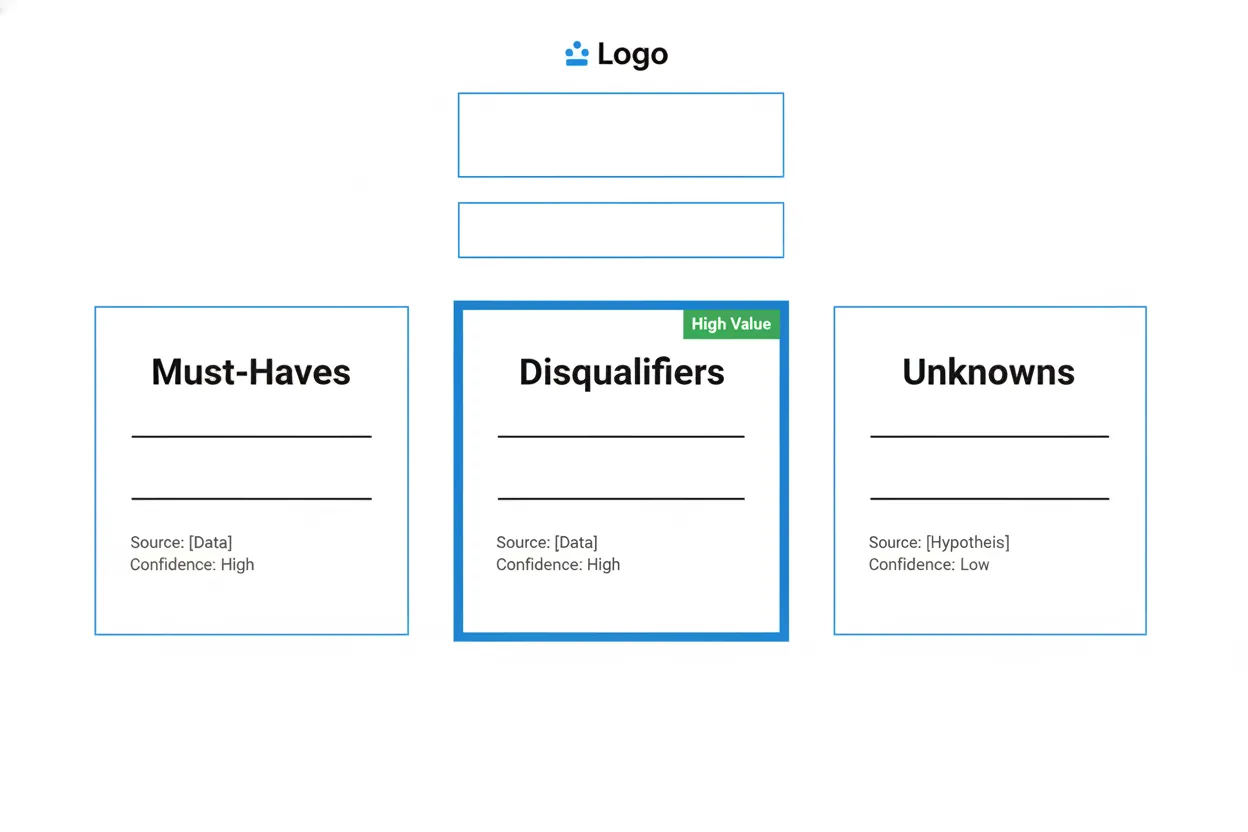
The deliverable is three lists, not one. Must-haves are the conditions without which value does not materialize. Disqualifiers are the conditions that reliably predict a bad fit even when the account can afford to buy. Unknowns are the criteria you suspect matter but cannot yet evidence, held open and labeled rather than quietly promoted to fact.
The exclusion list usually creates more immediate value than the inclusion list, because it stops spend and sales time rather than adding to it. A workable set is specific: regulatory status, procurement structure, existing in-house capability, data access, decision concentration, deployment constraints.
Each criterion carries a source and a confidence label, so a sales leader can see which rules came from closed-won analysis and which came from a vendor file. Ownership of that document matters too, which is the practical side of data sovereignty and business control.
Validate the profile against wins and losses
A hypothesis becomes a profile only after it survives contact with real buying decisions. Test the criteria against closed-won accounts, closed-lost accounts and the segment most teams skip: the accounts that did not match the assumed profile and converted anyway. Those outliers often reveal a buying trigger nobody wrote down.
Validation depends on whether records connect source to outcome rather than stopping at the form fill, which is the case for tracking records from source to outcome.
This is the same discipline behind attribution tracked to admission rather than to lead, and it is where the founder's background running marketing for a treatment network that grew from 3 to 24 locations, and managing $1.5 to $2M per month in Google Ads across 11+ behavioral and mental health accounts, informs how the research is structured.
Where the data is thin, the finding is reported as an estimate, not a conclusion.

Make the ICP operational for sales and marketing
Research that stays in a document changes nothing. Findings translate into three working artifacts: account research criteria that tell a researcher which organizations to add to the list and why, messaging guidance tied to the documented trigger and constraint, and qualification rules a rep can apply on a first call without interpreting a persona.
From there, the profile feeds the measurement layer. Fit criteria inform how campaigns are segmented, which accounts justify higher acquisition cost, and where spend should stop. If you are connecting this work to budget decisions, pair it with why an interaction is not a business outcome, customer acquisition cost definitions and marketing investment economics.
Questions, Answered.
An ICP describes organizations: use case, buying trigger, operating conditions, constraints and disqualifiers. A persona describes people inside those organizations: role, priorities, objections and language. Personas are useful after account fit is settled. Used in the reverse order, persona work produces messaging aimed at the wrong companies.
Yes, with the confidence labels made explicit. With few closed deals, the profile is built from the problem definition, early implementation evidence, interviews with buyers who declined, and accessible market data. It is stated as a hypothesis with a defined test, then revised as deals close. The risk is treating a small-sample profile as settled.
Common disqualifiers include no owner for the problem, a buying process that outruns the value window, an in-house team already performing the work, data or systems access the engagement depends on but cannot get, and regulatory or procurement conditions the offer does not meet. Budget is necessary and not sufficient.
A customer or account list with revenue and retention history, closed-lost records with stated reasons, CRM field access or an export, campaign and source data where it exists, and time with sales, delivery and finance. Scope depends on what records exist, how outcomes are recorded and which data can be shared under your agreements.
The intent is that you own the artifacts: the customer outcome definition, the inclusion and exclusion logic with sources and confidence labels, and a validated sample account list with provenance recorded. Exportable in a standard format, usable without ongoing access to any specific vendor model. Hosting, retention and access arrangements are documented during scoping rather than assumed. Build an evidence-based ICP
More Services
Ready to see where your marketing can improve?
Request a free audit of your paid media, landing pages, attribution, and measurement setup. You'll get a straight assessment of where the opportunities are.
or email us at info@marketingpowered.ai