Resources
Customer Acquisition Cost: How to Calculate It and Bring It Down
Customer acquisition cost represents the total commercial investment required to bring a paying client, patient, or account through your doors. When measured strictly as media spend divided by leads, it obscures the operational breakdowns that quietly destroy operating margins. Treating acquisition economics as a complete system allows organizations to identify pipeline friction, protect cash flow, and build scalable growth.
By Mike Hulick, Founder, Marketing Powered

The Fully Loaded CAC Formula: How to Calculate CAC Accurately

What Is Customer Acquisition Cost in High-Stakes Verticals?
In regulated industries and high-consideration sectors such as healthcare systems, specialty medical networks, legal practices, and enterprise professional services, customer acquisition cost cannot be treated as a simple ad-buying metric. A customer is not acquired when a form is submitted, an eBook is downloaded, or an incoming call rings at a front desk. Acquisition occurs only when an individual completes intake, signs an agreement, or completes their first billable appointment or clinical admission.
Standard marketing definitions often define acquisition cost narrowly: divide the monthly paid advertising invoice by the number of new customers attributed to that channel. In practice, this narrow definition creates severe financial distortions. A hospital marketing director might report a digital acquisition cost of $400 based solely on search ad spend, while the accounting ledger reveals an effective cost exceeding $1,200 once intake staffing, verification overhead, physician review time, and administrative churn are factored in. When executive leadership evaluates marketing performance through isolated media metrics, they misallocate capital and fail to diagnose operational bottlenecks.
The complexity intensifies in regulated environments. On platforms like Google, policy prohibits personalized advertising, remarketing lists, and behavioral retargeting for sensitive health conditions under Google Ads Help: Personalized advertising. In these categories, advertisers cannot rely on multi-touch retargeting sequences to nurture unconverted visitors over weeks. The initial click carries the full burden of qualification, trust building, and conversion. If the landing environment is fragmented or the intake team fails to connect immediately, that media investment is permanently lost. Understanding customer acquisition cost in these verticals requires looking beyond the ad auction and examining the operational pipeline that converts high-intent demand into actual revenue.
Calculating customer acquisition cost accurately requires compiling all direct and indirect expenses incurred to generate paying business. When leadership asks how to calculate CAC, the conversation often gets derailed by debates over which departments should absorb administrative overhead. The most reliable standard is the fully loaded CAC formula, which aggregates paid media, sales and intake payroll, external agency fees, and specialized software infrastructure.
The Fully Loaded CAC Formula
The standard equation for fully loaded customer acquisition cost is expressed as:
Fully Loaded CAC = (Total Variable Media Spend + Sales and Intake Payroll + Agency and Professional Retainers + MarTech and CRM Software Overhead) / Total Acquired Customers.
Each component represents a distinct operational layer:
- Total Variable Media Spend: Every dollar allocated directly to paid search auctions, paid social campaigns, local service ads, traditional media placements, and verified referral networks.
- Sales and Intake Payroll: The fully burdened cost (wages, benefits, payroll taxes, and performance bonuses) of the frontline staff who process inquiries. For healthcare networks, this includes admissions coordinators and intake nurses. For professional service firms, this covers business development representatives, legal intake specialists, and intake managers.
- Agency and Professional Retainers: Fees paid to specialized marketing agencies, technical media buyers, conversion optimization consultants, and creative producers supporting direct customer generation.
- MarTech and CRM Software Overhead: Dedicated software licensing required to support conversion and tracking. This includes call tracking platforms, HIPAA-compliant routing software, customer relationship management (CRM) databases, automated scheduling engines, and attribution platforms.
Hypothetical Calculation: Simple CAC Versus Fully Loaded CAC
To understand how operational blind spots alter commercial decisions, evaluate this hypothetical scenario modeling a multi-location specialty medical group operating over a single calendar month.
In this hypothetical model, the organization generates 80 fully admitted patients:
- Variable Google Ads and search spend: $40,000
- Frontline intake coordinators (burdened payroll): $32,000
- Specialized marketing agency retainer: $18,000
- Call tracking, CRM, and HIPAA-compliant automation licenses: $10,000
If the organization calculates simple media CAC:
Simple CAC = $40,000 / 80 = $500 per patient.
If the organization calculates fully loaded CAC:
Fully Loaded CAC = ($40,000 + $32,000 + $18,000 + $10,000) / 80 = $100,000 / 80 = $1,250 per patient.
The variance between $500 and $1,250 is not an accounting technicality. If the leadership team bases facility expansion or service pricing on the assumption that an admitted patient costs $500 to acquire, operating margins will erode rapidly. Measuring fully loaded acquisition economics reveals the true commercial hurdle rate the business must clear to remain profitable.
Why Blended CAC and Cost-Per-Lead Hide Operational Waste
Executive dashboards frequently rely on two vanity metrics that conceal severe operational leakage: blended customer acquisition cost and front-end cost per lead (CPL). Both metrics create an illusion of marketing efficiency while masking structural problems inside the conversion pipeline.
Blended CAC combines organic traffic, direct brand searches, physician or professional referrals, and paid advertising into a single aggregate average. While blended numbers look appealing in quarterly board decks, they prevent leaders from identifying unprofitable channels. If an established health system receives 150 patients per month through historic community reputation and word-of-mouth referrals, and 50 patients through digital paid media, blending the total marketing budget across all 200 patients artificially depresses the reported acquisition cost. The paid media channel might actually be operating at an unsustainable $3,000 per acquisition, but the organic baseline masks the deficit. To make disciplined capital allocation decisions, paid customer acquisition cost must be isolated and evaluated independently for each acquisition source.
Cost per lead presents an equally dangerous distortion. A marketing campaign that produces 500 form inquiries at $40 each appears successful inside an ad manager dashboard. However, if those inquiries consist of out-of-network callers, individuals seeking services outside your clinical or operational scope, or abandoned contact records, the down-funnel economics collapse.
Consider an intake pipeline where low-intent inquiries overwhelm admissions teams. When intake coordinators spend 70 percent of their working hours fielding unqualified leads, their response time for high-intent, qualified prospects slows down. Operational latency introduces catastrophic conversion drop-off. In multi-location healthcare and high-value professional services, a 15-minute delay in returning an inquiry can reduce qualification rates by more than half. If incoming calls go to voicemail or hold times exceed two minutes, abandonment spikes. Marketing reports a low cost per lead, but the realized customer acquisition cost escalates because the operational intake system is failing to convert the demand being generated.
Free Audit
Want a straight read on where your budget is leaking?
Calculating CAC Payback Period to Protect Operating Cash Flow
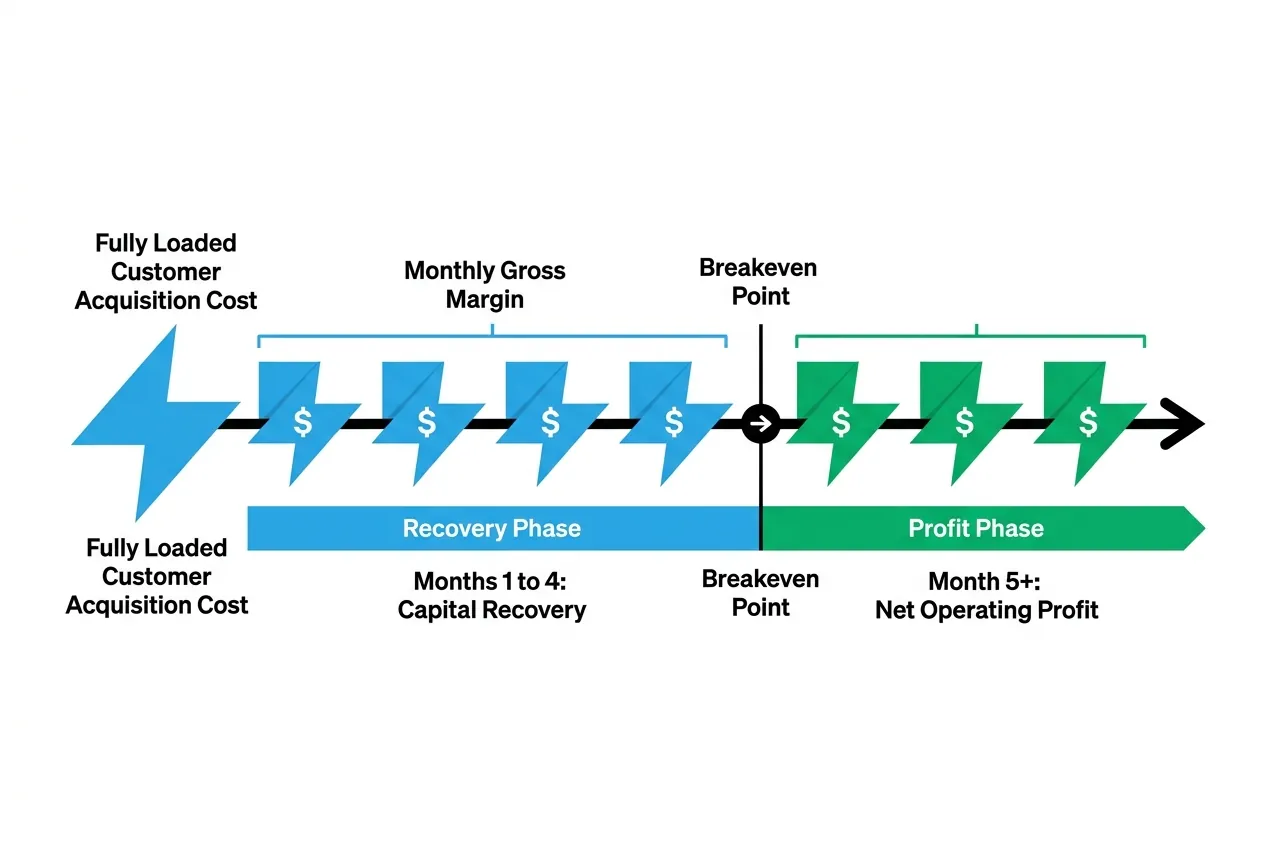
Understanding the absolute cost to acquire a client is only half of the financial equation. Executive teams must also manage cash flow velocity by calculating the CAC payback period. The payback period measures the elapsed time, in months, required for a newly acquired client or patient to generate sufficient gross margin to pay back the fully loaded cost of their acquisition.
The CAC Payback Period Formula
The standard formula for CAC payback period is:
CAC Payback Period (Months) = Fully Loaded Customer Acquisition Cost / (Average Monthly Revenue Per Account x Gross Margin Percentage)
For example, assume a commercial consulting firm or specialized outpatient clinic incurs a fully loaded acquisition cost of $3,600. The newly acquired client produces $1,500 in monthly billings with a direct operating gross margin of 60 percent ($900 in gross profit per month):
CAC Payback Period = $3,600 / ($1,500 x 0.60) = $3,600 / $900 = 4 months.
For the first four months of that engagement, the gross cash flow generated by that client does not fund general administrative expenses, facility overhead, or shareholder distributions; it merely restores the capital spent to acquire them.
Aligning CAC with Lifetime Value (LTV)
The CAC payback period must be analyzed alongside the total Lifetime Value to Customer Acquisition Cost ratio (LTV:CAC). Across healthy professional services and healthcare enterprises, an LTV-to-CAC ratio of 3:1 or higher is widely viewed as a benchmark for sustainable growth. A ratio of 1:1 indicates that the business spends all its potential profit simply replacing customer churn, while a ratio of 5:1 or higher may signal that the organization is underinvesting in growth and leaving market share to competitors.
The relationship between payback velocity and lifetime value directly impacts balance sheet stability:
- Payback Period Under 6 Months: Excellent cash efficiency. Working capital recycles quickly, enabling self-funded marketing expansion without external debt or cash reserves.
- Payback Period Between 7 and 12 Months: Manageable for mature businesses with stable balance sheets and low client churn, but sensitive to seasonal demand fluctuations.
- Payback Period Exceeding 12 Months: Dangerous for multi-location operators and mid-market organizations. Capital remains locked in acquisition debt, creating cash flow vulnerability if operational costs spike or retention drops.
Accelerating payback speed requires systemic intervention across both marketing and operations. Shortening the sales or intake cycle, improving initial contract terms, and reducing front-end onboarding friction return operating cash to the balance sheet faster, establishing a resilient baseline for future acquisition campaigns.
Four Operational Levers to Reduce Customer Acquisition Cost
Lowering customer acquisition cost does not mean bidding on cheaper keywords or shrinking paid media investments. Slashing budgets often reduces lead volume, starves intake teams of qualified prospects, and increases fixed overhead per acquisition. Sustainable reductions in CAC occur through engineering efficiencies across four operational levers.
1. Landing Page and Conversion Path Architecture
Sending paid media traffic to a generic corporate homepage is among the most expensive mistakes an organization can make. Homepages contain global navigation menus, corporate announcements, unrelated service links, and passive contact forms that introduce friction. High-intent search visitors require focused, dedicated landing pages that align directly with the specific search query that triggered the ad.
A dedicated landing page must isolate user intent, present clear value propositions, display verified credentials, and provide a single conversion mechanism. For a deeper analysis of conversion framework engineering, explore our guide on Conversion rate optimization for lead generation: a system, not a list of tests. By removing navigational escape routes and answering critical buyer objections immediately, organizations routinely lift visitor-to-inquiry rates significantly, driving down the media portion of CAC without requiring larger advertising budgets.
2. Inquiry Response Latency and Intake Automation
Speed-to-lead is an operational determinant of acquisition economics. In high-stakes service environments, a prospect reaching out for specialized care or urgent advisory support is often researching multiple providers concurrently. The organization that initiates contact first establishes trust and sets the diagnostic framework.
Organizations can compress response times by implementing automated CRM routing protocols:
- Immediate Call Dispatch: Incoming form inquiries trigger an automated outbound dialer that connects an available intake coordinator to the prospect within 90 seconds.
- Automated Confirmation Messaging: Immediate SMS or email notifications confirm receipt of an inquiry and set expectations for the next operational step.
- Dynamic Call Routing: Directing incoming phone calls based on geographic territory, payer type, or clinical acuity to prevent call transfers and hold-time abandonment.
Removing friction between the prospect's initial inquiry and the intake interview prevents pipeline decay, directly lowering the overall cost per acquired client.
3. Closed-Loop Attribution to Revenue
Many organizations operate with severed attribution systems. The marketing team optimizes campaigns for low cost per form submission, while the operations team evaluates closed revenue in an isolated CRM or electronic health record (EHR). When ad network bidding algorithms only receive data on initial form fills, they optimize toward users who submit forms easily, regardless of whether those users are qualified.
Reducing CAC requires implementing closed-loop attribution. By utilizing server-side tracking, unique click identifiers, and CRM offline conversion imports, organizations feed validated downstream outcomes back into platform bidding systems like Google Ads. When the bidding algorithm learns which specific keyword themes, ad creatives, and geographic regions produce admitted patients and signed agreements, it redirects media budget away from low-quality lead volume and concentrates capital exclusively on high-value intent.
4. Paid Search Intent Discipline and Negative Keyword Governance
In competitive search auctions, broad match bidding without rigorous governance burns working capital. Broad search queries often match with job seekers, individuals seeking free public assistance, or consumers researching academic definitions. Every non-converting click inflates the media component of CAC.
Organizations must enforce disciplined search hygiene:
- Negative Keyword Sculpting: Continuously reviewing search term queries and building comprehensive negative keyword libraries to block irrelevant clicks.
- High-Intent Keyword Focus: Bidding on specific, decision-stage intent queries rather than top-of-funnel informational topics.
- Geographic Match Verification: Ensuring campaigns target users physically located within verified service areas, rather than users merely expressing interest in those areas from other regions.
Tightening search intent lowers raw click waste, ensuring that every dollar deployed inside the ad auction reaches prospects capable of becoming qualified clients.
Engineering Conversion Systems: How Marketing Powered Helps Lower CAC
Marketing Powered designs and deploys marketing operations built around accountable business economics. The firm is led by a former healthcare Chief Marketing Officer who managed marketing operations for a multi-location treatment network that expanded from 3 to 24 locations. Backed by experience managing $1.5 to $2M per month in Google Ads across 11+ behavioral and mental health accounts, as well as credentials as a court-certified expert witness in advertising strategy, our team approaches acquisition cost from an operator's perspective.
We recognize that sustainable acquisition efficiency requires unifying media management, technical conversion engineering, and operational intake workflows into a single system.
Conversion Rate Optimization and Dedicated Landing Pages
We design and build dedicated conversion environments specifically engineered for high-consideration and regulated industries. In sectors where platform policies ban behavioral retargeting, capturing demand on the first interaction is an absolute requirement. Our approach focuses on message match, clinical and professional authority signals, structural trust architecture, and seamless mobile interactions. To evaluate agency models and capabilities, read our breakdown on Conversion rate optimization agency: what a specialist partner delivers and how to vet one and our review of Landing page optimization agency: what a specialist partner delivers and how to vet one.
CRM Architecture and Intake Automation
A high-performing landing page cannot compensate for an inefficient intake pipeline. We work directly with operations teams to configure CRM workflows, automated call distribution, and lead qualification engines. By integrating tools that streamline data capture and route inquiries instantly to the right staff, we eliminate the operational delays that cause lead abandonment. These operational automations ensure that marketing spend translates into completed intake consultations.
Closed-Loop Attribution to Admission and Revenue
Marketing Powered operates with an AI-native foundation established in 2022, utilizing owned, local AI infrastructure for HIPAA-aware inference. This infrastructure allows regulated organizations to process operational data securely without exposing sensitive records to public third-party models. We bridge the reporting divide between advertising dashboards and enterprise databases, tracking performance past the lead stage through to verified admission, signed engagement, or completed patient visit. When capital allocation is guided by verified downstream revenue rather than superficial lead counts, customer acquisition costs drop across every operational channel.
Learn more about our structured capabilities across Conversion optimization, landing pages, and CRM and intake automation.
Questions, Answered.
For multi-location organizations, calculate customer acquisition cost both at the consolidated enterprise level and independently for each operating facility. Combine local media spend, localized intake staffing, dedicated regional agency resources, and facility-specific software overhead, then divide by the customers acquired at that specific location. Calculating location-level CAC reveals which facilities suffer from operational intake bottlenecks versus those operating with high conversion efficiency.
A healthy Lifetime Value to Customer Acquisition Cost ratio is generally 3:1 or higher. An LTV:CAC ratio of 1:1 or 2:1 indicates that acquisition costs consume too much gross margin, leaving insufficient capital to cover fixed overhead, clinical delivery, and sustainable operations. Conversely, an LTV:CAC ratio exceeding 5:1 often suggests that an organization is underinvesting in customer acquisition and conceding market share to competitors.
Simple CAC accounts only for variable media spend divided by new customers, providing a narrow view of advertising efficiency. Fully loaded CAC incorporates all operational costs required to generate paying business, including frontline intake and sales payroll, external agency retainers, CRM subscriptions, call tracking tools, and qualification overhead. Fully loaded CAC provides executive leadership with the accurate financial hurdle rate needed for cash flow planning.
Intake response time directly governs conversion efficiency. When inquiries sit unaddressed for hours, prospects contact competing providers or reconsider their decision, leading to high inquiry drop-off. Fast response times, supported by automated routing and instant phone connections, keep qualification rates high. Improving speed-to-lead increases the percentage of inquiries that become paying customers, which lowers the media and operational spend required per acquisition.
Under its personalized advertising policies, Google restricts remarketing and audience targeting for sensitive health conditions, medical procedures, and personal struggles. These regulations protect consumer privacy by preventing ad platforms from tracking individuals based on clinical vulnerabilities. Because behavioral retargeting is prohibited, organizations in these verticals must engineer high-intent search campaigns and conversion paths that successfully convert prospects during their initial visit. Schedule a strategy call with Marketing Powered
Ready to see where your marketing can improve?
Request a free audit of your paid media, landing pages, attribution, and measurement setup. You'll get a straight assessment of where the opportunities are.
or email us at info@marketingpowered.ai