Resources
HIPAA Compliant Website Examples: What Works and Why
Studying real-world hipaa compliant website examples reveals a clear operational divide between standard web publishing and genuine patient privacy. Healthcare organizations must deliver responsive, accessible digital experiences while protecting sensitive health inquiries across every touchpoint. Achieving this requires an architecture that isolates clinical data, maintains reliable intake funnels, and preserves marketing measurement.
By Mike Hulick, Founder, Marketing Powered

Core Pillars of HIPAA Compliant Website Design

What Makes a Website HIPAA Compliant?
Under the Health Insurance Portability and Accountability Act, regulated entities must secure Protected Health Information (PHI) whenever it is collected, stored, or transmitted. The HHS tracking guidance underscores that digital interactions implicate federal privacy rules whenever an individual IP address or device identifier connects to clinical services, medical symptoms, or scheduling requests. A healthcare website does not achieve compliance through a front-end trust badge or an SSL certificate. True compliance requires technical safeguards that prevent Individually Identifiable Health Information (IIHI) from leaking to unauthorized third-party platforms.
To satisfy standards enforced by the Department of Health and Human Services (HHS) Office for Civil Rights (OCR), a healthcare digital presence must execute across three operational layers:
- Cryptographic security: Data in transit must use modern encryption protocols such as TLS 1.3, while stored intake submissions must use AES-256 encryption at rest.
- Contractual coverage: The healthcare provider must maintain an executed Business Associate Agreement (BAA) with every vendor touching web traffic that contains user identifiers, including hosting providers, form processors, database servers, and CRM platforms.
- Access and audit controls: Administrative interfaces require multi-factor authentication, role-based access restrictions, and immutable audit logs that record every interaction with sensitive records.
The legal boundary between general web browsing and regulated data exchange received greater clarity in federal court. In June 2024, the final judgment in AHA v. Becerra vacated portions of the OCR bulletin regarding subjective visitor intent on unauthenticated public webpages. However, severe regulatory exposure persists across web forms, authenticated patient portals, and dynamic URLs. Concurrently, the Federal Trade Commission has penalized digital health platforms for sharing sensitive consumer queries with advertising networks without affirmative consent, as demonstrated in the FTC enforcement action against GoodRx. A compliant web environment demands technical isolation between public browsing traffic and private clinical inquiries.
Building an effective healthcare site requires deliberate information architecture. Strategic hipaa compliant website design organizes user journeys so educational content consumption never mingles with clinical data intake. A visitor reading an informational article on physical therapy represents general web traffic. The moment that visitor inputs contact details and symptoms into a consultation form, the interaction becomes a regulated transmission.
High-performing healthcare designs solve this separation by routing user forms through isolated server-side endpoints. Third-party advertising tags and session-replay scripts must never load on pages hosting health questionnaires, appointment schedulers, or patient registration forms.
URL architecture also requires defensive engineering. Marketing teams frequently append diagnostic parameters to page URLs, such as ad click URLs that contain condition-specific terms. If a user subsequently navigates to a booking form, standard client-side advertising pixels can automatically capture that complete URL along with the visitor's IP address. Modern healthcare web design ensures that sensitive query parameters are stripped at the server edge, preventing downstream advertising platforms from ingesting health indicators.
To establish these technical boundaries cleanly across all channels, teams must align their digital assets with the core principles of HIPAA compliant marketing: what the rules mean for campaigns and tracking.
Enterprise Hospital Systems: Mayo Clinic and Cleveland Clinic
Examining enterprise health system websites illustrates how high-traffic healthcare providers maintain compliance while serving millions of visitors monthly. The web properties of Mayo Clinic and Cleveland Clinic function as medical encyclopedias, research hubs, and clinical intake portals simultaneously. Their digital architecture provides a practical model for handling high-volume consumer traffic without exposing patient interactions.
Both institutions establish hard technical barriers between public discovery content and interactive patient portals. On public pages detailing diseases, symptoms, or physician profiles, the interface functions as a modern publishing platform. Content delivery networks cache static assets close to visitors, ensuring fast load times while isolating backend clinical databases behind enterprise firewalls. These public pages allow users to research medical conditions without triggering unauthorized PHI disclosures.
When a visitor initiates an appointment or accesses personal health records, the website executes a secure redirect. The user transitions away from the open content domain to an isolated, authenticated subdomain powered by an electronic health record system such as Epic MyChart. This subdomain operates under rigorous security controls: no commercial advertising pixels are installed, session cookies are scoped to the authenticated origin, and all communications travel through encrypted tunnels governed by formal healthcare business associate agreements.
Free Audit
Want a straight read on where your budget is leaking?
Modern Digital Health Platforms: One Medical
Modern digital health organizations implement a different structural pattern, prioritizing seamless mobile user experiences and membership onboarding. The digital platform of One Medical illustrates how primary care systems design conversion funnels that adhere to federal privacy standards while maintaining consumer-grade usability.
Instead of embedding open text boxes on unauthenticated web pages, modern digital health providers guide prospective patients through structured intake sequences. Initial landing pages capture only basic demographic details, such as a ZIP code to confirm service availability. Detailed medical histories, insurance card uploads, and condition descriptions are collected exclusively after the user establishes an authenticated account secured by multi-factor authentication.
Digital health platforms also handle marketing attribution differently than traditional online businesses. Because advertising networks actively monitor sensitive categories, top operators implement server-side conversion APIs. When a visitor registers for an account, a clean conversion event is dispatched from the server directly to the advertising platform. Crucially, the payload contains no medical condition, service-line selection, or unhashed personal identifier. The attribution loop is completed without transmitting sensitive patient data to third-party ad networks.
Multi-Location Specialty Practices and Behavioral Health Networks
Multi-location behavioral health networks, addiction treatment centers, and specialty clinics operate under demanding regulatory constraints. In sensitive categories like mental health, standard advertising features such as audience retargeting are strictly barred under Google Ads healthcare advertising policies. Furthermore, substance use disorder treatment programs must comply with federal privacy protections under 42 CFR Part 2 alongside HIPAA, demanding uncompromising control over patient records and identity disclosure.
Leading specialty operators navigate these restrictions by decoupling their public marketing sites from clinical lead intake. Rather than utilizing standard embedded form widgets that transmit data to unsecured third-party servers, these networks deploy specialized form handlers. The form handler encrypts submissions immediately upon entry and uses private APIs to deliver contact information directly into a HIPAA-aware customer relationship management (CRM) platform.
Multi-location networks also configure privacy-safe call tracking. Rather than utilizing client-side scripts that capture call recordings and tie caller telephone numbers to dynamic browsing sessions, compliant specialty operators use call-tracking vendors that execute a formal BAA. Dynamic number insertion (DNI) is managed through secure server configurations, ensuring that incoming phone inquiries are attributed to the originating marketing campaign without exposing patient audio recordings or phone numbers to commercial ad networks.
Organizations managing multi-facility growth frequently consult HIPAA compliant marketing companies: what a specialist partner delivers and how to vet one to audit their intake pipelines and tracking configurations.
Choosing a HIPAA Compliant Website Builder and Hosting
Marketing executives frequently ask whether they must abandon familiar content management systems for specialized medical platforms. Compliance depends on how software is configured, hosted, and maintained rather than the specific software brand. Selecting a hipaa compliant website builder or content framework requires evaluating underlying data management practices.
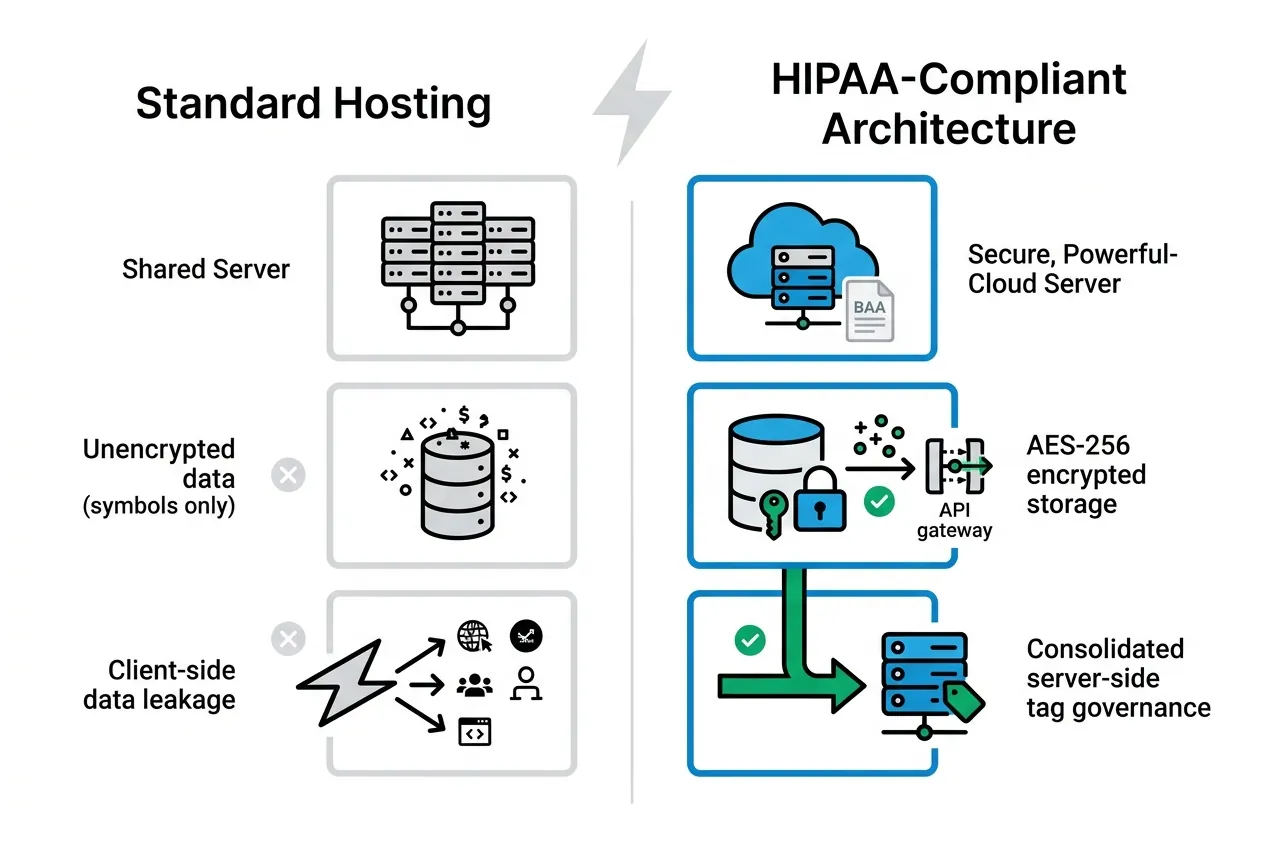
Content systems like WordPress, Webflow, and modern headless frameworks like Next.js can all serve as foundations for a compliant digital strategy. However, the system must prevent the CMS database from storing unencrypted patient information. If an open-source CMS stores form entries detailing patient medical symptoms inside an unencrypted database on shared hosting, the system violates HIPAA Security Rule mandates.
Configuring true hipaa compliant website hosting requires an infrastructure provider willing to sign a BAA while maintaining comprehensive physical, administrative, and technical safeguards. Providers such as Amazon Web Services (AWS), Microsoft Azure, and dedicated healthcare cloud hosts provide environments equipped with automated intrusion monitoring, encrypted backups, and isolated Virtual Private Clouds (VPCs). When deploying a hipaa compliant website for healthcare, isolating the front-end presentation layer from backend patient submission pipelines ensures long-term operational resilience.
Email Us
Prefer to send the context directly?
Measuring Acquisition: Privacy-Safe Tracking and Attribution
The most persistent tension between healthcare marketing teams and compliance officers involves analytics. Following federal enforcement notices, healthcare compliance teams routinely order all tracking code stripped from public websites. This leaves marketing leaders unable to calculate customer acquisition costs, measure campaign efficiency, or optimize paid media budgets.
The solution is server-side data governance. Conventional client-side tags execute directly inside the user's web browser, where scripts can inspect DOM elements, read query parameters, and capture personal data without explicit controls. By transitioning to server-side tracking, healthcare organizations place a secure cloud proxy between the user's browser and downstream analytics platforms.
Within this server proxy, sensitive identifiers are systematically stripped before any network payload leaves the organization's boundary. IP addresses are truncated or discarded, form inputs are removed, and sensitive query strings are scrubbed. The downstream analytics platform receives only clean, anonymized event data, such as a confirmation that an appointment conversion was completed. For an in-depth breakdown of analytical boundaries, review our guide to Google Analytics and HIPAA: what healthcare marketers can and cannot do.
Marketing Powered implements this infrastructure directly for healthcare networks and regulated businesses through our privacy-safe tracking and marketing technology services. Our engineering approach is shaped by direct operating experience. Marketing Powered was founded by a former healthcare CMO who ran marketing for a treatment network that grew from 3 to 24 locations, managed Google Ads across 11+ behavioral and mental health accounts, and serves as a court-certified expert witness in advertising strategy. Built specifically for sensitive verticals where retargeting is not permitted, our systems track attribution to admission, not just lead, utilizing owned, local AI infrastructure for HIPAA-aware inference.
Questions, Answered.
A website achieves compliance through administrative, technical, and physical safeguards that protect Individually Identifiable Health Information (IIHI). This requires TLS 1.3 transit encryption, AES-256 data storage encryption, signed Business Associate Agreements (BAAs) with all hosting and software vendors handling user data, role-based access controls, detailed audit logs, and the removal of unauthorized third-party tracking pixels from pages handling clinical inquiries.
Yes, provided WordPress is deployed correctly. The site must run on BAA-supported, dedicated cloud hosting rather than shared servers. Furthermore, form submissions must not be saved in clear text within the WordPress database. Instead, forms must route submissions securely via encrypted APIs directly to a HIPAA-compliant CRM or electronic health record system, with all third-party tracking scripts strictly governed through a server-side endpoint.
Yes. When a prospective or active patient inputs their name, contact details, and a requested medical service or condition, that submission constitutes protected health information. The form handler must be secured under a BAA, encrypt the data during transit and storage, and ensure that no client-side advertising scripts or recording tools can read the completed fields.
No. The June 2024 ruling in AHA v. Becerra vacated portions of the HHS tracking guidance regarding subjective visitor intent on unauthenticated public pages. However, the ruling did not eliminate liability for transmitting identifiable patient data through booking funnels, patient portals, or unencrypted web forms. Additionally, FTC enforcement actions continue to penalize healthcare brands that share identifiable health data with ad networks without explicit affirmative consent. Evaluate your healthcare tracking architecture
Ready to see where your marketing can improve?
Request a free audit of your paid media, landing pages, attribution, and measurement setup. You'll get a straight assessment of where the opportunities are.
or email us at info@marketingpowered.ai