Resources
Cost Per Lead Benchmarks Are Misleading: How to Calculate Allowable Acquisition Cost
Most acquisition dashboards celebrate an arbitrary drop in cost per lead while executive teams struggle to explain flat quarterly revenues and strained operating margins. Third-party benchmark reports aggregate disconnected business models, regional pricing differences, and loose definitions of intent into a single misleading average. Sustainable marketing programs ignore broad industry averages and establish an allowable acquisition threshold derived directly from downstream conversion rates, gross margins, and operational capacity.
By Mike Hulick, Founder, Marketing Powered

Why Average Cost Per Lead Benchmarks Waste Marketing Budgets
Marketing executives and multi-location operators face persistent pressure to align ad performance with published industry benchmarks. Software vendors compile annual benchmark studies that claim to show the average cost per lead across dozen of industries. Adopting these figures as internal operating targets introduces structural risk into media planning. A national benchmark report inevitably averages low-intent transactional inquiries with high-value professional services, enterprise contracts, and regional medical procedures.
A multi-location healthcare network or specialized advisory firm operates under competitive realities that aggregated surveys ignore. Local auction density, regulatory boundaries, state licensure limits, and variable commercial insurance reimbursement models directly dictate local click prices. In major metropolitan markets, competitive bidding across Google Ads search auctions drives cost-per-click rates significantly higher than the national median. An operator attempting to hit an artificial national benchmark in a competitive metro market must either bid on irrelevant search queries or strip essential friction out of their landing pages.
When acquisition teams chase an ungrounded average cost per lead, operational disconnects follow quickly. Media buyers shift budgets toward cheap, loose-match search terms, broad social placements, or pre-filled mobile lead forms. The ad account reports an impressive decrease in reported acquisition costs, but front-line intake specialists, commercial sales teams, and clinic coordinators spend hours sifting through uncontactable inquiries, duplicate submissions, and callers seeking services the organization does not provide. Measuring media success by industry averages rewards the generation of administrative waste while starving the business of actual commercial growth.

The Cost Per Lead Formula and Its Operational Blind Spot
The standard cost per lead formula serves as a basic accounting measurement for paid campaigns:
Cost Per Lead = Total Marketing Spend / Total Inquiries Generated.
If an organization spends $20,000 across search and social channels in a month and generates 250 form submissions and phone calls, the resulting cost per lead is $80.
While the mathematics are straightforward, the metric treats every recorded event as equal value. The primary blind spot of the standard cost per lead formula is its inability to distinguish between raw platform interactions and qualified commercial pipeline. A customer service dial from an existing patient, a bot submission on an unvalidated web form, an applicant looking for employment, and an executive ready to sign a contract register as identical conversions inside the advertising account.
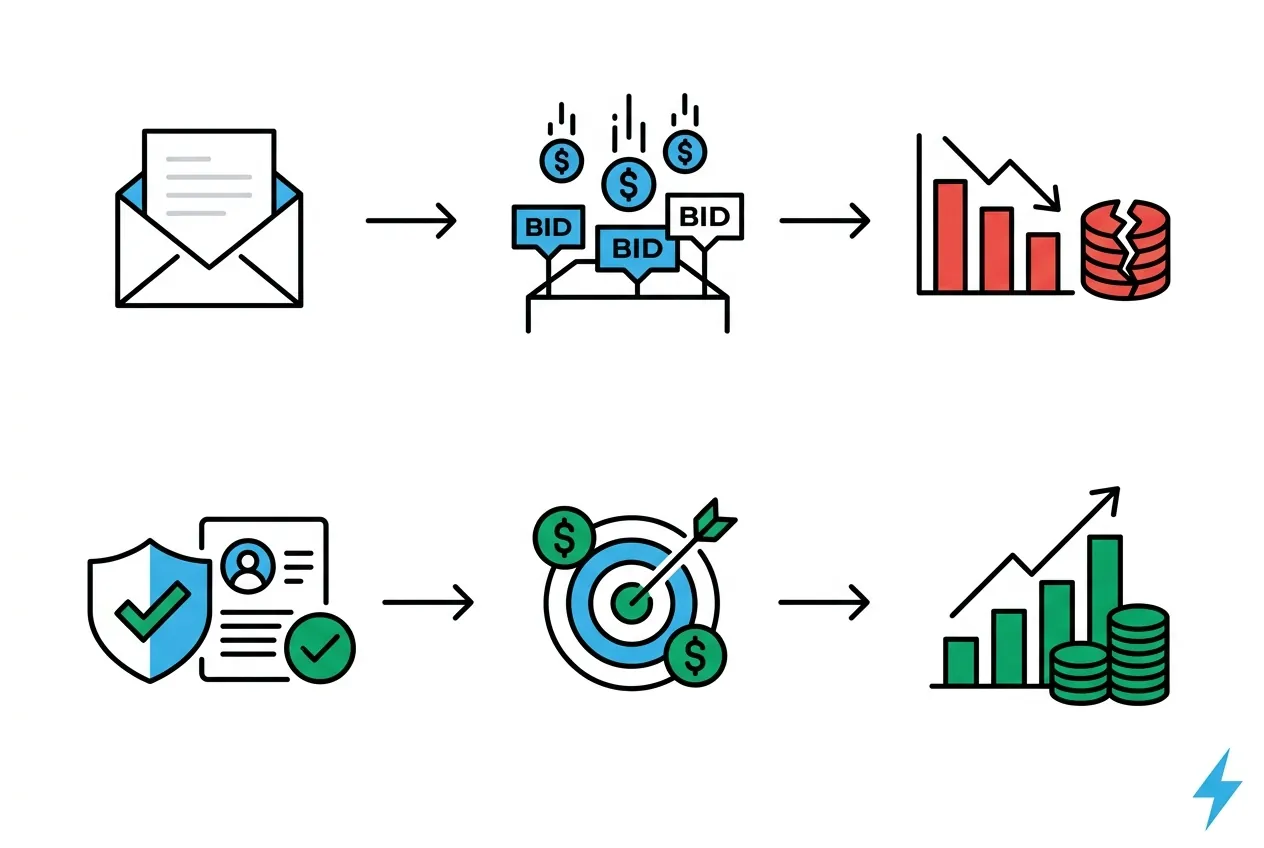
Evaluating marketing efficiency solely through front-end lead costs obscures fundamental business trade-offs. Generating 500 inquiries at $40 each appears more efficient than securing 250 inquiries at $80 each. If those $40 inquiries originate from broad top-of-funnel queries where only 2 percent reach an operational intake stage, the business pays $2,000 per qualified opportunity. If the $80 inquiries stem from high-intent searches where 20 percent reach qualification, the cost per qualified opportunity drops to $400. Media teams that fixate on the raw formula incentivize ad platforms to hunt for volume rather than revenue potential.
Calculating Allowable Cost Per Acquisition and Allowable CPL
Rather than relying on third-party benchmarks or raw form volume, disciplined organizations establish an allowable cost per acquisition. This model works backward from unit economics, operating margins, and qualification rates to determine the exact threshold a company can afford to pay for an initial inquiry.
Calculating an allowable cost per acquisition requires four sequential inputs:
- Unit Gross Margin: Establish the average gross profit of a customer or patient encounter, calculated as expected top-line value minus the direct costs required to fulfill the service (excluding marketing media spend).
- Target Marketing Allocation: Determine the maximum percentage of gross margin leadership will deploy to acquire a customer. If an enterprise advisory engagement generates $20,000 in gross margin and executive leadership sets a 25 percent marketing budget, the allowable cost per acquisition is $5,000.
- Downstream Conversion Velocity: Map the conversion funnel from raw lead to final delivery. This includes the contact rate (percentage of submissions reached), the operational qualification rate (percentage meeting clinical or financial criteria), and the terminal opportunity close rate.
- Allowable Cost Per Lead Calculation: Multiply the allowable cost per acquisition by the combined lead-to-customer conversion percentage.
Consider an illustrative scenario across two different acquisition campaigns:
- Model A: Low Friction. Inbound CPL: $40. Contact & Qual Rate: 25%. Opportunity Close Rate: 10%. Overall Lead-to-Sale: 2.5%. Cost Per Customer: $1,600.
- Model B: High Intent. Inbound CPL: $120. Contact & Qual Rate: 60%. Opportunity Close Rate: 35%. Overall Lead-to-Sale: 21.0%. Cost Per Customer: $571.
In this illustrative comparison, Model B carries an initial lead cost that is 200 percent higher than Model A. Because Model B uses intentional friction, verified search intent, and strict intake qualification, its conversion velocity downstream is substantially stronger. Model B cuts the ultimate customer acquisition cost by nearly two-thirds. When organizations understand their allowable thresholds, paying a premium for verified intent becomes an obvious operational advantage.
Free Audit
Want a straight read on where your budget is leaking?
How Bidding Algorithms Exploit Unqualified CPL Marketing
Modern digital advertising platforms depend heavily on automated bidding strategies. Solutions like Google Maximize Conversions, Target CPA, and Meta Advantage+ campaigns leverage machine learning to analyze user signals and deliver conversions at scale. These algorithms operate strictly toward the conversion goals configured within the account.
When an ad campaign optimizes toward raw form submissions or generic call completions, the machine learning engine seeks the cheapest available conversion path. It does not evaluate whether the user has commercial purchasing intent, possesses qualifying credit, or resides in an active service area. Instead, the system identifies platform users most prone to submitting forms online: individuals entering sweepstakes, mobile users accidentally clicking auto-filled forms, and non-commercial searchers.
The structural danger expands in sensitive and regulated markets. Under the Google Ads Personalized Advertising Policy and the Google Ads Healthcare and Medicines Policy, advertisers in healthcare and addiction treatment environments cannot deploy remarketing lists, customer match audiences, or personalized retargeting campaigns. Advertisers cannot casually recapture lost web traffic across the display network or YouTube.
Because retargeting is prohibited in these sensitive categories, every inbound click must stand on its own unit economics. If an account feeds generic conversion events into an automated bidding engine without passing back qualification data, the algorithm allocates spend to low-value queries that generate hollow lead counts. Effective cpl marketing in regulated sectors requires feeding verified down-funnel milestones back into the bidding engine, teaching the algorithm to bid for qualified intent rather than bulk submissions.
Downstream Attribution: Connecting Ad Clicks to Revenue
Establishing an accurate allowable cost per lead requires continuous, closed-loop attribution between media clicks and operational outcomes. Lead counts in an ad dashboard represent open questions; reconciled records in an intake platform or enterprise CRM supply the answers.
Building this measurement infrastructure requires a joined-up tracking architecture:
- Session Parameter Tracking: Every ad click must pass campaign, ad group, match type, and unique click identifiers (such as the Google GCLID or Meta FBCLID) into landing page hidden fields and web session logs.
- Privacy-Safe Call Attribution: Inbound phone calls should be routed through dynamic number insertion pools that associate the telephone conversation with the specific digital session without collecting protected personal information or clinical notes on third-party servers.
- Intake Milestones: The operational intake platform must log status progressions systematically, identifying which contacts were reached, which met financial eligibility criteria, and which progressed to scheduled assessments or signed contracts.
- Offline Conversion Uploads: Once intake teams qualify a prospect, that milestone should be uploaded back to Google Ads and Meta as an offline conversion action.
When platforms receive conversion value adjustments tied to verified commercial opportunities, automated bidding systems stop hunting for cheap form fills. The platform shifts auction bids toward higher-intent search queries that produce viable customers, effectively bringing realized lead costs in line with allowable acquisition targets.

Engineering Regulated Paid Search for Allowable Cost Limits
Structuring search accounts for profitability requires discipline across intent capture, messaging, and account controls. Operators running multi-location clinics, hospital networks, or professional service firms cannot afford media waste on broad informational queries.
At Marketing Powered, paid media management focuses on engineering acquisition systems that prioritize qualified demand and conversion value over vanity lead metrics. The operational team is led by a former healthcare CMO who ran marketing for a treatment network that grew from 3 to 24 locations, managing $1.5 to $2M per month in Google Ads across 11+ behavioral and mental health accounts. As a court-certified expert witness in advertising strategy, the founder has structured media programs designed to thrive under regulatory constraints. Marketing Powered is LegitScript-aware and HIPAA-aware, building paid programs engineered specifically for Google's sensitive healthcare vertical where retargeting is prohibited and attribution must be tracked directly to admission, not merely to initial lead submission.
Managing campaigns to an allowable cost per acquisition requires technical operational rigor:
- High-Intent Search Architecture: Segmenting campaigns into discrete ad groups based on transactional intent rather than loose thematic categories. For a deeper look at structuring high-intent campaigns, explore our framework for Healthcare PPC: structuring paid search for qualified patient demand.
- Controlled Landing Page Friction: Strategically introducing qualification steps into conversion paths. Requiring zip codes, service selections, or insurance verifications eliminates accidental submissions and protects intake teams from low-intent contacts.
- Negative Keyword Governance: Maintaining rigorous, shared negative keyword lists that exclude employment seekers, educational queries, free services, and out-of-market searchers before spend occurs.
- Value-Based Bid Optimization: Transitioning campaigns from simple conversion volume targets to target return on ad spend (tROAS) or value-based bidding rules once offline conversion uploads establish steady signal density.
- Specialist Partner Selection: Regulated media operations demand partners who understand margin-based acquisition rather than agency vanity metrics. When vetting potential collaborators, review our guides on Google ads agency: what a specialist partner delivers and how to vet one and Healthcare ppc services: what a specialist partner delivers and how to vet one.
To support enterprise data governance, Marketing Powered deploys owned, local AI infrastructure for HIPAA-aware inference, enabling automated reporting, creative analysis, and intake processing without sending proprietary operational workflows to public commercial clouds.
Questions, Answered.
Cost per lead (CPL) calculates the total advertising investment required to generate an initial contact, such as an email submission, contact form fill, or inbound telephone call. Cost per acquisition (CAC or CPA) measures the total media and operational investment needed to convert an inquiry into a paying client, admitted patient, or executed contract. While CPL tracks top-of-funnel inquiry costs, CPA reflects true commercial acquisition economics.
Published benchmarks combine self-reported data across disparate business models, geographical locations, and marketing budgets. An industry report labeled "healthcare" might aggregate small local dental practices, cash-pay cosmetic clinics, regional hospital networks, and nationwide telehealth providers. Each business model operates on completely different margins, search volumes, and customer values, rendering the combined average statistically unhelpful for individual media budgeting.
Generating an inbound lead at an allowable cost per lead is only the first stage of acquisition. If an intake department delays following up with an inbound web inquiry, contact rates drop precipitously. A lead that is not contacted within the first hour experiences a dramatic reduction in qualification velocity. Operational intake delays double or triple the realized customer acquisition cost without any change in digital ad performance.
An organization should willingly accept a higher initial lead cost when the inbound inquiry demonstrates significantly higher qualification, contact, and close rates. If paying $150 for an inquiry yields a 30 percent closing rate, the resulting cost per customer is $500. Paying $50 for an inquiry that closes at only 5 percent yields a cost per customer of $1,000. Acquisition teams must prioritize pipeline margin over raw lead volume.
Regulated industries such as healthcare and legal services must manage tracking parameters under strict compliance frameworks. Tracking scripts, pixels, and server-side conversion tools cannot transmit protected health information or confidential client communications to third-party ad networks. Organizations must utilize privacy-safe identifiers, hashed server-side events, and offline conversion imports to communicate qualification values back to advertising algorithms without violating regulatory boundaries. Request an acquisition audit
Ready to see where your marketing can improve?
Request a free audit of your paid media, landing pages, attribution, and measurement setup. You'll get a straight assessment of where the opportunities are.
or email us at info@marketingpowered.ai