Resources
Privacy First Marketing: Why Measurement Is an Engineering Problem
Healthcare marketing teams often treat compliance as a defensive reaction that begins only after legal counsel flags an ad campaign. When teams strip tracking pixels without an engineering replacement, acquisition algorithms go blind and patient acquisition costs escalate. Transitioning to privacy first marketing requires treating data privacy as an infrastructure problem rather than an afterthought.
By Mike Hulick, Founder, Marketing Powered

Why pixel-stripping breaks algorithmic bidding and conversion tracking

What is privacy first marketing in regulated healthcare?
Privacy first marketing is an operational framework where data governance, patient confidentiality, and regulatory boundaries dictate tracking architecture before any campaign goes live. In traditional digital advertising, growth teams routinely installed third-party JavaScript snippets directly into a website header. Those browser-based tags automatically scraped page URLs, button clicks, user IP addresses, and form inputs, broadcasting that telemetry back to commercial ad networks.
In regulated healthcare, that unmanaged collection model violates federal privacy standards. According to the HHS Office for Civil Rights Bulletin on Online Tracking Technologies, covered entities cannot transmit protected health information (PHI) to third-party tracking vendors without a signed Business Associate Agreement or an explicit HIPAA authorization from the individual. Transmitting an IP address paired with an appointment URL or a condition-specific search term can constitute an unauthorized disclosure.
The standard industry reaction to this enforcement has been blunt. Compliance officers audit the digital footprint, discover unvetted tracking scripts, and demand their immediate removal. Marketing teams comply, effectively cutting the feedback loop that powers digital patient acquisition.
Privacy first marketing rejects both unmanaged tracking and complete signal abandonment. Instead of treating privacy as a legal disclaimer or a cookie banner, this approach treats privacy as an engineering challenge. The discipline focuses on how data moves from a user interaction into an intake database, stripping identifiers and decoupling personal identity from commercial conversion signals before any payload leaves a controlled boundary.
When an organization abruptly removes client-side tracking tags from its landing pages, the immediate consequence is performance degradation. Modern advertising platforms rely entirely on real-time feedback loops. Bidding models such as Google Ads Target CPA (Cost Per Acquisition) and Target ROAS (Return on Ad Spend) use machine learning to evaluate auction signals, adjusting bids based on the likelihood that a click will result in a scheduled appointment or consultation.
When you remove conversion tags, the bidding engine cannot see which search queries, creative variants, or ad placements generated results. Within days, automated bidding algorithms revert to broad historical averages. Impression volume drifts toward lower-intent queries, conversion volume declines, and cost per patient acquisition rises.
The operational problem is compounded in specialized healthcare. Under the Google Ads policy on personalized advertising, advertisers cannot run remarketing campaigns or build audience lists based on personal health conditions, treatments, or medical procedures. In verticals like addiction treatment and mental health, remarketing is completely prohibited.
As a former healthcare CMO who ran marketing for a treatment network that grew from 3 to 24 locations, I saw firsthand that you cannot rely on mid-funnel retargeting to salvage an inefficient campaign. Managing $1.5 to $2M per month in Google Ads across 11+ behavioral and mental health accounts reinforces a fundamental truth: when retargeting is barred by policy, your initial acquisition mechanics must convert intent on the first interaction. Stripping pixels deprives the bidding engine of the single optimization mechanism that keeps first-touch acquisition financially sustainable.
Privacy by design: decoupling data collection from ad network ingestion
The solution to signal loss without regulatory exposure is privacy by design marketing. This approach re-engineers how conversion data travels between the browser and advertising networks.
In a conventional setup, a user lands on a treatment center web page. The user's browser runs client-side JavaScript provided by ad networks. That script reads the URL (which might say /programs/depression-treatment), captures the visitor's public IP address, reads device identifiers, and transmits that bundle directly to third-party servers. Because the tracking script executes directly inside the user's browser, the healthcare provider never has an opportunity to inspect, sanitize, or block the outbound payload.
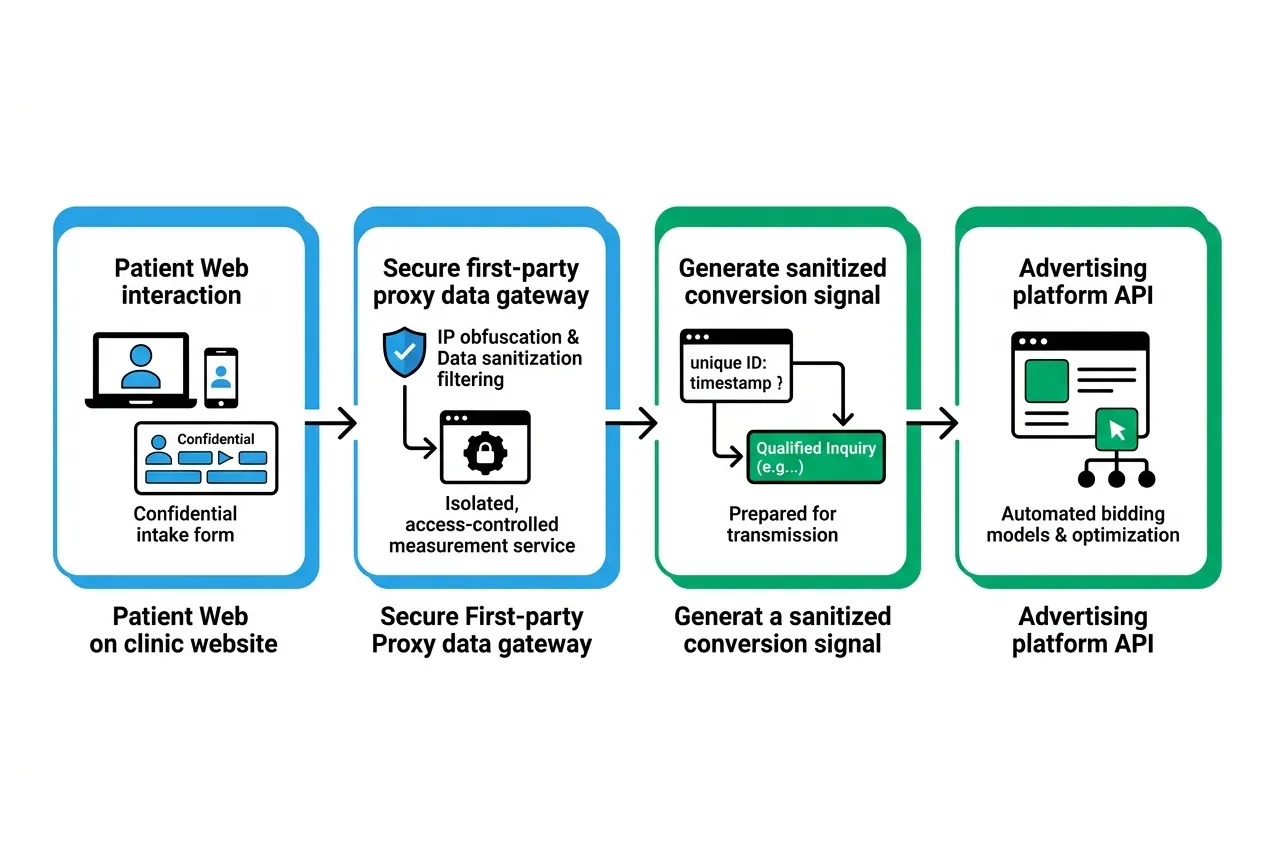
Privacy by design marketing replaces that direct browser-to-platform connection with a decoupled data pipeline. The browser communicates exclusively with an isolated, first-party proxy server owned and operated by the healthcare provider.
In this decoupled model:
- The visitor interacts with a landing page hosted on your first-party domain.
- A single, first-party event dispatcher sends telemetry solely to your private server endpoint.
- The server endpoint receives the request, strips the visitor's IP address, scrubs sensitive URL parameters, and eliminates any form field inputs containing medical history or personal identifiers.
- The server synthesizes an abstract event payload containing only non-identifying transaction data, such as an anonymized click identifier or a hashed transaction code.
- That sanitized payload is dispatched via a server-to-server API to the advertising network.
By placing a hardened server between the browser and the ad network, the organization achieves complete control over outbound data. The ad platform receives the optimization signal it needs to train its bidding models, but it never receives protected health information or identifiable browsing trails.
Free Audit
Want a straight read on where your budget is leaking?
Engineering privacy safe measurement without third-party browser trackers
Building a privacy safe measurement stack requires replacing client-side listeners with server-side API integrations. The technical architecture relies on server-to-server conversion protocols, such as Google Ads Conversions API and Meta Conversions API, operating behind a strict data hygiene gateway.
Consider a prospective patient completing a confidential intake form on a behavioral health clinic website. In an unmanaged tracking environment, the form submission fires a client-side conversion event. If the user entered their name, phone number, and a brief description of their clinical needs, an unvetted script could capture those fields via browser DOM scraping or automatic parameter parsing.
In an engineered privacy safe measurement architecture, the intake form submits data exclusively to an encrypted, access-controlled intake database. The front-end user session records a temporary, non-PHI identifier, such as a Google Click Identifier (GCLID), stored securely in an HTTP-only first-party cookie.
The intake application processes the clinical inquiry inside a secure clinical environment. Simultaneously, an isolated measurement service extracts only the click identifier and an abstract conversion timestamp. It maps that event to an anonymized conversion label (for example, "Qualified Inquiry") and transmits the event through a server-side endpoint.
The advertising network receives verification that an ad click generated a valuable conversion, allowing automated bidding models to calibrate auction pricing. However, no clinical context, form responses, phone numbers, or IP addresses are ever shared with the ad network.
This architecture requires discipline across three core engineering principles:
- Zero-PHI Data Contracts: Define strict data schemas for every outbound payload. Any field that does not explicitly serve an algorithmic optimization purpose is blocked at the gateway level.
- IP Address Obfuscation: Ensure your server-side proxy strips or truncates IP addresses before forwarding web events to external endpoints.
- Payload Encryption and Logging Audits: Maintain immutable server logs that record exactly what data was transmitted to external APIs, providing a clean audit trail for internal compliance reviews.
Healthcare marketing privacy governance across ad platforms and analytics
Implementing server-side pipelines solves the transport layer, but organizations must also govern how analytics platforms process user journeys. A major point of failure for healthcare providers is the default configuration of web analytics.
As detailed in our guide on Google Analytics and HIPAA: what healthcare marketers can and cannot do, standard web analytics implementations capture page titles and query parameters that frequently reveal clinical intent. If a user searches your site for a specific medication or selects a specialized treatment filter, that condition-specific data can enter analytics reports. Without a signed Business Associate Agreement, storing that telemetry inside a standard analytics account violates federal privacy requirements.
Establishing healthcare marketing privacy requires establishing clear boundaries between marketing analytics and patient intake. For organizations evaluating their tracking stack, our comprehensive overview on HIPAA compliant marketing: what the rules mean for campaigns and tracking outlines the operational standards necessary to protect digital properties.
Furthermore, compliance officers must scrutinize vendor claims. Many commercial software vendors claim to provide out-of-the-box compliance simply by filtering web traffic. As explored in our review of Hipaa compliant marketing companies: what a specialist partner delivers and how to vet one, software alone does not resolve organizational liability. Defensible governance requires aligning technical pipeline engineering, business associate agreements, and paid media management into a single, cohesive operating practice.
How Marketing Powered delivers privacy-safe tracking and marketing technology
Marketing Powered approaches healthcare compliance from the perspective of marketing economics and technical execution. We do not treat compliance as a series of prohibitive restrictions that stop acquisition campaigns. We view compliance as an engineering specification that defines how modern measurement systems must be constructed.
We deploy privacy-safe tracking and marketing technology engineered specifically for healthcare systems, behavioral health networks, and regulated enterprises. Our operational methodology reflects deep experience in high-stakes environments:
- Attribution Tracked to Admission, Not Just Lead: In healthcare, evaluating campaigns based solely on cost-per-lead produces distorted economics. A low-cost inquiry that fails clinical screening wastes intake resources. We build closed-loop measurement pipelines that connect advertising spend directly to verified admissions and completed appointments, ensuring bidding algorithms optimize for actual patient outcomes rather than surface-level form submissions.
- LegitScript-Aware and HIPAA-Aware Campaigns: As an operator who has managed millions in sensitive healthcare paid search, our campaigns are built to operate within strict regulatory and platform guidelines. We design intent-capture strategies that thrive without retargeting or sensitive audience modeling.
- Owned, Local AI Infrastructure for HIPAA-Aware Inference: Marketing Powered has been AI-native since 2022. To eliminate data leakage risks associated with multi-tenant cloud platforms, we operate owned, local AI infrastructure. This allows our team to run specialized language models, analyze campaign telemetry, and automate workflows locally without transmitting sensitive operational data to external third-party model providers.
- Court-Certified Expert Advertising Standards: Our strategic frameworks are grounded in verifiable, defensible methodology, drawing on experience as a court-certified expert witness in advertising strategy.
By controlling the measurement infrastructure from first-party collection to downstream conversion attribution, we keep acquisition campaigns performant while maintaining strict regulatory defensibility.
Questions, Answered.
Client-side tracking executes third-party code directly within a visitor's web browser, allowing ad platforms to automatically harvest user IP addresses, browsing behavior, and metadata. Server-side tracking routes web interactions through a provider-controlled server first. This intermediary server strips protected health information, removes IP addresses, and transmits only anonymized conversion signals to ad networks via secure APIs.
No. Server-side tracking provides the technical capability to scrub protected health information, but technology alone does not establish legal compliance. Google does not enter into a Business Associate Agreement for standard Google Analytics. Healthcare organizations must ensure that no protected health information, IP addresses, or condition-specific page paths are transmitted to Google services, or they must utilize specialized, HIPAA-supporting analytics platforms backed by signed agreements.
Yes. Modern ad platforms support server-to-server conversion APIs. By capturing click identifiers on first-party domains and relaying conversion events through a secure server pipeline, organizations provide the machine learning algorithms with the necessary optimization signals while keeping patient identities and clinical data completely isolated.
Major advertising platforms, including Google, classify behavioral health, substance use treatment, and medical conditions as sensitive personal categories. Retargeting relies on tracking an individual's browsing history across the web to serve personalized ads based on their inferred medical status, which violates platform user privacy policies. Healthcare marketers must win on direct search intent and first-touch conversion architecture. Request a privacy and tracking review of your marketing stack
Ready to see where your marketing can improve?
Request a free audit of your paid media, landing pages, attribution, and measurement setup. You'll get a straight assessment of where the opportunities are.
or email us at info@marketingpowered.ai