Resources
Google Ads for Rehab: Policy, Account Structure, and Admissions Economics
Running google ads for rehab is one of the most volatile and heavily scrutinized investments in behavioral health marketing. High cost-per-click rates and strict platform regulations leave no room for conventional lead generation playbooks. Achieving sustainable unit economics requires rigorous policy compliance, exact-match keyword discipline, and tracking systems tied directly to patient admissions.
By Mike Hulick, Founder, Marketing Powered

The Realities of Google Ads for Rehab: Why Standard Playbooks Fail
Commercial lead generation typically relies on inexpensive discovery clicks, broad audience interest targeting, and automated remarketing sequences across multiple touchpoints. In substance use disorder marketing, that playbook collapses immediately. A single click on an inpatient detox query often exceeds $50 to $100 in competitive metropolitan areas, and platform privacy protections eliminate standard audience retention tactics.
The physical environment of an addiction treatment center reveals why this economic pressure is so intense. Inside a facility admissions office, intake coordinators sit with headsets, navigating electronic health records, insurance verification portals, and multi-line phone queues. When a marketing campaign generates 100 raw phone calls, the operational burden on that staff is immediate. If 85 of those calls represent individuals seeking free state-funded beds, Medicaid services your facility does not credential, or out-of-state adolescent programs when you treat adult commercial insurance, the intake queue bottlenecks. True clinical emergencies get placed on hold, and staff morale erodes under the weight of unviable inquiries.
Addiction treatment marketing carries clinical and financial risks that standard e-commerce campaigns never encounter. If an e-commerce brand buys irrelevant clicks, it loses a few dollars on shopping cart abandonment. When an addiction treatment center buys unqualified search traffic, it depletes marketing reserves that support facility census, misallocates intake staff hours, and risks compliance violations under federal privacy and advertising standards.
Operating paid search in this environment requires treating Google Ads as an operational filtering mechanism rather than a volume generator. The objective is not to maximize top-of-funnel lead count. The objective is to deploy search budget so precisely that every dollar spent isolates an individual or family member who holds active commercial insurance or private funding, requires the specific clinical level of care you provide, and is ready to enter treatment immediately.

Regulatory Prerequisites: LegitScript and Google Addiction Treatment Policies
Before drafting ad copy or selecting keywords, providers must clear extensive regulatory clearance. Google strictly regulates all substance use disorder marketing to eliminate deceptive intake practices, patient brokering, and unverified referral call centers. To deploy google ads addiction treatment campaigns targeting users in the United States, an advertiser must complete formal verification through LegitScript Addiction Treatment Certification.
LegitScript evaluates applicants against comprehensive operational, legal, and clinical standards. The review verifies physical facility licensure, checks medical director credentials, inspects facility ownership structures, reviews commercial insurance billing practices, and verifies that the business operates a brick-and-mortar location capable of providing clinical care. Passing LegitScript requires extensive documentation:
- Current state facility licenses for each specific level of care offered.
- Proof of physical facility ownership or an active commercial lease.
- Medical and clinical staff licensure, including background checks for key operating leadership.
- Clear written policies prohibiting patient brokering, financial inducements, or fee-splitting arrangements.
- Transparent website disclosures detailing facility locations, ownership entities, and accepted payment methods.
Once LegitScript issues a certification compliance certificate, the operator must submit that credential directly through the Google Ads verification portal. A frequent administrative stumbling block occurs when legal entity names on state licenses, corporate registration records, LegitScript certificates, and Google Payments profiles fail to match character-for-character. Discrepancies between the registered domain name and the operating legal entity can stall campaign approval for weeks.
State-level statutory rules add an additional layer of oversight. Certain jurisdictions enforce statutory prohibitions against marketing out-of-state facilities or regulate how telehealth services are represented in search copy. Operators must maintain strict alignment between their verified service footprint, their active state licensure, and their ad account structure.
Structuring Rehab PPC Campaigns Without Audience Retargeting
The defining operational constraint of rehab ppc is the total prohibition of personalized remarketing. Under Google's personalized advertising policies, advertisers are barred from creating remarketing lists, customer match audiences, or demographic lookalikes based on personal hardships, physical health conditions, or mental health distress.
In standard commercial campaigns, marketing teams capture broad initial interest, drop a tracking cookie, and nurture prospects over 30 to 60 days using display ads, YouTube video pre-rolls, and search retargeting lists. In behavioral health, you have exactly one opportunity to earn the prospect's trust and capture the inquiry. If a family member visits your landing page at 2:00 AM, reads your clinical philosophy, and leaves without calling or submitting a form, platform policy prevents you from serving a reminder ad tomorrow morning.
Because you cannot rely on mid-funnel nurture ads, your search campaign architecture must isolate immediate, commercial, high-intent demand. Segment your account cleanly by specific level of care and geographic intent:
1. Inpatient Medical Detoxification
This is the highest-urgency tier in addiction marketing. Searchers are either in physical withdrawal or managing an immediate medical crisis for a family member. Keywords must isolate medical supervision, stabilization, and immediate bed availability. Match types should skew toward exact match and tightly controlled phrase match.
2. Residential Inpatient Treatment
Residential campaigns capture prospects seeking 30- to 90-day stays. Intent shifts toward facility amenities, clinical modalities, dual-diagnosis capabilities, and length-of-stay parameters. These campaigns require dedicated landing pages that display residential environments, clinical accreditations, and medical staffing credentials.
3. Outpatient Programming (PHP and IOP)
Partial Hospitalization Programs and Intensive Outpatient Programs serve local or regional patient populations. Search queries frequently include hyper-local geographic qualifiers, evening scheduling requirements, or step-down care requests. Budgeting for outpatient search must remain geographically tethered to realistic commuting radii.
Mixing these levels of care into shared ad groups dilutes budget allocation, distorts quality scores, and misroutes admissions calls. Every clinical tier must function as an independent campaign with its own negative keyword list, dedicated landing page, and specialized intake routing.
Free Audit
Want a straight read on where your budget is leaking?
Negative Keyword Architecture and Admissions Call Protection
In drug rehab advertising, negative keywords are more critical than positive keywords. An account running open phrase match or broad match terms without exhaustive negative filtering will spend 40% to 60% of its budget on search queries that have zero probability of yielding a qualified admission.
Consider the daily reality of an intake office review. When an admissions director sits down with media logs, the disconnect between search volume and clinical intake becomes obvious. A search query for "free rehab near me" or "salvation army detox center" triggers an ad if the operator targets the phrase match keyword "rehab near me." The searcher clicks an ad costing $65, clicks the telephone call extension, and reaches an intake coordinator. Three minutes into the assessment, the coordinator learns the caller has no commercial insurance, has no private pay capability, and is seeking a shelter bed. The $65 ad spend is lost, and the intake coordinator spent critical minutes unavailable for an admitting commercial call.
To eliminate this waste, behavioral health search accounts require extensive negative keyword lists deployed at the account and campaign levels before launching:
- Public assistance and state funding: "free", "state funded", "medicaid", "medicare", "salvation army", "county grant", "charity".
- Legal and correctional terms: "court ordered", "mandated", "probation approved", "jail alternative", "halfway house free", "community service".
- Employment and academic queries: "jobs", "careers", "salaries", "internship", "volunteer", "training", "counselor certification", "classes".
- Informational and homework research: "statistics", "definition", "symptoms of", "history of", "articles", "research paper", "effects of drugs on the brain".
- Low-intent clinical queries: "how to taper off at home", "home remedies for withdrawal", "can you quit cold turkey".
By systematically excluding informational, non-commercial, and state-funded queries, your campaigns preserve budget strictly for users searching for credentialed, private, or commercially covered clinical services.

Budget Allocation and Bid Strategy in Addiction Treatment PPC
Establishing a sustainable paid search budget in addiction treatment ppc requires backward modeling from required admissions and facility census, not forward guessing from arbitrary monthly spending caps.
Because cost per click varies substantially across markets and care levels, allocating capital across campaigns requires clear boundaries:
- Medical Detox. Primary Intent Trigger: Acute crisis, physical withdrawal. Typical CPC Range: $60 to $120+. Target Action: Direct phone call. Geographic Boundary: Regional / 150-mile radius.
- Residential Inpatient. Primary Intent Trigger: Dual diagnosis, 30-90 day stay. Typical CPC Range: $45 to $95. Target Action: Phone call / verified form. Geographic Boundary: Regional or National.
- Partial Hospitalization (PHP). Primary Intent Trigger: Day treatment, local step-down. Typical CPC Range: $25 to $50. Target Action: Phone call / assessment request. Geographic Boundary: Local / 30-mile radius.
- Intensive Outpatient (IOP). Primary Intent Trigger: Evening / flexible local recovery. Typical CPC Range: $20 to $45. Target Action: Assessment schedule. Geographic Boundary: Local / 25-mile radius.
Automated bidding strategies such as Maximize Conversions or Target CPA can be dangerous when launched inside fresh accounts. If Google's bidding algorithm optimizes purely for raw conversions, it will systematically favor the cheapest possible conversions: usually low-intent informational form submissions, chat interactions from job seekers, or misdialed calls.
Smart bidding should only be introduced after an account has built a stable baseline of 30 or more validated commercial inquiries per month using manual cost-per-click bidding with enhanced CPC. Once baseline query cleanliness is proven and negative keyword filters are established, automated bidding can be tested using value-based parameters tied to verified qualified leads rather than superficial clicks.
Closed-Loop Measurement: Tracking Spend to Bed Admissions
The fatal metric in behavioral health advertising is cost per lead (CPL). An agency reporting a $120 cost per lead may look successful on a monthly marketing dashboard. However, if those leads consist of 50 unqualified callers who do not possess commercial insurance and zero patients enter treatment, the true cost per admission is infinite.
Connecting paid media directly to facility admissions requires a closed-loop attribution architecture that operates inside strict regulatory boundaries. Marketing Powered's founder is a former healthcare CMO who ran marketing for a treatment network that grew from 3 to 24 locations, managing $1.5 to $2M per month in Google Ads across 11+ behavioral and mental health accounts. Operating at that scale demonstrates that marketing efficiency depends entirely on tracking the downstream outcome: the physical bed admission.
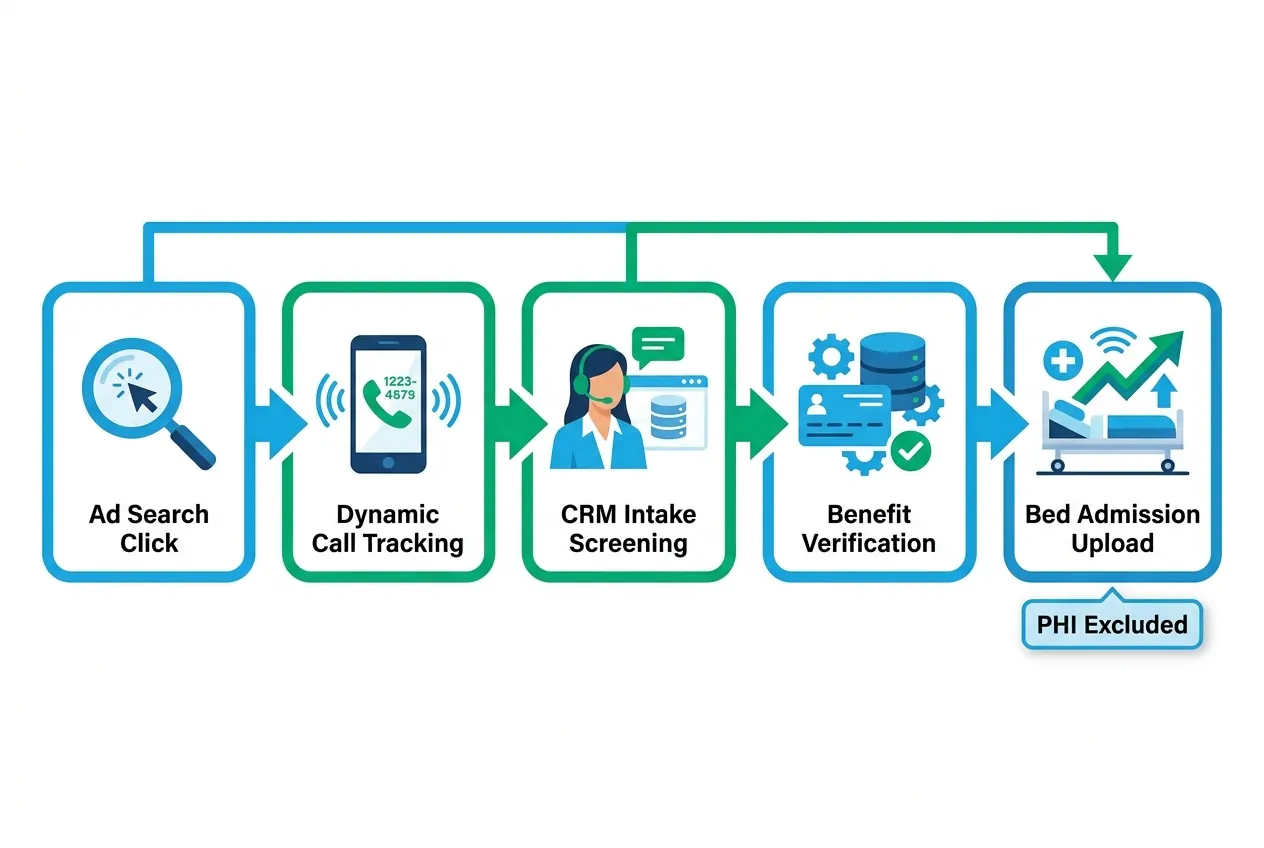
The closed-loop process operates systematically:
- Source Click Capture: The ad click captures campaign, ad group, and keyword source data alongside a unique click identifier on a HIPAA-aware landing page environment.
- Dynamic Number Insertion (DNI): Call tracking software dynamically assigns a unique phone number to the visitor session, associating the inbound phone call with the specific search query that triggered it.
- Intake CRM Logging: When the call reaches the admissions desk, the intake specialist logs the caller's insurance provider, clinical history, and clinical fit into an intake CRM or electronic health record (EHR).
- Verification of Benefits (VOB): The inquiry advances to financial screening. If the commercial policy is verified and in-network or possesses viable out-of-network benefits, the record updates to a Verified Benefit status.
- Bed Admission and Offline Conversion Import: Once the patient completes intake and arrives at the facility, the admission event is finalized. That conversion outcome, stripped of protected health information (PHI) and utilizing only hashed transaction identifiers, is uploaded back to Google Ads as an offline conversion.
By feeding actual admissions data back into Google Ads, the advertising platform learns to optimize for queries and search behaviors that produce admitted patients, systematically shifting ad spend away from dead-end volume.
Email Us
Prefer to send the context directly?
Compliant Paid Media Delivery with Marketing Powered
Managing paid media for regulated healthcare facilities requires combining operational admissions experience with advanced technical governance. Marketing Powered is an AI-native marketing firm operating since 2022, built to solve commercial acquisition problems for complex healthcare networks, hospitals, and regulated multi-location operators.
Our founder is a court-certified expert witness in advertising strategy who brings direct operational accountability to every engagement. Rather than treating Google Ads as an isolated marketing channel, we align paid search directly with your admissions department economics, call routing logic, and census requirements. We maintain LegitScript-aware and HIPAA-aware campaign workflows built specifically for Google's sensitive healthcare vertical, where retargeting is not permitted.
To safeguard organizational data sovereignty, Marketing Powered deploys owned, local AI infrastructure for HIPAA-aware inference. This approach allows healthcare operators to analyze marketing data, evaluate call transcripts, and optimize campaign structures without routing sensitive operational data through third-party consumer cloud platforms.
Our service covers every component of search acquisition: regulatory verification assistance, negative keyword architecture, high-conversion landing page design, dynamic call tracking integration, and offline conversion attribution tracked to admission, not just lead. For operators evaluating specialist support across broader service lines, our analysis on what a specialist partner should deliver in mental health marketing details the operational requirements of multi-level behavioral healthcare. Similarly, operators seeking an agency partner should review the criteria for vetting an addiction treatment marketing agency before signing a contract. For an executive-level overview of compliant growth, read our comprehensive framework on behavioral health marketing: an operator's guide to ethical growth.
Questions, Answered.
The approval timeline depends primarily on the LegitScript certification process. LegitScript reviews typically take between 4 to 12 weeks, depending on the completeness of your facility documentation, corporate disclosures, and background checks. Once LegitScript issues your certificate, Google's internal advertising verification typically processes within 3 to 7 business days.
Google's personalized advertising policies prohibit serving targeted ads based on sensitive personal health categories, including substance use disorders and mental health conditions. This policy prevents platforms from tracking vulnerable individuals across the web with ads that reveal their private medical status or personal hardships.
No. Google Ads explicitly blocks any advertiser from bidding on addiction treatment, substance use, or rehabilitation-related terms in the United States without active LegitScript certification and verified Google account authorization. Attempting to bypass this system using masked landing pages or alternative terminology violates platform policy and results in immediate account suspension.
Cost per admission varies widely based on geographic location, facility clinical reputation, and accepted insurance networks (in-network commercial versus out-of-network). In competitive markets, a realistic cost per admission through Google Ads typically ranges from $4,000 to $9,000 when tracked accurately to bed placement. Providers claiming customer acquisition costs below $2,000 in competitive residential verticals are usually relying on incomplete attribution or counting unqualified leads as admissions.
Bidding on competitor brand names in addiction treatment is technically permitted under Google's trademark policies, but it is rarely cost-effective. Competitor terms frequently carry low quality scores, resulting in inflated cost per click. Furthermore, callers searching for a specific facility by name often ask for that exact admissions office and hang up when they realize they reached a different provider, wasting intake staff time and media budget. Talk with Marketing Powered about your admissions and marketing economics
Ready to see where your marketing can improve?
Request a free audit of your paid media, landing pages, attribution, and measurement setup. You'll get a straight assessment of where the opportunities are.
or email us at info@marketingpowered.ai