Capabilities
Churn Analysis That Separates Risk From Assumptions
Most retention programs fail at the definition stage, not the modeling stage. Our churn analysis services begin by settling what actually counts as a lost customer, then rebuilding cohorts that can carry a business decision. Prediction comes later, and only when the data earns it.

Define churn before anyone builds a model
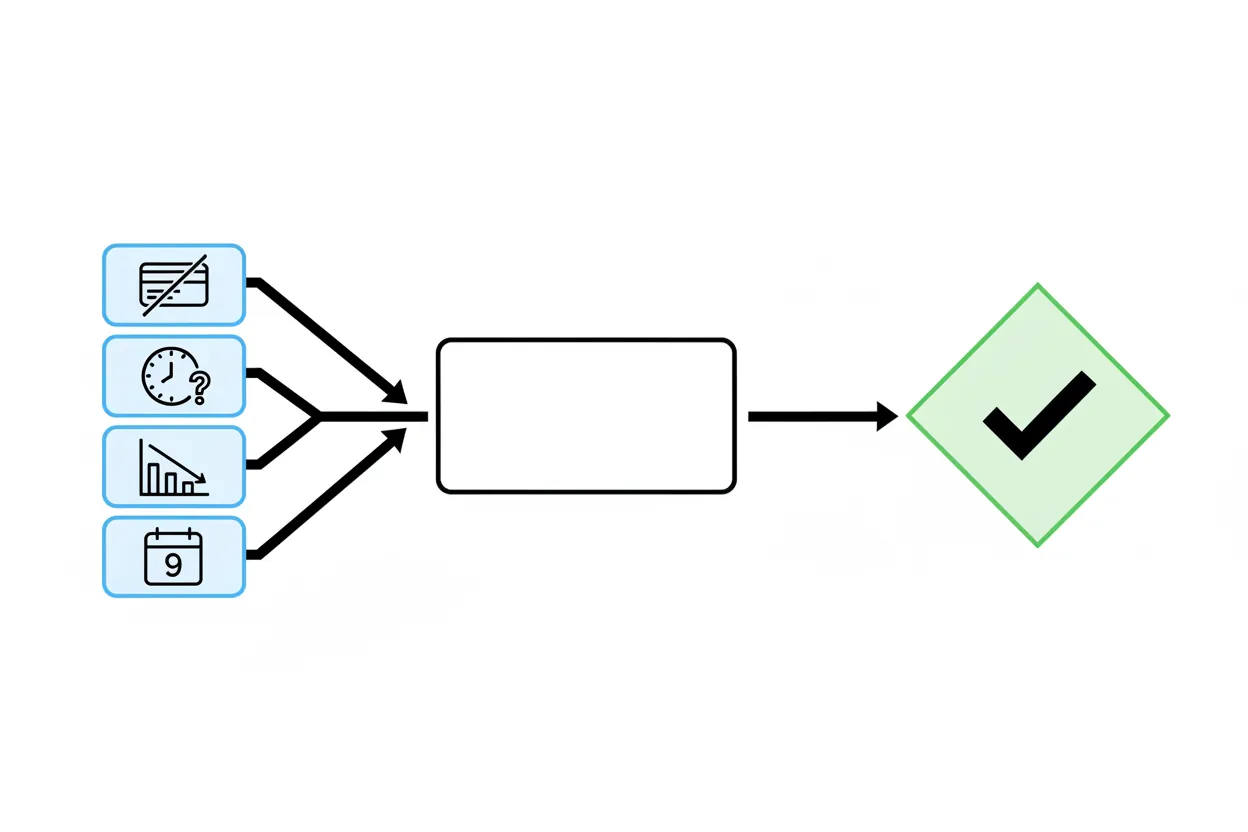
The first working session is usually not analytical. It is a table with finance, operations, product and marketing in the room, deciding which events belong in one number. A cancellation is a decision. Inactivity is an absence of evidence. Reduced usage or a smaller reorder is a downgrade, not a departure. A customer who buys every nine months is not churned in month four, they are inside a normal purchase interval.
Each of those categories calls for different handling, and a single blended rate hides all four. Documenting the churn definition by business model, including the observation window and the grace period, is what turns customer attrition analysis from a reporting exercise into something a leadership team can act on.
Build retention cohorts that compare like with like
Once churn is defined, the next question is who is being compared. New customers, mature customers and reactivated customers behave differently, and mixing them produces a trend line that moves for reasons nobody can name. Honest customer retention analysis separates them, uses comparable time windows, and reports how much history each cohort actually has.
This stage also exposes missing data: subscription records without cancellation reasons, orders that cannot be joined to accounts, channel data that stops at the first touch. Acquisition context belongs here as an input, not as the headline. If the cohorts that churn fastest are also the most expensive to buy, customer acquisition cost definitions help quantify what the loss is worth.
Explore associated factors without assuming causality
With clean cohorts in place, the work shifts to what differs between customers who stayed and customers who left. Product usage depth, support contacts, service failures, onboarding completion, pricing changes, discount expiry and contract terms are the usual candidates. Customer intelligence practice treats buying reasons, retention, willingness to pay and segmentation as linked disciplines rather than isolated metrics, and that framing matters here.
An association is not a cause. A support ticket spike before cancellation may be a symptom of a product gap, a signal of an already-made decision, or an artifact of how tickets are logged. Findings are reported with that distinction visible, and surfaced through decision-focused marketing dashboards rather than a static deck nobody revisits.
Free Audit
Want a straight read on where your budget is leaking?
Decide whether a prediction model is justified
Churn prediction consulting often starts with the model. It should start with a gate. Four conditions decide it: label quality, meaning the churn definition is stable and recorded consistently; sample size, meaning enough churn events across enough cohorts to train and validate on; drift, meaning the business has not changed pricing, packaging or market so recently that history misleads; and intervention value, meaning someone can and will do something different with a score.
When those conditions hold, a backtest against held-out history is the honest test, not accuracy on data the model already saw. When they do not hold, cohort monitoring and rules-based retention risk analysis are the stronger answer. Model hosting, data residency and access boundaries are scoped explicitly, which is why data sovereignty and business control is part of the conversation rather than an afterthought.
Design interventions people can actually run
A risk list is not a retention program. The most defensible interventions are usually operational: fixing the onboarding step where accounts stall, resolving the service failure that precedes cancellations, correcting a pricing tier that punishes growth.
Outreach is a supporting tactic, not the default response, and it carries consent and regulatory obligations that vary by sector. In healthcare, the HIPAA Privacy Rule generally requires an individual's written authorization before protected health information is used or disclosed for marketing, with limited exceptions (HHS Office for Civil Rights).
Human review sits in front of any contact list. Every treated customer should be identifiable later, which depends on tracking records from source to outcome being in place before the campaign runs, not reconstructed afterward.

Measure retention impact against an honest comparison
Retention results are easy to overstate, because the customers a model flags as high risk are often the ones most likely to resolve on their own. A holdout group, or at minimum a matched comparison and a stated pre-period, is what separates effect from regression to the mean. The measurement also has to include cost: discounts given to customers who would have stayed, service time consumed, and margin surrendered.
Unintended effects belong in the same report. Save offers can teach customers to threaten cancellation. Aggressive reactivation can raise complaint rates. Interaction counts are not outcomes, a distinction covered in why an interaction is not a business outcome.
Email Us
Prefer to send the context directly?
Where retention diagnostics meet your acquisition numbers
Retention and attrition are the primary subject of this work. Acquisition sits alongside it. The comparison is straightforward: acquisition analysis asks what it costs to add a customer, while repeat-purchase loss analysis asks what the business keeps after that customer arrives. Both use the same customer records, and they fail in the same way when identity and source data are incomplete.
Marketing Powered is operator-led. The founder is a former healthcare CMO who ran marketing for a treatment network that grew from 3 to 24 locations, managed $1.5 to $2M per month in Google Ads across 11+ behavioral and mental health accounts, and built attribution tracked to admission, not just lead. That background shapes how we read retention data: as commercial evidence, not dashboard decoration. Related reading covers measuring lead quality and marketing investment economics.

Questions operators ask before scoping this work
Can churn analysis work outside subscription businesses?
Yes, with a different definition. Repeat-purchase and appointment-based businesses have no cancellation event, so churn is inferred from purchase intervals. The analysis sets a lapse threshold based on observed buying rhythm by segment, then tests how sensitive the conclusion is to that threshold.
When is a predictive model worth building?
When labels are consistent, churn events are numerous enough to validate on, the business has been stable enough for history to apply, and a specific team is ready to act on scores. If any of those is missing, cohort monitoring usually produces better decisions at lower cost.
How do you distinguish a warning signal from a cause of churn?
A signal correlates with leaving. A cause changes the outcome when you change it. The practical test is an intervention study: alter the suspected driver for one group, hold another steady, and compare. Until that runs, factors are reported as associated, with the alternative explanations named.
What information and access are needed to scope this work?
Typically customer or subscription records with start, change and end dates, transaction or usage history, support and service records, pricing and plan history, and whatever source data exists. Read-only access is enough for scoping. Access, retention and approved data flows are documented before anything moves.
What will our organization own and be able to export at the end?
Scope agreements define this in writing. The intent of retention analytics services delivered this way is that the churn definition, cohort logic, queries and documentation stay with the business in portable form, so the analysis can be rerun by your team or another vendor without starting over.
More Services
Ready to see where your marketing can improve?
Request a free audit of your paid media, landing pages, attribution, and measurement setup. You'll get a straight assessment of where the opportunities are.
or email us at info@marketingpowered.ai