Capabilities
AI Data Agency for Analytics and Business Decisions
Sales reports one number, finance reports another, and the decision waits. Marketing Powered's data agency work focuses on cleaning, connecting and governing the records your business already creates, so analysis and AI use cases have something reliable underneath them. An AI data agency in this sense is not a training-data broker, an annotation marketplace or a seller of customer records.

Start with the decision your data cannot support
Most data projects begin with a tool request. The better starting point is a decision that is currently stalled: whether to open or consolidate a location, whether a service line is profitable once labor and acquisition cost are loaded in, or how to answer a board question on cost per acquired customer without three people reconciling exports the night before.
Common symptoms include manual reconciliation before every leadership meeting: someone exports a CRM report and a finance report and aligns them by hand. Two teams define "lead" differently, so conversion rate depends on who ran the query. A single location appears under four spellings across systems, and the person who assembles the reporting pack becomes the real source of truth.
A dashboard is a window. If the room behind it is disorganized, the window shows you the mess faster and in better colors. Organizations often buy visualization before they buy agreement, so every report runs and nothing reconciles. The missing work is not a chart. It is deciding what a customer, a patient encounter, a location and a qualified opportunity mean across systems, then enforcing those definitions somewhere the business owns.
Before scoping anything, the conversation starts with which decisions you need to make next, who has to approve them, and what evidence would change the answer. Everything downstream, including AI readiness, follows from that list rather than from a software category.

Connect the sources that actually carry the answer
A business data agency engagement starts with an inventory of where the truth currently lives, which is rarely one system.
Sources commonly in scope include the CRM, an EHR or practice management system in healthcare, finance or ERP records, scheduling and intake tools, call tracking and form submissions, advertising and analytics platforms, review data, staffing data when capacity is part of the question, and the spreadsheets that quietly run parts of the operation. Some engagements also involve externally licensed market or firmographic files, used under the license terms attached to them.
Connection is a controlled, approved-access process, not open-ended extraction. The working document lists systems, the objects and fields needed for the stated decisions, who authorizes each connection, where data will be stored, and how long it is retained.
For healthcare organizations, scoping includes whether protected health information is in scope at all, and whether the work can be done with de-identified or limited records instead.
HHS guidance is direct on the point: a cloud service provider that creates, receives, maintains or transmits electronic PHI on behalf of a covered entity is a business associate even if it stores only encrypted data and lacks the decryption key, and the parties must enter into a business associate agreement (HHS). That is a decision made before data moves, not a detail discovered mid-project.
Platform retention is another reason to hold records in a store you control. In Google Analytics properties, user-level data retention can be set to 2 or 14 months, and longer event-data retention is available only on Analytics 360 (Google Analytics Help). Multi-year analysis that depends on a reporting interface will hit that boundary. A copy of the events in a warehouse you own does not.
Where acquisition-to-outcome measurement is the priority, this connection work overlaps with healthcare attribution implementation, which handles the campaign-to-outcome side of the same plumbing.
Make the foundation trustworthy before anyone builds on it
Trust in a dataset comes from four unglamorous things: quality, identity, lineage and access.
Quality means knowing the defect rate before you publish a number: duplicate records, blank or invalid fields, test records never purged, currency and timezone drift, silent pipeline failures that leave a week of data missing. The useful deliverable is a profiling pass stating what is wrong, how often, and which findings affect the decisions on your list.
Identity is the part most organizations skip. If a customer exists in the CRM, the billing system and the scheduling tool under three different keys, visualization will not reconcile them.
The work is defining the entity, constructing a durable identifier, setting matching rules, and documenting what the match does when it is uncertain. The same applies to locations, services and staff.
A standardized location key can be a high-value fix for multi-site operators, because it is the axis most executive questions run on.
Lineage answers the question an executive asks the first time a number looks wrong: where did this come from and what happened to it on the way here. Each metric should trace back through its transformations to source fields, with the rules written in plain language rather than buried in query logic.
Access means defined roles, documented permissions and a record of who can see which fields. In regulated settings, field-level restriction is often more practical than table-level restriction.
The discipline behind this comes from operating history rather than theory. Marketing Powered's founder is a former healthcare CMO who ran marketing for a treatment network that grew from 3 to 24 locations and managed $1.5 to $2M per month in Google Ads across 11+ behavioral and mental health accounts, with attribution tracked to admission, not just lead.
That is the standard we aim to bring to finance and operations questions: measure the outcome the business sells, not the easiest event to count. For the campaign-specific version of this work, see marketing attribution services.
Free Audit
Want a straight read on where your budget is leaking?
Choose the delivery model that fits the problem
Not every buyer needs the heaviest option, and a data consulting agency that proposes the same engagement to every company is selling capacity rather than judgment. Four delivery shapes cover most situations.
A scoped assessment. Scope is defined up front around the decisions on your list. The work inventories sources, profiles quality, maps how a decision is currently produced, and documents a source-to-decision architecture with findings and a sequenced recommendation. Some teams may choose to implement the recommendations internally, and that is a reasonable outcome.
A data engineering project. Build the pipelines, warehouse structure, transformation layer and documented definitions. The output is a governed dataset with tested logic and traceable lineage, hosted in an environment you control. Scope follows the decisions it has to support rather than an abstract maturity model.
An analytical study. A bounded question answered with evidence: cohort retention, service line contribution, acquisition cost by location, referral source value, pricing or capacity analysis. The deliverable includes the method, the assumptions and the limitations, stated clearly enough that a skeptical CFO can argue with them.
An ongoing managed data product. Pipelines, monitoring, definition changes and analysis maintained over time, with named responsibilities on both sides. Availability of this tier depends on current capacity and is confirmed during scoping rather than assumed.
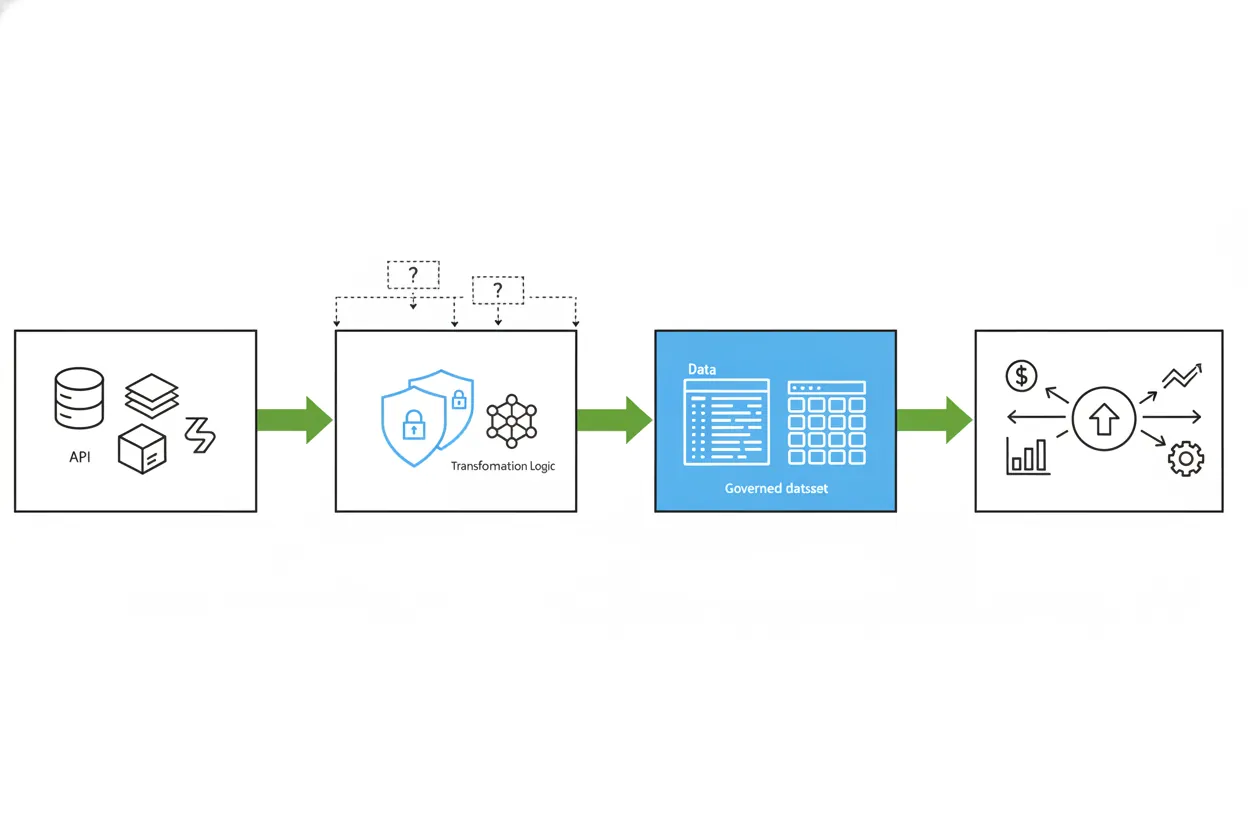
An illustrative source-to-decision path, shown as a text table rather than a chart:
- Collect. Example inputs: CRM, ERP, intake, call tracking, ad platforms. Example work: Approved connections, defined fields, retention rules. Example decision supported: None yet, because records are only made available.
- Resolve. Example inputs: Customer, location and service records. Example work: Entity definitions, identifier logic, match rules. Example decision supported: Which records describe the same customer or site.
- Govern. Example inputs: Metric definitions, permissions. Example work: Documented rules, lineage, access roles. Example decision supported: Whether a reported number can be defended.
- Decide. Example inputs: Governed dataset. Example work: Analysis with stated assumptions. Example decision supported: Budget, expansion, vendor and staffing choices.
The stages above are illustrative examples, not measured results.
The engineering tier often touches the same instrumentation layer described in workflow integration and tracking, because consistent collection at the source costs less than correction downstream. If the immediate problem is inconsistent event capture, start there instead of with a warehouse.

Support small teams and enterprise ownership
The operating model should scale with the organization. Pretending otherwise is how data budgets get spent without producing a usable answer.
A single-location business or small professional services firm usually needs clean basics: one customer record, one revenue definition, a reliable connection between spend and booked work, and a few reports that are correct. The right engagement is light, the governance artifact is a short definitions document, and the win is that leadership stops arguing about whose export is right.
A multi-location operator has a different problem. The entity model has to handle locations that open, close, rebrand and merge, and comparisons require normalization for maturity and market. Local managers need their own view without the ability to redefine shared metrics. Governance here is mostly change control: who can alter a definition, how the change is logged, and how historical reporting is treated when a definition moves.
A hospital, health system or large regulated firm adds role-based permissions, documented data flows, subprocessor lists, retention schedules and review by legal and compliance stakeholders. That review is a real dependency on timing, and it belongs in the plan rather than around it.
Deployment posture is part of the conversation. Marketing Powered has been AI-native since 2022 and operates owned, local AI infrastructure for HIPAA-aware inference, which creates options for where processing happens. Private deployment is a control choice. It does not by itself establish security or legal compliance, so hosting, access, retention and approved data flows are documented per engagement rather than asserted as a blanket posture. The tradeoffs are covered in data sovereignty and business control.
Show evidence and define scope before you commit
A data engagement should not be signed on the strength of a capability list. Ask any prospective partner for three artifacts, and judge the answers by how specific they get.
First, a source-to-decision architecture for a situation resembling yours: systems on the left, identity and transformation logic in the middle, the decision supported on the right, with assumptions labeled as assumptions. Second, a data-quality and lineage report, redacted as needed, showing defect categories and how a metric traces back to source fields.
Third, an analytical deliverable with documented limitations, because an analyst who will not say what the analysis cannot tell you is not finished thinking. During scoping we can walk through what each of these would look like for your systems, labeled where illustrative.
Be equally direct about dependencies: access approvals, the availability of people who understand your systems, legal and compliance review cycles, vendor API limits, and the quality of historical records, which cannot be reconstructed retroactively. Timelines that ignore these are fiction. The better practice is to state what is needed, by when, and what happens to the schedule if it arrives late.
For related reading on the decisions this foundation supports, see decision-focused marketing dashboards, tracking records from source to outcome and a healthcare CRM integration example.
Email Us
Prefer to send the context directly?
Questions buyers ask before starting a data engagement
How is a data agency different from a dashboard developer?
A dashboard developer builds the presentation layer on top of whatever data exists. A data analytics agency is accountable for the layer underneath: which sources are connected, how entities are matched, how metrics are defined and tested, and whether a number traces back to its origin. If reports run but nobody trusts them, the problem is rarely the dashboard, and visualization comes last in delivery.
Can you work with systems we already use?
Usually yes, and that is the preferred path. The relevant questions are whether a system exposes an API or scheduled export, whether your license permits that extraction, who controls the credentials, and whether the fields you need are populated.
Where a source is closed or an export is unreliable, the honest answer during scoping is to say so and propose an alternative rather than build a pipeline that breaks quietly. Replacing a core system is a separate decision, not a prerequisite for this work.
Who owns the datasets and transformations?
Ownership of datasets, transformation logic and documentation is intended to rest with your organization, and the written agreement confirms that before work starts. Where regulated data is processed on your behalf, the governing agreement defines permitted use.
HHS states that a contract with a business associate must establish permitted uses and disclosures and provide that the business associate will not use or further disclose the information other than as permitted by the contract or as required by law (HHS).
Agency ownership of infrastructure is a separate matter from ownership of your data, and the agreement should keep the two distinct.
What information and access are needed to scope this work?
Accurate scoping needs a list of systems with roles and approximate record counts, read access or representative sample exports, your current definitions for core metrics, examples of the reports leadership relies on, and the decisions the data has to support. Regulated organizations also need to identify which categories of data are in scope and who approves access. An assessment can be scoped from this without touching production systems first.
What will our organization own and be able to export at the end?
The intended end state is that you hold the governed datasets, the transformation code and its documentation, the entity and identifier logic, the data dictionary, the lineage mapping, and any analysis with its methods and limitations. Export in standard formats without agency involvement should be written into the agreement, and the work should leave your team able to run and modify the system. If a prospective partner cannot describe the exit clearly, that is the answer to the question.
If a decision in your business is waiting on numbers nobody trusts, that is the right thing to bring to a first conversation.
More Services
Ready to see where your marketing can improve?
Request a free audit of your paid media, landing pages, attribution, and measurement setup. You'll get a straight assessment of where the opportunities are.
or email us at info@marketingpowered.ai